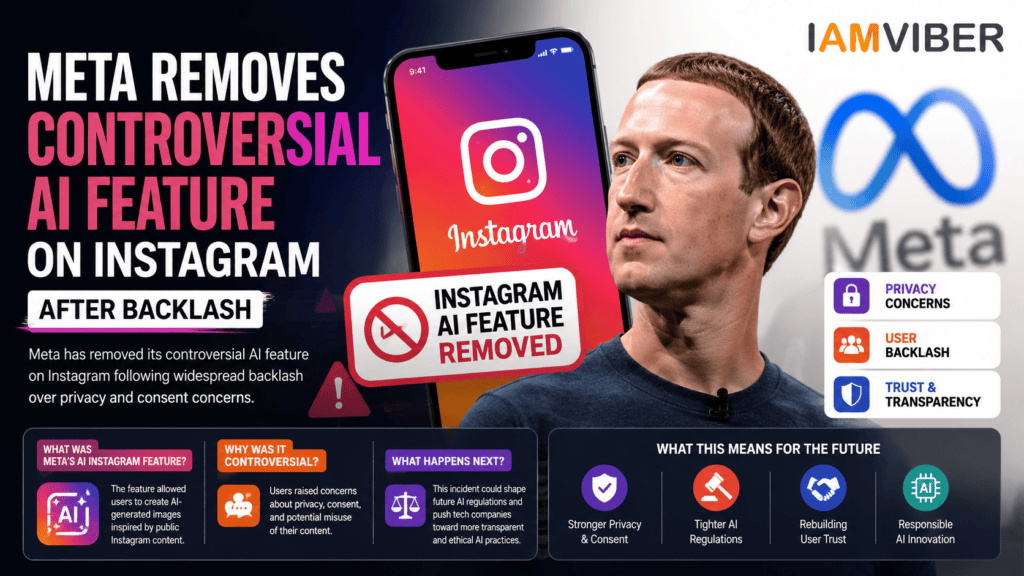
Meta removes controversial AI feature on Instagram after facing widespread privacy backlash from users, creators, and digital rights advocates. The company decided to roll back the feature only days after its launch, making it one of the fastest AI product reversals in recent years.
Meta has officially rolled back one of its newest AI-powered Instagram features after facing widespread criticism over privacy, consent, and the ethical use of public photos.
Just days after introducing Muse Image, an AI-powered image generation tool capable of creating images using content from public Instagram profiles, Meta announced that it was discontinuing the controversial functionality.
The decision comes after creators, celebrities, privacy experts, and digital rights organizations argued that the feature crossed an important ethical boundary by allowing AI to generate images of people without obtaining explicit permission.
Meta removes controversial AI feature on Instagram after criticism over user privacy. The move marks one of the fastest AI feature reversals by a major technology company and highlights the growing pressure on Big Tech to prioritize user consent as generative AI becomes deeply integrated into social media.
Meta recently launched Muse Image, an AI-powered image generator integrated into its expanding ecosystem of AI products.
Unlike traditional AI image generators that rely entirely on text prompts, Muse Image introduced a new capability: Users could reference a public Instagram account inside a prompt, allowing Meta AI to generate entirely new images inspired by that person’s publicly available photos. For example, users could theoretically type prompts like:
- "Show @username as an astronaut."
- "Create a fantasy portrait of @username."
- "Put @username inside a movie poster."
- The AI would analyze publicly available Instagram images and generate new visuals based on them.
Although Meta promoted the feature as a creative tool for making personalized content, many users immediately questioned whether anyone should be able to generate AI images using someone else’s likeness without permission.
What Happened? Meta Removes Controversial AI Feature on Instagram
Meta removes controversial AI feature on Instagram after facing widespread criticism from users, privacy advocates, and digital rights organizations. The company decided to roll back the feature within days of its launch after concerns grew over how AI could generate images using publicly available Instagram photos without explicit consent.
The decision marks one of Meta’s quickest AI product reversals and highlights the increasing pressure on technology companies to prioritize user privacy alongside innovation.
- Software development
- AI coding assistance
- Engineering workflows
- Agentic AI systems
- Knowledge-heavy reasoning
- Technical documentation
- Complex research tasks
- Long-running problem solving
- The company says the model was developed alongside Cursor to better understand how developers write, debug, and ship software.
Why Did Users React So Strongly?
The backlash began almost immediately after the feature launched. The biggest concern wasn’t the AI technology itself—it was consent. Many users were surprised to learn that:
1. Public Instagram accounts were included by default.
2. Users had to manually opt out.
3. Most people weren’t even aware the feature existed.
Privacy advocates argued that an opt-out system is fundamentally different from obtaining explicit permission beforehand.Critics said AI systems capable of recreating someone’s face should require an opt-in model instead. This debate quickly spread across social media, where many users described the feature as invasive. The decision where Meta removes controversial AI feature on Instagram highlights changing expectations from users.
Privacy Experts Raised Serious Concerns
The announcement that Meta removes controversial AI feature on Instagram has intensified discussions around AI ethics and data privacy. Experts believe AI tools that recreate a person’s appearance should require clear consent rather than relying on publicly available content.
AI Deepfakes
Although Meta included safety measures, critics argued that any tool capable of recreating a person’s appearance increases the risk of fake images spreading online.
Identity Manipulation
Experts warned that AI-generated images could misrepresent people in situations they were never involved in.
Consent
Many questioned why users should have to disable a feature instead of granting permission before their content is used.
Harassment
Public figures, journalists, influencers, and creators expressed concern that the feature could become another tool for online abuse or impersonation. These concerns quickly pushed the discussion beyond simple AI creativity into a much larger debate about digital identity.
Hollywood Also Joined the Criticism
The backlash wasn’t limited to everyday Instagram users. Several organizations representing actors and creators criticized the feature.
The fact that Meta removes controversial AI feature on Instagram has been welcomed by privacy groups and several organizations representing creators and artists. Many believe the decision sets an important precedent for future AI-powered features across social media platforms.
Among the strongest voices was SAG-AFTRA, which argued that AI systems capable of generating images based on someone’s likeness should require clear permission rather than relying on public social media content.
Talent agencies and entertainment groups warned that such technology could blur the line between creative AI tools and unauthorized digital replicas.
As AI-generated media becomes increasingly realistic, these concerns are becoming central to discussions about intellectual property and image rights.
Meta Says It "Missed the Mark"
After days of criticism, Meta responded. The company acknowledged that it had “missed the mark” with the feature and announced that the Instagram account-based image generation capability would be removed. Meta emphasized that:
- Private accounts were never included.
- Accounts belonging to users under 18 were excluded.
- Adult users with public accounts had an option to disable the feature.
- AI-generated images included visible watermarking.
- However, despite these safeguards, Meta ultimately decided the public response demonstrated that users expected stronger privacy protections.
What Happens Next After Meta Removes Controversial AI Feature on Instagram
Instagram AI feature removed
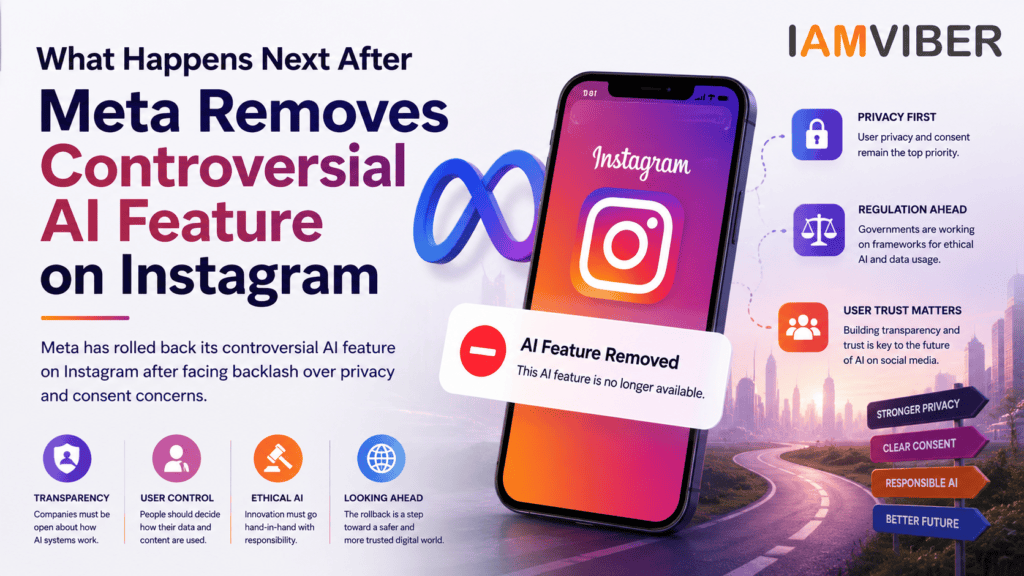
Although Meta removes controversial AI feature on Instagram, the broader conversation about AI regulation and digital privacy is far from over. Governments and regulators across the world are already working on frameworks that could define how AI companies use public data in the future.
This incident is likely to influence future AI product launches, encouraging companies to build systems that balance innovation with transparency and user trust.
The rollback is also expected to influence Meta’s future AI roadmap. While the company remains committed to integrating generative AI across Instagram, Facebook, and WhatsApp, it will likely introduce stronger privacy controls and clearer disclosures before launching similar features again. Building user trust has become just as important as building powerful AI capabilities.
Ultimately, Meta removes controversial AI feature on Instagram not only to address immediate public concerns but also to rebuild trust with its global user base. The controversy serves as a reminder that successful AI products must balance innovation with ethical responsibility. As AI continues to reshape social media, companies that listen to user feedback and implement responsible AI practices will be better positioned for long-term success.
Could This Become a Turning Point for AI?
Many analysts believe this incident could become an important milestone in the future of consumer AI. Over the past two years, AI companies have focused heavily on improving image quality, realism, and creativity. Now, public conversations are shifting toward another equally important question:
Who owns your digital identity?
The Meta controversy shows that technical capability alone is no longer enough. Users increasingly expect AI products to be built around transparency, permission, and user control.
Why This Matters Beyond Instagram
This isn’t just about one social media feature. Nearly every major technology company is racing to build AI assistants capable of generating images, videos, avatars, and personalized content. As these tools become more advanced, companies will face growing pressure to answer difficult questions:
- Should public photos automatically be usable by AI?
- Does posting online imply permission for AI training or generation?
- Should AI require explicit consent before recreating someone's appearance?
- How should companies protect users against AI impersonation?
- These questions will likely influence future AI regulations around the world.
What Users Can Still Do
Although Meta removed the controversial Instagram account generation feature, users should still review their privacy settings.
People with public Instagram accounts can control how their content is shared and reused by navigating to Settings → Sharing and Reuse and adjusting AI-related permissions where available. Privacy experts also recommend reviewing account visibility, especially for creators and public figures who may be more vulnerable to misuse.
Industry Impact
The incident serves as an important reminder that trust has become just as important as innovation. Generative AI companies are moving incredibly fast, but users expect clear communication about how their data and images are used.
Meta’s quick decision to withdraw the feature demonstrates that public feedback can still influence product development—even at one of the world’s largest technology companies. It also sends a message across the AI industry: Building powerful AI isn’t enough. Building AI that users trust may become the real competitive advantage.
Final Thoughts
The decision that Meta removes controversial AI feature on Instagram demonstrates that responsible AI development requires more than advanced technology. Companies must also ensure that users understand how their data is being used and have meaningful control over it.
Meta’s decision to remove its controversial Instagram AI feature highlights the growing tension between rapid AI innovation and user privacy. While AI-powered creativity continues to unlock exciting possibilities, the backlash over Muse Image shows that consumers expect greater transparency, meaningful consent, and stronger safeguards when their personal content is involved.
As AI becomes deeply embedded in everyday social platforms, companies will need to strike a careful balance between innovation and digital rights. The future of generative AI may depend not only on what it can create, but also on how responsibly it treats the people behind the data.
FAQs
1. Why did Meta remove the controversial AI feature on Instagram?
Meta removed the controversial AI feature on Instagram after facing widespread backlash from users, creators, and privacy advocates who raised concerns about consent, digital identity, and the use of public Instagram photos for AI-generated images.
2. What was the controversial Instagram AI feature?
The feature allowed Meta AI to generate images inspired by content from public Instagram accounts. While designed as a creative tool, it sparked criticism because many users believed their photos could be used without explicit permission.
3. Did Meta use private Instagram photos for the AI feature?
No. Meta stated that the feature only worked with public Instagram accounts. Private accounts and users under the age of 18 were not included in the AI image generation feature.
4. Why were users concerned about Meta's AI feature?
Users were mainly concerned about privacy, consent, and the possibility of AI-generated images being used for impersonation, misinformation, or creating misleading content without the subject’s approval.
5. Has Meta permanently removed the Instagram AI feature?
Meta has discontinued the controversial AI image generation feature following public backlash. However, the company continues to invest in AI-powered products and may introduce new features with stronger privacy safeguards in the future.
6. How does Meta's decision impact the future of AI on social media?
Meta’s decision highlights the importance of transparency and user consent in AI development. It may encourage other social media platforms to adopt stricter privacy policies before launching similar AI features.
7. Can users still control how their Instagram content is used by AI?
Users should regularly review Instagram’s privacy settings and Meta’s AI-related controls. Public account holders can limit content visibility by switching to a private account or adjusting available privacy preferences.
8. What does Meta removing the controversial AI feature on Instagram mean for creators?
The rollback is seen as a positive step for creators, influencers, and public figures because it reinforces the need for permission before AI tools use a person’s likeness. It also signals that user feedback can influence how AI products are developed and deployed.
Topics to follow: Current Affairs & Insights Tech Innovation GenZ entrepreneurship Collaborative Fashion GEO AI Agentic SME