Introduction: A New Chapter for AI-Powered Conversations
Artificial intelligence is moving beyond text-based chatbots into systems that can listen, respond and complete tasks through natural conversations. On October 14, 2026, xAI introduced Grok Voice 3.0, an upgraded speech-to-speech model designed for real-time voice agents and enterprise applications.
According to xAI’s official announcement, the new model delivers sub-second latency, performs strongly on speech-to-speech benchmarks and remains available at the same API price as its predecessor. The release is aimed at developers building voice experiences for customer support, sales and other interactive workflows.
The announcement matters because businesses increasingly want AI systems that can do more than answer questions. They need software that can understand spoken requests, handle interruptions, follow instructions and complete tasks without making conversations feel robotic.
This positions Grok Voice 3.0 within a rapidly developing market where conversation quality, response speed and successful task completion are becoming important measures of performance.
What Is New in Grok Voice 3.0?
The latest release focuses on improving how an AI system handles spoken interactions in real time. Instead of treating every conversation as a simple question-and-answer exchange, modern voice agents need to understand context, manage conversational turns and respond appropriately when users change or clarify their requests.
Grok Voice 3.0 aims to make voice interactions feel faster and more natural, allowing users to speak directly instead of navigating complex menus or typing lengthy queries.
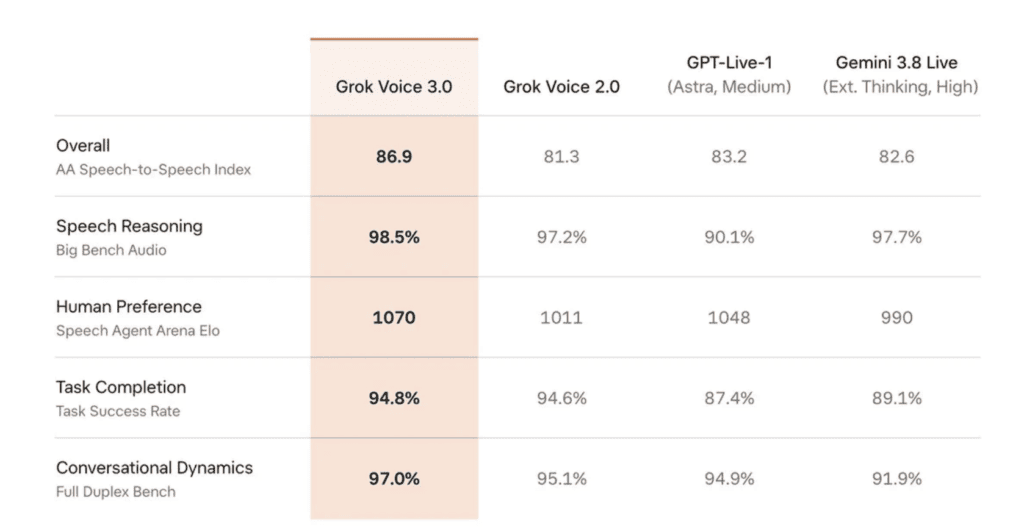
One notable claim is the model’s benchmark performance. In testing published by Artificial Analysis on October 13, 2026, it received a score of 86.9 on the Speech-to-Speech Index. The index combines multiple measures, including speech reasoning, agent performance, human preference and task success. xAI also reported a 97% result on the Full Duplex Bench measure of conversational dynamics. These scores provide useful comparison points, although benchmark performance does not guarantee the same results in every business environment.
For developers, another important aspect of the release is compatibility. xAI’s release notes state that grok-voice-latest now points to the new model and that the API remains unchanged. Existing implementations using the alias may be upgraded automatically, but teams should still test their prompts, integrations and production workflows before relying on the new version.
How Speech-to-Speech AI Works
Speech-to-speech AI enables a system to receive spoken input and generate a spoken response. Traditional voice applications often use separate components for speech recognition, language understanding and speech generation. These components must coordinate before a user hears the answer.
Businesses can explore Grok Voice 3.0 for handling routine enquiries, answering product questions and guiding customers through common service workflows.
A real-time system aims to make this process feel more fluid. It must understand what someone says, determine an appropriate response and produce audio without creating long or unnatural pauses.
For users, the difference can be significant. They can explain a problem in their own words rather than navigating a fixed menu. They can ask follow-up questions, clarify information or interrupt when the conversation moves in the wrong direction.
Grok Voice 3.0 is built for this kind of real-time interaction, where natural conversation is only one part of the job. The system may also need to use tools, retrieve information and follow business rules before providing a response.
A voice model that sounds convincing but gives incorrect information will not deliver a good customer experience. Accuracy, reliability and correct execution remain as important as conversational fluency.
Speed, Accuracy and Benchmark Performance
Latency is a central consideration for real-time voice AI. A delayed response may be acceptable in some text-based applications, but long pauses during a phone conversation can make the system feel unresponsive.
xAI says its model has latency below one second. The company also reported a 94.8% task success rate on a benchmark and a 98.5% score on a speech-reasoning test. On ServiceNow’s EVA-Bench, the company reported a 74% accuracy result for enterprise voice-agent scenarios.
These results should be interpreted within the context of their respective benchmarks. They do not mean that every customer query will be answered correctly or that all deployments will deliver identical response times.
The potential value of Grok Voice 3.0 extends beyond natural-sounding speech; businesses must also assess whether it understands requests accurately and completes tasks reliably.
A business evaluating Grok Voice 3.0 should test it against representative calls, including unclear questions, background noise, different accents, interruptions and requests requiring several steps. Results from real workflows can reveal limitations that a single benchmark may not capture.
Independent evaluation is also important because competing models evolve quickly. Benchmark results can change as new versions appear and evaluation methods improve. Businesses should therefore judge a model on current evidence and their own operational requirements rather than relying on a single ranking.
API Pricing and Availability
Pricing can influence whether a company chooses to automate a large volume of conversations. The published API price for Grok Voice 3.0 is $0.08 per minute, equivalent to $4.80 per hour. According to xAI, this is the same rate as the previous model. The model is available through the Voice Agent API documentation.
However, the model’s usage price is only one component of the total cost. Companies may also need to budget for telephony, software integrations, customer-data access, monitoring, engineering and support for conversations that require a human agent.
For example, a customer-service company handling thousands of calls daily should calculate the cost of completed tasks rather than just minutes of audio. A system with a lower price per minute may not be more economical if it frequently transfers customers to human staff or fails to resolve their requests.
Developers should also verify current pricing, rate limits and API capabilities before committing to a production rollout. For developers, Grok Voice 3.0 offers an opportunity to build voice-enabled applications that can respond to spoken requests and support interactive customer journeys.
Grok Voice 3.0 may be useful in existing customer-facing applications, but successful implementation depends on secure integrations, clear permissions and dependable access to business information.
Four Business Use Cases for AI Voice Agents
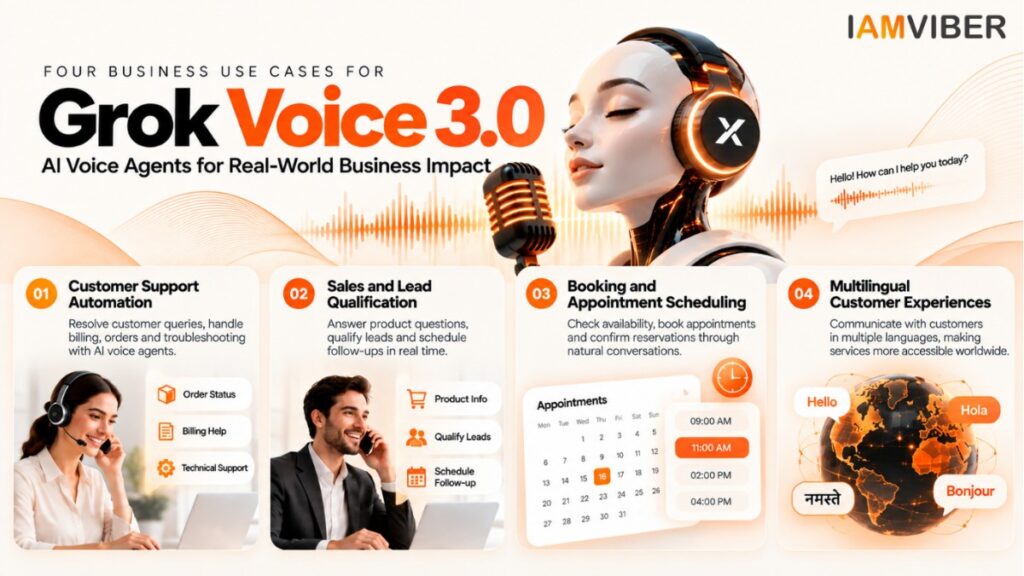
1. Customer Support Automation
Customer support is one of the clearest applications for AI voice agents. Businesses receive recurring questions about orders, billing, account access, technical troubleshooting and service availability.
Grok Voice 3.0 could help customer support teams reduce unnecessary waiting by enabling quicker spoken responses, provided the system is properly integrated and tested.
An appropriately integrated agent can retrieve approved information, ask clarifying questions and complete permitted actions. For example, a telecommunications customer might describe an internet connection problem and receive guided troubleshooting instead of navigating several menu options.
For customer support automation, the key measure is whether the customer receives the correct resolution. Businesses should track resolution rates, escalation rates, customer satisfaction, repeat calls and the frequency of incorrect responses.
2. Sales and Lead Qualification
Sales teams spend considerable time answering routine questions, identifying customer requirements and scheduling follow-ups. Voice agents can help gather basic details, explain approved product information and route qualified prospects to the right team.
With Grok Voice 3.0, developers can explore conversational sales workflows where the system asks relevant questions and responds to follow-up requests in real time. A human salesperson should remain available for complex negotiations, sensitive decisions or cases that require judgement beyond the agent’s permitted role.
Clear disclosures and safeguards are also important. An AI agent should not invent product claims, misrepresent terms or pressure customers into unsuitable purchases.
3. Booking and Appointment Scheduling
Appointments, service bookings and reservations often involve structured steps: asking for a date, checking availability, collecting preferences and confirming the result.
An AI voice agent can perform these steps when connected to a reliable booking system. It must check actual availability before promising a slot and confirm the final booking only after the system reports success.
With the right booking integrations, Grok Voice 3.0 could help users request appointments, check available options and receive confirmation through a conversational interface.
This type of workflow illustrates the difference between a system that merely talks and one that completes a useful task. Businesses should test cancellation, rescheduling and unavailable-slot scenarios before launch.
4. Multilingual Customer Experiences
Many customers find speaking easier than typing, especially when they are using a mobile device or need assistance while performing another task. Voice technology can make services more accessible, provided it handles the languages and accents used by the intended audience.
Grok Voice 3.0 can be evaluated for multilingual voice applications, particularly by businesses seeking to serve customers who prefer speaking over typing.
xAI’s broader voice platform advertises multilingual capabilities, but organisations should test performance for their specific languages, regional accents and specialist terminology. Code-switching, noisy environments and local names can create additional challenges.
For companies serving diverse populations, the quality of multilingual support can affect whether a voice agent is genuinely useful or simply available in theory.
How Businesses Should Evaluate a Voice AI Model
Before adopting a new model, businesses should define a limited workflow and establish measurable success criteria. A support team might focus on how often calls are resolved correctly, while a sales organisation could measure qualified leads, completed bookings and successful hand-offs.
Testing should include typical requests as well as edge cases. What happens when a customer interrupts? What if a caller provides incomplete information? Can the agent recognise when it lacks the information needed to answer confidently?
Organisations should assess security and privacy requirements before integrating voice systems with customer databases. Voice conversations may contain personal or financial information, so access controls, retention policies, consent and auditability need careful consideration.
Human escalation should also remain available when a request is sensitive, ambiguous or outside the agent’s permitted scope. Automation should make the customer journey easier, not trap people in a conversation they cannot resolve.
Limitations and Risks to Consider
No voice model is error-free. AI agents can misunderstand a customer’s intent, misinterpret spoken amounts or provide incorrect answers if their source data is incomplete. Even a highly natural voice can create a false impression of certainty.
Companies should therefore set clear boundaries around what their systems can do. Financial transactions, account changes and other sensitive actions may require additional verification, approval or human oversight.
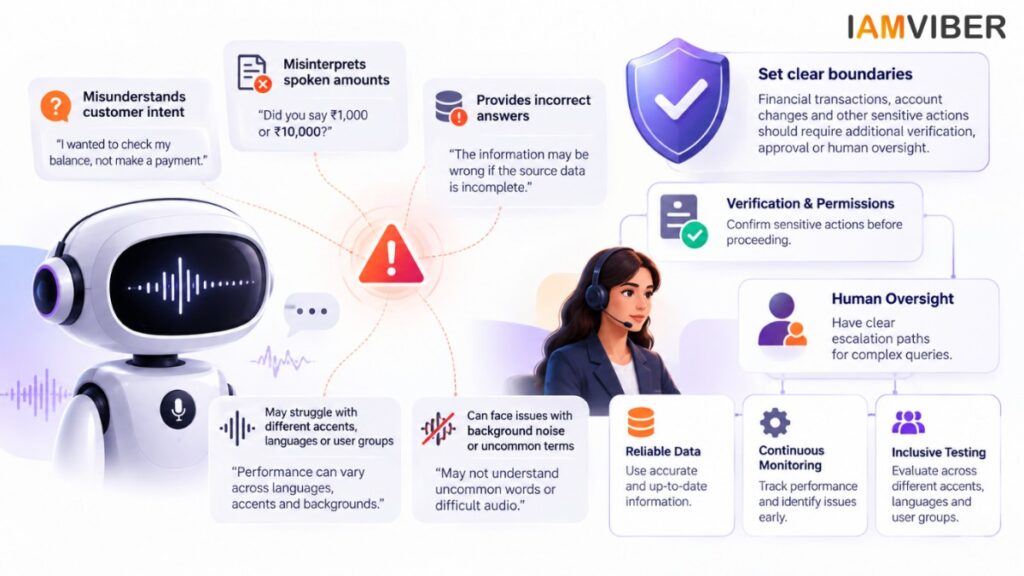
Businesses must also examine how performance varies across accents, languages and user groups. A model that performs well in a controlled test may struggle with background noise, uncommon terms or a different customer population.
The strongest implementations combine capable models with reliable data, explicit permissions, clear escalation paths and continuous monitoring. The goal is not maximum automation at any cost; it is safe and effective assistance.
Companies considering Grok Voice 3.0 should begin with a clearly defined use case, test representative conversations and compare results against existing service methods.
What This Launch Means for the Future of Voice AI
The wider shift in AI is from systems that primarily generate responses to systems that can participate in live conversations and help carry out multi-step tasks. That creates opportunities for customer service, sales, scheduling and other interactions where speaking is more convenient than typing.
Grok Voice 3.0 gives developers another model to evaluate for these applications. Its reported benchmark performance, low-latency design and unchanged API price may make it worth testing for businesses that need responsive voice interactions.
The competitive challenge is bigger than making an AI sound human. A useful agent must understand the request, follow policy, use tools correctly and resolve the task at a sustainable cost. Businesses will need to compare model performance, integration effort, reliability and customer outcomes before making a long-term decision.
As voice interfaces evolve, Grok Voice 3.0 represents another option for developers exploring conversational AI, with long-term adoption depending on reliability, cost and real customer value.
Conclusion
The launch of Grok Voice 3.0 reflects the growing importance of voice interfaces that can respond quickly and help complete practical tasks. It offers developers an option to evaluate for customer support, sales, bookings and other real-time applications.
The opportunity is substantial, but successful deployment requires more than selecting a powerful model. Businesses need reliable integrations, realistic testing, responsible data practices and a clear path to human assistance.
For organisations exploring speech-to-speech AI, the best next step is a controlled pilot with a defined workflow and measurable outcomes. The long-term winners will be the systems that solve customer problems accurately, reliably and responsibly—not simply the ones that sound the most natural.
Frequently Asked Questions
1. What Is Grok Voice 3.0?
Grok Voice 3.0 is xAI’s speech-to-speech model for real-time voice agents. It is designed to power spoken interactions in applications such as customer support and other task-oriented workflows.
2. How Much Does the API Cost?
The announced API rate is $0.08 per minute, or $4.80 per hour. Additional costs may arise from telephony, integrations, infrastructure and human support.
3. What Is Speech-to-Speech AI?
Speech-to-speech AI receives spoken input and produces a spoken response. It is designed to enable more direct, natural interactions than systems that rely entirely on fixed voice menus.
4. Can AI Voice Agents Handle Customer Support?
Yes, AI voice agents can handle defined support tasks when connected to approved company data and tools. Complex, sensitive or unresolved cases should be transferred to a human representative.
5. Is the Model Available to Developers?
Yes. xAI provides access through its Voice Agent API. Developers should consult the official documentation for the current model name, pricing, supported options and implementation requirements.
6. How Fast Is the New Model?
xAI reports latency below one second. Actual performance depends on the application, network conditions, tools and configuration, so teams should measure end-to-end response times in their own environment.
7. Can Voice AI Support Multiple Languages?
xAI’s broader voice platform advertises support for multiple languages. Businesses should test the exact languages, regional accents and vocabulary that their customers use.
8. How Can Businesses Measure Success?
Businesses can track task completion, accuracy, customer satisfaction, escalation rates, repeat calls, response time and total cost per resolved interaction. These measures provide a more useful assessment than conversational fluency alone.
Topics to follow on IAMVIEBR : AI & Tech, Startup, AI Creative, Agentic AI, Current Affairs & Insights, Collaboration