Indian startup funding cooled this week, but the details show a market that is changing rather than collapsing.In Indian startups raised more than $184 million, or about ₹1,747 crore, across 17 deals between October 19 and 23. That is 22 per cent lower than the $236.2 million, about ₹2,243 crore, raised across 25 deals in the previous week. At the same time, artificial intelligence companies took close to half of the money. If you are a founder, an investor or just someone who follows the startup world, this snapshot of Indian startup funding explains where capital is flowing and where it is drying up.
The week in numbers
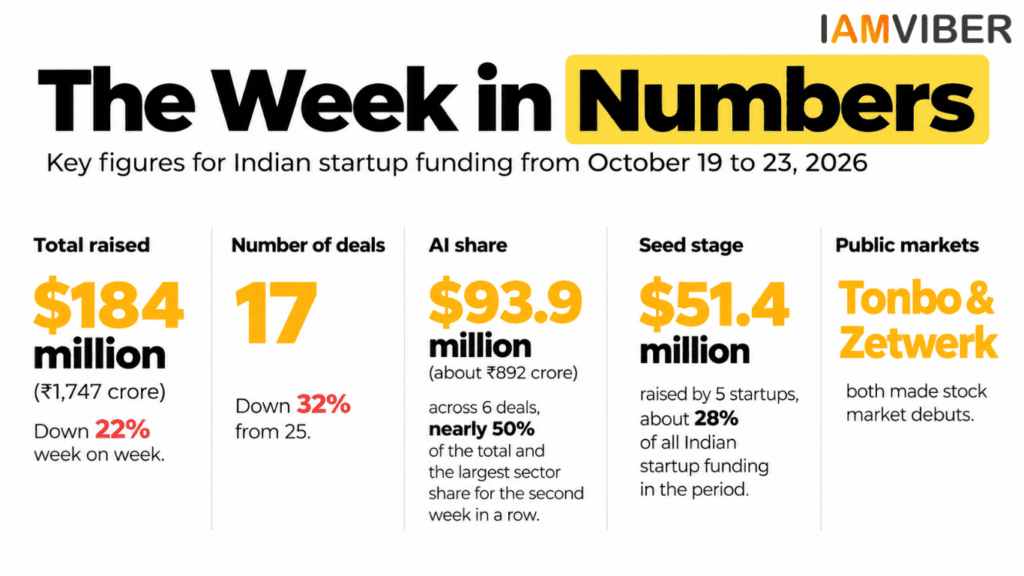
Here are the key figures for Indian startup funding from the week of October 19 to 23:
- Total raised: about $184 million (₹1,747 crore), down 22 per cent week on week.
- Number of deals: 17, down 32 per cent from 25.
- AI share: $93.9 million (about ₹892 crore) across six deals, nearly 50 per cent of the total and the largest sector share for the second week in a row.
- Seed stage: five startups raised a combined $51.4 million, about 28 per cent of all Indian startup funding in the period.
- Public markets: Tonbo and Zetwerk both made stock market debuts.
Another tracker, Entrepreneur India, counted a slightly different window of October 16 to 22 and recorded $193.49 million (₹1,712 crore) across 16 equity rounds, up marginally from $187.54 million a week earlier. The difference is mainly the dates and the way each outlet counts deals, but both agree on a similar overall level of roughly $185 million to $195 million a week. That level of Indian startup funding is far below the peaks seen in earlier years but steady enough to show that investors are still writing cheques.
Biggest deals of the week
- Even, a Bengaluru health insurance provider founded in 2020, raised $50 million in a Series B led by Khosla Ventures with Alpha Wave Global participating. It was the largest deal of the week on Entrepreneur's list.
- Baba Care, a Gurugram healthcare navigation startup founded in 2025, raised $40 million in a Series A led by FirstMark, with CVS Health Ventures, General Catalyst and others joining. A Series A of that size for a company only a year old is rare.
- AuxoAI raised $20.7 million in a Series A led by NTTVC.
- Firstwork secured $15 million in a Series A led by Earlybird Venture Capital.
- Greenzo Energy, a Delhi hydropower services company, raised $13.66 million from angel investor Ashish Kacholia.
- The Pant Project, a Mumbai apparel brand, raised $11.46 million in a Series B led by Mirae Asset Venture Investments.
Then came Monday’s roundup for October 26. Matiks raised $10 million in a pre-Series A round led by General Catalyst. BioStack raised $9.5 million in a seed round led by Peak XV and Afore Capital to build training datasets for medical AI. Paar Autonomy raised ₹10 crore, Bucketlistt.com raised ₹7.6 crore, and Glance received a strategic investment from L Catterton. The pace of Indian startup funding is not stopping; it is simply more selective.
Why AI is capturing so much money
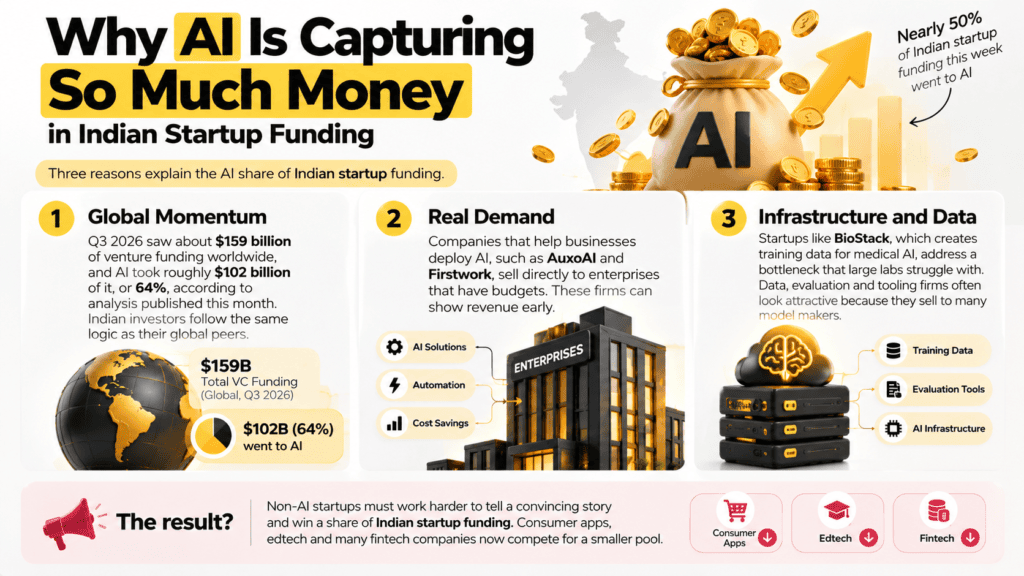
Three reasons explain the AI share of Indian startup funding.
Global momentum. Q3 2026 saw about $159 billion of venture funding worldwide, and AI took roughly $102 billion of it, or 64 per cent, according to analysis published this month. Indian investors follow the same logic as their global peers.
Real demand. Companies that help businesses deploy AI, such as AuxoAI and Firstwork, sell directly to enterprises that have budgets. These firms can show revenue early.
Infrastructure and data. Startups like BioStack, which creates training data for medical AI, address a bottleneck that large labs struggle with. Data, evaluation and tooling firms often look attractive because they sell to many model makers.
This trend means non-AI startups must work harder to tell a convincing story and win a share of Indian startup funding. Consumer apps, edtech and many fintech companies now compete for a smaller pool.
What is happening with later-stage funding
Growth rounds have not disappeared, but investors are demanding profitability or clear paths to it. The strong results from companies such as Ather Energy and Paytm this week help that case, as both showed profit improvements.
At the same time, the market for exits is tough globally: exit values are high, but payouts to funds are low and the IPO queue is long. In India around 44 startups have filed or are preparing to list, seeking about ₹70,000 crore. A smooth run of listings would restore confidence in Indian startup funding by returning cash to early investors, who can then back new founders.
Sector watch: who is winning and who is struggling
Winning:
- AI applications and infrastructure. Enterprise AI, data tooling and agent platforms are in high demand.
- Healthtech and insurtech. Even and Baba Care show that healthcare remains a favoured theme, especially where technology reduces costs.
- Defence and deeptech. Paar Autonomy and Nova Spectral AI, which raised ₹21.15 crore for an India-made infrared sensor chip aimed at drones and defence, point to rising interest in import substitution and strategic technology.
- Gaming with global reach. Matiks’s $10 million round shows investors will back Indian consumer products that can scale overseas.
Struggling:
- Pure consumer plays without clear margins. Rounds are smaller and more selective.
- Late-stage companies without profit. Valuations are under pressure unless growth is exceptional.
What Indian startup funding trends mean for founders
If you are building a startup in India right now, here is practical advice drawn from the data.
- Show revenue early. The Indian startup funding market rewards evidence. Pilots with paying customers beat pitch decks full of projections.
- Be honest about AI. Investors can spot companies that simply add the word AI to a slide. Explain what proprietary data, workflow or distribution you own.
- Raise smaller, last longer. Seed rounds of $2 million to $10 million are still being done. Plan 24 months of runway.
- Pick the right investor. Funds like General Catalyst, Peak XV, Khosla Ventures and Accel appear again and again in AI and health deals. Study their portfolios before pitching.
- Prepare for tough diligence. Expect questions on unit economics, customer concentration, data privacy compliance and regulation, including India’s new data protection law.
What this means for investors and readers
For investors, the week’s Indian startup funding data suggests selectivity rather than panic. Deal count is falling faster than deal value, which indicates larger cheques going into fewer companies.
For job seekers, AI roles will continue to grow while some consumer startups remain cautious about hiring.
For students, building practical skills in AI tools, data and product thinking is more valuable than ever. Remember that weekly figures bounce around and a single large round can distort a tracker, so avoid drawing long-term conclusions from one week.
What to watch next
- November funding totals. Monthly numbers from Inc42, Entrackr and Tracxn will show whether the cooling continues.
- IPO outcomes. The reception for Tonbo, Zetwerk and upcoming listings will influence late-stage sentiment.
- Global AI sentiment. Big Tech earnings this week and the Anthropic and OpenAI financing news will move investor mood.
- Government support. Any new fund-of-funds or tax changes could improve Indian startup funding for deeptech and manufacturing.
Final thoughts
The latest Indian startup funding data tells a balanced story. Money is available, yet it is flowing mostly to companies with strong technology, clear markets and credible teams. The 22 per cent weekly dip is a reminder to build carefully, while the high share of AI shows where the next wave of opportunity lies. Founders who focus on revenue, discipline and real problems will find investors, and the broader Indian startup funding picture should remain healthy. Data in this article comes from public reports as of October 27, 2026.
Frequently Asked Questions
1. How much Indian startup funding was raised in October 2026?
Indian startup funding reached approximately $184 million (₹1,747 crore) across 17 deals between October 19 and 23, 2026, according to the figures cited in this article.
2. Why has Indian startup funding declined in 2026?
Indian startup funding has fluctuated due to fewer investment deals, stricter investor selection, valuation pressures, and a stronger focus on profitability and sustainable business models.
3. Which startups received Indian startup funding in October 2026?
Indian startup funding deals in October 2026 included investments in Even, Baba Care, AuxoAI, Firstwork, Greenzo Energy, The Pant Project, Matiks, and BioStack.
4. Which sector attracts the most Indian startup funding in 2026?
Artificial intelligence is attracting a significant share of Indian startup funding, particularly in enterprise AI, AI infrastructure, data tooling, and specialised AI applications.
5. How much Indian startup funding are AI startups receiving in 2026?
AI startups received approximately $93.9 million across six deals during October 19–23, 2026, accounting for nearly half of the Indian startup funding reported for that week.
6. How can founders secure Indian startup funding in 2026?
Founders seeking Indian startup funding should demonstrate revenue traction, validate product-market fit, maintain healthy unit economics, build a credible team, and approach investors who specialise in their sector.
7. Is Indian startup funding available for early-stage startups in 2026?
Yes, Indian startup funding remains available for early-stage businesses, especially those with strong technology, clear customer demand, scalable business models, and credible growth plans.
8. What are the latest Indian startup funding trends in 2026?
The latest Indian startup funding trends include growing AI investments, continued interest in healthtech and deeptech, greater scrutiny of profitability, selective seed-stage deals, and increased attention to IPOs and investor exits.
Topics to follow on IAMVIEBR : AI & Tech, Startup, AI Creative, Agentic AI, Current Affairs & Insights, Collaboration