Baba Series A Funding: $40M Round Led by FirstMark and CVS Health Ventures Aims to Fix Medicare Care
The Baba Series A funding announcement on October 20, 2026 has put a spotlight on a neglected corner of healthcare: helping older and low-income Americans actually use the coverage they already have. New York-based Baba, which some people search for as “Baba Care,” raised $40 million to scale AI-supported care coordination for Medicare and Medicaid members.
This guide explains the Baba Series A funding in plain language: who invested, why CVS Health Ventures joining matters, how the money will be used, and what risks remain. If you follow healthtech, venture capital or Medicare AI care coordination, this round is worth understanding.
Baba Series A Funding at a Glance
| Detail | Information |
|---|---|
| Company | Baba |
| Headquarters | New Work |
| Founded | 2025 |
| Founder & CEO | Connor Sweeney |
| Round | Series A |
| Amount | $40 million |
| Lead investor | FirstMark Capital |
| New investors | CVS Health Ventures, Valtruis |
| Returning investors | General Catalyst, Genius Ventures, Ground Up Ventures |
What Is Baba and What Does It Do?
Baba is an applied AI company that acts as a care partner for patients and their families. Instead of leaving people to fight through phone trees, referrals and paperwork alone, Baba gives each patient a dedicated care team of care coordinators, licensed therapists and providers. The team helps with specialist visits, behavioral health and social needs such as housing and financial assistance, while AI handles much of the background coordination. Founder and CEO Connor Sweeney leads the company.
Who Invested in the Baba Series A Funding?
FirstMark Capital led the round. CVS Health Ventures and Valtruis participated, alongside returning backers General Catalyst, Genius Ventures and Ground Up Ventures. Returning investors matter because they have watched the company up close and chose to back it again.
FirstMark co-founder and partner Rick Heitzmann described Baba as the firm’s latest bet on the consumerization of healthcare, this time for rural, older Americans with more complex needs. In other words, the investors behind the Baba Series A funding see Medicare as a consumer experience problem, not only an insurance one.
Why CVS Health Ventures Joining Matters
Money from a venture firm is useful, but money from a strategic investor is a signal. CVS Health owns Aetna, a major Medicare Advantage insurer, so CVS Health Ventures has direct exposure to whether better care navigation lowers the cost of caring for Medicare patients. That is why many analysts read the Baba Series A funding as a real-world test of the model, not just a financing event.
CVS Health Ventures partner Carter Prince said Baba looks promising because it trains AI on specific, long-horizon activities while keeping humans deeply involved. That human-in-the-loop idea runs through the entire company.
How Baba Will Use the Money
The company says the Baba Series A funding will go toward three priorities:
- Expanding clinical care teams so more patients get a dedicated team.
- Advancing AI research, including an applied research effort focused on AI for complex care.
- Growing health plan partnerships and accelerating value-based arrangements, where payment is tied to patient outcomes.
Connor Sweeney told Fierce Healthcare that the capital lets Baba scale how care is delivered and coordinated for people on government-sponsored coverage.
The Medicare Gap Behind the Baba Series A Funding
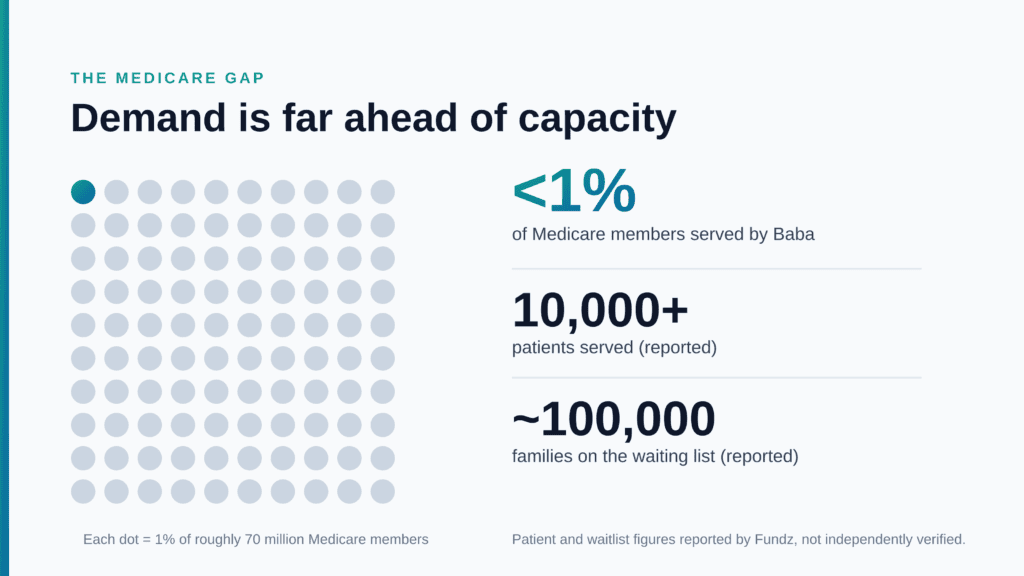
Roughly 70 million Americans are on Medicare, and Baba says it has served fewer than 1% of them. Funding database Fundz also reports more than 10,000 patients served and a waiting list of about 100,000 families (treat this as reported, not independently verified). If accurate, demand is far ahead of capacity, which is the clearest reason the Baba Series A funding exists.
Medicare members often juggle several conditions, many doctors, confusing benefits and financial stress at once. Missed follow-ups, unfilled prescriptions and unclaimed assistance programs are common, and families end up acting as unpaid case managers. Better Medicare AI care coordination aims to close exactly these gaps.
Humans Plus AI: How Baba’s Model Works
Baba does not pitch itself as AI replacing caregivers. The core product is a human service supported by software. Advocates and therapists stay in touch with patients, while AI helps with repetitive, multi-step work such as tracking referrals, following up on approvals and finding assistance programs. Trust is everything with older patients, so this design is deliberate. The Baba Series A funding scales that blend instead of swapping people for chatbots.
What the Baba Series A Funding Means for Patients and Families
For patients, the promise is a single point of contact across medical, financial, social and behavioral needs. Families who currently carry that coordination burden could finally get relief. Rural patients, who face long distances and provider shortages, may benefit most. Access will likely depend on partnerships with health plans, so availability may grow gradually rather than all at once.
What It Means for Health Plans and the Healthtech Industry
For insurers, the Baba Series A funding points toward value-based arrangements, where better coordination could reduce avoidable emergency visits and missed follow-ups. In theory, that lowers costs while improving patient experience. For the wider industry, the round adds to a growing wave of applied AI startups that pair licensed clinicians with automation rather than relying on technology alone.
Risks and Open Questions
Even with Baba Series A funding of $40 million, real challenges remain:
- Scaling people: Clinician-staffed care teams do not scale like software, and a waiting list that large is a hiring challenge.
- Reimbursement: Baba must show that payers will reliably pay for outcomes.
- Quality: Advocate follow-through, the heart of the product, must hold up as volume grows.
- Evidence: Public outcome data is limited, and claims-cost savings still need proof.
What Comes Next for Baba
Fundz notes that Series A companies typically raise their next round within 10 to 18 months, though that is a general estimate, not a Baba announcement. After the Baba Series A funding, the milestones to watch are new health plan partnerships, hiring of care teams, published outcomes data and progress from its AI research effort.
Key Takeaways
- The Baba Series A funding totals $40 million, announced on October 20, 2026.
- FirstMark Capital led, with CVS Health Ventures and Valtruis joining.
- Funds go to care teams, AI research and health plan partnerships.
- Baba has served under 1% of roughly 70 million Medicare members, so the opportunity is large.
- The real test is proving that Medicare AI care coordination lowers costs and improves outcomes.
Conclusion
The Baba Series A funding is more than a headline number. It is a vote of confidence that human-led, AI-supported care can fix one of healthcare’s most frustrating experiences. With FirstMark Capital leading and CVS Health Ventures adding strategic weight, Baba now has the resources to prove its model at a larger scale. Keep watching this space, because the results will shape how Medicare care coordination evolves.
Frequently Asked Questions
1. How much is the Baba Series A funding?
The Baba Series A funding totals $40 million. Baba announced it on October 20, 2026.
2. Who led the Baba Series A funding round?
FirstMark Capital led the round. It is a venture firm known for backing digital health companies.
3. Who are the other investors in Baba?
CVS Health Ventures and Valtruis joined the round. Returning investors General Catalyst, Genius Ventures and Ground Up Ventures also participated.
4. What does Baba do?
Baba is an applied AI company founded in 2025. It acts as a care partner for Medicare and Medicaid patients and their families, giving each patient a dedicated team of care coordinators, licensed therapists and providers, supported by AI.
5. Is Baba the same as “Baba Care”?
The company’s name is Baba. “Baba Care” is just a common search variation for the same Medicare and Medicaid care platform.
6. Why does CVS Health Ventures’ participation matter?
CVS Health owns Aetna, a major Medicare Advantage insurer. Its investment signals that a large health player is interested in whether care navigation can lower the cost of caring for Medicare patients.
7. How will Baba use the new funding?
Baba plans to expand its clinical care teams, advance its AI research for complex care, and grow partnerships with health plans to speed up value-based care arrangements.
8. How many patients has Baba served so far?
Baba says it has served fewer than 1% of the roughly 70 million Americans on Medicare. Funding database Fundz reports over 10,000 patients served and a waiting list of about 100,000 families, but this figure is not independently verified.
Topics to follow on IAMVIEBR : AI & Tech, Startup, AI Creative, Agentic AI, Current Affairs & Insights, Collaboration