
The Ather Energy profit announced on Monday, October 26, 2026 is a milestone for Indian electric mobility. After thirteen years of building electric scooters, Bengaluru-based Ather Energy posted its first-ever quarterly net profit in the September quarter of FY27. The amount is small, ₹1.26 crore, but the swing is huge: a year ago the company lost ₹154 crore in the same quarter. For founders, investors and EV buyers across India, the Ather Energy profit is a signal that hardware startups can reach profitability even in a tough, capital-hungry sector. This blog explains the numbers, the context and the risks in simple words.
The headline numbers
According to the company’s exchange filing and reports here is what Ather reported for Q2 FY27 (July to September 2026):
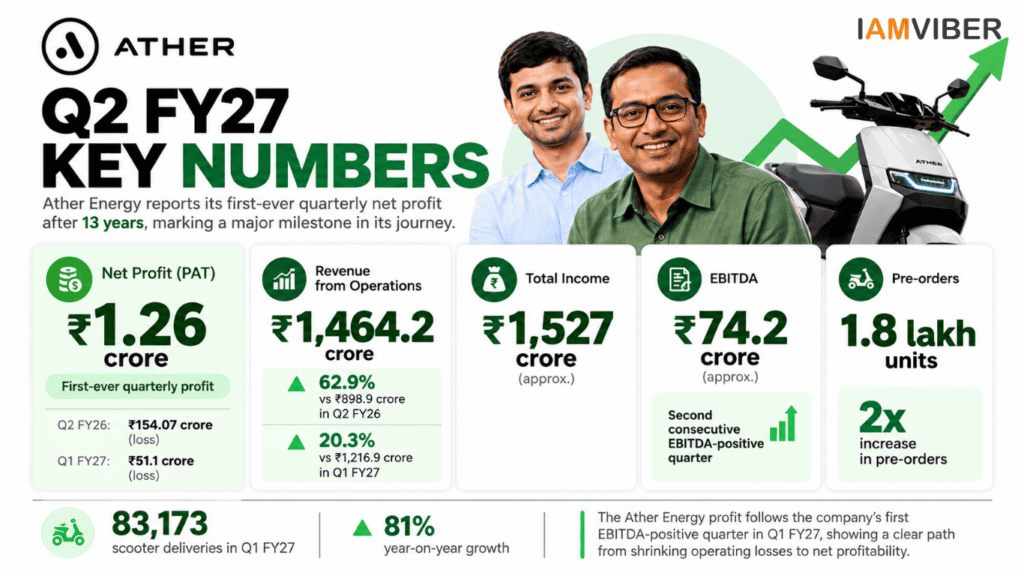
- Net profit (PAT): ₹1.26 crore, against a loss of ₹154.07 crore in Q2 FY26 and a loss of ₹51.1 crore in the previous quarter.
- Revenue from operations: ₹1,464.2 crore, up 62.9 per cent from ₹898.9 crore a year earlier and up 20.3 per cent from ₹1,216.9 crore in Q1.
- Total income: about ₹1,527 crore.
- EBITDA: about ₹74.2 crore, the company’s second consecutive EBITDA-positive quarter.
- Pre-orders: reported to have doubled to about 1.8 lakh units.
The Ather Energy profit follows the company’s first EBITDA-positive quarter in Q1 FY27, when it also reported 83,173 scooter deliveries, up 81 per cent year on year. In other words, the path was visible: operating losses shrank first, then net losses disappeared.
What actually drove the profit
It is worth being precise. Inc42 notes that other income played a role in the maiden profit, and a separate analysis points out that Ather’s total expenses rose about 39 per cent to roughly ₹1,526 crore, almost matching total income. That means the Ather Energy profit is thin, and part of it comes from non-operating income such as interest earned on the cash the company raised from investors, rather than purely from selling scooters.
That does not make it fake. Several real operating improvements helped:
- Volume and operating leverage. Revenue grew far faster than fixed costs. When a factory and a retail network are used more fully, each extra scooter adds more profit.
- Pricing and mix. Ather has taken selective price increases and sells more of its popular Rizta family scooter. Accessories and software such as Pro packs also add high-margin revenue. The company reported a very high accessory attach rate in Q1.
- Value engineering. Ather says it renegotiated with suppliers and redesigned parts to hold margins despite rising copper, aluminium and lithium costs.
- Non-vehicle business. Charging, accessories, insurance and software contribute a growing share of earnings.
Understanding this split between operating strength and other income is the key to judging whether the Ather Energy profit will last, because only operating strength can be repeated every quarter.
The funding backdrop
Profit is not the only reason Ather looks stronger. In the first half of the fiscal year it raised capital from a qualified institutional placement of about ₹1,300 crore, and earlier coverage mentions more than ₹2,500 crore raised across a QIP and a preferential allotment. Hero MotoCorp, its largest shareholder, invested around $184 million and now holds about 32.8 per cent. The India-Japan Fund also took part. This money builds factories and research capacity, and it explains why the Ather Energy profit does not mean the company will stop spending. Growth capital is still the fuel.
The manufacturing crunch
The most interesting part of the story is that demand is running ahead of supply. Reports say Ather has faced several quarters of supply constraints, and its first production scooter on a new EL platform, called Konarc, has launched this year. To fix capacity, Ather is building Factory 3.0 at AURIC in Chhatrapati Sambhaji Nagar.
Phase one adds 5 lakh units of annual capacity and is due to start production in Q3 FY27. When both phases are complete, total installed capacity will reach about 14.2 lakh units a year.
This matters because profit alone will not keep the company growing. If Ather cannot build enough scooters, customers may switch to rivals. At the same time, a new factory creates execution risk: ramp-up delays, quality problems or cost overruns can push the Ather Energy profit back into the red. Capacity, more than demand, is now the biggest variable behind the Ather Energy profit, and every month of delay at the new plant is a month of lost sales.
The competition
India’s electric two-wheeler market is crowded. Ather faces Ola Electric, TVS, Bajaj, Hero’s own Vida brand and a wave of new entrants. In Q1 FY27 its market share slipped to about 16.8 per cent from a high of 18.8 per cent in Q3 FY26, as competition intensified. Margins per vehicle also came under pressure from input costs.
Three forces will shape the next few quarters:
- Commodity prices. Rare earths, lithium and aluminium costs can erode margins quickly.
- Incentives and policy. Government subsidies, state-level incentives and import rules for components change the economics for every EV maker.
- Price wars. If rivals cut prices, Ather must choose between market share and profit.
Each of these forces can erase a thin Ather Energy profit within a quarter or two if the company slips, which is why analysts are cautious despite the cheerful headlines.
Why this is a big moment for Indian startups
Indian hardware startups have often been told that they cannot match software companies on profitability. The Ather Energy profit pushes back on that story. Ather listed on the stock exchange in 2025, built its own technology stack, designed its own charging network and kept investing in research for more than a decade. It shows that patient capital and strong engineering can work in India’s difficult manufacturing environment.
It also affects sentiment. This week’s funding data shows that Indian startups raised only about ₹1,747 crore across 17 deals, down 22 per cent from the previous week, with AI taking nearly half. Investors are choosy. A profitable EV maker reminds them that climate and manufacturing companies can reward patience, which may help other cleantech and deeptech founders raise money.
What buyers and investors should know
For buyers. More profit and capacity usually mean better service networks, shorter waiting times and more charging points. But a profitable company may also hold prices firm, so do not expect big discounts. Compare running costs, battery warranty and resale value before choosing a scooter.
For investors. The Ather Energy profit is a first step, not a finish line. Look at operating EBITDA, cash burn, factory timelines and whether other income continues to support earnings. Valuation also matters: shares have risen sharply this year, and a high price already assumes strong growth. Check the quarterly filings yourself and consult a registered adviser. This blog is not investment advice.
For founders. Study the sequence behind the Ather Energy profit: volume growth, gross margin discipline, EBITDA, then net profit. Ather did not skip steps, and each stage was built on supply-chain and product improvements.
What to watch next
Here are five things to track after the Ather Energy profit announcement:
- Q3 FY27 factory start. Did the Factory 3.0 first phase begin production on schedule?
- Market share. A recovery above 17 or 18 per cent would show demand strength.
- Operating profit. Can EBITDA keep growing without help from other income?
- New launches. How do Konarc and the EL platform sell?
- Competition from Ola and TVS. Price cuts or new models could squeeze margins.
Final thoughts
The Ather Energy profit may be tiny, but it carries a big message for India’s startup ecosystem: hard-tech businesses can reach profitability with focus and patience. The real test starts now, because Ather must scale production, defend margins and prove that the improvement is more than one good quarter. If it succeeds, the Ather Energy profit will be remembered as the moment Indian EV startups grew up. All facts here come from public reports as of October 27, 2026.
Frequently Asked Questions
1. How much was Ather Energy profit in Q2 FY27?
Ather Energy profit reached ₹1.26 crore in Q2 FY27, compared with a net loss of ₹154.07 crore in the same quarter of the previous financial year. The company reported operating revenue of ₹1,464.2 crore.
2. Why did Ather Energy profit increase in Q2 FY27?
Ather Energy profit improved due to higher revenue, increased scooter sales, better operating leverage, product mix, cost optimisation, and contributions from other income. The company still needs to demonstrate consistent operating profitability.
3. Is Ather Energy profit sustainable in the coming quarters?
Ather Energy profit sustainability depends on continued revenue growth, lower production costs, improved operating margins, and increased manufacturing capacity. Since other income contributed to the latest result, future quarters will help establish whether profitability can be maintained.
4. What was Ather Energy's revenue when it reported a profit?
When Ather Energy profit reached ₹1.26 crore in Q2 FY27, the company reported operating revenue of approximately ₹1,464.2 crore, representing 62.9% year-on-year growth from ₹898.9 crore.
5. How did Ather Energy profit change compared with the previous quarter?
Ather Energy profit improved from a net loss of ₹51.1 crore in Q1 FY27 to a net profit of ₹1.26 crore in Q2 FY27, marking a significant improvement in quarterly earnings.
6. Did other income contribute to Ather Energy profit?
Yes, other income contributed to Ather Energy profit in Q2 FY27. This means the reported net profit did not come entirely from core operations, making operating EBITDA and recurring revenue important indicators to monitor.
7. How will Ather Energy profit be affected by its new manufacturing facility?
Ather Energy profit could benefit from Factory 3.0 through increased production capacity, improved supply availability, and economies of scale. However, construction delays, ramp-up costs, and manufacturing challenges could affect future profitability.
8. What does Ather Energy profit mean for India's electric vehicle industry?
Ather Energy profit is an important milestone for India’s electric vehicle industry because it demonstrates progress towards profitability in a capital-intensive manufacturing business. Its long-term significance will depend on sustained earnings, market share, production growth, and competition.
Topics to follow on IAMVIEBR : AI & Tech, Startup, AI Creative, Agentic AI, Current Affairs & Insights, Collaboration