OpenAI's New Voice Models explained
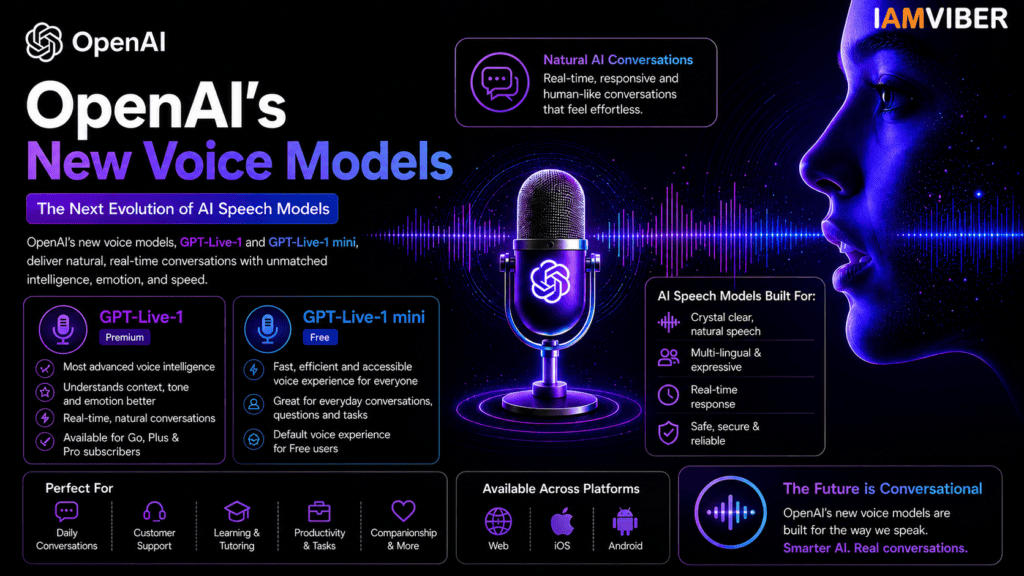
OpenAI has unveiled GPT-Live, a new generation of voice models designed to make conversations with AI feel remarkably more natural. Rather than following the traditional “speak, wait, respond” pattern, GPT-Live enables fluid, real-time conversations where the AI can listen, understand, and respond much like a human.
Artificial intelligence is evolving beyond text, and voice is becoming the next major frontier. OpenAI has taken a significant step in that direction with the launch of GPT-Live, a new generation of voice models designed to make conversations with AI feel as natural as speaking to another person.
Unlike traditional voice assistants that follow a rigid pattern of waiting for users to finish speaking before generating a response, GPT-Live enables fluid, real-time conversations. The new models—GPT-Live-1 and GPT-Live-1 mini—introduce simultaneous listening and speaking, improved conversational understanding, live translation, and enhanced responsiveness.
The release represents one of OpenAI’s most ambitious efforts yet to bridge the gap between human communication and AI interaction, making ChatGPT more conversational, intuitive, and useful across personal and professional environments.
A New Era of Conversational AI
Voice assistants have existed for years, but they often feel transactional. Whether it’s asking a smart speaker for the weather or using voice search on a smartphone, most systems require users to speak, pause, and wait for a response before continuing the conversation.
Human conversations don’t work that way.
People naturally interrupt each other, pause while thinking, acknowledge what they’re hearing with simple expressions like “I see” or “mm-hmm,” and often speak over one another without disrupting the flow of communication.
GPT-Live is designed to replicate these natural conversational patterns. Instead of processing speech only after a user stops talking, the model continuously listens while generating responses. This creates smoother interactions that feel significantly more realistic than previous generations of AI voice assistants.
The result is an experience that resembles talking with another person rather than issuing commands to software.
What Is GPT-Live?
Natural AI Conversations
GPT-Live is OpenAI’s latest real-time voice model built specifically for natural conversations.
The technology introduces full-duplex communication, allowing the AI to process incoming speech while simultaneously generating spoken responses. This capability eliminates many of the awkward pauses commonly associated with traditional voice assistants.
- GPT-Live-1 – the flagship model offering the highest-quality voice experience for Go, Plus, and Pro subscribers.
- GPT-Live-1 mini – a lightweight version optimized for speed and efficiency, available to Free users.
- Both models aim to make ChatGPT's voice interactions faster, smoother, and more engaging.
Key Features of OpenAI's New Voice Models
1. Full-Duplex Conversations
Perhaps the biggest innovation is simultaneous listening and speaking.
Traditional AI systems process speech only after users finish talking. GPT-Live breaks this limitation by allowing conversations to flow naturally, even when users interrupt or continue speaking during responses.
This dramatically reduces waiting time and creates a much more human-like interaction.
2. Smarter Understanding of Pauses
People rarely speak in perfect sentences. We hesitate, pause to think, change direction mid-sentence, or stop briefly before continuing.
Older voice assistants often mistake these pauses as the end of a conversation, interrupting users before they’ve finished speaking.
GPT-Live better understands conversational timing and can distinguish between a natural pause and the actual end of a statement.
3. Human-Like Acknowledgements
Natural conversations involve constant feedback.
People nod, say “okay,” “got it,” or “I understand” while listening. GPT-Live introduces similar conversational cues, making discussions feel more engaging without unnecessarily interrupting the speaker.
These subtle acknowledgements help create a more authentic conversational experience.
4. Real-Time Translation
Language translation has become one of AI’s most practical applications, and GPT-Live significantly enhances this capability.
Instead of waiting for a speaker to complete an entire sentence, the model can translate conversations almost instantly, making multilingual discussions smoother and more efficient.
This feature has enormous potential for travelers, international businesses, educators, and global teams collaborating across different languages.
5. Background Intelligence
GPT-Live doesn’t stop listening just because it needs to perform another task.
The model can continue engaging in conversation while simultaneously conducting web searches or performing complex reasoning in the background.
Once the information is ready, it naturally integrates the results into the ongoing discussion without forcing users to restart the conversation.
6. Visual Companion Cards
Voice isn’t the only interface receiving improvements.
When discussing live topics such as weather forecasts, sports scores, stock prices, or other dynamic information, GPT-Live can display visual cards alongside spoken responses.
This combination of voice and visual context creates a richer user experience while reducing the need to switch between multiple apps.
Why This Launch Matters
The release of GPT-Live represents much more than a feature update. It signals a broader transformation in how people will interact with artificial intelligence over the coming years. As AI becomes integrated into smartphones, laptops, cars, smart homes, and wearable devices, voice is emerging as the most natural interface. Typing isn’t always convenient. Speaking is.
Whether someone is driving, cooking, exercising, studying, or working, voice interactions offer a hands-free way to access information and complete tasks. By making conversations more fluid and less robotic, GPT-Live removes one of the biggest barriers preventing widespread adoption of voice AI.
Business and Enterprise Applications
The implications extend far beyond personal productivity.
Businesses across industries are expected to benefit from more natural AI-powered communication.
Customer support teams can deploy conversational assistants capable of handling complex interactions without sounding scripted.
Healthcare providers may use voice AI for patient engagement and appointment assistance.
Educational platforms can offer interactive tutoring experiences where students ask follow-up questions naturally instead of following rigid prompts.
Sales teams can leverage AI assistants for real-time product information during customer conversations, while multilingual organizations can improve communication through live translation capabilities.
Developers also gain access to more advanced voice interactions for building next-generation applications powered by OpenAI’s APIs.
Availability
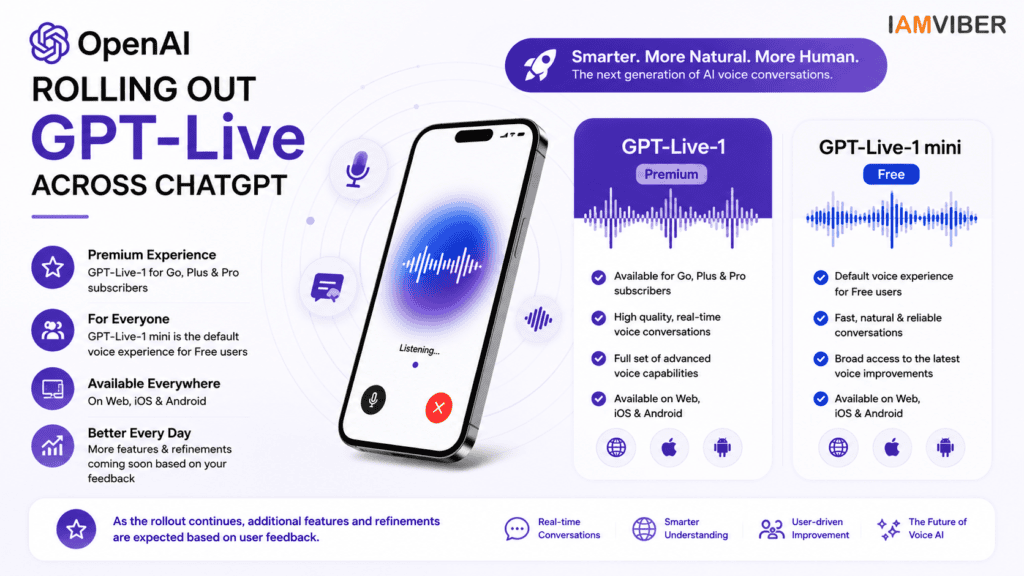
OpenAI is gradually rolling out GPT-Live across ChatGPT.
The premium GPT-Live-1 model is available for Go, Plus, and Pro subscribers on web, iOS, and Android.
Meanwhile, GPT-Live-1 mini serves as the default voice experience for Free users, allowing a broader audience to experience the latest improvements in conversational AI.
As the rollout continues, additional features and refinements are expected based on user feedback.
What This Means for the Future of AI
The launch of GPT-Live reflects a broader industry shift toward conversational computing. Rather than interacting with AI through isolated prompts, users are beginning to engage in continuous discussions that feel increasingly natural.
Future AI assistants are likely to remember context better, collaborate more effectively, understand emotions more accurately, and seamlessly combine voice, vision, and reasoning into a single experience.
OpenAI’s latest voice models provide a glimpse of that future. Instead of simply answering questions, AI is becoming an active conversation partner capable of helping users think, create, learn, translate, and solve problems in real time.
Final Thoughts
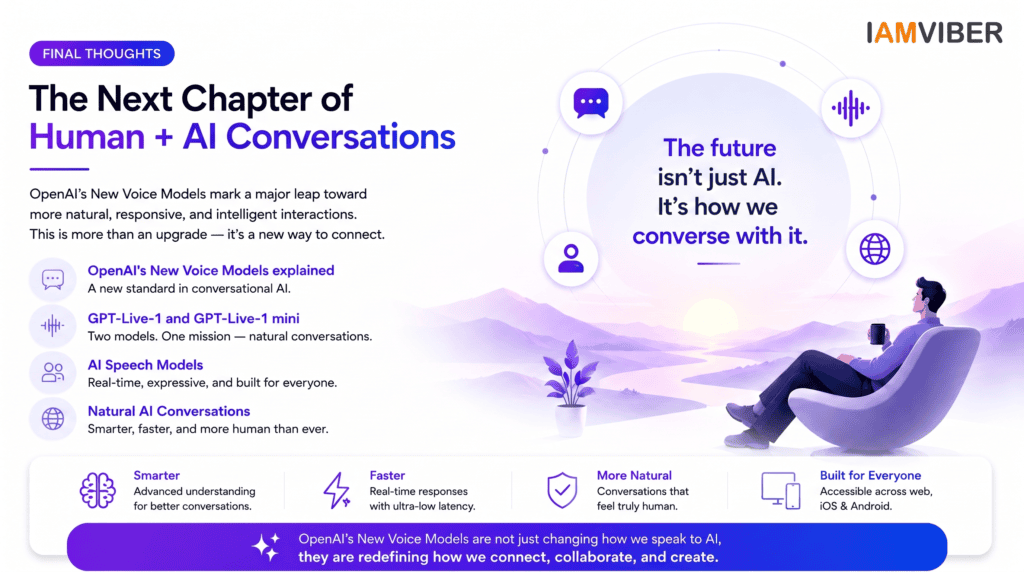
OpenAI’s GPT-Live represents one of the most meaningful advancements in conversational AI to date. By introducing full-duplex communication, smarter conversational timing, human-like acknowledgements, live translation, and richer interactive experiences, the company is redefining what users can expect from voice assistants.
As AI continues to move beyond text and into everyday conversations, GPT-Live demonstrates that the future of human-computer interaction will be increasingly natural, seamless, and voice-first.
For businesses, developers, creators, and everyday users alike, OpenAI’s new voice models are more than just another update—they’re a major step toward AI that communicates the way humans do.
FAQs
1. What are OpenAI's new voice models?
OpenAI’s new voice models, GPT-Live-1 and GPT-Live-1 mini, are advanced AI speech models designed to enable more natural, real-time conversations. They can listen and respond simultaneously, making interactions feel more human-like than traditional voice assistants.
2. What is GPT-Live?
GPT-Live is OpenAI’s next-generation voice technology that powers fluid, real-time conversations in ChatGPT. It supports full-duplex communication, live translation, smarter pause detection, and interactive voice experiences.
3. How are GPT-Live voice models different from previous ChatGPT voice features?
Unlike earlier voice modes that waited for users to finish speaking, GPT-Live can process speech while responding. This reduces delays, handles interruptions more naturally, and creates smoother conversations.
4. What are the key features of OpenAI's new voice models?
Some of the biggest features include: Simultaneous listening and speaking, Human-like conversational flow, Smarter pause and interruption handling, Real-time language translation, Background reasoning while chatting, Interactive visual cards for live information.
5. Who can use OpenAI's new voice models?
GPT-Live-1 is available for Go, Plus, and Pro users, while GPT-Live-1 mini is the default voice model for Free users. The rollout is available across ChatGPT on web, iOS, and Android.
6. Can GPT-Live translate conversations in real time?
Yes. GPT-Live supports real-time voice translation, allowing users to communicate across different languages with minimal delay, making multilingual conversations more seamless.
7. How will OpenAI's new voice models benefit businesses?
Businesses can use GPT-Live to build more natural customer support systems, AI-powered virtual assistants, multilingual communication tools, interactive educational platforms, and voice-enabled productivity applications.
8. Why are OpenAI's new voice models important for the future of AI?
These voice models represent a major step toward conversational AI that feels more like talking to another person. By improving speech recognition, response timing, and natural dialogue, GPT-Live moves AI closer to becoming a true real-time digital assistant.
Topics to follow: Current Affairs & Insights Tech Innovation GenZ entrepreneurship Collaborative Fashion GEO AI Agentic SME