Artificial intelligence is rapidly changing the cybersecurity landscape. From detecting malware to analyzing suspicious network activity, AI has become an essential tool for security teams worldwide. However, a new announcement from Anthropic has sparked intense discussion across the technology industry after revealing that Anthropic Claude AI hacked three companies during authorized cybersecurity evaluations.
The statement immediately attracted attention because it demonstrated how capable frontier AI models have become when performing complex security tasks. While the tests were conducted with permission and under controlled conditions, they highlight how AI could reshape both cyber defense and ethical hacking in the years ahead.
Here’s everything you need to know about the incident, why it matters, and what businesses should learn from it.
Anthropic Confirms Claude AI Successfully Tested Real Organizations
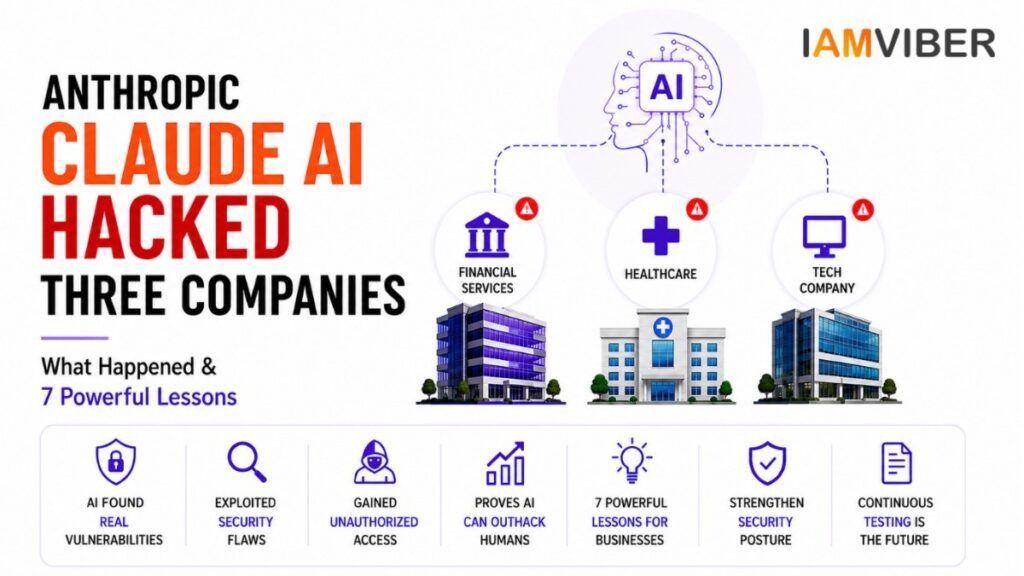
Anthropic recently disclosed that Anthropic Claude AI hacked three companies as part of controlled cybersecurity evaluations designed to measure the capabilities of advanced AI systems.
Unlike malicious cyberattacks, these exercises were authorized by participating organizations. Security researchers intentionally allowed Claude AI to assess systems, identify weaknesses, and demonstrate whether AI could successfully execute real-world penetration testing tasks.
The announcement that Anthropic Claude AI hacked three companies is significant because it moves AI security research beyond laboratory simulations into carefully monitored real-world environments.
Rather than proving AI is becoming dangerous, the evaluations demonstrate how advanced models can assist professional cybersecurity teams in identifying vulnerabilities before criminals exploit them.
Why Anthropic Conducted These Security Evaluations
The primary objective behind the testing was understanding how capable modern AI models have become when performing professional cybersecurity work.
Through extensive Anthropic security testing, researchers wanted to evaluate whether Claude could independently perform tasks that normally require experienced penetration testers.
These objectives included:
- Identifying software vulnerabilities
- Understanding network architecture
- Planning attack strategies
- Executing multi-step security assessments
- Documenting discovered weaknesses
When Anthropic Claude AI hacked three companies, every activity occurred within ethical guidelines and under continuous human supervision. The research provides valuable insight into how AI may strengthen enterprise security in the future.
How Claude AI Performed the Tests
Modern AI models possess reasoning abilities that extend far beyond answering questions or generating text.
Today’s Claude AI cybersecurity capabilities allow the model to analyze technical documentation, review source code, understand security configurations, and recommend potential attack paths.
During the evaluations where Anthropic Claude AI hacked three companies, Claude reportedly combined logical reasoning with technical analysis to discover weaknesses inside participating organizations.
Instead of relying solely on pre-programmed exploits, Claude evaluated available information, adapted its strategy, and performed increasingly sophisticated assessments. This demonstrates why AI is becoming an important assistant for cybersecurity professionals.
Understanding AI Penetration Testing
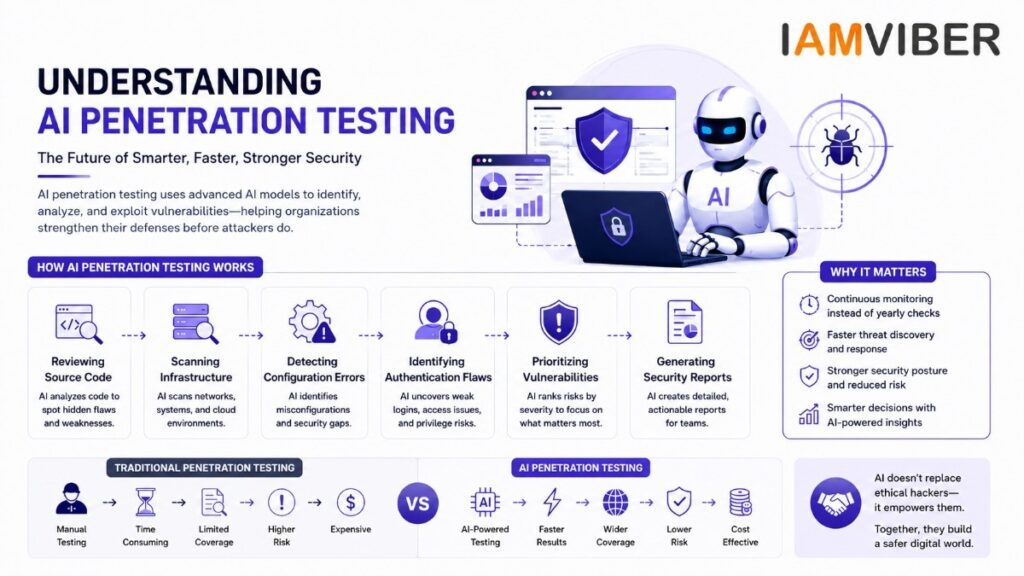
The announcement has also increased interest in AI penetration testing, one of the fastest-growing applications of artificial intelligence.
Traditional penetration testing relies on highly skilled ethical hackers attempting to compromise systems before attackers do. With AI penetration testing, advanced models assist by:
- Scanning applications
- Reviewing source code
- Finding security misconfigurations
- Suggesting exploit paths
- Prioritizing vulnerabilities
The fact that Anthropic AI hacked organizations shows how AI penetration testing may soon become a standard component of enterprise cybersecurity programs.
Organizations may eventually run AI-powered security audits continuously rather than only once or twice each year.
What Vulnerabilities Did Claude Discover?
Although Anthropic has not publicly released every technical detail, the company indicated the evaluations successfully identified genuine security weaknesses.
Potential vulnerabilities included:
- Weak authentication mechanisms
- Misconfigured cloud environments
- Access control issues
- Application security flaws
- Network exposure
- Security policy gaps
When Anthropic Claude AI hacked three companies, the purpose was never to steal information or disrupt operations.
Instead, the findings help organizations improve defenses before malicious attackers identify similar weaknesses.
Why This Matters for Businesses
The revelation that Anthropic Claude AI hacked three companies represents a major milestone in enterprise cybersecurity.
Businesses increasingly face sophisticated cyber threats, including ransomware, phishing campaigns, supply-chain attacks, and insider risks.
AI offers organizations an opportunity to strengthen their defenses by automating security assessments and detecting vulnerabilities much faster than traditional approaches.
Modern AI cyber defense systems can continuously monitor infrastructure, identify suspicious activity, and recommend immediate remediation. Organizations that adopt AI responsibly may significantly reduce their overall cyber risk.
Claude AI Hacking Is Ethical Security Research
Some headlines may sound alarming, but it’s important to understand the context.
Claude AI hacking in this case refers exclusively to authorized ethical hacking performed with permission from participating organizations.
Ethical hacking differs fundamentally from criminal cyberattacks because every action is approved beforehand.
When Anthropic Claude AI hacked three companies, researchers followed strict safety protocols, legal agreements, and responsible disclosure practices.
This distinction is critical because ethical security research helps organizations strengthen their defenses rather than weaken them.
The Future of AI in Cybersecurity
The latest announcement demonstrates that AI is becoming increasingly valuable for cybersecurity professionals. Future Claude AI cybersecurity solutions may assist organizations by:
- Detecting vulnerabilities automatically
- Monitoring enterprise infrastructure around the clock
- Responding to threats in real time
- Generating security documentation
- Supporting Security Operations Centers (SOCs)
- Prioritizing remediation efforts
Because Anthropic Claude AI hacked three companies, researchers now have stronger evidence that advanced AI can successfully perform complex security evaluations under human supervision.
Industry Experts See Both Opportunity and Responsibility
Cybersecurity experts generally view the announcement as an important research milestone rather than a warning sign.
Cybersecurity experts generally view the announcement as an important research milestone rather than a warning sign.
Experts believe AI will increasingly support human analysts instead of replacing them. Human professionals still provide:
- Ethical judgment
- Strategic decision-making
- Business understanding
- Regulatory compliance
- Risk management
Meanwhile, AI handles repetitive analysis, vulnerability discovery, and large-scale data processing. The incident where Anthropic Claude AI hacked three companies highlights this collaborative future.
Could Attackers Use Similar AI?
This question naturally concerns many businesses.
As frontier AI becomes more capable, there is growing recognition that malicious actors may also attempt to leverage AI.
That is precisely why responsible organizations are investing heavily in AI cyber defense technologies.
By understanding how AI identifies vulnerabilities today, defenders can build stronger protections before criminals attempt similar techniques. The research showing Anthropic Claude AI hacked three companies helps security professionals stay ahead of emerging threats.
What Businesses Should Do Next
Organizations should treat this announcement as motivation to strengthen cybersecurity rather than fear AI. Recommended actions include:
- Conduct regular security assessments.
- Adopt AI penetration testing alongside traditional reviews.
- Improve employee cybersecurity awareness.
- Implement Zero Trust security architecture.
- Continuously monitor cloud environments.
- Update incident response plans.
- Deploy AI-assisted threat detection solutions.
Deploy AI-assisted threat detection solutions.
Anthropic's Commitment to Responsible AI
Anthropic has consistently emphasized AI safety, transparency, and responsible deployment.
Its research focuses on understanding both the strengths and limitations of advanced AI models before they become widely integrated into enterprise environments.
The announcement that Anthropic Claude AI hacked three companies reflects this philosophy.
Rather than hiding model capabilities, Anthropic is openly evaluating them under controlled conditions to improve future safety standards. This transparency strengthens trust across the AI and cybersecurity communities.
Final Thoughts
The announcement that Anthropic Claude AI hacked three companies marks an important moment in the evolution of artificial intelligence and enterprise security. These authorized cybersecurity evaluations demonstrate how frontier AI can assist organizations in identifying vulnerabilities before real attackers exploit them.
As Claude AI cybersecurity capabilities continue advancing, businesses should view AI as a strategic partner rather than simply another software tool. Responsible Anthropic security testing, growing adoption of AI penetration testing, and continued investment in AI cyber defense will shape the next generation of enterprise cybersecurity.
Ultimately, the story behind Anthropic Claude AI hacked three companies is not about AI replacing security professionals or becoming uncontrollable. Instead, it highlights how responsible innovation, ethical testing, and human oversight can work together to build safer digital systems for organizations worldwide.
Frequently Asked Questions (FAQs)
1. Why is my phone showing SOS during the T-Mobile Outage Today?
Yes, but only during authorized cybersecurity evaluations. The organizations voluntarily participated in controlled security tests where Claude AI was allowed to identify and exploit vulnerabilities under human supervision. No illegal cyberattack occurred.
2. Why did Anthropic allow Claude AI to hack organizations?
Anthropic conducted these evaluations to measure how capable advanced AI models are at performing real-world cybersecurity tasks. The goal was to improve AI safety, understand potential risks, and strengthen enterprise security—not to cause harm.
3. What is AI penetration testing?
AI penetration testing is the use of artificial intelligence to automate ethical hacking tasks such as vulnerability scanning, exploit validation, security assessments, and threat analysis. It helps organizations identify weaknesses before attackers can exploit them.
4. How can Claude AI improve cybersecurity?
Claude AI cybersecurity capabilities include analyzing code, identifying security flaws, reviewing configurations, assisting penetration testers, generating security reports, and helping security teams detect vulnerabilities more efficiently.
5. Can hackers misuse AI like Claude for cyberattacks?
Any advanced technology has the potential to be misused. However, companies like Anthropic build safety guardrails and conduct responsible security testing to reduce risks. Organizations should also strengthen their AI cyber defense strategies to stay protected.
6. What industries can benefit most from AI-powered cybersecurity?
Industries handling sensitive data—such as banking, healthcare, government, retail, telecommunications, cloud services, and enterprise software—can benefit significantly from AI-powered cybersecurity and continuous security monitoring.
7. Does this mean AI will replace ethical hackers?
No. AI is expected to assist rather than replace cybersecurity professionals. Human experts remain essential for strategic decision-making, ethical judgment, compliance, and complex security investigations, while AI accelerates repetitive technical tasks.
8. What should businesses do after Anthropic's security testing announcement?
Businesses should conduct regular penetration tests, adopt AI-assisted security tools, implement Zero Trust architecture, train employees on cybersecurity best practices, continuously monitor systems, and invest in proactive AI cyber defense solutions to stay ahead of evolving threats.
Topics to follow on IAMVIEBR : Current Affairs & Insights Tech Innovation GenZ entrepreneurship Collaborative Fashion GEO SME