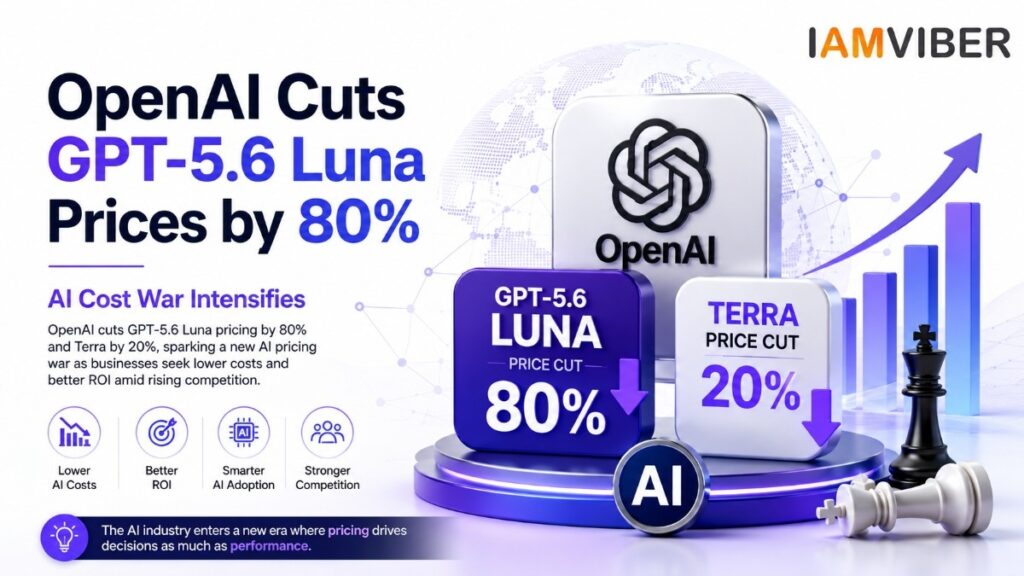
The OpenAI GPT-5.6 Luna Price Cut marks one of the biggest pricing changes the AI industry has seen this year. OpenAI has announced a massive reduction in pricing for its lightweight GPT-5.6 Luna model, cutting costs by 80%, while also reducing the price of its mid-tier Terra model by 20%. Meanwhile, the flagship Sol model continues to retain its premium pricing.
The OpenAI GPT-5.6 Luna Price Cut arrives at a time when businesses are carefully evaluating AI investments. Companies worldwide have rapidly adopted generative AI over the last few years, but many organizations are now questioning whether their AI spending is generating enough return on investment. Lower API costs could remove one of the biggest barriers preventing wider AI adoption.
The decision also reflects growing competition across the AI landscape. As Chinese AI companies continue launching lower-cost models, OpenAI is adjusting its OpenAI pricing strategy to remain competitive in an increasingly crowded market.
Why the OpenAI GPT-5.6 Luna Price Cut Matters
The OpenAI GPT-5.6 Luna Price Cut is about much more than cheaper API access. It signals a shift in how AI providers compete.
Until recently, AI companies focused primarily on releasing larger, more powerful models. Today, organizations are equally concerned about operating costs, scalability, and predictable pricing.
For startups, SaaS businesses, developers, and enterprise customers, lower AI costs directly improve profit margins.
The OpenAI’s GPT-5.6 Luna Price Cut makes advanced language models significantly more accessible for companies running customer support, document automation, AI chatbots, workflow automation, marketing tools, coding assistants, and knowledge management systems.
Businesses that previously limited AI usage because of costs may now expand deployments across multiple departments.
What Changed in OpenAI Pricing?
OpenAI announced three major pricing decisions.
- GPT-5.6 Luna pricing reduced by 80%
- OpenAI Terra pricing reduced by 20%
- Sol pricing remains unchanged
This new OpenAI pricing strategy positions GPT-5.6 Luna as the affordable model for high-volume workloads while maintaining Sol as the premium option for advanced reasoning tasks.
The move provides businesses with greater flexibility when choosing models based on cost and performance requirements.
The OpenAI’s GPT-5.6 Luna Price Cut is likely to encourage organizations to migrate workloads that do not require the highest-performing model.
Why Businesses Are Scrutinizing AI Spending
The rapid growth of Enterprise AI has led companies to invest billions of dollars in AI infrastructure. However, many executives are now asking important questions.
- Are AI deployments generating measurable ROI?
- Can operational costs be reduced?
- Which AI provider offers the best value?
- How can organizations optimize AI budgets?
The OpenAI GPT-5.6 Luna Price Cut directly addresses these concerns.
Instead of encouraging customers to spend more, OpenAI is helping businesses reduce infrastructure costs while continuing to adopt AI at scale. This is an important milestone in AI cost optimization.
Competition Is Driving AI Model Pricing Lower
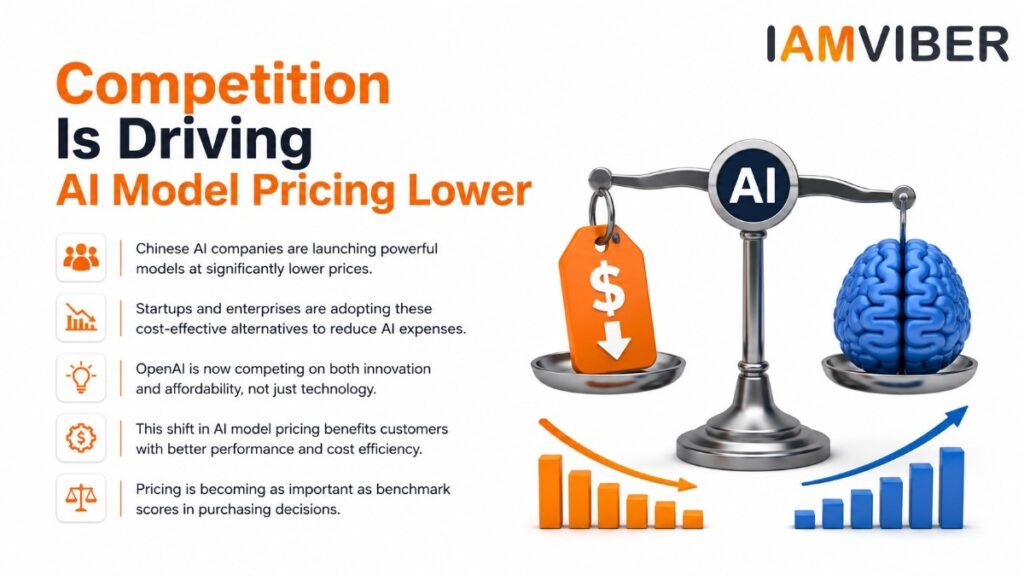
The OpenAI GPT-5.6 Luna Price Cut also reflects increasing competition across the global AI ecosystem.
Chinese AI companies have introduced several powerful language models at significantly lower prices than Western competitors.
These models have gained traction among startups and enterprises looking to reduce AI expenses.
Rather than relying solely on technological leadership, OpenAI is now competing on both innovation and affordability. This evolution in AI model pricing benefits customers because providers must continually improve both performance and cost efficiency.
The AI industry is entering a new phase where pricing will influence purchasing decisions almost as much as benchmark scores.
How the OpenAI GPT-5.6 Luna Price Cut Benefits Startups
For startups, infrastructure expenses often determine whether a product becomes profitable. The OpenAI GPT-5.6 Luna Price Cut could dramatically improve economics for AI-first companies. Benefits include:
- Lower API costs
- Improved profit margins
- More affordable customer support bots
- Reduced AI infrastructure expenses
- Faster product experimentation
- Greater scalability
Many startups previously limited AI features because API expenses increased alongside customer growth.
The new OpenAI pricing structure could eliminate this bottleneck. Companies can now process more AI requests while spending significantly less.
Enterprise AI Adoption Could Accelerate
Large organizations often process millions of AI requests every day. A significant reduction in AI model pricing can translate into millions of dollars in annual savings.
The OpenAI GPT-5.6 Luna Price Cut enables enterprises to:
- Expand AI assistants internally
- Automate repetitive workflows
- Improve customer service
- Analyze larger datasets
- Scale AI-powered applications
For many organizations, AI cost optimization is now a board-level priority. Lower pricing makes enterprise-wide deployment much easier.
Why OpenAI Terra Still Matters
Although much attention has focused on Luna, OpenAI Terra also received a meaningful 20% price reduction.
Terra sits between Luna and Sol, providing stronger capabilities while remaining more affordable than flagship models.
Organizations needing higher reasoning quality without premium pricing may increasingly adopt OpenAI Terra for production workloads. Together, Luna and Terra provide businesses with flexible pricing options depending on workload complexity.
The Future of AI Model Pricing
The OpenAI GPT-5.6 Luna Price Cut may represent the beginning of a broader pricing trend. As more AI companies enter the market, customers will expect:
- Lower costs
- Better efficiency
- Transparent billing
- Faster models
- Higher accuracy
Future competition may focus less on who has the smartest AI and more on who offers the best value.
This changing landscape could reshape the economics of Enterprise AI over the next several years. Businesses will increasingly compare providers based on both intelligence and affordability.
IAMVIBER Insight
The biggest takeaway from the OpenAI GPT-5.6 Luna Price Cut isn’t simply that prices are lower.
The real story is that AI has entered its efficiency era.
Over the past few years, the race centered on building the most capable AI models.
Today, organizations are asking a different question: Can AI deliver measurable business value at a sustainable cost?
The latest OpenAI pricing update suggests the company understands this shift. Lower pricing could encourage startups, enterprises, and developers to build larger AI-powered products while maintaining healthier margins.
At the same time, competitors will likely respond with additional price reductions, creating an even more competitive AI marketplace.
For businesses planning long-term AI investments, this is positive news.
Affordable AI means innovation becomes accessible to more companies, not just those with massive technology budgets.
The OpenAI GPT-5.6 Luna Price Cut could ultimately accelerate global AI adoption while setting a new benchmark for AI cost optimization and AI model pricing.
Conclusion
The OpenAI GPT-5.6 Luna Price Cut represents a major strategic move in the evolving AI industry. By reducing Luna pricing by 80% and lowering OpenAI Terra costs by 20%, OpenAI is responding directly to enterprise demand for affordable, scalable artificial intelligence.
As businesses continue evaluating AI investments, pricing will become just as important as performance. This latest update strengthens OpenAI’s position in the market while increasing pressure on competitors to offer better value.
For startups, developers, and Enterprise AI teams, lower costs create new opportunities to scale AI applications, improve profitability, and accelerate innovation.
If current trends continue, the OpenAI GPT-5.6 Luna Price Cut may be remembered as the moment the AI industry shifted from competing only on intelligence to competing on affordability, efficiency, and long-term business value.
Frequently Asked Questions (FAQs)
1. What is the OpenAI GPT-5.6 Luna Price Cut?
The OpenAI GPT-5.6 Luna Price Cut is OpenAI’s decision to reduce GPT-5.6 Luna API pricing by 80%, making the model significantly more affordable for developers and businesses.
2. Did OpenAI reduce pricing for other models?
Yes. Along with the OpenAI GPT-5.6 Luna Price Cut, OpenAI reduced OpenAI Terra pricing by 20%, while keeping Sol pricing unchanged.
3. Why is OpenAI reducing AI model pricing?
The move helps businesses lower AI costs, improves AI cost optimization, and strengthens OpenAI’s competitiveness against lower-priced global AI providers.
4. How does the OpenAI GPT-5.6 Luna Price Cut benefit businesses?
Businesses can reduce infrastructure expenses, improve ROI, expand Enterprise AI deployments, and scale AI-powered applications at a lower cost.
5. Could this trigger a wider AI pricing war?
Yes. Many industry analysts believe the OpenAI GPT-5.6 Luna Price Cut could encourage other AI providers to lower prices, making AI model pricing a key competitive factor.
Topics to follow on IAMVIEBR : Current Affairs & Insights Tech Innovation GenZ entrepreneurship Collaborative Fashion GEO SME