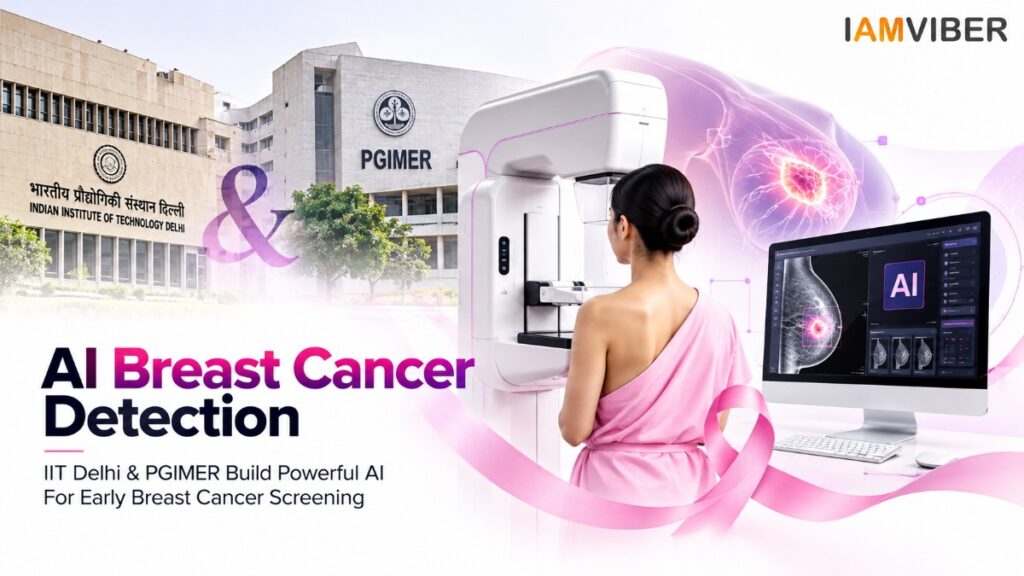
IIT Delhi & PGIMER Build AI for Breast Cancer Detection in Indian Women
IIT Delhi and PGIMER Chandigarh are working together on a new AI-powered technology designed to support early breast cancer detection in Indian women. The project aims to develop an indigenous diagnostic tool trained using data from Indian patients, rather than relying primarily on datasets representing Western populations.
The collaboration was reported on October 3, 2026, after doctors at PGIMER and researchers from IIT Delhi signed a memorandum of understanding. The technology is currently in the trial phase and is being developed around digital mammography, with plans to expand its capabilities to 3D breast imaging and ultrasound.
The development represents another significant step in AI breast cancer detection in India, particularly because breast imaging can present different challenges across populations.
Why India Needs Its Own AI for Breast Cancer Detection
Artificial intelligence is increasingly being explored as a supporting technology in medical imaging. However, the performance of an AI system can depend heavily on the data used to train and validate it.
The new AI breast cancer detection initiative by IIT Delhi and PGIMER focuses specifically on Indian patient data. According to PGIMER, the project is being developed using patient information covering different breast densities, with the aim of building a system more relevant to the Indian population.
This matters because breast cancer in Indian women can present at younger ages, while dense breast tissue can make conventional mammography more challenging to interpret. Prof. Veenu Singla of PGIMER’s Department of Radiodiagnosis and Imaging said these factors are among the reasons the team is working toward an India-specific approach.
The broader idea behind AI breast cancer detection is not to replace doctors. Instead, AI can potentially act as an additional layer of analysis, helping radiologists identify abnormalities that may require closer examination.
How the PGIMER and IIT Delhi AI Technology Works
The technology being developed for AI breast cancer detection is currently being tested with digital mammography.
The system uses a compact hardware setup connected to a computer. Mammography images can be processed and analysed digitally, with the AI designed to identify abnormalities that could indicate breast cancer.
The current project is not limited to one type of imaging. Researchers are also working toward expanding the system to interpret:
- Digital mammograms
- 3D breast scans, also known as tomosynthesis
- Ultrasound videos
- Breast-density variations
- Potential tissue abnormalities
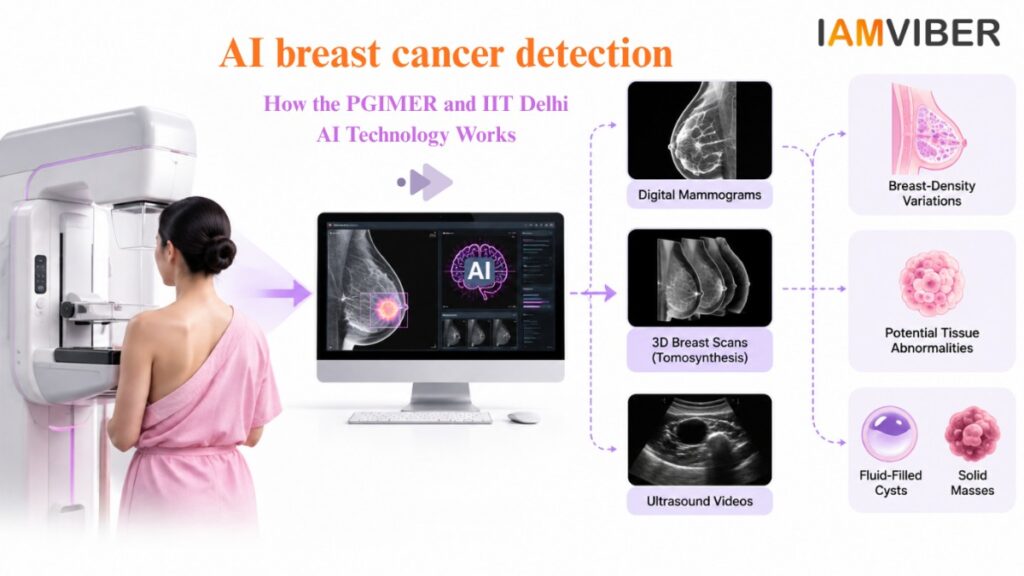
The ultrasound component could eventually analyse video in real time and help identify hidden abnormalities, including differentiating between fluid-filled cysts and solid masses.
This makes the project more ambitious than a simple image-classification system. The longer-term goal is to create a broader platform that can support doctors across multiple forms of breast imaging.
What Makes This AI Breast Cancer Detection Project Different?
One of the most important aspects of the project is its focus on Indian healthcare data.
Many medical AI systems are trained using datasets collected from particular hospitals, countries or demographic groups. When such systems are used in a different population, researchers need to establish whether their performance remains reliable.
The PGIMER-IIT Delhi project is attempting to address this challenge by using data from Indian patients during development.
That is the central idea behind AI breast cancer detection tailored to India: build technology around the imaging characteristics and clinical context of the population where it is intended to be used.
PGIMER is using its own patient data, including different breast-density categories, to help develop the system.
The approach also aligns with India’s wider push toward AI in healthcare India, where institutions are increasingly exploring artificial intelligence for screening, diagnosis, clinical decision support and healthcare delivery.
The Government of India has already supported AI-focused healthcare initiatives, including the IndiaAI Mission’s Cancer AI & Technology Challenge, which provides support for developing and validating AI solutions across the cancer-care continuum.
AI Breast Cancer Screening Could Support Radiologists
One of the most practical applications of AI breast cancer screening is providing doctors with an additional opinion when analysing medical images.
Breast imaging can sometimes contain subtle abnormalities that require careful interpretation. AI systems can potentially scan large volumes of images consistently and flag areas that deserve further review.
The PGIMER-IIT Delhi technology is being designed with this type of assistance in mind.
Rather than positioning AI breast cancer detection as an autonomous replacement for medical professionals, the project is aimed at providing an expert-support layer during diagnosis.
the technology could eventually help reduce false alarms and unnecessary needle biopsies by supporting more consistent interpretation. These potential benefits will depend on successful development, clinical validation and appropriate deployment.
That distinction is important.
The technology is still being developed and tested. It should therefore be viewed as an emerging research and healthcare technology rather than a proven standalone diagnostic solution.
The Role of IIT Delhi in AI Healthcare
The project also highlights how India’s leading technology and medical institutions are increasingly working together.
IIT Delhi has been involved in research around medical AI and cancer imaging. Its broader healthcare AI work has included collaborations involving medical institutions and efforts to develop technologies for early disease detection.
The IIT Delhi AI healthcare ecosystem is therefore becoming part of a larger movement in which engineering, computer science and medicine are being combined to solve clinical problems.
PGIMER brings clinical expertise and access to medical imaging data, while IIT Delhi contributes research and engineering capabilities.
This combination could become increasingly important as India attempts to build healthcare technologies specifically suited to its own population.
Could AI Make Breast Cancer Screening More Accessible in India?
Accessibility is one of the biggest potential advantages of AI breast cancer detection.
India has a large and diverse population, and access to specialist medical expertise can vary considerably between major cities and smaller healthcare centres.
If an AI system is successfully validated and eventually deployed at scale, it could potentially help healthcare centres analyse medical images more consistently.
For example, an AI-assisted workflow could allow a mammogram to be initially analysed by software before being reviewed by a qualified radiologist.
This does not eliminate the need for doctors. Instead, it could help prioritise cases, support reporting and potentially reduce workload.
The same principle is already being explored in other Indian healthcare AI initiatives. The IndiaAI-NCG Cancer AI & Technology Challenge, for example, is supporting multiple solutions across cancer screening, diagnostics and care.
From Mammography to Ultrasound
Another reason the PGIMER project is attracting attention is its planned expansion beyond mammography.
Traditional mammography remains an important tool for breast screening, but dense breast tissue can make interpretation more difficult.
The project is therefore exploring 3D tomosynthesis and ultrasound.
In the future, AI breast cancer detection systems that can work across multiple imaging modalities could give doctors a more comprehensive picture of suspicious areas.
The ultrasound component being developed by the team is intended to flag hidden tissue abnormalities in real time and help distinguish benign fluid-filled cysts from potentially dangerous tumours.
If successfully validated, such capabilities could make AI-assisted imaging more useful in clinical environments.
What Happens Next?
The most important stage now is validation.
The PGIMER-IIT Delhi project is still in the trial phase. Before AI breast cancer detection technology can become a widely deployed clinical tool, it would need rigorous testing to determine its accuracy, reliability and clinical usefulness across appropriate patient populations.
That means researchers will need to evaluate how the system performs across different breast densities, age groups, imaging conditions and clinical scenarios.
Data quality and privacy will also remain critical.
Healthcare AI depends on sensitive patient information, making responsible data handling, anonymisation, clinical oversight and regulatory compliance essential.
India’s national AI-health initiatives have also emphasised ethical and responsible use of health data, including safeguards, anonymisation and institutional oversight.
What This Means for the Future of AI in Indian Healthcare
The PGIMER-IIT Delhi partnership represents a broader shift in India’s approach to medical technology.
Instead of simply importing AI systems developed for other healthcare environments, Indian institutions are increasingly exploring technologies trained, tested and adapted around Indian clinical data.
That could become one of the most important trends in AI in healthcare India over the next few years.
The future of AI breast cancer detection may therefore not be about replacing radiologists. It could be about giving doctors better tools, helping them process large volumes of imaging data and providing additional support during difficult cases.
The technology still has a long road ahead before it can become a widely available clinical solution.
But the direction is significant: IIT Delhi’s engineering expertise and PGIMER’s clinical experience are being combined to develop an AI system specifically for Indian patients.
For a country with a huge and diverse healthcare system, locally developed medical AI could eventually play an important role in improving access to advanced diagnostic support.
The Bigger Picture
The most interesting part of this development is not simply that another medical AI system is being built.
It is that India is increasingly moving toward population-specific AI.
For AI breast cancer detection, that means developing technology with Indian clinical data, Indian healthcare challenges and Indian patients in mind.
If the technology successfully passes clinical validation, it could eventually become another tool available to radiologists and healthcare providers across India.
For now, the project remains an important research initiative — and a clear example of how India’s AI ecosystem is moving beyond chatbots and generative AI into high-impact areas such as medical imaging, cancer screening and clinical decision support.
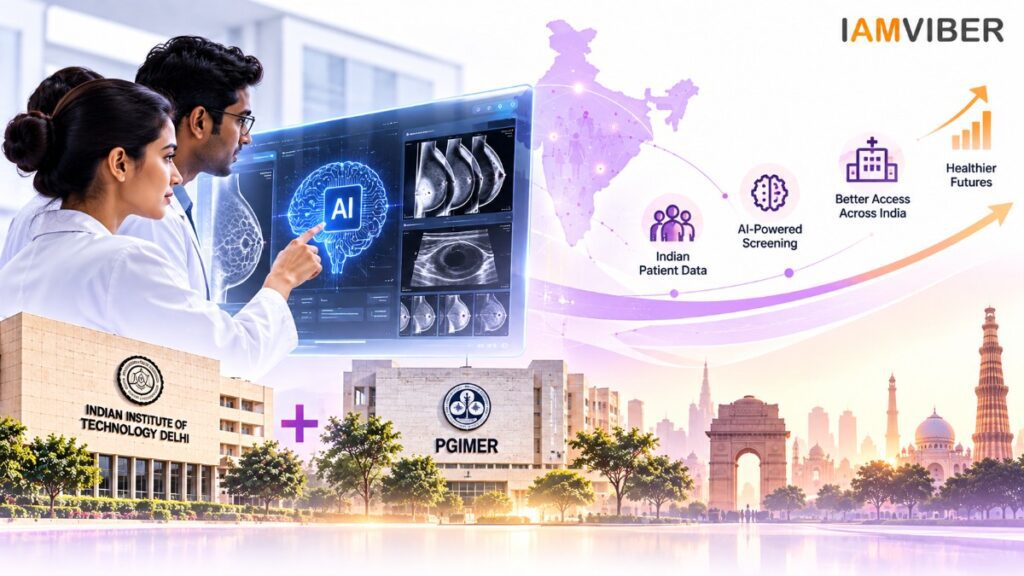
IIT Delhi + PGIMER + Indian patient data could be the beginning of a new chapter for AI-powered healthcare in India.
Frequently Asked Questions
1. What is AI breast cancer detection?
AI breast cancer detection uses artificial intelligence to analyse medical images such as mammograms and identify abnormalities that may require further examination by a qualified medical professional.
2. What is the IIT Delhi & PGIMER AI breast cancer detection project?
The IIT Delhi & PGIMER AI breast cancer detection project aims to develop an AI-powered tool that can support the early identification of breast cancer using medical imaging and Indian patient data.
3. Why is IIT Delhi & PGIMER AI breast cancer detection important for India?
The IIT Delhi & PGIMER AI breast cancer detection project focuses on Indian patient data, which could help researchers develop technology better suited to the imaging characteristics and healthcare requirements of the Indian population.
4. Can IIT Delhi & PGIMER AI breast cancer detection replace doctors?
No. IIT Delhi & PGIMER AI breast cancer detection is being developed as a diagnostic-support technology. Doctors and qualified radiologists would still be responsible for interpreting medical results and making clinical decisions.
5. Will IIT Delhi & PGIMER AI breast cancer detection work with ultrasound?
The IIT Delhi & PGIMER AI breast cancer detection project is planned to expand beyond digital mammography to explore 3D breast imaging and ultrasound, potentially allowing AI to analyse multiple types of breast imaging.
6. Is IIT Delhi & PGIMER AI breast cancer detection available in India?
The IIT Delhi & PGIMER AI breast cancer detection technology is currently in the development and trial stage. It is not yet a widely available standalone diagnostic solution across India.
7. How could IIT Delhi & PGIMER AI breast cancer detection help radiologists?
The IIT Delhi & PGIMER AI breast cancer detection system could potentially help radiologists analyse medical images, identify suspicious areas for further review and provide additional decision-support during breast cancer screening.
8. What is the future of IIT Delhi & PGIMER AI breast cancer detection?
The future of IIT Delhi & PGIMER AI breast cancer detection could involve combining AI with mammography, 3D imaging and ultrasound. Clinical validation, accuracy, data privacy and regulatory requirements will be important before wider adoption.