Enterprise AI is moving beyond chatbots and copilots. A new category is gaining attention: software designed to complete business processes rather than simply generate text.
Ema is one of the startups pushing that model forward, and its latest funding round has put AI employees at the center of the conversation.
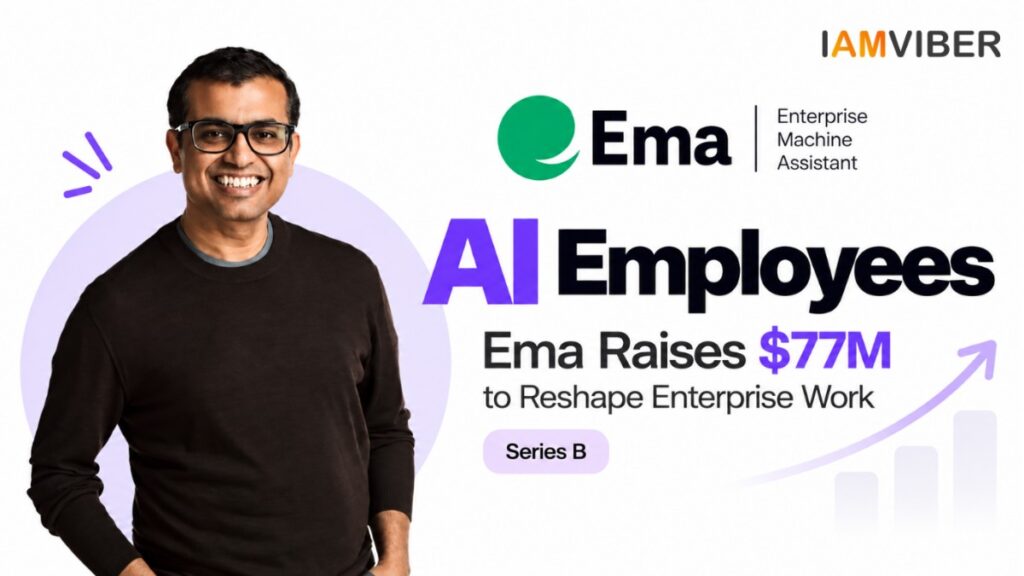
On September 23, 2026, Ema AI announced a $77 million Series B led by Creaegis, with existing investors Accel, S32 and Prosus also increasing their investments. The company said the round takes its total funding to $140 million and more than quadruples its valuation from its previous round.
The bigger story is not just another startup funding headline. It is the question of what happens when enterprise software stops being something employees operate manually and starts becoming something AI coordinates for them.
What Are AI Employees?
AI employees are software systems designed to perform work across business applications. Ema describes its platform as coordinated teams of AI agents that can handle multi-step processes across HR, IT and finance.
That is different from a typical chatbot. A chatbot can explain an IT process. An agentic system can potentially receive a request, plan several steps, use enterprise applications, execute the task and ask a human for approval when required. Ema positions its platform around this kind of workflow execution.
The rise of AI employees is therefore closely connected to the broader shift from generative AI assistants toward agentic AI: systems that can act, coordinate and complete work.
Why Ema Raised $77 Million
The Ema AI funding round arrives as enterprise customers are increasingly testing how AI can move from pilots into production.
According to Ema, the company has more than 50 active enterprise deals, more than 1 million active enterprise users, and has handled more than 5 million actions and queries. These figures are company-reported.
The funding will support go-to-market expansion, particularly sales and marketing, while Ema continues to develop its platform. Reports that the company has grown to nearly 200 employees and has offices in Bengaluru, London and Vancouver.
Ema’s own announcement describes the goal as putting AI employees to work inside real enterprise operations rather than keeping them at the pilot stage.
Ema AI Is Building a New Layer Between People and Software
The core idea behind Ema AI is not to force businesses to replace every application they already use.
Instead, the platform connects with existing enterprise tools and coordinates work across them. Ema says its technology can draw on more than 150 models, including frontier and open-source models, while focusing on domain knowledge, integrations and orchestration.
Imagine an HR onboarding process. One employee request might require checking an HR system, creating an account, sending information, updating records and escalating an exception. Traditional software provides the systems. An agentic layer attempts to coordinate the sequence.
This is why AI employees are different from simple productivity copilots. Their value proposition is tied to completing a workflow or business outcome, not just producing a response.
AI Employees vs AI Chatbots
The comparison matters because much of the public understanding of enterprise AI still comes from chat interfaces.
A chatbot is generally optimized around conversation. A copilot helps a person complete a task. Agentic systems aim to take a request and execute a chain of actions across software.
Ema’s reported customers include NTT DATA, Hitachi, ADP, PwC, Google, KPMG, Wipro and Microsoft. The company says more than 90% of its customers have expanded beyond their initial use case, with some deploying the platform across dozens of workflows.
The spread of AI employees into multiple workflows could therefore matter more than a flashy demo. It suggests enterprises are evaluating AI as an operational layer, not only as an assistant sitting beside an employee.
What Ema's Customers Are Doing With AI
The strongest part of the story is the scale of the deployments Ema says it is supporting.
Ema’s system at a large IT-services customer supports more than 240,000 employees across 65 countries and handles around 2.9 million employee queries annually, according to the company. The report also notes Ema’s named customers include Wipro, Hitachi, ADP and PwC.
Ema says its platform at NTT DATA handles more than 1 million IT service-management tickets and more than 1 million calls annually across more than 15 languages. Its public materials cite roughly 95% accuracy and fewer than 10% of interactions being escalated to a human. These are company-reported figures rather than independent benchmarks.
These examples show where AI employees are being positioned: support, HR operations, finance workflows and other repeatable processes where many systems have to work together.
Can AI Employees Replace SaaS?
This is one of the most provocative parts of the Ema story.
Ema CEO Surojit Chatterjee told that some customers are moving toward replacing large SaaS applications, arguing that certain products could increasingly function as databases while AI coordinates the work.
That should not be read as evidence that SaaS is disappearing immediately. It points to a possible change in where the user interface and business logic live.
For years, companies bought software for specific functions and trained employees to operate those tools. In an agentic model, an employee could increasingly describe an outcome while the AI layer handles the coordination across several systems.
Under that model, AI employees could become a new interface for enterprise software.
Why the $77M Funding Matters to Startup Founders
The Ema $77M funding is also a signal for founders building in enterprise AI.
Ema does not charge customers by traditional software seats or AI-token consumption. Instead, the company ties pricing to task completion and business outcomes.
That approach is notable because agentic software can potentially create value through completed work rather than the number of people logged into a platform.
Ema also said its revenue grew 50-fold over the past two years and that revenue bookings surpassed $150 million. The company clarified that bookings include the total value of multiyear contracts and are not the same as annual recurring revenue.For the startup market, the model points toward an important shift: enterprise AI may increasingly compete on tickets resolved, workflows completed, approvals processed and business tasks finished.
The Rise of AI Employees Comes With Risks
The opportunity also creates a new risk surface.
A system that drafts an email can be corrected easily. A system that changes an HR record, modifies access permissions or triggers a financial workflow needs much stronger controls.
Businesses need clear rules about which actions an AI can perform independently and which should require human approval. They also need audit trails, permissions, monitoring, evaluation and reliable escalation.
This means AI employees depend on much more than model quality. They require identity management, security, governance and predictable behavior across real enterprise systems.
What Ema Plans to Do Next
Ema says the new capital will be used to expand its go-to-market operations and continue developing its platform. The company also plans to expand beyond its current U.S. and European focus into markets including Asia-Pacific, South America and parts of the Middle East.
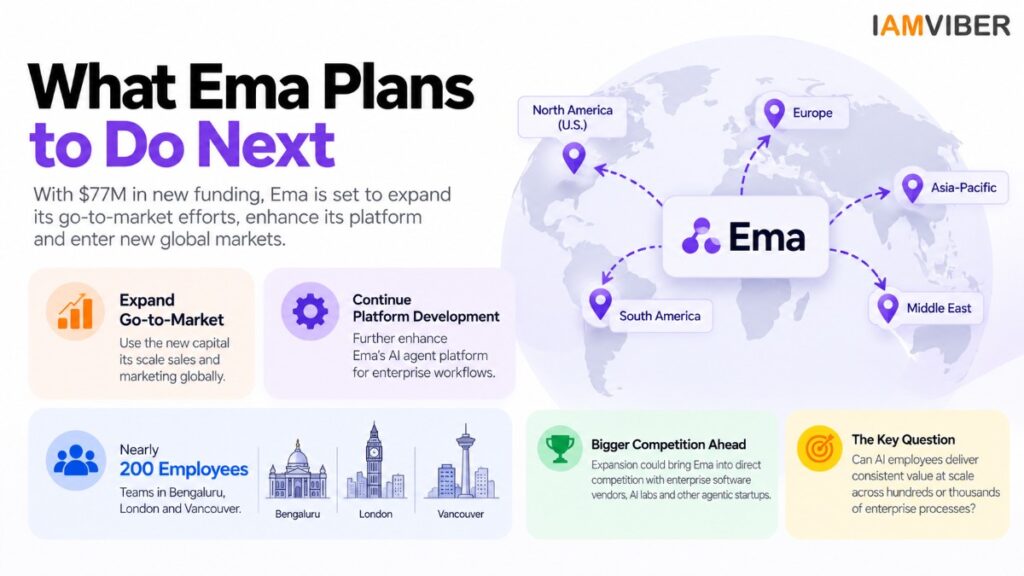
The company has nearly 200 employees and operates from Bengaluru, London and Vancouver, giving the startup a base for international expansion. TechCrunch
That expansion could bring Ema into more direct competition with enterprise software vendors, AI labs and other agentic startups.
The key question will be whether AI employees can deliver consistent value when they move from a handful of high-value workflows into hundreds or thousands of enterprise processes.
The Bigger Startup Trend
The phrase AI employees may sound like marketing language, but the underlying product category is becoming more concrete: software agents that can interact with existing applications, execute multi-step workflows and involve humans when decisions require approval.
Ema’s $77 million Series B brings its total funding to $140 million, giving the company more capital to scale this model.
The broader enterprise AI market is also moving in the same direction. Businesses are exploring systems that can do more than answer questions: they want automation that connects data, tools, permissions and actions into an end-to-end process.
That makes AI employees an important keyword not only for this Ema story, but for a much bigger conversation around the future of enterprise software.
What This Means for the Future of Work
For companies, the question is gradually changing from “Can AI answer this?” to “Can AI safely complete this?”
For founders, that creates opportunities in agent orchestration, enterprise integrations, governance, security and outcome-based pricing.
For workers, the rise of AI employees could change the shape of everyday work. Repetitive software interactions may be increasingly automated, while human roles could place more emphasis on supervision, exception handling, decision-making and accountability.
This is not a guarantee that AI will replace large numbers of jobs. It is a sign that the boundary between software and labor is being tested in new ways.
Final Takeaway
Ema’s $77 million Series B is more than a funding announcement. It is a current signal that enterprise AI is moving toward systems designed to perform work, not simply assist with it.
The next phase of AI employees will likely be judged by reliability, measurable business outcomes, security, governance and how well these systems fit into existing enterprise environments.
Ema has raised substantial capital to pursue that vision, and its growing set of enterprise deployments gives the company a meaningful platform to scale.
That is why AI employees are becoming one of the clearest signals of the shift from AI assistance to AI execution. The companies that can safely turn AI agents into useful digital workers may end up redefining how enterprise software is bought, used and measured.
Topics to follow on IAMVIEBR : AI & Tech, Startup, AI Creative, Agentic AI, Current Affairs & Insights, Collaboration