Claude AI India has taken an important step toward becoming a more enterprise-ready AI market.
Anthropic has enabled in-country inference for Claude in India through Amazon Bedrock, allowing requests sent through the India endpoint to be processed on servers located within India. The rollout covers Claude Opus 5, Claude Sonnet 5 and Claude Haiku 4.5.
On the surface, this may sound like another cloud infrastructure update.
But for Indian banks, government organisations, large enterprises and companies handling sensitive information, the change could be much bigger.
The key issue is where AI processing happens.
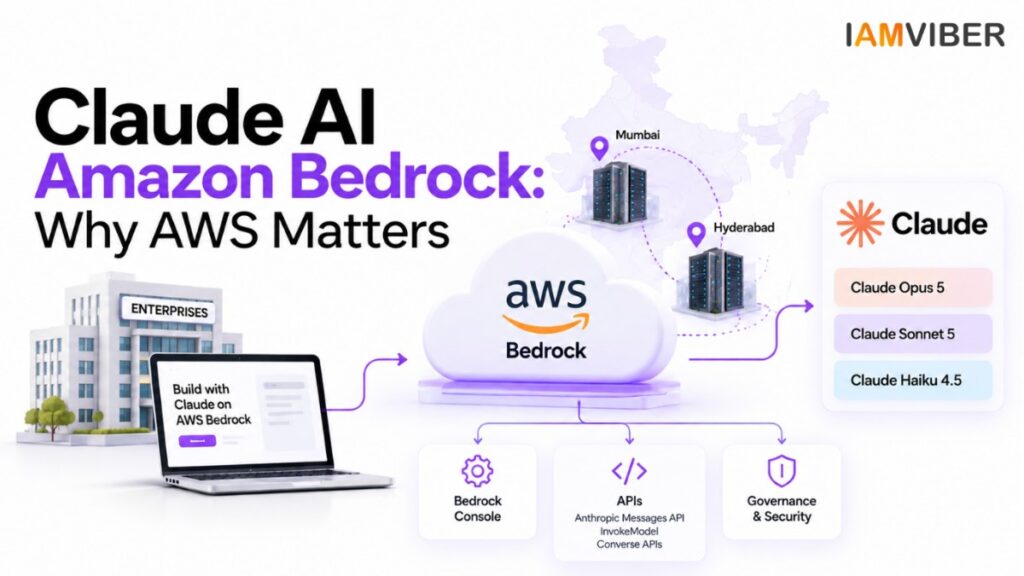
With the new India geographic inference capability, organisations can use Claude through Amazon Bedrock while keeping inference within AWS’s India Regions. AWS says the India endpoint uses geographic cross-Region inference involving its Mumbai and Hyderabad Regions.
That brings Claude closer to the requirements of enterprises that need stronger control over where their data is processed.
What Has Anthropic Changed?
Anthropic’s latest move makes Claude AI India available for in-country inference through Amazon Bedrock. In simple terms, when an organisation uses the India endpoint, the prompt and model response can be processed within India’s AWS infrastructure rather than being routed through a global inference setup.
AWS announced availability of Claude Opus 5, Claude Sonnet 5 and Claude Haiku 4.5 through its India geographic cross-Region inference capability.
The models can be accessed through Amazon Bedrock’s console as well as APIs, giving developers and enterprises multiple ways to integrate Claude into existing applications and workflows.
This distinction matters because Amazon Bedrock is already designed for enterprises that want to use foundation models while maintaining governance, security and operational controls within their cloud environment.
For companies that have been cautious about putting sensitive workloads into AI systems, Claude AI India can remove one of the major barriers to enterprise AI adoption.
Why Claude AI India Matters for Enterprises
The biggest opportunity isn’t necessarily individual consumers using Claude for everyday tasks.
It is enterprise AI.
Companies increasingly want AI systems that can work with internal documents, customer information, financial records, software repositories and operational data.
But highly regulated organisations cannot always treat data location as a secondary consideration. Banks, financial institutions, healthcare companies, government bodies and large enterprises may operate under strict internal and regulatory requirements around data handling.
This is where Claude AI India becomes particularly interesting for businesses operating in regulated industries.
By offering an India-specific inference option, Anthropic is giving enterprises another path to deploy advanced AI while meeting requirements around local processing.
Business Standard reported that the India deployment comes with the kinds of audit trails and access controls that risk and compliance teams look for when deploying AI in production.
The result could be a significant reduction in friction for companies evaluating Claude for sensitive workloads.
Data Residency Is Becoming an AI Buying Decision
For years, companies choosing an AI model mainly looked at factors such as:
- Model intelligence
- Accuracy
- Speed
- Cost
- Context window
- API capabilities
Now another factor is becoming increasingly important:
Where is my data being processed?
That question becomes especially important when AI is connected to enterprise systems.
Imagine a bank using an AI assistant to analyse internal documents. Or an insurance company using AI to process customer cases. Or a technology company giving an AI coding agent access to proprietary software repositories.
In all these scenarios, organisations need more than an intelligent model.
They need governance.
This is why Claude AI India and data residency could become increasingly important considerations for enterprise AI buyers.
But keeping inference within the desired geography can make those conversations considerably easier.
Which Claude Models Are Available in India?
The current Claude AI India rollout includes three Claude models:
Claude Opus 5
Claude Opus 5 is positioned as Anthropic’s high-end model for complex workloads.
For enterprises evaluating Claude AI India, Opus 5 can be relevant for complex reasoning, research and advanced software development.
Claude Sonnet 5
Sonnet sits closer to the balance between capability, speed and cost.
That makes it particularly relevant for organisations looking to deploy AI across larger numbers of employees or customer-facing workflows.
For organisations looking at Claude AI India for broader workplace deployment, Sonnet 5 offers a balance between capability, speed and cost.
Claude Haiku 4.5
Haiku is designed for faster and more lightweight workloads.
For businesses running high-volume AI applications, speed and cost efficiency can be just as important as maximum model capability.
All three are now available through Amazon Bedrock’s India geographic inference capability.
For high-volume applications, Claude AI India through Haiku 4.5 could be particularly relevant where speed and efficiency matter.
Claude AI Amazon Bedrock: Why AWS Matters
Anthropic isn’t bringing this capability to India in isolation.
AWS is an important part of the story.
Amazon Bedrock gives enterprises a unified environment through which they can access and deploy foundation models while using AWS infrastructure and governance capabilities.
For companies already running workloads on AWS, integrating Claude can therefore become easier than adopting an entirely separate AI infrastructure stack.
AWS says developers can access the India inference profiles through the Bedrock console and programmatically through APIs including the Anthropic Messages API, InvokeModel and Converse APIs.Developers exploring Claude AI India can access the models through Amazon Bedrock’s console and APIs.
This makes the announcement relevant not only to CIOs and compliance teams, but also to developers building production AI applications.
The combination of Claude and AWS infrastructure makes Claude AI India particularly relevant for companies already operating on Amazon Web Services.
India Is Already a Major Claude Market
India’s growing adoption makes Claude AI India more than just another regional AI availability announcement.
According to Anthropic India managing director Irina Ghose, India is the company’s second-largest market for Claude.ai. Software development accounts for 45.2% of work-related tasks that users bring to Claude in India, according to data shared with The Times of India.
That tells us something important. Indian users aren’t simply experimenting with AI.
A significant amount of usage is connected to actual work, particularly software development.
The increasing professional use of Claude creates a strong foundation for Claude AI India to move from individual productivity into enterprise deployment.
Could This Accelerate Enterprise AI Adoption?
Potentially, yes.
One of the biggest barriers to enterprise AI adoption isn’t always whether a model is capable enough.
Sometimes the question is whether the organisation is comfortable deploying it.
Companies may have concerns around:
Data → Compliance → Security → Governance → Infrastructure
If one of those areas creates significant risk, an AI project can remain stuck in experimentation.
In-country inference addresses one important part of that equation.
It can give organisations greater confidence that their AI workloads are being processed within a specified geography.
That could encourage more companies to move AI projects from proof-of-concept stages into production.
What It Means for India's AI Ecosystem
The announcement also reflects a broader trend.
Global AI companies are increasingly treating India as an infrastructure and enterprise AI market rather than simply a large consumer market.
That distinction matters.
The first phase of India’s AI growth was largely about access.
People started using ChatGPT, Claude, Gemini and other AI tools.
The next phase is likely to be about deployment. Businesses will embed AI into:
- Customer support
- Software development
- Financial analysis
- Internal knowledge management
- Research
- Sales
- Marketing
- Operations
- Cybersecurity
- Enterprise automation
For these use cases, infrastructure and governance become just as important as model intelligence.
Claude AI India therefore isn’t simply a story about another AI model becoming available locally.
It is a story about the infrastructure required to make advanced AI usable at enterprise scale.
What Should Indian Businesses Pay Attention To?

Businesses considering Claude should look beyond the headline. The important questions are:
1. Where is the AI workload processed?
The India inference option is designed to keep processing within India’s AWS Regions.
2. What type of data will the model receive?
Not every enterprise workload should automatically be sent to an AI model. Data classification and governance remain essential.
3. What compliance requirements apply?
Different industries have different obligations. Local inference can help with geographic processing requirements, but organisations still need to conduct their own compliance assessment.
4. Which model is appropriate?
Opus, Sonnet and Haiku serve different performance and cost requirements.
5. How will AI integrate with existing systems?
The real value comes when AI becomes part of workflows rather than remaining a standalone chatbot.
The Bigger Picture
The bigger story behind Claude AI India is not simply that Claude is being processed locally.
It is that AI infrastructure is becoming increasingly regional.
As AI moves deeper into banking, healthcare, government, technology and enterprise operations, companies will care more about where their AI runs, how it is governed and how sensitive information is handled. As enterprise AI adoption grows, Claude AI India demonstrates why infrastructure and localisation are becoming important competitive factors.
That is likely to influence which AI models enterprises choose. The winning AI platforms may therefore not be determined only by who has the smartest model. They may also be determined by who can provide the right combination of:
Intelligence + Infrastructure + Security + Governance + Localisation.
Anthropic’s India rollout puts Claude closer to that equation.
And for Indian enterprises, that could be more important than another incremental improvement in chatbot performance.
What Happens Next?
ndia’s enterprise AI market is entering a more mature phase. The question is shifting from:
“Can we use AI?”
to:
“Can we deploy AI safely at scale?”
Anthropic’s India inference rollout is an answer to part of that question.
With Claude Opus 5, Sonnet 5 and Haiku 4.5 available through Amazon Bedrock’s India infrastructure, organisations now have another option for building AI applications while keeping inference within the country.
For developers, it opens another infrastructure path.
For enterprises, it can reduce concerns around geographic processing.
And for India’s broader AI ecosystem, it is another sign that the country is becoming an increasingly important market for advanced enterprise AI.
The next big question isn’t whether AI will enter Indian enterprises. It is how deeply it will become embedded in them.
Frequently Asked Questions
1. What is Claude AI India?
Claude AI India refers to Anthropic’s Claude AI availability and infrastructure for users and businesses in India. The latest development enables in-country inference through Amazon Bedrock, allowing supported Claude requests to be processed within India’s AWS infrastructure.
2. What does Anthropic's Claude AI India announcement mean?
The announcement means Indian enterprises can access supported Claude models through Amazon Bedrock with inference processed within India’s AWS Regions. This is particularly relevant for organisations with data residency, security and compliance requirements.
3. Which Claude models are available for in-country inference in India?
The current rollout includes Claude Opus 5, Claude Sonnet 5 and Claude Haiku 4.5 through Amazon Bedrock’s India geographic inference capability.
4. What is Claude AI Amazon Bedrock?
Claude AI Amazon Bedrock refers to accessing Anthropic’s Claude models through Amazon Web Services’ Amazon Bedrock platform. It allows developers and enterprises to integrate Claude into applications using AWS infrastructure, APIs and enterprise controls.
5. Why is Claude AI data residency important for Indian businesses?
Claude AI data residency is important because some organisations have requirements around where sensitive information is processed. In-country inference can help businesses keep supported AI processing within India’s AWS infrastructure while evaluating their broader compliance requirements.
6. Can Indian enterprises use Claude for sensitive business workloads?
Yes, enterprises can use Claude for various business applications, but they should first evaluate their data classification, security policies, contractual requirements and applicable regulations. In-country inference can address the geographic processing aspect, but it does not automatically make every workload compliant.
7. Is Claude AI available only in India now?
No. India is an additional geographic inference option. Claude continues to be available through other supported Amazon Bedrock inference configurations and regions.
8. Why is Anthropic expanding Claude's infrastructure in India?
India is an increasingly important AI market, with significant Claude usage across software development and other professional workflows. Expanding local inference can make Claude more attractive to Indian enterprises that need advanced AI combined with stronger geographic processing controls.