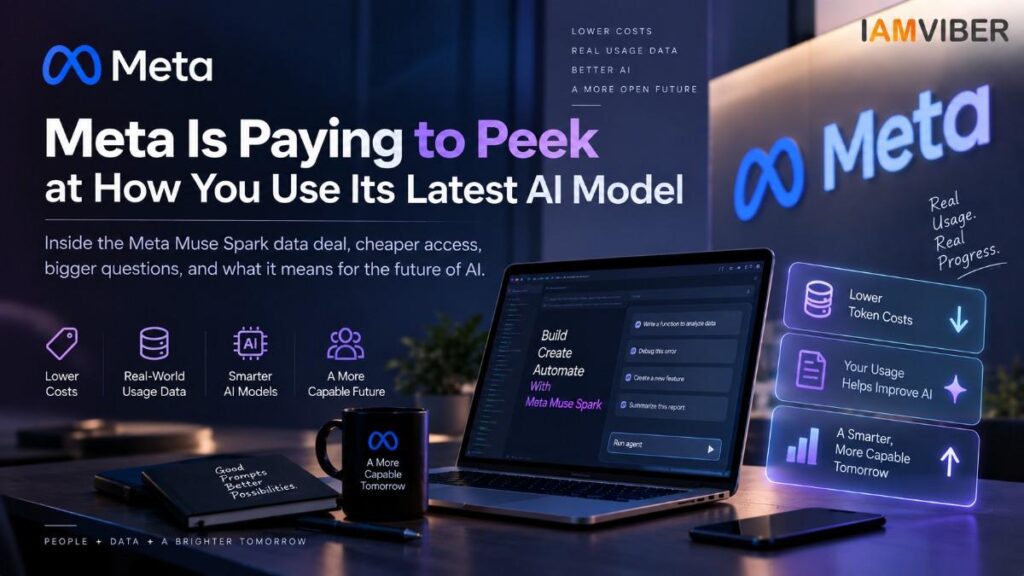
What if an AI company offered you a much cheaper AI model—but only if you agreed to let it learn from the way you use that model?
That is essentially the idea behind Meta’s latest move with Meta Muse Spark, a new AI model designed for coding and other AI agents. Instead of simply asking users to share their data for free, Meta is offering significantly lower prices to organizations that agree to contribute their prompts and model outputs to help improve future AI systems.
The numbers are hard to ignore.
Under Meta’s standard pricing, one million input tokens cost $1.25, while the contributor pricing brings that down to just $0.10. Output tokens drop from $4.25 per million to $0.20. That’s roughly a 95% discount for customers willing to participate in the data-sharing program.
So, is Meta really paying people to spy on how they use AI?
Not exactly.
It’s actually a clever exchange: cheaper AI access in return for useful real-world usage data.
And Meta Muse Spark sits right at the center of that experiment.
What Is Meta Muse Spark?
Meta Muse Spark is a new AI model from Meta designed primarily for operating coding agents and other agentic AI systems.
That’s important because AI development is moving beyond simple chatbots.
Today’s most interesting AI systems aren’t only answering questions. They are increasingly being asked to write code, interact with software, browse the web, operate tools, and complete multi-step tasks.
Meta’s own AI platform describes its newer systems as capable of answering questions and completing tasks such as research reports and other workflows.
Meta Muse Spark is aimed at this more action-oriented side of AI.
Instead of simply generating a paragraph of text, the model can be used as part of systems that actually perform work.
That makes real-world usage data extremely valuable.
Why Does Meta Want to See How People Use AI?
This is where the story gets interesting.
AI models can look impressive in demonstrations, benchmarks and controlled tests. But developers eventually need to know something much more practical:
How do people actually use these models when nobody is telling them what to do?
A developer might ask an AI coding agent to build a feature.
Another might use it to debug a complicated application.
Someone else might ask it to refactor an old codebase.
Another user might give it a completely unexpected task.
These real interactions reveal where an AI model succeeds, where it fails, and where it needs improvement.
For Meta Muse Spark, this kind of information could be especially useful because agentic systems behave differently from traditional chatbots.
The model isn’t simply producing an answer.
It may be participating in a longer sequence of actions.
Meta Is Offering a Huge Discount for Data
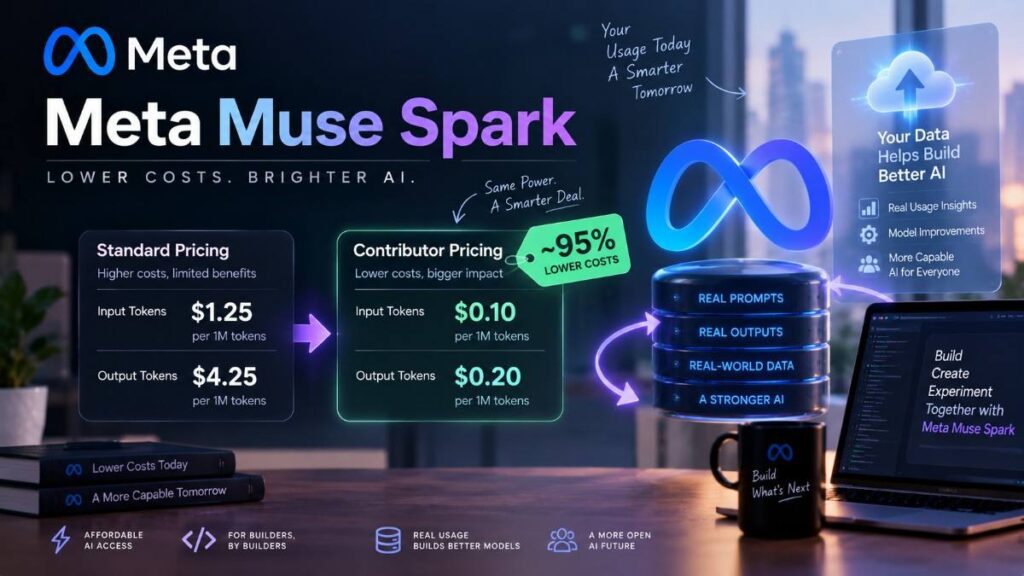
The most eye-catching part of the Meta Muse Spark announcement is the pricing difference.
Under the contributor model, one million input tokens cost only 10 cents compared with $1.25 under the standard agreement.
For output, the contributor price is 20 cents per million tokens compared with $4.25 normally.
That’s an enormous difference.
For companies experimenting heavily with AI, token costs can add up quickly.
An organization running thousands of coding-agent sessions could potentially save a significant amount of money.
For Meta, however, the value isn’t just the revenue from selling tokens.
The company gets something potentially more valuable: real-world training and evaluation data.
That’s why this pricing strategy is so interesting.
Meta is effectively saying:
If you’re willing to help us improve future models with your usage data, we’ll make today’s model much cheaper.
It’s a very different way of thinking about the relationship between an AI company and its customers.
What Kind of Data Is Meta Getting?
The contributor model involves sharing prompts and model outputs with Meta so that the information can contribute to future model development.
That could include the instructions developers give to the AI and the responses generated by the system.
For Meta Muse Spark, that information could reveal how developers actually interact with coding agents.
For example, a company might discover that its AI agent consistently struggles with a particular type of codebase.
Another organization might repeatedly use the model for tasks the creators didn’t initially anticipate.
Those interactions can become valuable feedback.
The important distinction, however, is that companies need to understand exactly what they are agreeing to share before choosing the discounted pricing option.
Why AI Training Data Has Become So Valuable
Modern AI companies are facing a growing problem.
The models are getting better, but high-quality data for improving them is becoming harder to obtain.
Public internet data can help build general-purpose models, but it doesn’t necessarily show how people use AI in real professional environments.
That’s where Meta Muse Spark becomes interesting.
A coding agent’s real-world session can contain a huge amount of information about what developers actually need from AI.
It can reveal common mistakes.
It can reveal successful workflows.
It can reveal where an agent gets stuck.
It can show which instructions produce useful results.
And it can expose edge cases that traditional benchmarks might never capture.
For an AI company, that information can be incredibly valuable.
Meta Has Already Learned That AI Data Collection Can Be Sensitive
The company’s latest pricing strategy comes after a difficult experience with internal AI usage tracking.
Earlier this year, Meta introduced an initiative that involved tracking how employees used computer systems and AI tools. The effort attracted criticism and was later paused.
That background makes the Meta Muse Spark strategy even more interesting.
Instead of forcing people to provide data, Meta is creating a financial incentive.
Users can choose whether the cheaper contributor pricing is worth giving Meta access to their prompts and outputs.
From Meta’s perspective, this could be a more practical way to collect useful data.
From a customer’s perspective, however, the calculation is different.
Is the discount worth sharing your AI interactions?
That depends heavily on what you’re using the model for.
The Privacy Question Is the Biggest Issue
The phrase “paying to peek” sounds dramatic, but the real issue is transparency.
If a company uses Meta Muse Spark for harmless experimentation, the trade-off may seem reasonable.
Imagine a developer testing an open-source project.
A 95% discount could make experimentation dramatically cheaper.
But imagine a company using an AI agent to work with confidential source code.
Suddenly, the decision becomes much more complicated.
Businesses have to consider intellectual property, customer information, security policies, compliance requirements and internal data governance.
This is one reason enterprise AI contracts often place significant emphasis on data retention and training policies.
The cheaper option isn’t automatically the better option.
Why Coding Agents Need This Kind of Data
Coding agents are still developing rapidly.
Unlike a basic chatbot, an AI coding agent may interact with a repository, inspect files, make changes, run tests, interpret errors and continue working.
That means a single session can contain a much richer picture of how AI performs in real software-development environments.
Meta Muse Spark is specifically aimed at this type of agentic use.
And that makes the data generated through these interactions particularly useful for improving future models.
The AI industry has increasingly realized that benchmarks alone aren’t enough.
A model might score extremely well on a coding benchmark but behave differently when confronted with a messy production codebase.
Real users provide that messy reality.
Could This Make AI Models Better?
Potentially, yes.
More real-world data can help developers identify weaknesses that aren’t obvious in controlled evaluations.
With enough useful examples, researchers can improve model behavior, tool use and reliability.
This could be particularly important for AI coding agents, where small mistakes can cause an entire workflow to fail.
For Meta Muse Spark, the contributor program could therefore serve two purposes.
First, it can encourage more developers to experiment with the model because the price is dramatically lower.
Second, those experiments can produce feedback that Meta can potentially use when developing future AI models.
It’s essentially a feedback loop.
More users create more interactions.
More interactions create more data.
More data can potentially lead to better models.
Better models attract more users.
And the cycle continues.
Is Meta Actually Paying Users?
This is where the headline needs a little clarification.
Meta isn’t simply sending users a cheque for chatting with Meta Muse Spark.
Instead, the company is offering a large pricing discount to customers who agree to contribute their prompts and model outputs.
So “paying to peek” is better understood as a catchy way of describing the economic trade-off.
You’re not necessarily receiving money. You’re potentially saving money.
In return, Meta gets access to usage data that can help it improve future models.
That distinction matters because the actual business model is closer to discounted AI in exchange for data.
How Does This Fit Into Meta's Larger AI Strategy?
The move makes sense when you look at Meta’s broader AI ambitions.
Meta has been rapidly expanding its AI portfolio.
Its current AI platform includes models and products for text, coding, image generation, video generation and agentic tasks. The company has also been releasing new versions of Muse Spark and other Muse models throughout 2026.
Earlier this year, Meta introduced Muse Image, its first image-generation model from Meta Superintelligence Labs, bringing advanced image creation and editing capabilities into Meta AI.
The broader strategy is clear.
Meta doesn’t want AI to be just a chatbot.
It wants AI systems that can create, reason and act. And models such as Meta Muse Spark are part of that transition.
Why This Could Become a Bigger Industry Trend
Meta’s approach could influence the wider AI market.
AI companies need two things:
Compute is expensive.
High-quality real-world data can be difficult to obtain.
If companies can convince users to voluntarily contribute useful data by offering cheaper access, they may have found a new way to balance those challenges.
We could eventually see more AI providers offering different pricing tiers based not only on model capability but also on data-sharing preferences.
One plan could provide stronger privacy.
Another could offer cheaper inference in exchange for allowing the provider to use interactions for model improvement.
That would make data-sharing a more visible part of AI pricing.
What Should Businesses Consider Before Choosing the Discount?
For businesses considering Meta Muse Spark, the most important question shouldn’t simply be:
“How much money can we save?”
It should be:
“What exactly are we giving up in exchange for that saving?”
Companies should carefully review the applicable data-use terms, determine what information their AI workflows contain, and make sure employees don’t accidentally send confidential information into a contributor environment.
A company working with public code has a very different risk profile from a company processing sensitive customer or proprietary information.
The discount may be attractive. But data governance should come first.
The Bigger Story Behind Meta Muse Spark
The fascinating thing about Meta Muse Spark isn’t just that it is another AI model.
It’s that Meta is experimenting with a new relationship between AI providers and users.
For years, consumers have often given technology companies data in exchange for free or cheaper services.
Now, that idea is moving directly into the AI model market.
Instead of simply saying, “Help us improve our AI,” Meta is putting a price on that contribution.
And the price difference is significant.
A roughly 95% discount is large enough to make some developers and businesses seriously consider participating.
But it also raises an uncomfortable question:
How valuable is your AI usage data?
Meta’s pricing strategy suggests the answer may be: quite valuable.
Final Thoughts
Meta Muse Spark shows that the AI race isn’t only about building smarter models.
It’s also about collecting better feedback, understanding real-world usage and finding sustainable ways to improve future systems.
Meta is offering customers dramatically cheaper access to Meta Muse Spark if they agree to contribute prompts and outputs that can help develop future models.
For developers, the discount could make experimentation much cheaper.
For Meta, the resulting AI training data could provide valuable insight into how coding agents behave in real-world situations.
For businesses, however, the decision requires more thought.
Saving 95% on AI costs sounds fantastic—until the data you’re sending through that AI turns out to be worth far more than the money you saved.
That’s ultimately what makes Meta Muse Spark so interesting.
The model itself is only half the story.
The other half is the data generated by the people using it.
And Meta is betting that enough users will decide that the discount is worth the trade.
Frequently Asked Questions
1. What is Meta Muse Spark?
Meta Muse Spark is Meta’s AI model designed to support advanced tasks, especially AI coding agents and other agentic workflows.
2. Why is Meta offering discounts for Meta Muse Spark?
Meta is offering major discounts to users who agree to contribute prompts and model outputs, giving Meta valuable real-world usage data to improve future AI models.
3. How much cheaper is Meta Muse Spark for contributors?
Contributor pricing can be dramatically lower than standard pricing, with Meta offering discounts of roughly 95% on input and output tokens.
4. What kind of data does Meta Muse Spark collect from users?
The program can involve sharing prompts and model outputs with Meta, allowing the company to study how people actually use the model and improve future AI systems.
5. Is Meta Muse Spark mainly designed for coding?
Meta Muse Spark is particularly aimed at operating coding agents, but its capabilities can also support broader AI agent workflows and complex tasks.
6. Does Meta Muse Spark raise privacy concerns?
Yes. Because the discount is connected to contributing prompts and outputs, users and businesses should carefully understand what data is shared, how it is handled, and what permissions they are giving.
7. Why does Meta need AI training data for Meta Muse Spark?
High-quality real-world AI training data has become increasingly valuable. Usage data can help Meta understand failures, improve model responses, and make AI agents more useful in practical situations.
8. Is Meta Muse Spark actually paying users for their data?
Not exactly. The headline can make it sound like Meta is sending users money, but the deal is primarily a large pricing discount in exchange for permission to contribute prompts and outputs.
Topics to follow on IAMVIEBR : Current Affairs & Insights Tech Innovation GenZ entrepreneurship Collaborative Fashion GEO SME