The AI Industry Is Moving Beyond Chatbots
For the last two years, the AI race has mostly been about chatbots. Every major tech company wanted to build the fastest, smartest, and most human-like conversational assistant. But now, the focus is shifting.
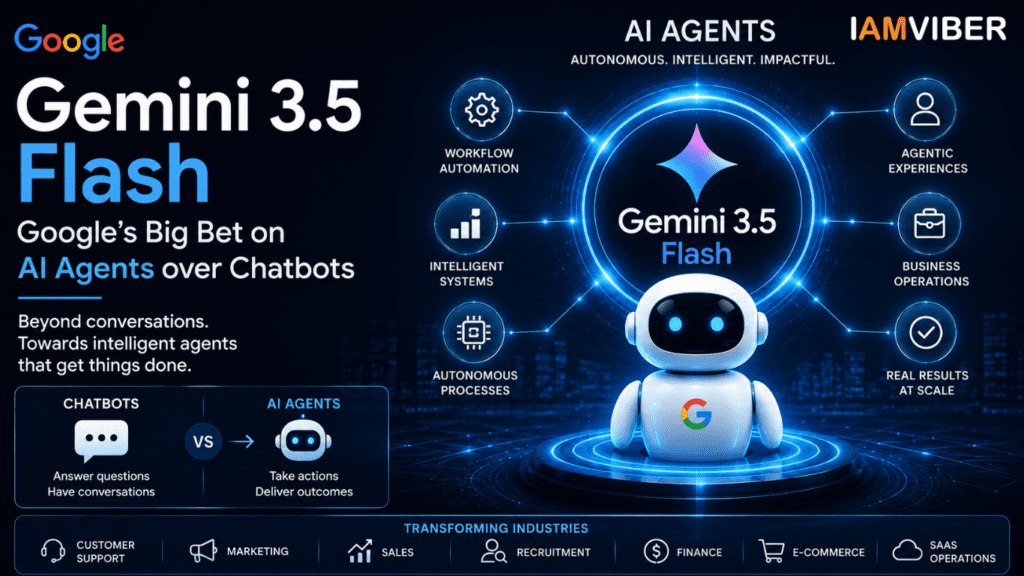
With the launch of Gemini 3.5 Flash, Google is signaling something much bigger: the future of AI is not just answering questions — it is completing tasks.
Instead of AI tools that simply “talk,” the next generation of systems will act like intelligent agents capable of researching, planning, automating workflows, and making decisions with minimal human input.
This transition could redefine how businesses use AI in daily operations.
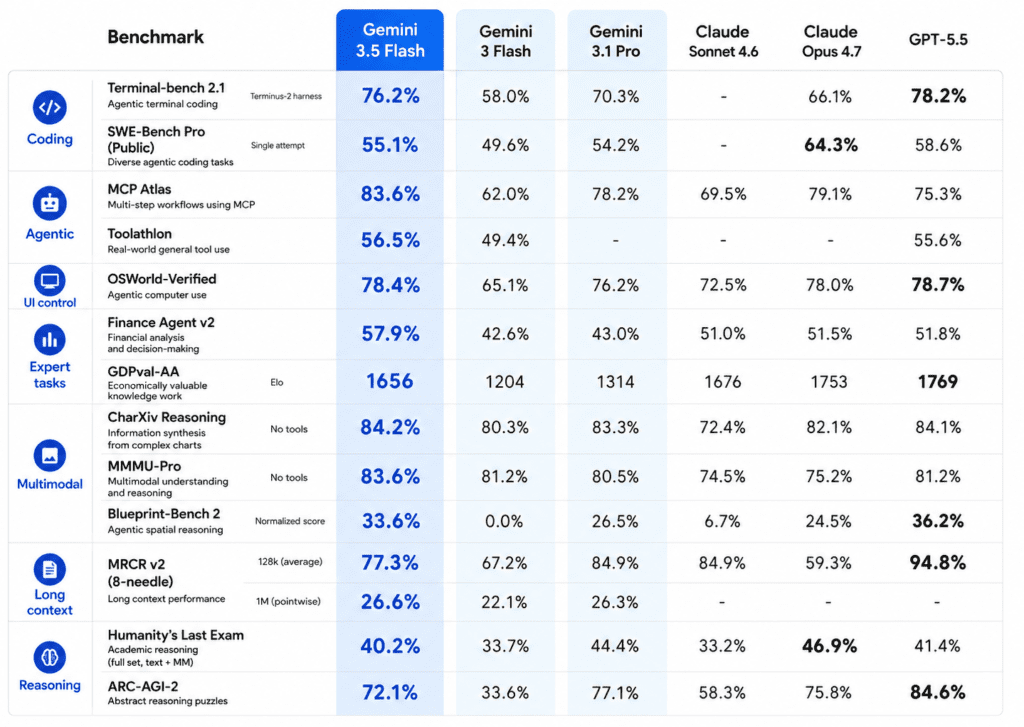
Google designed Gemini 3.5 Flash as a lightweight yet highly capable AI model optimized for speed, efficiency, and large-scale deployment. Unlike traditional large models that prioritize lengthy reasoning or creative generation, Gemini Flash focuses on:
- Faster response times
- Lower operational costs
- Better tool usage
- Strong multimodal understanding
- Real-time automation capabilities
The model is built for environments where AI needs to work continuously inside products, workflows, CRMs, support systems, and enterprise operations. That is exactly why many analysts believe Google is positioning Gemini Flash as the foundation for AI agents rather than another chatbot competitor.
Why AI Agents Matter More Than Chatbots
Chatbots Answer. Agents Execute.
Traditional AI chatbots mainly operate in a conversational loop:
- User asks something
- AI responds
- Conversation ends
AI agents work differently. They can:
- Understand goals
- Break tasks into steps
- Use tools and APIs
- Access databases
- Perform actions automatically
- Continue workflows independently
For example, instead of asking an AI chatbot to “write an email,” an AI agent could:
- Analyze incoming leads
- Draft personalized outreach
- Schedule meetings
- Update CRM records
- Send follow-ups automatically
All with minimal supervision. This shift transforms AI from an assistant into an operational layer for businesses.
Building AI Infrastructure for Everyday Work
Google’s long-term advantage is not only its models — it is its ecosystem. With products like:
- Gmail
- Google Workspace
- Docs
- Sheets
- Android
- Chrome
- Android
- Cloud infrastructure
Google already owns many of the environments where people work daily. By integrating Gemini-powered agents into these systems, Google can create AI workflows deeply embedded into productivity tools businesses already use. Imagine AI agents inside:
- Google Meet summarizing and assigning tasks automatically
- Gmail replying based on context and priorities
- Sheets generating forecasts and dashboards in real time
- Docs creating reports using live organizational data
This creates an AI ecosystem where automation becomes invisible and continuous.
Gemini 3.5 Flash Could Accelerate Enterprise AI Adoption
Businesses Want Automation, Not Just Conversations
Many companies experimented with AI chatbots in 2023 and 2024. But most organizations eventually realized something important: Chat alone does not generate business value. Automation does. Businesses are now prioritizing AI systems that can:
- Reduce manual operations
- Improve customer response time
- Automate repetitive tasks
- Increase operational efficiency
- Increase operational efficiency
That is where agent-based AI becomes powerful.Gemini 3.5 Flash appears designed for exactly these use cases because speed and low latency matter more in operational systems than long conversational depth.
The Rise of AI Agents in Startups and SaaS
Startups Are Already Building Agent Workflows
The startup ecosystem is rapidly moving toward AI agents as the next phase of automation. Modern SaaS companies are building AI sales agents, customer support systems, research assistants, workflow automation tools, coding agents, and AI operations managers to handle tasks beyond simple conversations.
Rather than replacing humans entirely, these systems act as force multipliers that help small teams work faster and more efficiently. A 5-person startup using advanced AI agents could soon operate with the productivity of a much larger company. That is why the infrastructure layer powering these agents — the AI models themselves — is becoming increasingly important.
Speed Is Becoming the New Competitive Advantage
Why Flash Models Matter
Large reasoning-heavy AI models are powerful, but they are expensive and slower to deploy at scale. Flash models are different. They are optimized for:
- High-frequency requests
- Real-time interactions
- Low-cost deployment
- Continuous automation systems
For AI agents operating 24/7 across thousands of workflows, efficiency becomes critical. This is likely why Google is investing heavily in Flash-based architectures. The future AI winner may not be the model with the longest responses — but the one capable of running millions of autonomous workflows reliably and affordably.
What This Means for Businesses
AI Adoption Is Entering a New Phase
Businesses now need to think beyond AI content generation and focus on how AI can transform day-to-day operations. The next major opportunity lies in AI-driven workflows, intelligent internal systems, autonomous business processes, and agentic customer experiences that can reduce manual work and improve efficiency across organizations.
Companies that adopt AI agents early could gain a major operational advantage over competitors still relying on traditional systems. This shift is especially important for industries like customer support, marketing, sales, recruitment, finance, e-commerce, and SaaS operations, where automation and faster execution can directly impact productivity and growth.
Final Thoughts
Gemini 3.5 Flash represents more than another AI model release from Google. It reflects a broader industry transition. The AI race is no longer just about building better chatbots. It is about creating intelligent agents capable of handling real work autonomously.
As businesses increasingly prioritize automation over conversation, agentic AI may become the defining technology shift of the next decade. And with Gemini 3.5 Flash, Google appears determined to lead that shift.