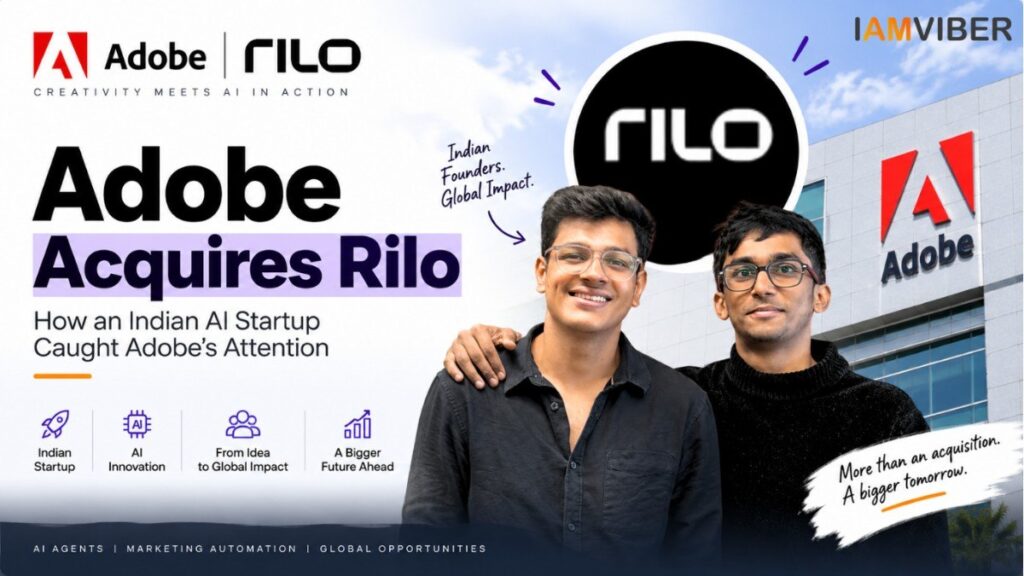
Adobe Acquires Rilo: What Happened?
Adobe acquires Rilo, an Indian AI startup that built AI-powered workflow automation for marketing and go-to-market teams.
The acquisition comes less than a year after Rilo was founded, making the story particularly notable in India’s rapidly expanding AI startup ecosystem. Financial terms of the transaction have not been disclosed.
According to Reports, the deal involves Rilo’s technology and its six-member team joining Adobe. Rilo’s standalone product is being wound down following the acquisition.
For the founders, this marks a remarkably fast journey from startup launch to joining one of the world’s biggest software companies.
And for the Indian startup ecosystem, Adobe acquires Rilo is another example of how quickly specialized AI companies can attract global technology giants when they solve a specific enterprise problem.
Who Founded Rilo?
Rilo was founded in 2025 by Dhruv Jaglan and Georgi Boby, who were batchmates at IIT Bombay.
The founders focused on a problem that is becoming increasingly important for modern businesses: how to turn AI from a chatbot into something that can actually execute multi-step workflows.
Instead of simply generating text or answering questions, Rilo allowed users to describe what they wanted to accomplish in natural language. Its AI agents could then create and execute workflows across connected tools.
Reports say these workflows included:
- Competitor intelligence
- Prospecting
- Sales outreach
- Content distribution
- Content repurposing
- Sales-call analysis
- Campaign research
- Marketing operations
This positioning placed the Rilo AI startup within the growing market for agentic AI and AI-powered workflow automation.
What Did Rilo Actually Build?
The interesting part of the Rilo story isn’t simply that Adobe acquires Rilo.
It is what Adobe appears to have found valuable.
Rilo was designed around the idea of giving AI agents an outcome rather than asking users to manually build every individual automation.
A marketing professional could describe a task in plain English, and the platform could turn that request into an actionable workflow.
For example, instead of manually researching competitors, collecting information, analysing it and preparing a report, an AI-powered workflow could handle several of those steps automatically.
This is part of a larger shift from AI assistants to AI agents.
AI assistants primarily help users complete individual tasks.
AI agents are increasingly being designed to perform sequences of actions, interact with tools, reason through information and work toward an outcome. That distinction is important when understanding why Adobe acquires Rilo is attracting attention across the technology and marketing industries.
Rilo Crossed 10,000 Users
Rilo’s growth was another notable part of the story.
Co-founder Dhruv Jaglan said that more than 10,000 people had tried the product within months of its launch. TechCrunch also reported the 10,000-user figure while covering the acquisition.
For a startup founded in 2025, reaching that level of early adoption gave Rilo a meaningful signal of product-market interest.
The company also raised approximately $1 million from investors including Peak XV Partners, DeVC and Day Zero Ventures.
Reports have put Rilo’s pre-acquisition valuation at approximately $10 million, although the acquisition price itself has not been publicly disclosed.
This means the Adobe Rilo acquisition is not a traditional story of a large company buying an established, mature software business.
Instead, it is a story about a relatively young AI company whose technology and team attracted the attention of a global enterprise software company.
Why Did Adobe Acquire Rilo?
The biggest question surrounding Adobe acquires Rilo is simple:
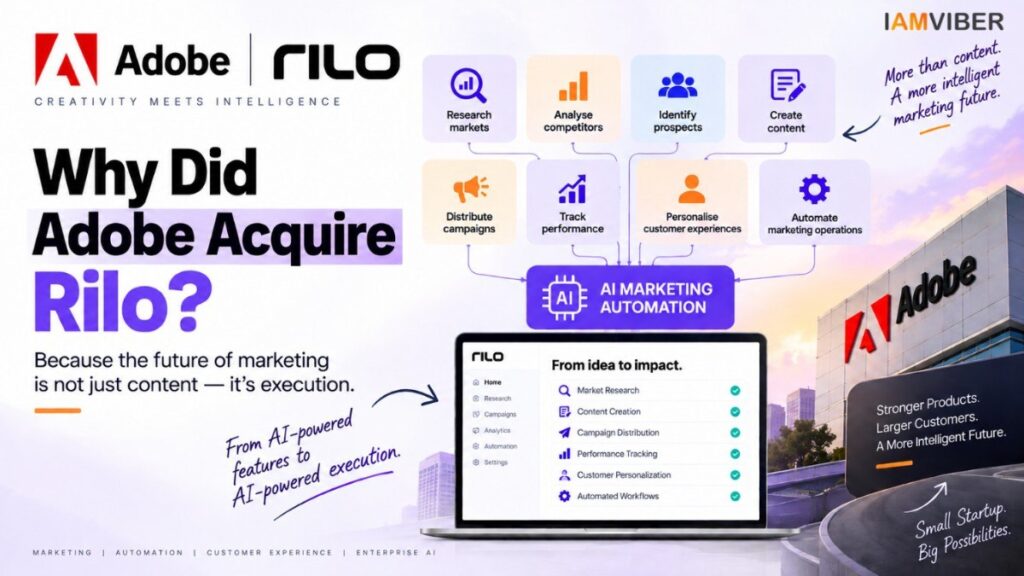
Why would Adobe want a startup that was less than a year old?
One answer lies in the changing nature of marketing technology. Marketing is no longer only about creating content. Companies increasingly need technology that can:
- Research markets
- Analyse competitors
- Identify prospects
- Create content
- Distribute campaigns
- Track performance
- Personalise customer experiences
- Automate repetitive marketing operations
This is where AI marketing automation is becoming increasingly important.
Adobe already has a massive presence in creative software, customer experience and marketing technology. Adding technology focused on autonomous workflows could potentially complement its broader enterprise AI strategy.Rilo’s technology could strengthen Adobe’s existing products as the company targets larger customers.
So, Adobe acquires Rilo can be viewed in the larger context of enterprise software companies trying to move from AI-powered features toward AI-powered execution.
What Happens to Rilo After the Acquisition?
Here’s the part that makes this acquisition particularly unusual.
Rilo is shutting down as a standalone product.
Rilo announced that new signups had been closed and that its hosted application was no longer available. The company said it was winding down the hosted product as it joined Adobe.
In other words, customers will no longer use Rilo as an independent platform.
Instead, the technology, intellectual property and team are moving into Adobe.
Adobe’s deal includes Rilo’s six-person team and some of its intellectual property.
This is why the Rilo AI startup story is also relevant to founders building AI products.
A startup does not necessarily have to become a billion-dollar standalone company to create significant value.
Sometimes, its technology, team, product insight or speed of execution can become valuable to a much larger company.
Adobe's Second Known Indian Acquisition
The Adobe Rilo acquisition is also significant because it is reportedly Adobe’s second acquisition from India.
Adobe previously acquired Indian generative AI video startup Rephrase.ai in 2023.
Rilo therefore becomes another example of an Indian technology startup becoming part of Adobe’s global product strategy.
The pattern also highlights India’s growing role in AI development.
Indian startups are increasingly building products for global markets rather than focusing exclusively on local customers.
For founders, this creates an opportunity to build highly specialised technology that can eventually become strategically valuable to international companies.
What This Means for AI Marketing
The Adobe acquires Rilo deal also highlights a bigger change taking place in marketing.
The traditional marketing technology stack is becoming increasingly automated. Earlier, a marketer might use separate tools for:
- Research
- Content creation
- Lead generation
- Customer analytics
- Campaign management
- Reporting
AI agents can potentially connect several of these activities into a single workflow.
Rilo’s approach was built around exactly this concept.
Its platform allowed users to create workflows for marketing and go-to-market activities using natural-language instructions. That makes the Rilo AI startup story relevant beyond Adobe. It reflects the broader movement toward AI systems that don’t just generate information but can act on it.
The Bigger Startup Lesson
There is another important takeaway from Adobe acquires Rilo. Speed matters.
Rilo was founded in 2025.
Within months, the company reportedly attracted more than 10,000 users, raised around $1 million and eventually became part of Adobe.
That does not mean every startup should chase an acquisition.
But it demonstrates the value of solving a focused problem and building technology that fits a rapidly expanding market. For AI founders, the opportunity may increasingly lie in building specialised products that solve specific enterprise problems better than general-purpose tools.
Why This Acquisition Matters for India
India’s AI ecosystem is moving beyond outsourcing and IT services.
Startups are increasingly building proprietary AI products, agentic systems and automation platforms.
The Adobe Rilo acquisition adds another international example to that story.
The founders came from IIT Bombay, built a specialised AI product, attracted institutional and venture investors, achieved early user traction and ultimately joined a global technology company. At the same time, the deal shows that the AI startup market is evolving quickly. A product launched today may look completely different a year later because technology companies are moving rapidly to acquire capabilities, teams and intellectual property.
What We Know About the Adobe-Rilo Deal
Here’s a quick breakdown:
| Detail | Information |
|---|---|
| Startup | Rilo |
| Founded | 2025 |
| Founders | Dhruv Jaglan & Georgi Boby |
| Education | IIT Bombay |
| Funding | About $1 million reported |
| Reported Investors | Peak XV, DeVC, Day Zero Ventures |
| Reported Users | 10,000+ |
| Team | 6 members |
| Acquirer | Adobe |
| Deal Value | Not disclosed |
| Product Status | Standalone product being wound down |
| Focus | AI agents & workflow automation |
Frequently Asked Questions
1. Why did Adobe acquires Rilo?
Adobe acquires Rilo to bring the Indian startup’s AI-powered workflow automation technology and team into its broader AI and marketing technology ecosystem. The exact financial terms of the deal have not been disclosed.
2. What is Rilo AI startup?
The Rilo AI startup was founded in 2025 by IIT Bombay batchmates Dhruv Jaglan and Georgi Boby. It developed AI agents designed to automate marketing and go-to-market workflows.
3. How much did Rilo raise before Adobe acquires Rilo?
Rilo reportedly raised around $1 million from investors including Peak XV Partners, DeVC and Day Zero Ventures before Adobe acquires Rilo. The acquisition value itself has not been publicly disclosed.
4. Who are the founders of Rilo?
Rilo was founded by Dhruv Jaglan and Georgi Boby, who studied together at IIT Bombay. Their startup focused on using AI agents for research, marketing, sales and workflow automation.
5. How many users did Rilo have before Adobe acquires Rilo?
Rilo reportedly crossed 10,000 users within months of launching. This early adoption was achieved before Adobe acquires Rilo, making the startup’s rapid growth an important part of the story.
6. Is Rilo still available after Adobe acquires Rilo?
No. Rilo announced that new signups had been closed and that its hosted product was being wound down following the acquisition. Adobe acquires Rilo as a technology and team acquisition rather than continuing Rilo as the same standalone product.
7. What technology did Adobe acquire from Rilo?
The Adobe Rilo acquisition brings technology related to AI agents and automated workflows for marketing and go-to-market activities. These capabilities could complement Adobe’s broader focus on AI-powered creative and marketing tools.
8. What does Adobe acquires Rilo mean for Indian AI startups?
Adobe acquires Rilo highlights the growing global interest in Indian AI startups building specialised products. Rilo’s journey from its 2025 launch to acquisition also shows how quickly AI startups can evolve when they address a focused enterprise problem.
Topics to follow on IAMVIEBR : AI & Tech, Startup, AI Creative, Agentic AI, Current Affairs & Insights, Collaboration