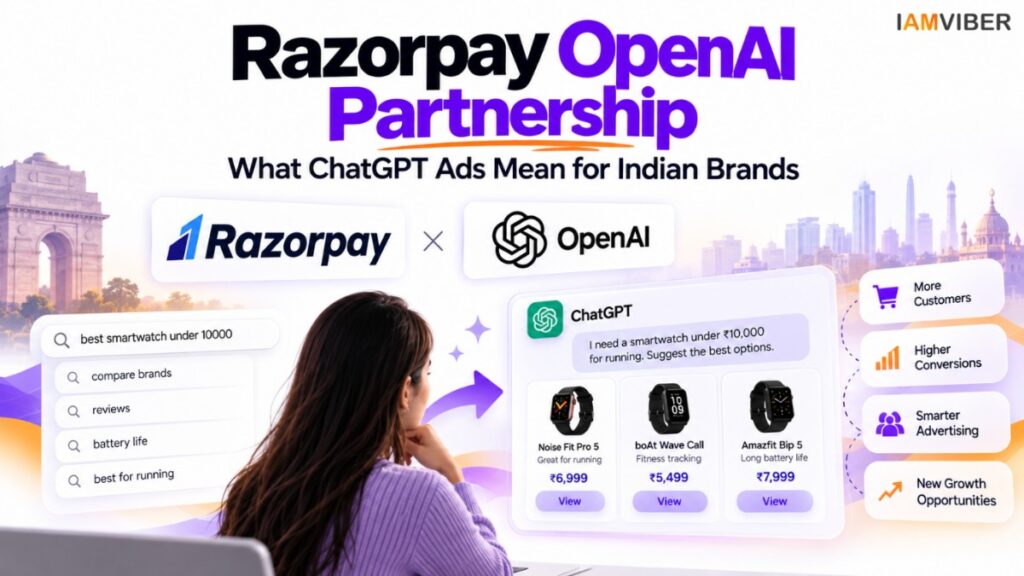
The way people discover products online is changing. Earlier, a customer would search on Google, open websites, compare products, read reviews and then make a decision. Today, that journey can begin with a simple question inside an AI assistant.
That is why the Razorpay OpenAI Partnership matters.
On October 5, 2026, Razorpay announced that it is working with OpenAI to help Indian businesses advertise on ChatGPT through Razorpay Engage, its growth marketing platform. The partnership will help brands prepare product catalogues, structure product feeds, launch campaigns and measure performance on ChatGPT Ads. Early participants include Tanishq, Fastrack, Traya, Tata Neu, Rivaah by Tanishq, Shaadi.com, Axis Max Life, Palmonas and NMIMS.
The Razorpay OpenAI Partnership is important because it is not just about placing another ad on another platform. It points to a bigger change: brands are starting to think about how they can become visible inside AI-led product discovery.
What Is the Razorpay OpenAI Partnership?
In simple words, the Razorpay OpenAI Partnership connects Razorpay Engage with OpenAI’s ChatGPT Ads ecosystem in India.
Razorpay Engage will help businesses check whether their product catalogue is ready, improve product feeds, create campaigns, manage campaigns and measure results. Razorpay also says the platform uses an AI agent based on ChatGPT Ads best practices to help create and manage campaigns, while its team provides human oversight when needed.
For brands, the value is practical. Instead of learning every part of a new ad channel from zero, businesses can get support with the technical and operational work needed to start.
The Razorpay OpenAI Partnership also builds on an existing relationship around AI-led commerce. Razorpay, OpenAI and NPCI have previously worked on bringing payments and commerce experiences into ChatGPT.
Why ChatGPT Ads Matter in India
The biggest shift is not the ad format itself. It is the way people are discovering products.
In a traditional search journey, a person may type “best running shoes” and receive a page of results. In ChatGPT, the same person can explain the full need: “I run five kilometres every morning, have flat feet, and want shoes under ₹8,000.”
The conversation can continue. The user can ask for alternatives, compare features, narrow the budget or change the requirements.
That is why ChatGPT Ads India is becoming interesting for marketers. A product can be relevant in different conversations based on the customer’s needs and context, rather than only one fixed keyword. Razorpay says product information and catalogue structure become especially important in this environment.
OpenAI has also been building its advertising system around moments when people explore ideas, compare options and discover products and services. On October 5, OpenAI announced a new visual ad format and expanded measurement tools for ChatGPT Ads.
The Razorpay OpenAI Partnership gives Indian businesses a practical route into this growing ecosystem.
Razorpay Engage: The Layer Behind the Campaign
One of the most interesting parts of the news is Razorpay Engage.
Razorpay Engage is a payments-integrated growth marketing platform. In this new use case, it becomes an operating layer that helps brands prepare for and manage ChatGPT advertising.
The work starts with product information. A catalogue needs to be clear and organised. Product feeds need the right structure. Campaigns then need to be created, managed and measured.
For a large company with hundreds or thousands of products, that can become a serious operational task.
Razorpay Engage can assess catalogue readiness, improve product feeds, create campaigns and track performance. Its AI agent can monitor results and make adjustments, with human oversight from the Razorpay team.
This makes the Razorpay OpenAI Partnership interesting for marketers because the opportunity is not only about media buying. It is also about preparing product information for an AI-first discovery environment.
From Search to Conversation
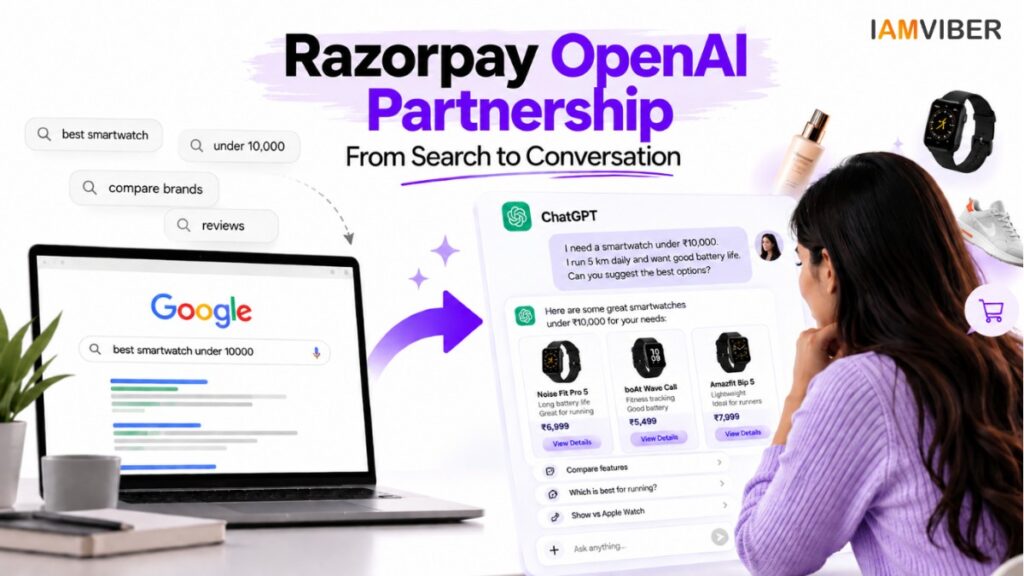
The Razorpay OpenAI Partnership also highlights a larger trend in digital marketing: conversational commerce.
For years, search engine optimisation focused heavily on helping pages appear when people searched for specific terms. Social media then added feeds, creators, short videos and recommendation systems.
AI assistants add another layer.
Now, a customer may not search for a brand at all. They may describe a problem and ask an AI tool what to buy.
For example, a user may ask for a smartwatch under ₹10,000, a beginner skincare product or business insurance options to compare.
The important point is that the customer is asking for help with a decision, not simply a list of websites.
That makes conversational commerce valuable for marketers. Brands need to think about how clearly their products are represented, what information is available and how useful that information is when a customer is deciding.
The Razorpay OpenAI Partnership gives this shift a real business example in India.
What This Means for Indian Brands
The Razorpay OpenAI Partnership could be especially relevant for Indian brands because India already has a large digital consumer market and strong adoption of mobile shopping and digital payments.
The opportunity is not just getting another impression. It is being discoverable when a customer is actively trying to solve a problem.
A jewellery brand may want to appear when someone is researching wedding jewellery. A travel company may want to be visible when someone asks for a three-day trip plan. A skincare brand may want to appear when a user is comparing products for a specific need.
This is why product data matters.
If information is incomplete, unclear or poorly structured, it becomes harder for an AI-driven experience to understand what a product is, who it is for and when it may be relevant.
The Razorpay OpenAI Partnership sends a simple message to marketers: your product catalogue is becoming a marketing asset.
Will ChatGPT Ads Replace Google or Social Media Ads?
Probably not.
Google Search, Instagram, YouTube, marketplaces and other channels will continue to play major roles. ChatGPT Ads should be seen as another channel as AI changes product discovery.
The Razorpay OpenAI Partnership does not mean brands should stop investing in existing channels. It means they should start testing where AI fits into the marketing mix.
For some categories, ChatGPT may be especially interesting for comparison-heavy purchases where customers want guidance before buying, such as financial services, jewellery, travel, education, electronics and beauty.
The Rise of AI Advertising in India
The broader story is the growth of AI advertising.
Traditional advertising often tries to capture attention. AI advertising can appear closer to a moment when someone is actively making a decision.
That does not mean ads should become intrusive. Trust will matter even more.
OpenAI says ChatGPT ads are clearly labelled and kept separate from its answers, and that advertising does not influence the answers ChatGPT provides.
For marketers, the better question is not simply, “How do I put an ad into ChatGPT?”
A better question is: “How do I make my brand useful in an AI-led buying journey?”
That is the deeper opportunity behind the Razorpay OpenAI Partnership.
What Brands Should Start Doing Now
Indian businesses do not need to rebuild their marketing strategy overnight. But the Razorpay OpenAI Partnership is a reason to start preparing for AI-led discovery.
First, clean up product information. Make names, descriptions, features, categories, pricing and other details clear and consistent.
Second, review product feeds. Good AI advertising depends on good product data.
Third, think beyond keywords. Study the questions customers ask, the problems they are trying to solve and the comparisons they may make.
Fourth, measure the new channel carefully. Reach matters, but brands should also watch qualified traffic, conversions, engagement and the types of questions that lead to product discovery.
Finally, keep humans in the loop. AI can automate parts of campaign work, but brand judgment, positioning and customer understanding still matter.
The Razorpay OpenAI Partnership makes it easier for businesses to experiment without building every part of the infrastructure internally.
What Comes Next?
The most interesting part of the news may be what happens next.
As more people use AI assistants to discover products, brands will need to rethink digital visibility. SEO will still matter, but AI visibility may become another part of the marketing conversation.
A company may eventually need to ask three questions:
Can customers find my brand?
Can AI understand my product?
Can my product become relevant at the right moment in the conversation?
That is a different mindset from traditional digital advertising.
The Razorpay OpenAI Partnership is an early sign of where the market could be heading. Indian brands now have another route to explore AI advertising, and the companies that learn how conversational discovery works early may have an advantage.
Final Takeaway
The Razorpay OpenAI Partnership is bigger than a fintech company helping brands buy ads.
It shows how advertising, commerce and AI are starting to come together.
ChatGPT is becoming a place where people can ask questions, compare options and make decisions. For brands, that creates a new marketing opportunity.
The winners may not simply be the companies with the biggest ad budgets. They may be the companies with clear product information, strong customer understanding and the ability to show up when a customer is ready to decide.
For Indian marketers, the time to learn is now.
The Razorpay OpenAI Partnership gives brands a new doorway into that future. The Razorpay OpenAI Partnership shows why AI advertising is becoming part of the present.