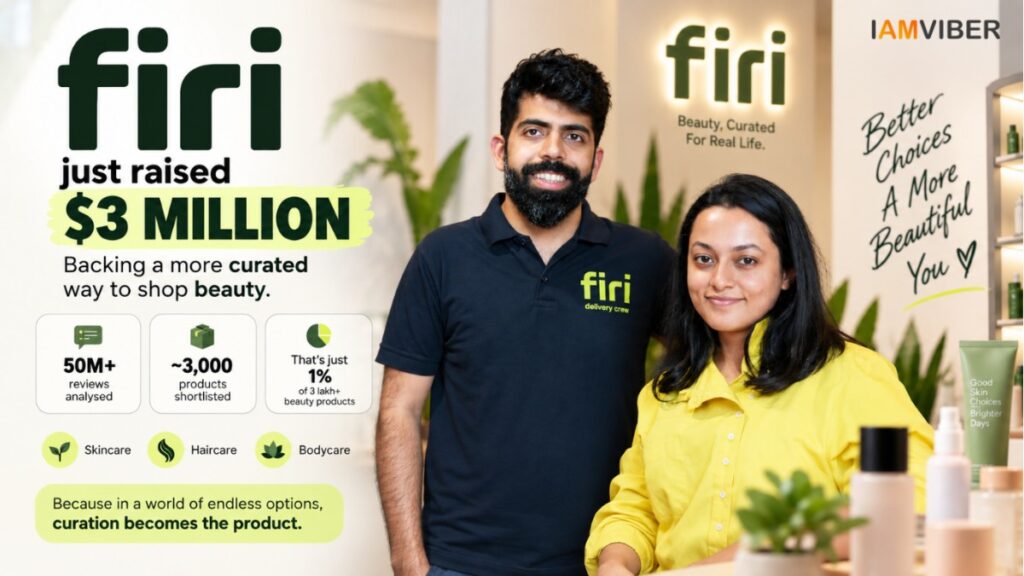
The latest Firi funding round has put the young beauty and personal-care startup on the radar of India’s growing startup ecosystem. Gurugram-based Firi has raised $3 million in seed funding, with 360 ONE Asset leading the round. Better Capital, CRED founder Kunal Shah, Consumer Collective by Atrium, and other founders and operators also participated.
But the story behind the Firi funding is more interesting than the headline amount.
Firi is not trying to become another marketplace with thousands of beauty products. Instead, the company is building a curated beauty-commerce model where products are researched, evaluated and shortlisted before they appear on the platform.
That approach addresses a problem that has quietly become significant in online beauty shopping: too much choice can make discovery harder rather than easier.
According to the company, its systems have analysed more than 50 million reviews and shortlisted around 3,000 products from an estimated 300,000 beauty products globally.
Firi Funding: What Happened?
The Firi funding round is a seed investment of $3 million, led by 360 ONE Asset.
The round also includes participation from Better Capital, Kunal Shah and other investors. The fresh capital is expected to help Firi expand its product categories and strengthen its quick-commerce infrastructure in Gurugram.
The company currently focuses on skincare, haircare and bodycare.
With the new capital, Firi plans to expand into categories including makeup and fragrances, while adding more dark stores in Gurugram before eventually moving into additional cities.
The timing of the Firi funding is also notable because India’s quick-commerce market is increasingly moving beyond groceries and everyday essentials.
Beauty and personal care is becoming an important category within this shift.
Instead of waiting days for a beauty product to arrive, consumers are increasingly being introduced to the possibility of buying personal-care products through rapid delivery networks.
Firi is attempting to build around that behaviour from the beginning.
What Makes Firi Different?
The core idea behind the Firi funding story is not simply speed. It is curation + discovery + speed.
Traditional beauty marketplaces generally compete through assortment. The more brands and products they can list, the wider the selection becomes.
Firi is taking a different approach.
The company describes itself as an opinionated beauty retailer. Instead of asking consumers to browse an enormous catalogue, it attempts to decide which products deserve to be stocked.
Its AI-led systems analyse reviews, online discussions, video reviews, ingredient information and other product data before products are shortlisted.
The company says it has processed more than 50 million reviews and selected approximately 3,000 products.
That means the platform is deliberately narrowing the catalogue rather than expanding it indefinitely. And that is arguably the most important part of the Firi funding thesis. The company is betting that consumers may value trusted selection as much as unlimited choice.
From 50 Million Reviews to 3,000 Products
One of the most striking numbers associated with the Firi funding announcement is the company’s claimed review-analysis volume.
Firi says it has analysed more than 50 million reviews to understand beauty products and shortlist approximately 3,000 products.
The company has described this as roughly a 1% qualification rate. The idea is relatively straightforward.
Beauty shoppers often encounter hundreds of claims around ingredients, effectiveness, suitability and value. Consumers can spend significant amounts of time reading reviews, watching videos and searching for recommendations before making a purchase.
Firi wants technology to perform much of that research before the customer reaches the product page. This creates a different role for AI in ecommerce.
Rather than simply using AI for recommendations after a customer has searched for something, the company is using AI and data analysis as part of the product-selection layer itself.
That distinction could become important as AI increasingly influences how consumers discover products.
Firi Funding and the Rise of Beauty Quick Commerce
The Firi funding also reflects the growing intersection between beauty and quick commerce in India.
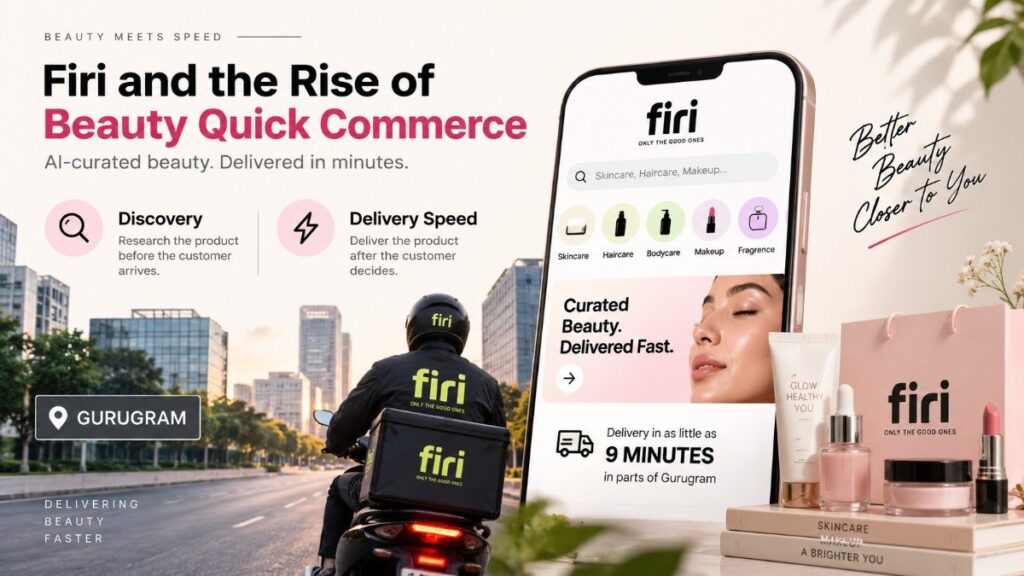
Firi currently operates from Gurugram and says deliveries in parts of the city can take as little as nine minutes. The company began with a pilot in January 2026 and moved into full operations in September.
Its current Beauty Studio model combines local inventory with rapid fulfilment. This creates an interesting proposition: Research the product before the customer arrives.
Deliver the product after the customer decides.
The company is therefore combining two traditionally separate ecommerce advantages.
The first is discovery. The second is delivery speed.
The Firi funding will help the startup develop both sides of this model as it expands its catalogue and physical fulfilment footprint.
Who Founded Firi?
The founders behind the Firi funding announcement are Vivek Madani and Karishma Rathaur, former Uber India executives.
Before Firi, the founders also worked on Honestly, an AI-powered beauty search and discovery platform.
Their previous experience is relevant because Firi isn’t entering beauty commerce without prior exposure to the category.
The founders have already spent time thinking about the beauty discovery problem.
At Firi, that experience has been translated into a more commerce-focused model.
The company’s current approach combines product research, AI-assisted discovery, curated inventory and rapid fulfilment. That combination is what makes the Firi funding more than a conventional early-stage ecommerce announcement.
Where Will the New Capital Go?
The Firi funding will primarily support expansion.
According to reports, Firi plans to add more dark stores in Gurugram before expanding into other Indian cities. It also intends to broaden its product selection into makeup, fragrance and additional beauty categories.
The company currently focuses on:
- Skincare
- Haircare
- Bodycare
The next phase is expected to include:
- Makeup
- Fragrances
- Additional beauty and personal-care categories
This expansion could allow Firi to increase the number of occasions for which consumers use the platform.
Instead of being a destination for one particular beauty requirement, the company wants to become a broader destination for curated beauty purchases.
Why the Firi Funding Matters for Beauty Commerce
The Firi funding comes at an interesting point for India’s beauty and personal-care market.
Large marketplaces already offer extensive catalogues. Traditional beauty platforms have built strong online shopping ecosystems. Meanwhile, quick-commerce platforms are rapidly increasing the number of beauty and personal-care products available through fast delivery.
That means Firi is entering a market where selection, trust, convenience and speed are all becoming competitive factors.
Its strategy is to combine them differently.
Rather than saying:
“Here are thousands of products. Choose one.”
The Firi model is closer to:
“We researched thousands of products. Here are the ones we believe are worth considering.”
That is a meaningful difference in ecommerce design. It shifts the value proposition from assortment to filtering.
And as AI becomes better at processing enormous volumes of consumer information, this type of filtering could become increasingly common across ecommerce categories.
What Firi's Model Could Mean for AI Commerce
The Firi funding story also highlights a broader trend: AI is moving deeper into commerce. Earlier ecommerce applications of AI largely focused on recommendations, search, chatbots and customer support.
Now, startups are increasingly exploring how AI can influence what gets sold in the first place.
Firi’s approach illustrates this shift.
Instead of simply recommending a product after a shopper searches for “best moisturiser,” the company is attempting to evaluate products before they enter its catalogue.
That creates an AI-powered selection layer between the enormous global product universe and the consumer.
The company says its systems analyse reviews, discussions, video content and ingredient information to help determine which products make the cut
For consumers, the potential benefit is less research.
For brands, the potential benefit is access to a curated distribution channel.
For the platform, the challenge will be maintaining trust as it scales.
The Road Ahead for Firi
The Firi funding gives the startup capital to test whether its curated beauty-commerce model can scale beyond its initial Gurugram footprint.
The company has already started with a narrow product selection and a city-focused fulfilment model. The next challenge is expansion.
Can the same level of curation work when the catalogue becomes larger?
Can the company maintain product quality while adding makeup, fragrances and other categories?
Can rapid delivery remain economically viable as it enters new cities?
And most importantly, will consumers trust a curated catalogue enough to return repeatedly?
These are questions that the company’s next phase will begin to answer. For now, the Firi funding gives the startup an opportunity to build that model with fresh institutional backing.
Final Takeaway
The Firi funding announcement is ultimately about more than a $3 million seed round.
It represents a different approach to beauty commerce.
Firi is building around a simple idea: consumers don’t necessarily need access to every product available. They may need someone—or something—to help them identify the products worth buying.
By combining AI-led research, curated selection and quick-commerce fulfilment, the startup is attempting to turn product discovery itself into a competitive advantage.
The company has analysed 50M+ reviews, shortlisted around 3,000 products, started operations in Gurugram and plans to expand its categories and fulfilment network with the new capital.
Whether this model becomes a major new format for beauty commerce will depend on execution, consumer retention, unit economics and expansion.
But the Firi funding round clearly puts the startup among the emerging companies to watch at the intersection of AI, beauty and quick commerce.
And perhaps the biggest question isn’t whether ecommerce needs more products. It’s whether, in an age of infinite choice, the real product is the shortlist.
Topics to follow on IAMVIEBR : AI & Tech, Startup, AI Creative, Agentic AI, Current Affairs & Insights, Collaboration