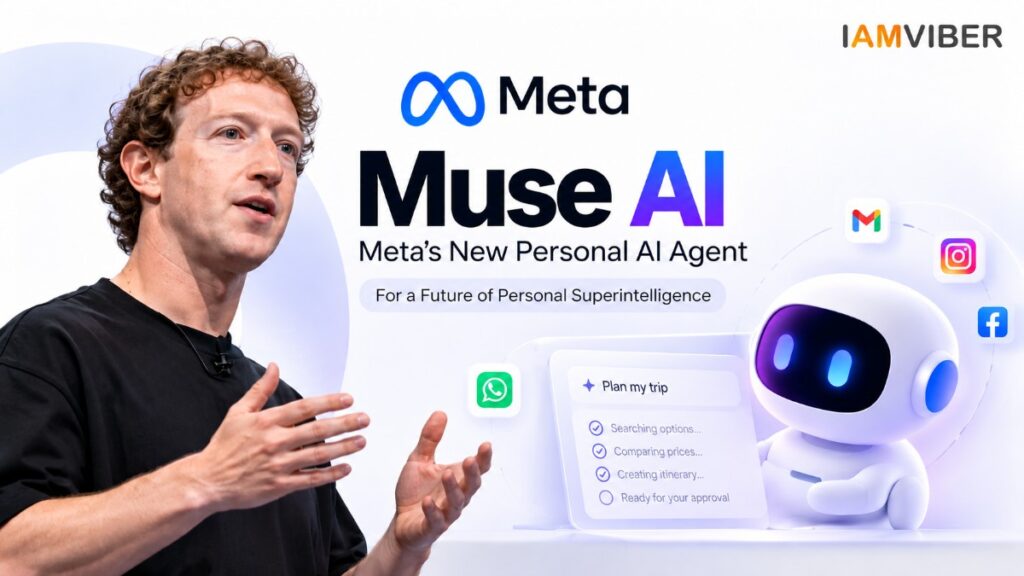
Meta has made a major move in the personal artificial intelligence race with Meta Muse AI, a new AI agent designed to do more than answer questions. At Meta Connect 2026, Mark Zuckerberg positioned Muse as the centrepiece of Meta’s vision for personal superintelligence. The announcement expands the conversation around AI from chatbots and content generation to systems that can understand goals, plan tasks, browse the web, use connected apps and act on a user’s behalf.
What Is Meta Muse AI?
Meta Muse AI is Meta’s personal AI agent built to complete tasks rather than simply respond to prompts. Meta says Muse can browse the web, complete multi-step tasks, make purchases, generate images, create documents, connect to apps and services, set reminders, track goals and continue working in the background. Users can interact with Muse through its app and WhatsApp, while Meta is also extending Muse to wearable devices.
The important difference is agency. A conventional chatbot may tell you how to book a trip. An agent can potentially navigate websites, fill forms and complete parts of the booking workflow with your permission.
Meta says Muse can create action plans around goals, monitor progress and proactively suggest next steps. That moves AI from simply generating information toward actually helping users accomplish objectives.
At Meta Connect 2026, Zuckerberg described this direction as a path toward personal superintelligence that could eventually help billions of people pursue their individual goals.
How Meta Muse AI Works
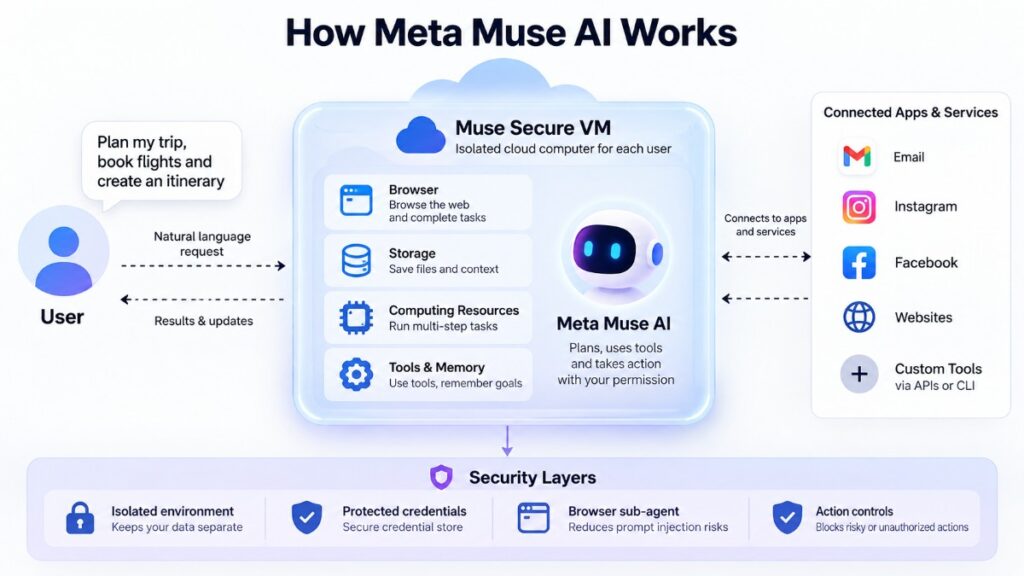
Meta Muse AI is built around an isolated cloud computer called Muse Secure VM. According to Meta, each user gets a dedicated virtual machine with a browser, storage, computing resources and access to connected services. This environment is designed to let Muse perform real work while separating the agent from other users and systems.
The architecture matters because an AI agent needs more than a language model. It needs tools, memory, browser access, permissions and a way to execute multi-step tasks.
Meta says Muse can use connectors for services such as email, Instagram and Facebook, and can create custom tools when a required service exposes suitable APIs or command-line interfaces.
Meta’s research team also says Muse uses a browser sub-agent and multiple security layers to reduce risks such as prompt injection and unauthorized actions.
Meta Muse AI and the Rise of Agentic AI
The launch of Meta Muse AI reflects a broader shift from generative AI toward agentic AI.
Generative AI primarily creates text, images, code or other content in response to instructions. Agentic AI adds the ability to plan, use tools, take actions and continue working toward an objective.
That distinction could change how people use computers.
Instead of opening several applications and completing a workflow manually, a user could describe the desired outcome and let an agent coordinate the steps.
For example, a user might ask an agent to organize a trip, compare options, prepare a schedule and wait for approval before making a purchase.
In another scenario, an agent could monitor a project, summarize changes and remind the user when an action is required.
Meta Muse AI is being positioned around exactly this type of interaction.
What Can Meta Muse AI Actually Do?
Meta’s current product information lists several capabilities. Muse can answer questions, browse the web, complete tasks, make purchases, generate images, create documents and work with connected applications. It can also set reminders, monitor goals and keep working in the background.
One of the most important features is permission-based action.
Meta says Muse can ask users to approve critical actions such as sending emails, making purchases or sharing information with connected apps. Users can review activity and maintain an audit trail of what the agent has done or plans to do.
This approval layer is important because autonomous software creates a different risk profile from a chatbot.
A wrong answer can be corrected.
A wrong purchase, message or booking can create a real-world consequence.
That makes user controls a fundamental part of the personal AI experience.
Meta Muse AI and Privacy
Privacy is one of the biggest questions surrounding personal AI agents because useful agents need access to personal information.
Calendars, email, shopping accounts and other connected services can make an agent much more useful, but they also increase the consequences of security failures.
Meta says Muse was designed with privacy and security controls, including isolated virtual machines and protected credential handling. The company says user logins are kept in a secure credential store that the agent cannot directly read. Meta also says conversations are not shared with its advertising systems.
Meta’s AI research team says the system also uses browser protections and classifiers that can block actions or ask users to review them when a threat is detected.
However, security is not a one-time feature.
AI agents interact with changing websites, untrusted content and increasingly complex tools. The safety of an agent therefore depends on continuous monitoring, permission controls and improvements to its underlying systems.
Meta Muse AI Enters a Competitive AI Agent Market
The arrival of Meta Muse AI comes as the technology industry moves toward AI agents.
OpenAI, Google, Anthropic and other companies are developing systems that can increasingly interact with tools, applications and digital environments.
Meta has a unique ecosystem advantage in this competition: Instagram, Facebook, WhatsApp and its hardware products give the company multiple surfaces through which an AI agent can reach consumers.
That ecosystem could make personal AI less like a standalone chatbot and more like a layer that sits across everyday digital activities.
At the same time, it creates a major challenge.
Users need to trust an agent before allowing it to act across important accounts and services. The more powerful an agent becomes, the more important permissions, transparency and user control become.
Meta Muse AI and Wearable Computing
One of the biggest announcements at Meta Connect 2026 was the expansion of Muse beyond smartphones and computers.
Meta said Muse is coming to its glasses, allowing users to access their personal agent throughout the day.
Meta also unveiled Muse Charm, a small keychain-sized device designed to bring the Muse experience into the physical world. Reports from the event say the device is targeted for a December launch, although pricing had not been announced at the time of reporting.
This signals a broader strategy: the future of AI may not be limited to screens.
AI assistants could increasingly live across glasses, phones, computers and dedicated devices.
For Meta, that creates a connection between AI software and the hardware ecosystem it has been building for years.
Why Meta Muse AI Matters for Startups
For startups, Meta Muse AI is more than another consumer AI launch.
It highlights a new product opportunity around AI agents, connectors, vertical workflows and agent infrastructure.
Instead of building another general-purpose chatbot, startups can build specialized agents for industries such as finance, healthcare, education, travel, customer support, recruitment and sales.
The opportunity is moving toward systems that can complete specific jobs.
A travel agent could monitor prices and prepare itineraries.
A sales agent could research accounts and update a CRM.
A finance agent could organize documents and flag deadlines.
A customer-service agent could resolve routine requests across multiple systems.
This is where agentic AI could create a new generation of software businesses.
The Challenges Meta Still Needs to Solve
Despite the excitement around Meta Muse AI, autonomous agents face difficult technical and product challenges.
1. Reliability
Agents must execute long sequences of actions without making costly mistakes.
2. Security
Agents can encounter malicious instructions on websites, deceptive content and attempts to manipulate their behaviour.
3. Privacy
The more an agent knows about a person, the more valuable it becomes—and the greater the consequences if that access is misused.
4. User Experience
People need to understand what an agent is doing, why it is doing it and when they should intervene.
Meta has acknowledged the need for safety and has built approval and security mechanisms into Muse. But the broader agentic AI industry is still developing standards for how autonomous systems should operate.
The Future of Personal AI
Meta Muse AI represents an important change in how major technology companies are thinking about artificial intelligence.
The focus is moving from models that generate answers toward agents that can pursue goals.
The most significant idea is not simply that an AI can write an email or create an image. It is that an AI system can understand a broader objective, break it into steps, use tools and continue working with limited supervision.
If that model becomes reliable, personal AI could become a new interface for computing.
Instead of asking which app to open, users could describe what they want done and allow an agent to coordinate the workflow.
Meta’s vision of personal superintelligence is ambitious, and the practical limits of the technology will become clearer as more people use these systems. But the direction is already visible: AI is moving from conversation toward action.
Meta Muse AI is one of the clearest examples of that shift, combining personal assistance, agentic workflows, connected applications and wearable computing into a single product strategy.
Conclusion
Meta’s Muse launch shows that the next phase of consumer AI may be defined by action rather than answers.
The technology is evolving from systems that respond to prompts into agents that can plan, browse, execute tasks and work in the background.
Meta Muse AI also shows why the future of AI will depend on more than model intelligence. Trust, security, permissions, reliability and user control will be equally important.
For consumers, the question is how much digital work they are comfortable delegating.
For startups, the question is what new products can be built on top of agentic AI.
And for the technology industry, the bigger question is whether a personal AI agent can become a dependable layer between people and the digital world.
Meta has made its direction clear: Muse is not being presented as just another chatbot. It is being developed as a personal agent—and potentially as a foundation for the company’s broader vision of personal superintelligence.
Meta Muse AI therefore represents more than a new AI product. It is a signal of where consumer AI could be heading next: from answering questions to taking meaningful action.
Frequently Asked Questions
1. What is Meta Muse AI?
Meta Muse AI is Meta’s personal AI agent designed to do more than answer questions. It can potentially browse the web, complete multi-step tasks, work with connected apps, create content, set reminders and perform actions with user permission.
2. Is Meta Muse AI just another AI chatbot?
Not exactly. The major difference is agency. Traditional chatbots primarily respond to prompts, while Muse is designed to plan and execute tasks. This makes it part of the broader shift toward agentic AI.
3. What can Meta Muse AI actually do?
Muse can answer questions, browse the web, generate images, create documents, connect with services and perform certain tasks. Meta also says it can work in the background on goals and ask for approval before sensitive actions such as purchases or sending messages.
4. Is Meta Muse AI available on WhatsApp?
Meta says Muse can be accessed through its AI experiences, including WhatsApp, and the company is also extending the experience to its wearable ecosystem. Availability and specific features can vary by market and rollout stage.
5. How is Meta Muse AI different from Meta AI?
Meta AI is Meta’s broader AI assistant experience across products such as WhatsApp, Instagram and Facebook. Muse represents a more agentic direction, where the AI is designed not only to answer but also to plan, use tools and complete tasks on a user’s behalf.
6. Is Meta Muse AI safe and private?
Meta says Muse has been designed with multiple security and privacy protections, including isolated computing environments, protected credentials and permission controls. Because AI agents can take real-world actions, security and user approval remain critical parts of the technology.
7. What is Meta Muse Charm?
Muse Charm is a small wearable device introduced by Meta as part of its broader personal-AI strategy. It is designed to make the Muse experience more accessible in the physical world rather than keeping personal AI limited to phones and computers.
8. Why is Meta Muse AI important for the future of AI?
Muse highlights the industry’s shift from AI that answers questions to AI that takes action. If these systems become reliable and secure, personal AI agents could eventually coordinate everyday digital tasks across apps, websites, devices and services—potentially changing how people interact with computers.
Topics to follow on IAMVIEBR : AI & Tech, Startup, AI Creative, Agentic AI, Current Affairs & Insights, Collaboration