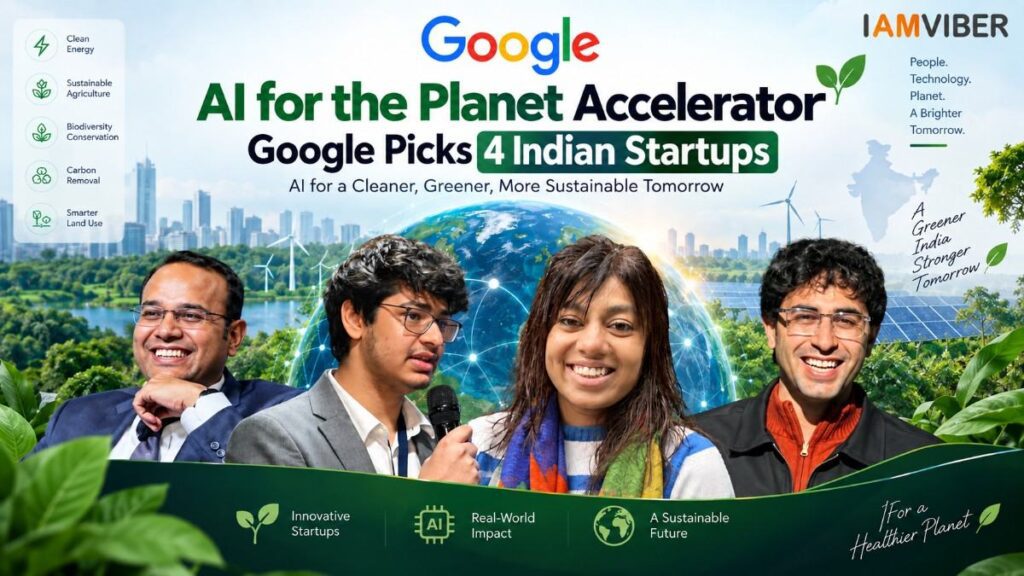
Google has selected four Indian startups for its debut AI for the Planet Accelerator, a new initiative focused on using artificial intelligence to tackle some of the Asia Pacific region’s most urgent environmental challenges.
The selected Indian startups — Terrastack, Varaha Climate, Farmers for Forests (F4F), and Climitra Carbon — are among 16 startups, nonprofits and research teams chosen across the APAC region for the programme.
The AI for the Planet Accelerator will provide participating organisations with access to Google’s latest AI technologies, technical support and expert mentorship over a three-month programme. The initiative is designed to help startups move from promising ideas and early-stage solutions towards scalable technologies capable of addressing real-world environmental problems.
The programme kicked off with a hands-on bootcamp in Singapore, bringing together teams working across areas such as agriculture, biodiversity, land intelligence, carbon removal and ecosystem restoration.
According to Google, participants will explore frontier AI models including AnthroKrishi, ForestCast, AlphaEarth Foundations, SpeciesNet and Perch to develop solutions for environmental monitoring, climate action and sustainable development.
What Is The AI for the Planet Accelerator?
The AI for the Planet Accelerator is Google’s new AI-focused accelerator programme for organisations working on environmental challenges across the Asia Pacific region.
Unlike conventional startup accelerators that may focus primarily on business growth, funding or market expansion, the programme places technology at the centre of environmental problem-solving.
Artificial intelligence can process enormous volumes of satellite imagery, agricultural data, climate information and ecological datasets. This makes it increasingly useful for monitoring environmental changes, improving resource efficiency and helping organisations make faster, data-driven decisions.
Through the AI for the Planet Accelerator, Google aims to give selected teams access to AI infrastructure, technical expertise and specialised models that could help them improve their existing solutions.
The initiative also highlights a broader shift taking place across the technology ecosystem. AI is increasingly being applied beyond consumer applications and enterprise software, with startups exploring how the technology can contribute to climate resilience, sustainable agriculture, biodiversity conservation and carbon removal.
For India, the development is particularly significant because the country faces complex environmental challenges involving agriculture, water consumption, land degradation, emissions and biodiversity.
Four Indian Startups Selected By Google
Four companies from India have been selected for the AI for the Planet Accelerator. Each startup is approaching environmental challenges from a different angle, ranging from rural land intelligence to carbon removal and ecosystem restoration.
Together, the startups demonstrate the growing diversity of Indian climate tech startups and their potential to combine technology with environmental impact.
1. Climitra Carbon
Founded: 2025
Founders: Shubhankar Mihir Seth, Shaurya Sharma and Aryaman Mihir Seth
Headquarters: Delhi NCR
Climitra Carbon is working at the intersection of waste management, industrial decarbonisation and carbon removal.
The startup focuses on converting waste biomass into industrial-grade bio-coal and biochar. Its bio-coal product is designed to serve as a direct replacement for fossil coal in steelmaking, while its biochar business focuses on permanent carbon dioxide removal.
The opportunity is significant because heavy industries such as steel remain among the more difficult sectors to decarbonise. Replacing fossil-based inputs with lower-carbon alternatives could therefore play an important role in reducing industrial emissions.
With the AI for the Planet Accelerator, Climitra Carbon could potentially explore new ways of using AI and data to improve monitoring, optimise processes and scale its climate-focused solutions.
The selection also puts the spotlight on how waste biomass can become a potential resource rather than simply an environmental liability.
2. Farmers for Forests
Founded: 2019
Founders: Krutika Ravishankar, Aditya Avinashe and Arti Dhar
Headquarters: Pune
Farmers for Forests, also known as F4F, takes a different approach to environmental restoration.
The organisation uses a Payment for Ecosystem Services (PES) model to encourage farmers and local communities to transform degraded land into biodiverse forests.
Its programmes cover several areas, including agroforestry, forest protection and restoration, urban biodiversity, prevention of human-elephant conflict, and climate and ecology education.
The central idea is to connect environmental conservation with economic incentives for communities. Instead of treating conservation as a standalone activity, F4F aims to create systems where farmers and communities can benefit from protecting and restoring ecosystems.
The AI for the Planet Accelerator could help organisations like F4F strengthen their ability to monitor ecosystems and understand environmental changes at scale.
AI-powered analysis of satellite imagery and ecological data can potentially support more efficient assessment of land restoration, biodiversity and forest health.
3. Terrastack
Founded: 2024
Founders: Aaryan Dangi and Milind Sohoni
Headquarters: Mumbai
Terrastack is building a geospatial data platform focused on rural land intelligence and transactions.
The startup combines satellite imagery, mapping tools and digital land records to structure and digitise information about rural land.
Its platform aims to digitise land boundaries and ownership while enabling governments and enterprises to analyse land-related information. It also focuses on simplifying land verification, transactions and governance.
Land data can be complex, fragmented and difficult to interpret, particularly in rural areas. By combining multiple datasets into a structured platform, Terrastack is attempting to make land information more accessible and useful.
Its participation in the AI for the Planet Accelerator could help advance the use of AI in geospatial intelligence, land analysis and environmental monitoring.
The company’s selection also demonstrates that climate-focused technology does not necessarily have to be limited to carbon credits or renewable energy. Better land intelligence can play a role in sustainable planning, resource management and environmental decision-making.
4. Varaha Climate
Founded: 2022
Founders: Madhur Jain, Ankita Garg and Vishal Kuchanur
Headquarters: Delhi NCR
Varaha Climate is one of the Indian companies selected for the AI for the Planet Accelerator and operates in the carbon dioxide removal and regenerative agriculture space.
The WestBridge-backed startup operates carbon dioxide removal projects across India, Nepal, Bangladesh, Bhutan and Ivory Coast.
Varaha works with smallholder farmers to promote regenerative agriculture and agroforestry while generating carbon credits that businesses can use to address their emissions.
The startup also plans to work with industrial companies by providing digital monitoring, reporting and verification services, along with carbon-credit origination capabilities.
Its approach combines agriculture, technology and carbon markets. By working directly with farmers, the company is also attempting to connect climate action with rural livelihoods.
Participation in the AI for the Planet Accelerator could provide another technological layer to this model, particularly in areas such as monitoring, measurement and verification.
Google’s Growing Climate Push In India
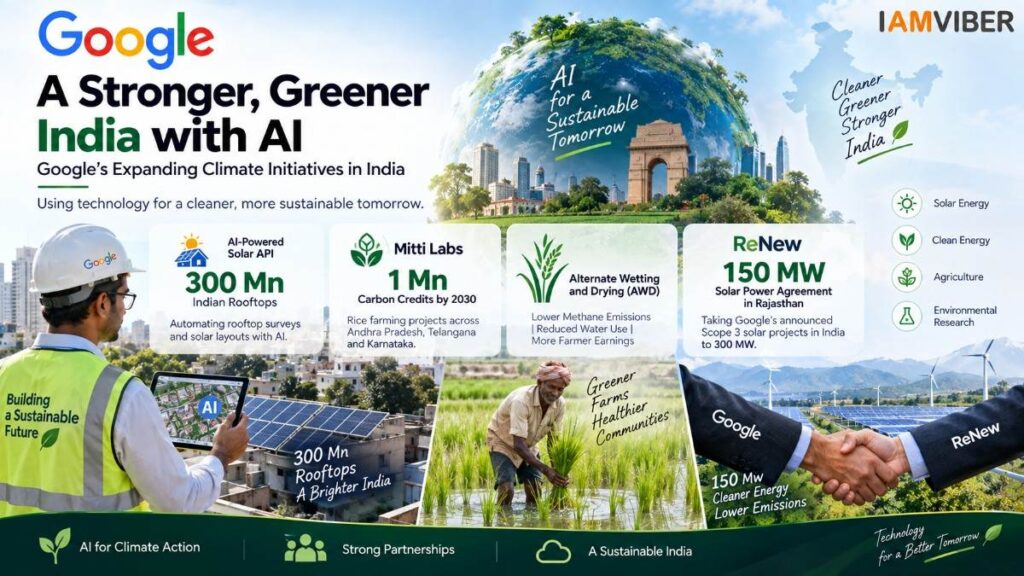
The launch of the AI for the Planet Accelerator comes as Google expands its broader climate and sustainability initiatives in India.
The company is working across areas including solar energy, clean energy, agriculture and environmental research.
One of its initiatives involves scaling its AI-powered Solar API across around 300 Mn Indian rooftops. The technology is designed to help automate rooftop surveys and solar layouts, potentially making solar planning more efficient.
Google has also entered into a four-year agreement with climate tech startup Mitti Labs to supply 1 Mn carbon credits through 2030, with financial terms undisclosed.
The carbon credits will come from rice farming projects across Andhra Pradesh, Telangana and Karnataka. Mitti Labs currently covers more than 1 Lakh hectares across these projects.
The startup uses alternate wetting and drying (AWD) techniques to reduce methane emissions and water consumption in rice cultivation while sharing carbon-credit revenue with farmers.
Its technology platform combines satellite data, remote sensing, field measurements and biogeochemical models to track emissions and water savings.
Google has also signed a long-term 150 MW solar power agreement with ReNew Power in Rajasthan. The agreement is aimed at addressing supply chain emissions and takes Google’s announced Scope 3 solar projects in India to 300 MW.
These initiatives indicate how climate tech in India is becoming increasingly connected to AI, data, renewable energy and carbon markets.
Why AI Matters For Climate Technology
The growing interest in AI for sustainability is being driven by the technology’s ability to analyse large and complex datasets.
Environmental systems generate enormous amounts of information. Satellite images, weather patterns, agricultural measurements, biodiversity observations and land records can all provide useful signals, but processing these datasets manually can be difficult and expensive.
AI can help identify patterns, automate analysis and potentially make environmental monitoring more scalable.
For example, AI can help analyse satellite imagery to identify changes in forests, monitor agricultural land or understand changes in ecosystems. It can also support forecasting, optimisation and data-driven decision-making.
This is where the AI for the Planet Accelerator could become particularly valuable for participating startups.
Access to advanced AI models and technical mentorship could allow these teams to experiment with applications that may otherwise require significant resources and specialised expertise.
The impact could extend beyond individual startups if successful solutions are eventually deployed across larger geographies or integrated into government and enterprise systems.
India’s Growing Climate Tech Opportunity
India is emerging as an important market for climate-focused innovation because of the scale and complexity of its environmental challenges.
Agriculture supports millions of livelihoods, while the country is simultaneously expanding renewable energy capacity, developing carbon markets and looking for ways to reduce emissions from major industries.
This creates opportunities for Indian climate tech startups to build solutions specifically designed for local conditions.
The four startups selected by Google represent different parts of this ecosystem.
Terrastack is focused on land intelligence. Farmers for Forests works on ecosystem restoration. Varaha Climate is developing carbon removal and regenerative agriculture projects, while Climitra Carbon is targeting industrial decarbonisation through biomass-based products.
Their diversity is important because climate change cannot be addressed through a single technology or business model.
The AI for the Planet Accelerator brings these different approaches into a common technology ecosystem, potentially allowing participating organisations to explore new ways of applying AI to their respective challenges.
What Happens Next?
The selected teams will participate in the three-month AI for the Planet Accelerator, receiving access to Google’s AI technology stack, technical guidance and expert mentorship.
The programme’s initial bootcamp in Singapore marks the beginning of this collaboration.
Over the coming months, the startups are expected to work on advancing their technology and exploring how frontier AI models can improve their environmental solutions.
For the four Indian startups, the programme could provide an opportunity to strengthen their technological capabilities while gaining exposure to a broader APAC ecosystem.
For Google, the programme represents another step in its effort to apply artificial intelligence to environmental challenges.
The bigger question will be how these technologies perform outside the accelerator environment and whether they can eventually be deployed at meaningful scale.
The Bigger Picture
The selection of four Indian startups for the AI for the Planet Accelerator reflects a broader convergence between artificial intelligence and climate technology.
From tracking forests and analysing land data to supporting regenerative agriculture and developing alternatives to fossil coal, startups are exploring increasingly specialised applications of technology to environmental problems.
The rise of AI for sustainability could accelerate this trend by making complex environmental data easier to analyse and act upon.
At the same time, technology alone will not solve climate challenges. Successful deployment will require strong partnerships with farmers, governments, enterprises, researchers and local communities.
For India, the combination of a large technology ecosystem, expanding climate-tech sector and significant environmental challenges creates a strong foundation for innovation.
The four startups selected for Google’s programme offer a glimpse into what that future could look like.
As the AI for the Planet Accelerator progresses, the focus will shift from potential to execution — and ultimately, from promising AI applications to measurable environmental impact.
If these startups can successfully translate advanced AI capabilities into practical solutions on the ground, the programme could become an important example of how artificial intelligence can contribute to India’s sustainability journey.
For the broader startup ecosystem, the message is equally clear: climate technology is no longer limited to traditional clean-energy businesses. Data, artificial intelligence, geospatial intelligence, regenerative agriculture, biodiversity and carbon removal are becoming increasingly important parts of the next generation of environmental innovation.
Topics to follow on IAMVIEBR : Current Affairs & Insights Tech Innovation GenZ entrepreneurship Collaborative Fashion GEO SME