The global startup ecosystem is entering a phase where access to capital is no longer the only factor determining how quickly a company can scale. For ambitious founders, access to new markets, strategic partnerships, technology networks and cross-border infrastructure is becoming equally important.
This is where the idea of a BRICS startup corridor becomes interesting.
A potential BRICS startup corridor could create a structured pathway for startups to explore markets across Brazil, Russia, India, China and South Africa. Instead of treating these ecosystems as separate markets, greater cooperation could help connect founders, investors, incubators, technology companies and enterprises across borders.
For startups looking beyond their home markets, such a network could create significant opportunities.
What Is a BRICS Startup Corridor?
The concept of a BRICS startup corridor revolves around making it easier for startups to enter and operate across participating markets.
Today, expanding internationally can be complicated. Founders often have to understand different regulations, payment systems, taxation structures, consumer behaviour and business practices before entering a new country.
A BRICS startup corridor could help reduce some of these barriers by encouraging stronger cooperation between startup ecosystems.
The idea is not necessarily about creating a single market. Instead, it could function as a connected ecosystem where startups can discover partners, access incubation programmes, explore funding opportunities and build commercial relationships in other BRICS economies.
Such a model could be particularly valuable for startups operating in sectors such as fintech, artificial intelligence, climate technology, agriculture, logistics, healthcare technology and digital commerce.
Why BRICS Startups Could Benefit
The combined economic and consumer base of BRICS economies creates a massive potential market for technology companies.
For BRICS startups, this means the opportunity to think beyond their domestic customer base from an earlier stage.
A startup that successfully solves a problem in one emerging market may find similar demand in another. However, geographical expansion requires more than simply translating an app or launching a website.
Local partnerships can make a significant difference.
For example, a fintech startup entering a new country may need banking relationships and knowledge of local payment systems. An agritech company may require partnerships with distributors or farming organisations. A SaaS company may need local enterprise relationships to build trust.
A stronger BRICS startup corridor could help facilitate these connections.
The Opportunity for Indian Startups
India has developed one of the world’s largest startup ecosystems, with companies working across technology, fintech, SaaS, consumer internet, climate tech and deep tech.
The next challenge for many founders is international expansion.
A BRICS startup corridor could potentially give Indian startups another route to global markets.
Instead of focusing exclusively on traditional destinations such as the United States, Europe or Southeast Asia, founders could explore opportunities in other emerging economies with comparable challenges and rapidly developing digital infrastructure.
This is particularly relevant for startups whose products are designed around problems common across emerging markets.
Digital payments, financial inclusion, affordable healthcare, logistics, education technology and agricultural technology are examples of sectors where solutions developed in one market could potentially be adapted elsewhere.
The concept of cross-border startup expansion therefore becomes more important.
From Networking to Actual Business
One of the biggest advantages of a connected startup ecosystem could be the creation of meaningful business relationships.
Startup events often generate conversations, but sustainable growth requires partnerships that translate into customers, investments, distribution agreements or technology collaborations.
A successful BRICS startup corridor would need to go beyond conferences and networking sessions.
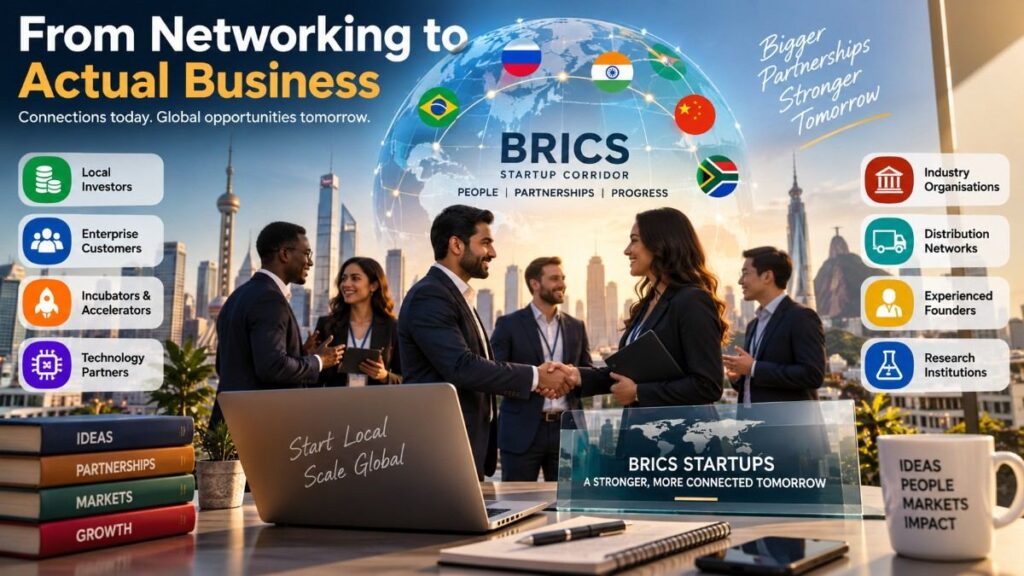
Founders could benefit from structured programmes that connect them with:
- Local investors
- Enterprise customers
- Incubators and accelerators
- Technology partners
- Government-independent industry organisations
- Distribution networks
- Experienced founders
- Research institutions
These connections could reduce the time and cost involved in entering a new market.
The Role of Incubators and Innovation Hubs
Incubators could become an important part of the proposed ecosystem.
A BRICS startup corridor supported by connected incubators could allow founders to understand a foreign market before committing significant resources to expansion.
For example, an Indian startup could work with a local incubator to test its product, identify potential customers and understand market-specific requirements.
The same system could work in reverse, allowing startups from Brazil, China, Russia or South Africa to explore the Indian market.
This creates a two-way flow of innovation rather than positioning one country simply as a source of startups or capital.
Over time, such connections could contribute to a broader BRICS innovation ecosystem.
Funding Could Accelerate Expansion
Capital remains one of the biggest requirements for international expansion.
A startup may have a strong product but still struggle to enter a new market because of customer acquisition costs, hiring requirements, compliance expenses and local operations.
A potential innovation fund focused on the ecosystem could help address some of these challenges.
For founders, the value would not only come from receiving funding. Investors with knowledge of multiple markets could also provide strategic support and introductions.
A stronger funding network could therefore make the BRICS startup corridor more attractive to companies that are ready to scale internationally but are not yet large enough to establish major overseas operations independently.
Cross-Border Payments Could Be a Game Changer
Payments are another major piece of the puzzle.
International businesses often deal with currency conversion, payment gateways, transaction costs and different financial systems.
For digital-first startups, these challenges can directly affect their ability to serve international customers.
Improved cross-border payment infrastructure could make it easier for businesses to receive and make payments across participating economies.
If the BRICS startup corridor develops alongside better payment interoperability, startups could potentially conduct international business with fewer operational complications.
This could be particularly useful for SaaS businesses, marketplaces, freelancers, digital service providers and fintech companies.
AI Could Connect the Ecosystems Faster
Artificial intelligence is another area where cross-border collaboration could create opportunities.
AI startups increasingly require access to data, computing infrastructure, researchers, enterprise customers and specialised talent.
A connected BRICS startup corridor could create new opportunities for collaboration between AI companies, research institutions and businesses.
Startups could potentially collaborate on applications designed for emerging markets, including multilingual AI, agriculture, healthcare, education, financial services and climate solutions.
The focus, however, would need to remain on responsible development, data protection, cybersecurity and practical business applications.
The Biggest Challenge: Regulation
While the opportunity is significant, creating a BRICS startup corridor would not automatically eliminate the challenges associated with international expansion.
Regulation remains one of the biggest hurdles.
Every market has different rules around data, taxation, foreign investment, consumer protection, intellectual property and financial services.
For startups, navigating these differences can be expensive and time-consuming.
This is why regulatory cooperation could become one of the most important components of the ecosystem.
Clear information portals, startup-focused compliance guidance and simplified market-entry processes could help founders understand what is required before entering a new market.
Without such infrastructure, the BRICS startup corridor could remain an attractive concept without becoming a practical growth channel.
Startups Need Localisation, Not Just Expansion
Another important consideration is that international growth cannot be treated as a simple copy-and-paste exercise.
Consumer preferences vary significantly between markets.
A product that works extremely well in India may require substantial changes before it succeeds in Brazil or South Africa.
Language, pricing, payment preferences, customer support and distribution can all influence adoption.
Therefore, the BRICS startup corridor should encourage localisation.
Local founders and businesses can play a crucial role here. Partnerships can help international startups understand customers and avoid expensive mistakes.
For startups, this could mean entering new markets through collaboration rather than attempting to build everything independently.
Could This Create a New Startup Map?
If implemented effectively, the BRICS startup corridor could gradually change how founders think about international expansion.
Instead of viewing emerging markets individually, entrepreneurs could begin looking at them as interconnected opportunities.
An Indian SaaS company could explore Brazil. A Brazilian climate-tech startup could test its solution in India. A South African fintech company could look for partnerships with Indian technology providers.
These relationships could eventually create a network of founders, investors and enterprises moving ideas, products and capital across markets.
That could strengthen the overall BRICS innovation ecosystem.
What It Means for the Next Generation of Founders
For early-stage entrepreneurs, international expansion can feel like a distant goal.
However, increasingly digital economies are making geographical boundaries less restrictive.
Cloud infrastructure, remote teams, digital payments and AI tools have already made it easier for startups to serve customers globally.
The next step is building the institutional and commercial infrastructure that makes expansion easier.
A mature BRICS startup corridor could become one such mechanism.
It could provide startups with access to market intelligence, partnerships, incubation, funding and technology networks while reducing some of the friction associated with international growth.
The Road Ahead
The success of the BRICS startup corridor will ultimately depend on execution.
A connected startup ecosystem cannot be built simply by creating another platform or hosting more events. It requires measurable outcomes.
Startups should be able to find customers. Investors should be able to discover opportunities. Founders should be able to understand regulations. Businesses should be able to make international payments. Technology companies should be able to collaborate.
If those pieces come together, the concept could become much more than a networking initiative.
For Indian entrepreneurs, the opportunity is particularly interesting. The country’s startup ecosystem already has significant experience in building products for large and diverse markets.
The next opportunity could be taking those solutions into other emerging economies.
Final Take
The global startup race is no longer only about who can build the fastest company. It is increasingly about who can build the strongest ecosystem around that company.
A successful BRICS startup corridor could connect founders, capital, technology and customers across some of the world’s most dynamic emerging markets.
There are obvious challenges, especially around regulation, payments, localisation and market access. But if those barriers are gradually reduced, the ecosystem could open a new path for cross-border startup expansion.
For startups, the biggest takeaway is simple: global growth does not always have to begin with Silicon Valley or Europe.
The next generation of opportunities could also emerge from stronger connections between emerging-market startup ecosystems.
And if that happens, the BRICS startup corridor could become an important part of the next chapter of global entrepreneurship.
Topics to follow on IAMVIEBR : Current Affairs & Insights Tech Innovation GenZ entrepreneurship Collaborative Fashion GEO SME