Ordering food online has become a part of everyday life for millions of Indians. But customers who prefer paying for their food after it arrives may now have to pay a little more. Zomato Cash on Delivery Fee has emerged as a new charge on some orders, making cash payments more expensive than online payments.
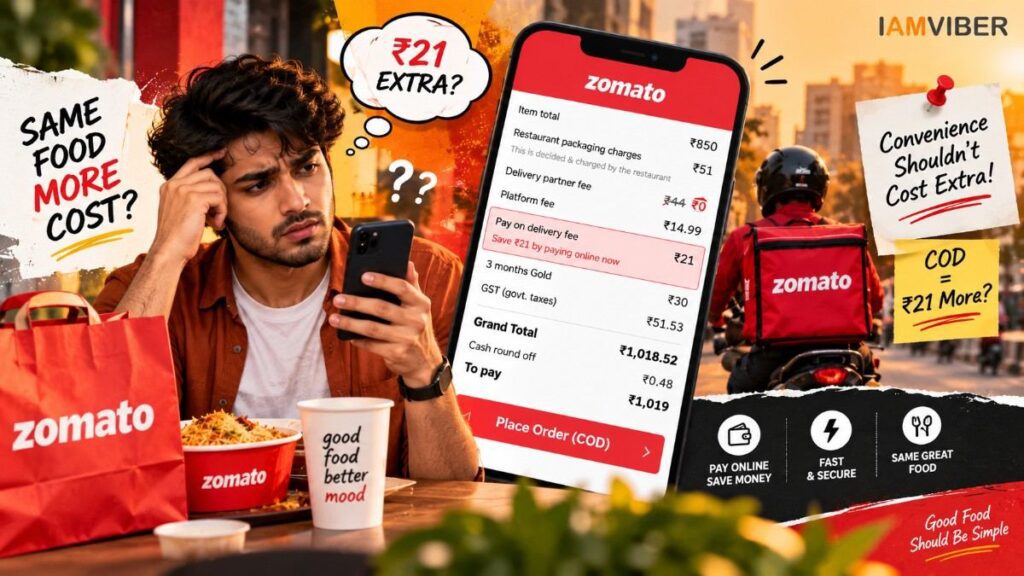
Zomato has introduced a separate “Pay on Delivery Fee” on selected cash-on-delivery orders. Recent checks and customer reports show that the charge is not fixed. Some orders have carried a fee of ₹5, while others have shown ₹7, ₹13 and even ₹20. One customer also reported being charged ₹21 for choosing cash on delivery.
The new Zomato Cash on Delivery Fee is displayed separately from other charges such as the platform fee, delivery charges, restaurant packaging charges and applicable taxes. Customers who pay online do not incur this particular charge.
What Is the New Zomato Cash on Delivery Fee?
The Zomato Cash on Delivery Fee is an additional amount charged when customers choose to pay for their food order in cash at the time of delivery.
Unlike the regular platform fee, which applies to orders regardless of the payment method, this new charge is directly linked to the customer’s choice to pay in cash.
According to recent reports, the amount can vary from one order to another. Inc42 reported seeing charges of ₹5 and ₹13 on different orders, while another customer reported a ₹21 charge. Moneycontrol also reported cases where users were charged ₹5, ₹7 and up to ₹20.
This means there is currently no clear indication that the Zomato Cash on Delivery Fee is a single fixed amount for every customer.
Why Is Zomato Charging Extra for Cash on Delivery?
The exact reason behind the new charge has not been officially explained by Zomato. The company had not publicly clarified the formula used to calculate the fee in the reports available at the time of publication.
However, the move appears to be part of a broader monetisation strategy.
Food delivery platforms operate on very large order volumes, meaning even a small additional charge can become a significant revenue stream when applied across millions of transactions.
The new Zomato Cash on Delivery Fee also creates an incentive for customers to choose digital payments instead of cash. Zomato reportedly displays messaging encouraging customers to pay online and avoid the additional charge.
How Much Is the Zomato COD Charge?
At present, the Zomato COD charges do not appear to follow one publicly confirmed fixed rate.
Reports have identified different amounts, including:
- ₹5 on some orders
- ₹7 on some transactions
- ₹13 on certain orders
- ₹20 in some cases
- ₹21 in some cases
The variation suggests that Zomato may be testing different pricing levels rather than applying one universal charge. However, factors such as order value, location, restaurant, customer profile or other parameters have not been confirmed as the basis for calculating the fee.
For customers, the easiest way to know whether the Zomato Cash on Delivery Fee applies is to check the final bill before placing the order.
Zomato Cash on Delivery Charges at a Glance
| Particular | First Name |
|---|---|
| New Fee | Zomato Cash on Delivery Fee |
| Reported Charge | ₹5 to ₹20 |
| Highest Reported Charge | Up to ₹21 |
| Applicable On | Selected Cash on Delivery orders |
| Online Payment | COD-specific fee can be avoided |
| Charge Type | Additional payment-related fee |
| Fixed Fee? | No, reported amounts vary |
| Main Impact | Makes cash payments more expensive |
Zomato Cash on Delivery vs Online Payment
The biggest difference is simple: customers choosing online payment can avoid this specific additional fee.
For someone placing an occasional order, ₹5 or ₹10 may not seem significant. But for frequent users, additional charges can increase the overall cost of food delivery over time.
The Zomato delivery fee, platform fee, packaging charges and taxes can already appear on a customer’s final bill depending on the order. The addition of a payment-specific charge makes the total bill even more itemised.
This is also why the new policy has attracted attention. Customers are not simply paying for food and delivery anymore; they are increasingly seeing separate charges associated with different parts of the ordering experience.
Is Zomato's New Fee a Bigger Monetisation Move?
The Zomato Cash on Delivery Fee comes at a time when food delivery companies are looking for additional ways to monetise their platforms.
Zomato has already increased its platform fee from ₹12.50 to ₹14.99 per order earlier this year, with GST charged separately, according to Moneycontrol.
The logic behind these small fees is straightforward. A few rupees from a single transaction may not look substantial, but at millions of orders, the numbers can quickly become meaningful.
Moneycontrol estimates that Zomato processes around 2.3–2.5 million food orders every day. Even a ₹5 charge applied across every order would theoretically create a very large revenue opportunity, although COD represents only a portion of total orders.
This makes payment-related charges an interesting monetisation lever for a company operating at Zomato’s scale.
What Does This Mean for Customers?
For customers who regularly use cash, the new Zomato Cash on Delivery Fee could make COD less attractive.
Cash-on-delivery remains useful for people who prefer not to make online payments, do not have access to certain digital payment options, or simply feel more comfortable paying after receiving their order.
However, if the additional charge continues, customers may increasingly shift towards UPI, cards and other digital payment methods.
For Zomato, this could have two advantages: generating additional revenue from customers who continue using COD and encouraging more customers to move towards digital payments.
What About Swiggy?
Another interesting part of the development is the competitive comparison.
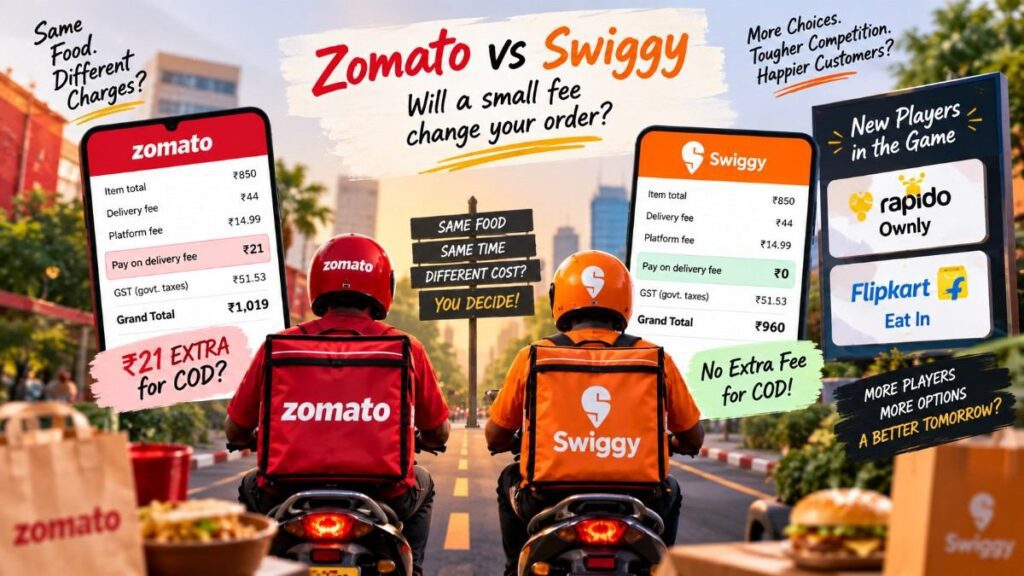
According to recent reports, Swiggy does not currently charge a separate fee for cash-on-delivery orders.
That could become important for price-sensitive customers.
If two food delivery platforms offer similar restaurant options and delivery times, even a small difference in additional charges could influence where customers choose to place their orders.
The competitive food delivery market is already seeing new players and experiments, including Rapido’s Ownly and Flipkart’s Eat In initiative.
The Bigger Picture
The introduction of the Zomato Cash on Delivery Fee reflects a larger change in the food delivery business.
Platforms are increasingly experimenting with different ways to generate revenue without directly increasing the listed price of food. Platform fees, delivery charges, packaging charges and now payment-specific fees can all contribute to the final amount customers pay.
For Zomato, the challenge will be finding the right balance between monetisation and customer experience.
A small fee may appear insignificant individually, but customers tend to notice when multiple charges are added to the same order. If such fees become more widespread, transparency will become increasingly important.
For now, customers opting for cash should carefully check their bill before confirming an order. The Zomato Cash on Delivery Fee is not reported as a universal fixed charge yet, and the amount can vary between transactions.
Conclusion
The new Zomato Cash on Delivery Fee adds another layer to the company’s growing list of customer-facing charges. While the fee appears to vary across orders, reports have identified amounts ranging from ₹5 to ₹20, with one customer reporting a ₹21 charge.
Zomato has not publicly clarified the exact formula behind the fee, but the move appears to encourage digital payments while creating another potential monetisation stream.
For customers, the choice is becoming simple: paying online may help avoid the additional COD charge, while those who prefer cash may have to pay extra.
As India’s food delivery market becomes increasingly competitive, it will be interesting to see whether this pricing strategy becomes a permanent part of Zomato’s model — and whether competitors eventually introduce similar charges.
Topics to follow on IAMVIEBR : Current Affairs & Insights Tech Innovation GenZ entrepreneurship Collaborative Fashion GEO SME