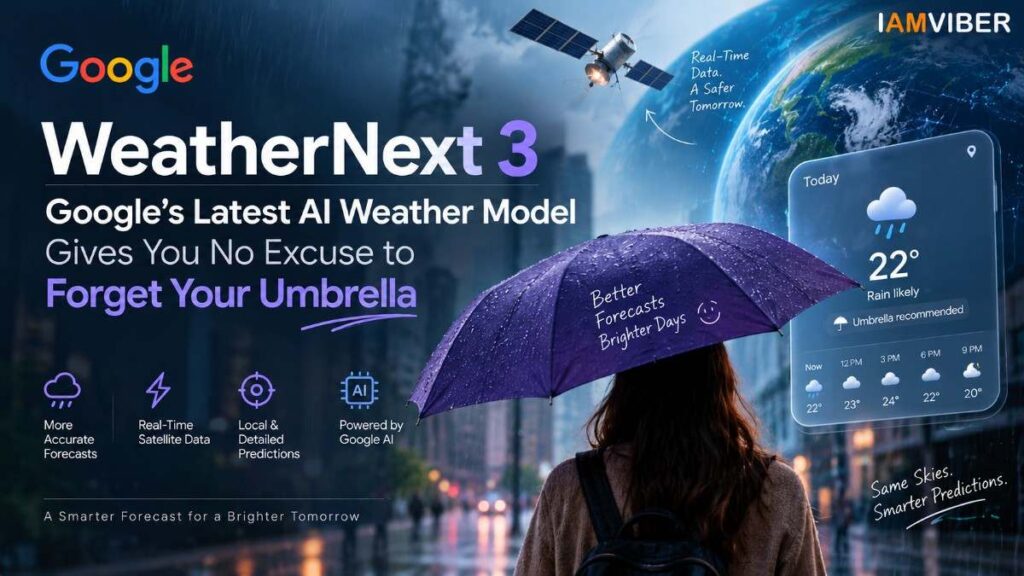
Google’s Latest AI Weather Model Gives You No Excuse to Forget Your Umbrella
For most people, checking the weather before leaving home is a simple routine. Is it going to rain? Will it be too hot? Should I carry a jacket?
Now, Google wants to make those answers much more precise.
On September 3, 2026, Google DeepMind introduced WeatherNext 3, its latest global weather AI model. The system is designed to produce forecasts every hour, use real-time satellite observations, and deliver higher-resolution predictions for changing weather conditions.
And while that might sound like another technical AI announcement, the everyday benefit is surprisingly simple.
You may have fewer excuses for leaving your umbrella at home.
What Is WeatherNext 3?
WeatherNext3 is Google’s newest AI-powered system for global weather forecasting.
Unlike traditional forecasting approaches that rely heavily on complex physics-based simulations, WeatherNext 3 learns from real-world observations and directly incorporates live satellite imagery. Google says this allows the model to generate forecasts every hour and provide a more detailed view of rapidly changing weather.
That hourly refresh is a major part of the story.
Weather doesn’t politely wait for a forecast to update.
A storm can develop quickly. Rain can arrive earlier than expected. A sunny afternoon can suddenly turn cloudy.
With WeatherNext3, Google is trying to make weather information respond faster to those changes.
Why WeatherNext 3 Could Make Weather Forecasts Better
The biggest challenge with weather forecasting isn’t simply predicting whether tomorrow will be hot or cold. It’s predicting where and when conditions will change.
A weather system can behave differently just a few kilometres away. Mountains, coastlines, cities and other geographical features can all influence local conditions.
That’s where WeatherNext3 is designed to make a difference.
Google says its new model provides temperature and humidity information at a 5-kilometre resolution, while other surface variables such as wind are available at 10-kilometre resolution. Atmospheric variables can be represented at 25-kilometre resolution.
Compared with WeatherNext 2’s 25-kilometre grid and six-hour forecast increments, Google says WeatherNext3 offers a weather picture that is roughly five times sharper overall.
That’s a significant improvement when you’re interested in what’s happening close to you rather than across an entire region.
WeatherNext 3 Uses Real-Time Satellite Data
One of the most interesting things about WeatherNext3 is where its information comes from.
The model directly uses raw satellite imagery from geostationary satellites. This gives it a continuously updating view of the atmosphere rather than relying only on older forecast information.
Why does that matter?
Imagine a rain system forming over your city.
A forecast generated several hours ago may not fully capture how quickly that system is developing. By incorporating more recent observations, WeatherNext 3 can create a new forecast every hour.
That doesn’t mean the model can see the future perfectly.
But it means the forecast can be refreshed with a much more current picture of what’s happening above us.
Better Rain Predictions Are the Real Game Changer
Temperature forecasts are useful, but precipitation is where weather forecasting becomes genuinely frustrating.
You can plan around heat.
You can dress for cold.
But unexpected rain can destroy an outdoor plan in minutes.
This is why WeatherNext3 puts significant emphasis on precipitation forecasting.
Google says the model was trained using high-quality precipitation datasets, including NASA’s IMERG satellite-based observations and its own global precipitation reanalysis. The company reports significant improvements in precipitation forecast accuracy compared with several baseline systems.
For ordinary users, this could eventually translate into a more useful Google weather forecast.
Instead of simply asking whether there’s a chance of rain sometime during the day, people can increasingly get information about how conditions may evolve over time.
And that makes the humble umbrella a surprisingly good test of AI forecasting.
How WeatherNext 3 Could Help in Everyday Life
The practical applications of WeatherNext3 go well beyond umbrellas.
Think about someone planning a weekend picnic.
They don’t need a complicated meteorological report. They need to know whether the weather is likely to cooperate.
A delivery company needs to know whether severe weather could affect routes.
A farmer needs information about rain, temperature and humidity.
A traveller wants to know whether conditions could affect a journey.
An event organizer needs to decide whether an outdoor event is realistic.
In each situation, better AI weather forecasting can turn complicated atmospheric information into something people can actually use.
That’s the larger goal behind WeatherNext 3.
WeatherNext 3 Is Also Designed for Businesses
Google isn’t building WeatherNext3 only for consumers.
The company says the model is designed for industry applications as well, including renewable-energy forecasting. It can provide information such as wind speed, cloud cover and solar radiation that can help wind and solar operators manage their assets more efficiently.
That is important because weather has a direct financial impact on many industries.
A solar farm needs to estimate how much sunlight will reach its panels.
A wind farm needs to understand expected wind conditions.
Agriculture depends heavily on rainfall and temperature.
Transportation networks have to deal with storms and extreme conditions.
For these industries, even a relatively small improvement in forecasting can potentially make planning more efficient.
WeatherNext 3 Is Coming to Google Search, Maps and Gemini
You won’t necessarily need to become a weather expert to benefit from WeatherNext3.
Google says the model is being integrated into products including Search, Gemini and Maps. It is also available through Google Maps Platform and Google Cloud for developers and businesses.
That makes the technology much more interesting.
AI forecasting doesn’t have to exist as a separate application.
It can become part of the tools people already use.
You search for a destination.
You check Maps before leaving.
You ask Gemini about tomorrow’s weather.
The underlying forecast technology can quietly improve those experiences.
This is one reason WeatherNext3 could have a bigger impact than its technical name suggests.
Is WeatherNext 3 Actually More Accurate?
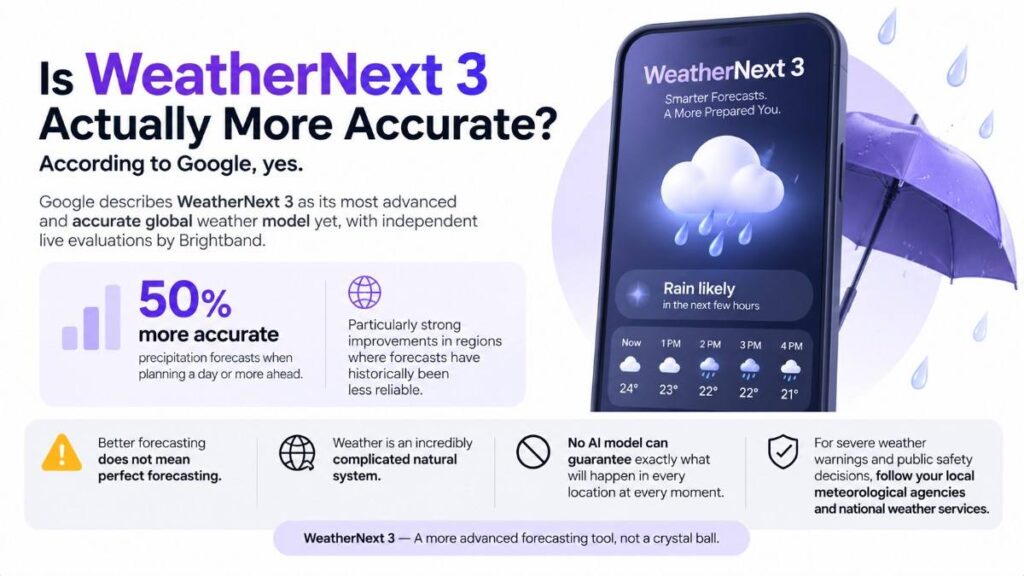
According to Google, yes.
Google describes WeatherNext3 as its most advanced and accurate global weather model yet and cites independent live evaluations by Brightband. The company also says that, when planning a day or more ahead, users can see precipitation forecasts that are up to 50% more accurate, with particularly strong improvements in regions where forecasts have historically been less reliable.
However, there’s an important distinction here.
Better forecasting does not mean perfect forecasting.
Weather is still an incredibly complicated natural system.
No AI model can guarantee exactly what will happen in every location at every moment.
That’s why WeatherNext 3 should be viewed as a more advanced forecasting tool, not a crystal ball.
For severe weather warnings and public safety decisions, people should continue to follow their local meteorological agencies and national weather services. Google also gives this guidance for its experimental Weather Lab.
How WeatherNext 3 Builds on Earlier AI Weather Models
Google’s work in AI weather forecasting didn’t begin with WeatherNext 3.
Google DeepMind has previously developed models such as GraphCast and GenCast.
GraphCast demonstrated that AI could produce global weather forecasts efficiently, while GenCast introduced an ensemble approach capable of generating multiple possible weather scenarios.
More recently, Google’s WeatherNext technology was also used for cyclone forecasting.
Google DeepMind reported in August 2026 that WeatherNext achieved state-of-the-art results in forecasting cyclone track, intensity and wind structure.
So, WeatherNext 3 isn’t an isolated experiment. It’s the latest step in Google’s broader attempt to use machine learning to improve how weather is predicted.
Why Weather Prediction AI Matters More Than Ever
Weather forecasting isn’t just about deciding what clothes to wear. Extreme weather can affect food production, energy, transportation, supply chains and entire economies.
This is where weather prediction AI becomes particularly important.
If forecasting systems can identify changing conditions earlier and with greater local detail, organizations may have more time to respond.
A farmer could adjust plans.
A renewable-energy operator could prepare for changing production.
An emergency team could monitor developing conditions.
A traveller could change a route.
These decisions may seem unrelated, but they all depend on one thing: knowing what the atmosphere is likely to do next.
What Makes WeatherNext 3 Different From a Normal Weather App?
It’s worth making one thing clear.
WeatherNext 3 isn’t simply a new weather app with a different interface.
It is an underlying forecasting model.
The model generates weather information that can then be used by products and services such as Google Search, Gemini and Maps.
Think of it as the engine underneath the experience.
The user doesn’t necessarily need to know which model generated the forecast.
They simply see better information when they need it.
That approach could eventually make advanced AI weather forecasting feel completely normal.
Can WeatherNext 3 Predict Every Rain Shower?
No—and that’s important.
Even with better satellite data, higher resolution and hourly updates, weather remains unpredictable.
WeatherNext 3 can improve probabilities and provide more detailed forecasts, but it cannot guarantee that every forecast will be correct.
A rain cloud can change direction.
A storm can weaken.
A local weather event can develop differently from what a model expects.
So while WeatherNext 3 could make it easier to decide whether you need an umbrella, you probably shouldn’t throw your umbrella away just yet.
The Future of Google Weather Forecasts
The bigger story behind WeatherNext 3 is that weather forecasting is becoming increasingly connected to artificial intelligence.
Google is effectively trying to make forecasts:
- Faster, with hourly updates.
- More local, with higher-resolution information.
- More responsive, through live satellite observations.
- More useful, with improved precipitation predictions.
- More accessible, through Search, Maps and Gemini.
And that’s where this technology could become genuinely valuable.
People don’t necessarily want more weather data.
They want better decisions.
Should I leave now?
Should I postpone the trip?
Should I carry an umbrella?
Should I cancel the outdoor event?
A good forecast turns complicated data into a simple answer.
Final Thoughts
WeatherNext 3 is another example of how AI is moving beyond chatbots and content generation and into systems that influence everyday decisions.
Google’s newest model combines real-time satellite observations, hourly forecasting and higher-resolution predictions to create a more detailed picture of changing weather conditions.
The technology could help ordinary users plan their days while also supporting industries such as agriculture, transportation and renewable energy.
But perhaps the easiest way to understand the value of WeatherNext 3 is to think about the smallest possible decision.
You’re standing at the door.
The sky looks fine.
You check your phone.
The forecast says rain is moving toward your area.
You grab the umbrella.
That’s AI weather forecasting doing exactly what it’s supposed to do: turning incredibly complicated science into one simple, useful decision.
And if WeatherNext 3 keeps getting better, forgetting your umbrella might soon be less about the forecast—and more about you ignoring it.
Frequently Asked Questions
1. What is WeatherNext 3?
WeatherNext 3 is Google’s latest AI-powered weather forecasting model, designed to provide faster, more detailed, and higher-resolution global weather predictions.
2. How does WeatherNext 3 improve weather forecasting?
WeatherNext 3 uses AI and real-time satellite observations to generate updated forecasts every hour, helping capture rapidly changing weather conditions more effectively.
3. Is WeatherNext 3 more accurate than traditional weather models?
According to Google, WeatherNext 3 delivers improved forecasting accuracy, particularly for precipitation and other rapidly changing weather conditions. However, no weather model can predict every event perfectly.
4. Can WeatherNext 3 predict rain accurately?
WeatherNext 3 is specifically designed to improve precipitation forecasting. Its more frequent updates can help provide a clearer picture of when and where rain or snow may occur.
5. Where will WeatherNext 3 be available?
Google says WeatherNext 3 is being integrated into products and services including Google Search, Gemini, Google Maps, Google Maps Platform, and Google Cloud.
6. How does WeatherNext 3 use satellite data?
WeatherNext 3 directly incorporates raw imagery from geostationary satellites, giving the AI more recent information about atmospheric conditions and helping it update forecasts more frequently.
7. Can WeatherNext 3 help businesses?
Yes. It can support industries affected by weather, including renewable energy, agriculture, transportation, and other businesses that rely on accurate weather information for planning.
8. Does WeatherNext 3 mean you will never need an umbrella?
Not quite! It can make rain forecasts more useful and timely, but weather remains unpredictable. So it’s still smart to check the latest forecast—and keep an umbrella nearby when rain is possible.
Topics to follow on IAMVIEBR : Current Affairs & Insights Tech Innovation GenZ entrepreneurship Collaborative Fashion GEO SME