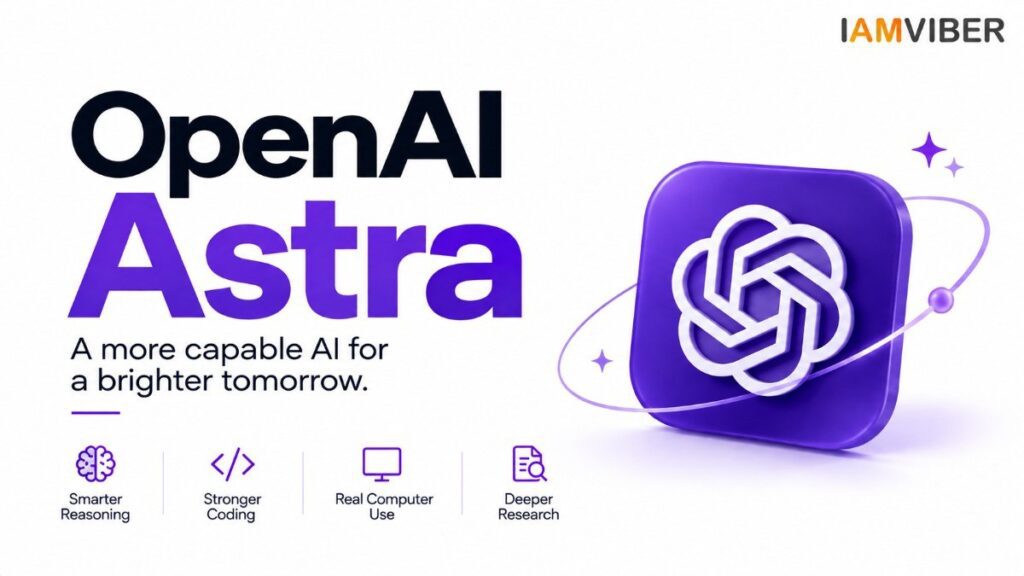
OpenAI Launches Astra: Its Powerful and Controversial New AI Model
Artificial intelligence is moving faster than most people expected. Every few months, a new model arrives promising better reasoning, stronger coding, smarter research, or more useful AI agents. But OpenAI Astra is getting attention for a different reason: it represents a bigger shift in what people expect an AI system to actually do.
Rather than simply answering questions, the new generation of AI is increasingly being designed to work through complex tasks, interact with digital tools, write and analyze code, conduct research, and complete multi-step workflows.
That makes the OpenAI Astra AI model interesting not only for developers and AI enthusiasts, but also for businesses and professionals who are watching how quickly AI is changing everyday work.
So, what exactly is Astra, what makes it different, and why has its launch created so much discussion?
What Is OpenAI Astra?
OpenAI Astra is positioned as a powerful new AI model focused on more advanced reasoning and task completion.
Traditional chatbots are largely reactive. You ask a question, and the model gives you an answer. More advanced AI systems are moving toward something different: they can break a complicated request into smaller steps and work through those steps using available tools.
That is where Astra becomes particularly interesting.
The model is designed around capabilities such as reasoning, coding, research, computer interaction, and handling longer workflows. Instead of simply telling a user how something could be done, an AI agent can potentially carry out more of the process itself.
This is an important evolution because the future of AI may not be about having the smartest chatbot. It may be about having the most capable digital assistant.
What Makes the Astra AI Model Different?
One of the biggest changes is the model’s focus on action rather than just generation.
Earlier AI tools became popular because they could write emails, summarize documents, create images, answer questions, and generate code. Those capabilities are still useful, but they generally require the user to take the next step.
For example, an AI might create a piece of code, but the developer still has to test it, identify problems, modify it, and deploy it.
A more capable agent could potentially handle several of these steps itself.
The same idea applies to business research.
Instead of asking an AI to summarize five websites, users could increasingly ask an agent to research a topic, compare information, organize the findings, prepare a report, and present the results.
That is the larger direction represented by the Astra AI model.
OpenAI Astra Features: What Can It Do?
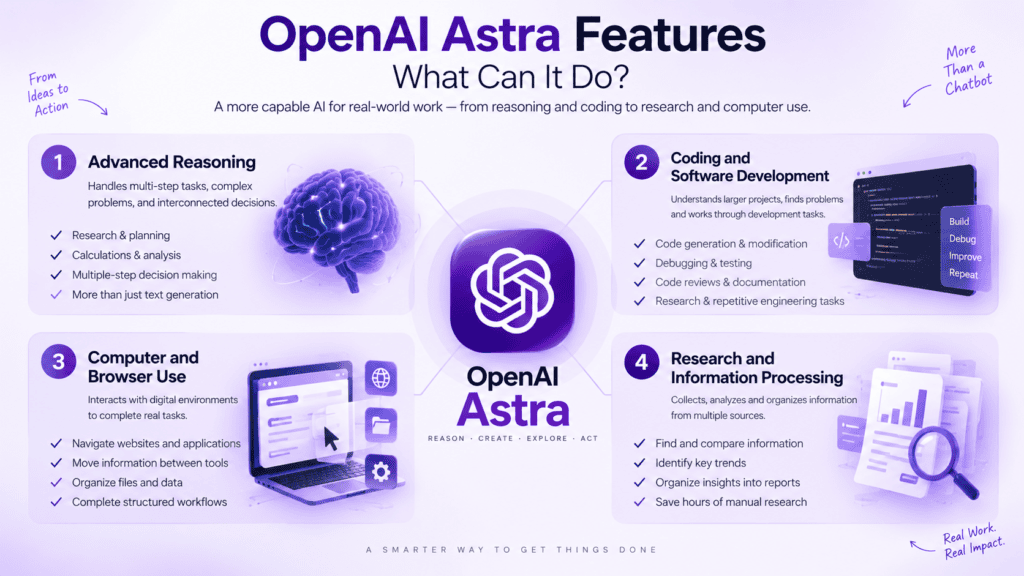
The most interesting OpenAI Astra features revolve around complex digital tasks.
1. Advanced Reasoning
Astra is designed to handle tasks that require multiple steps rather than producing an immediate response.
This matters when a problem involves research, planning, calculations, code, or several interconnected decisions. The goal is to make AI more useful for work where simply generating text is not enough.
2. Coding and Software Development
Coding is another major area where advanced AI models are making rapid progress.
Instead of only generating individual functions or snippets, newer systems are becoming better at understanding larger projects, identifying problems, modifying code, and working through development tasks.
For software teams, this could mean AI becoming more deeply integrated into the development process.
Developers could use systems like Astra for debugging, code reviews, documentation, testing, research, and repetitive engineering tasks. The human developer would still remain important, particularly for architecture, product decisions, security, and final approval.
3. Computer and Browser Use
Perhaps the most exciting capability is the ability of AI agents to interact with computers.
An AI that can understand what is displayed on a screen and take actions inside digital environments can potentially complete tasks that previously required a human to manually operate software.
Think about repetitive activities such as moving information between applications, organizing files, researching information online, or completing structured workflows.
This is where AI starts looking less like a chatbot and more like a digital employee.
4. Research and Information Processing
Modern work often involves collecting information from multiple sources and turning it into something useful.
Advanced AI can potentially help with this entire process.
A user might start with a broad question and ask the system to investigate the topic, compare sources, identify important trends, and organize the information into a report.
That could save professionals hours of repetitive research work.
Why Is OpenAI Astra Controversial?
The excitement surrounding Astra comes with an obvious concern: the more capable an AI becomes, the more important its safety controls become.
When an AI only generates text, mistakes can usually be corrected relatively easily.
But when an AI can interact with software, access tools, modify files, execute code, or perform long-running tasks, mistakes can have much larger consequences.
This is particularly important in cybersecurity.
A highly capable AI can potentially help security professionals discover vulnerabilities, analyze systems, and respond to threats faster.
At the same time, similar capabilities could potentially be misused.
That creates a difficult balancing act for AI companies. They need to make models powerful enough to be genuinely useful while also ensuring that those capabilities cannot easily be turned into harmful actions.
OpenAI Astra and the Future of AI Agents
The OpenAI Astra launch is important because it fits into a much larger trend across the technology industry.
AI development is gradually moving from generative tools toward autonomous or semi-autonomous agents.
The difference is simple.
A generative AI tool creates something.
An AI agent can potentially use that output to take the next action.
For example, instead of asking AI to write a marketing plan and then manually turning that plan into tasks, an agent could potentially create the plan, organize the workflow, prepare the required documents, and interact with other software.
This could fundamentally change how businesses use AI.
Companies could eventually have AI systems handling portions of research, operations, customer support, software development, analysis, and administration.
What Does Astra Mean for Jobs?
Whenever a powerful new AI model launches, one question appears immediately:
Will AI replace human jobs?
The answer is more complicated than a simple yes or no.
AI is likely to automate certain tasks long before it completely replaces entire professions.
For example, an employee may spend less time preparing spreadsheets, writing routine reports, searching for information, or handling repetitive digital processes.
Instead, that person may spend more time making decisions, managing relationships, reviewing AI-generated work, and solving problems that require human judgment.
However, some highly repetitive roles could experience significant disruption.
That is why the rise of models such as Astra is not only a technology story. It is also a workplace story.
The most valuable skill may increasingly become the ability to work effectively with AI.
Is OpenAI Astra the Future of AI?
It may be too early to say that Astra alone represents the future of artificial intelligence.
AI development is extremely competitive, and new models are being released constantly.
What Astra does demonstrate, however, is where the industry is heading.
The focus is shifting from:
“Can AI answer this question?”
to:
“Can AI complete this task?”
That difference is enormous.
If AI systems can reliably perform complicated workflows with limited supervision, they could become one of the most important productivity technologies of the decade.
But reliability will be just as important as intelligence.
Businesses will not trust an AI agent simply because it produces impressive results in a demonstration. They will need systems that are predictable, secure, auditable, and easy for humans to control.
The Bigger Picture
The story of OpenAI Astra is ultimately bigger than one model.
It is about the changing relationship between people and artificial intelligence.
For years, AI has primarily been something we interacted with through prompts. We asked questions, requested content, and reviewed the answers.
The next stage is much more active.
AI systems are increasingly being developed to reason through problems, use tools, interact with computers, and complete tasks on behalf of users.
That could make AI dramatically more useful.
It could also introduce new risks that the industry has never had to manage at this scale.
For OpenAI, the challenge will be proving that greater capability can come with greater reliability and stronger safeguards.
For businesses, the challenge will be figuring out where AI agents genuinely add value.
And for workers, the challenge will be learning how to adapt as AI moves from being a tool they use occasionally to becoming a system that works alongside them every day.
Final Thoughts
The OpenAI Astra launch highlights one of the biggest changes happening in artificial intelligence right now.
AI is no longer developing only toward better conversations and better content generation. It is moving toward systems that can reason, interact with computers, use tools, and complete increasingly complicated tasks.
That is exciting—but it also demands caution.
The real test for Astra will not simply be how impressive it looks in demonstrations. The real test will be whether people and businesses can trust it with meaningful work.
If OpenAI can combine powerful reasoning with reliable controls, Astra could become an important step toward the next generation of AI assistants.
And if the broader industry follows the same path, the future of AI may look very different from the chatbot experience we know today.
Frequently Asked Questions
1. What is OpenAI Astra?
OpenAI Astra is a new-generation AI model designed to handle more complex tasks involving reasoning, coding, research, computer use, and multi-step workflows. Instead of only generating answers, it is designed to help complete tasks more directly.
2. What are the main features of OpenAI Astra?
The key OpenAI Astra features include advanced reasoning, coding assistance, research capabilities, computer and browser interaction, and support for longer, multi-step tasks. These capabilities make it more useful for both individual users and businesses.
3. How is OpenAI Astra different from traditional AI chatbots?
OpenAI Astra is focused more heavily on completing tasks rather than simply responding to prompts. A traditional chatbot may explain how to perform a task, while an advanced AI agent can potentially use tools and interact with digital environments to complete parts of that task.
4. Can OpenAI Astra help with coding?
Yes. OpenAI Astra is designed to support software development tasks such as understanding code, finding problems, writing code, debugging, documentation, and working through more complex development workflows.
5. Can OpenAI Astra use a computer or browser?
One of the notable capabilities associated with OpenAI Astra is computer and browser interaction. This allows an AI agent to potentially navigate digital interfaces and perform certain tasks that would otherwise require manual user interaction.
6. Why is OpenAI Astra considered controversial?
OpenAI Astra has attracted discussion because greater AI autonomy also creates greater safety concerns. If an AI can interact with software, tools, files, or other digital systems, mistakes or misuse could potentially have more significant consequences than a simple incorrect chatbot response.
7. Will OpenAI Astra replace human jobs?
OpenAI Astra is more likely to automate specific tasks before completely replacing entire professions. It could reduce the amount of time people spend on repetitive research, coding, reporting, and administrative work while increasing the importance of human judgment, creativity, supervision, and decision-making.
8. What does OpenAI Astra mean for the future of AI?
OpenAI Astra reflects the broader shift from generative AI toward AI agents that can reason, use tools, interact with computers, and complete multi-step workflows. If these systems become reliable and safe enough, they could significantly change how people and businesses use AI.
Topics to follow on IAMVIEBR : Current Affairs & Insights Tech Innovation GenZ entrepreneurship Collaborative Fashion GEO SME