The AI Battle Has Moved Beyond Chatbots
For the past two years, the artificial intelligence race has largely focused on consumer tools. Companies competed to build better chatbots, smarter assistants, and more powerful AI models. But the next phase of AI is no longer about answering questions. It is about taking actions.
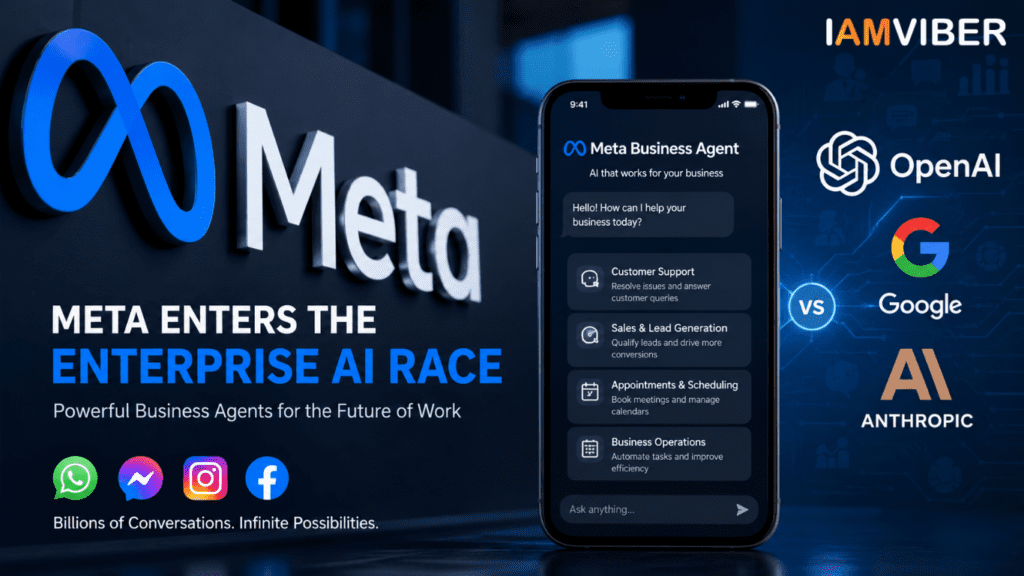
That shift became clear on June 3, 2026, when Meta announced its new AI-powered Business Agent platform at its WhatsApp Conversations event in London. The launch marks Meta’s biggest step yet into the enterprise AI market, placing the company in direct competition with OpenAI, Google, and Anthropic.
With this move, Meta is aiming to transform AI from a customer support tool into a digital employee capable of handling real business operations.
Meta unveiled a new AI Business Agent designed to help companies automate day-to-day business activities across WhatsApp, Messenger, and Instagram. The agent can respond to customers, schedule appointments, answer questions, qualify leads, and even help close sales.
Unlike traditional chatbots that simply provide scripted responses, Meta’s Business Agent introduces “agentic” capabilities. This means the AI can perform tasks on behalf of businesses rather than only providing information.
The announcement represents a major evolution in how businesses may interact with customers in the future.
Why This Launch Matters
The AI industry is rapidly moving toward autonomous agents. Instead of asking AI for information and then manually completing tasks, businesses increasingly want AI systems that can handle workflows independently.
Meta believes this is where the next trillion-dollar opportunity exists.
The company is leveraging its enormous ecosystem of platforms, including WhatsApp, Instagram, Facebook, and Messenger, to create an enterprise AI ecosystem that millions of businesses can access immediately.
Because many businesses already communicate with customers through Meta-owned platforms, the transition to AI-powered automation becomes significantly easier.
How the Business Agent Works
Customer Support Automation
One of the most obvious use cases is customer service. Businesses can deploy the AI agent to answer common customer questions, provide product information, handle order inquiries, and offer support around the clock.
This reduces response times while allowing human teams to focus on more complex situations.
Appointment Booking
The Business Agent can also manage scheduling tasks. For example, a customer messaging a salon, clinic, or consulting company through WhatsApp could book an appointment directly through the AI without waiting for a staff member to respond. This creates a smoother customer experience while reducing administrative workload.
Sales Assistance
Meta’s AI agent goes beyond support functions. The system can recommend products, answer buying questions, guide customers through purchasing decisions, and help complete sales conversations. For small businesses, this could effectively create a digital sales representative available 24/7.
Lead Qualification
The AI can also help businesses identify high-value prospects. By analyzing customer conversations, the agent can determine purchasing intent and pass qualified leads to human sales teams for follow-up. This capability could significantly improve conversion rates for businesses using messaging platforms as a primary sales channel.
Meta's Bigger Enterprise AI Strategy
More Than Just a Chatbot
Meta did not stop with the Business Agent announcement. The company also introduced a broader Business Agent Platform that allows organizations to build customized AI solutions tailored to their specific workflows. Businesses will be able to connect AI agents with external systems and operational tools.
E-commerce companies can integrate AI agents with Shopify stores to automate customer interactions, order management, and sales support.
Customer support teams using Zendesk can connect Meta’s AI systems to improve ticket management and customer service automation.
Custom Enterprise Workflows
Meta is positioning its platform as a flexible solution capable of adapting to different industries rather than offering a one-size-fits-all AI product. This strategy mirrors the enterprise-focused approaches used by Microsoft, OpenAI, and Salesforce.
The Competitive Landscape
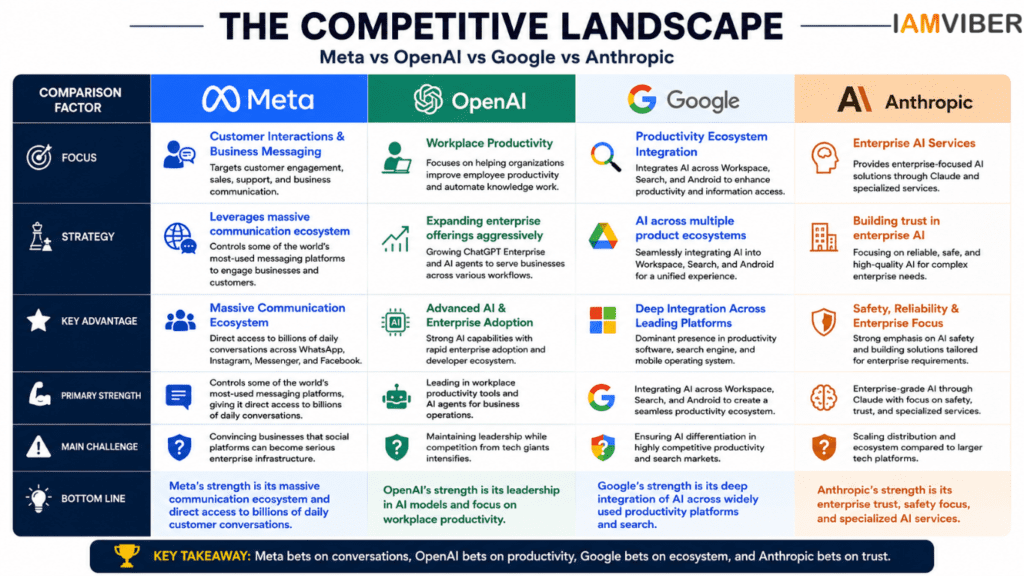
Meta vs OpenAI, Google, Anthropic
The Hidden Enterprise Opportunity
WhatsApp has over three billion users globally and has become a key communication channel for businesses in many regions. However, monetization has historically been limited.
The Business Agent initiative gives Meta a new way to generate revenue while increasing the value of WhatsApp for businesses. Industry analysts view this as one of Meta’s most important monetization opportunities outside advertising.
Challenges Ahead
Security Concerns
As AI agents gain more authority and access to business operations, security risks become increasingly important.
Meta has acknowledged the need for strong safeguards after recent security incidents involving AI-powered systems.The company will need to demonstrate that its agents can operate safely and responsibly at scale.
Trust and Reliability
Businesses will not adopt AI agents if they cannot trust them.
Accuracy, transparency, and reliability will determine whether enterprise customers embrace Meta’s platform or choose alternatives. This challenge extends across the entire AI industry.
The Future of Enterprise AI
From Assistants to Digital Employees
The launch of Meta’s Business Agent reflects a broader transformation occurring throughout the technology industry. AI is evolving from an information tool into an operational workforce.
Instead of helping employees complete tasks, future AI systems may perform many of those tasks independently. Enterprise experts increasingly view autonomous AI agents as the next major productivity revolution.The companies that successfully build trustworthy AI agents could shape the future of work.
Conclusion
Meta’s Business Agent launch is far more than another chatbot announcement. It represents a strategic shift into the rapidly growing enterprise AI market, where businesses are looking for systems capable of handling customer support, scheduling, sales, and operational workflows automatically.
By combining AI capabilities with the global reach of WhatsApp, Messenger, and Instagram, Meta is positioning itself as a serious competitor in the next phase of artificial intelligence.
The race is no longer about who has the smartest chatbot.The race is about who can build the most capable digital workforce.