Microsoft ACS Gives Developers More AI Agent Control
Artificial intelligence is rapidly moving beyond simple chatbots and assistants. In 2026, businesses are increasingly deploying AI agents that can perform tasks, access tools, interact with software systems, and make decisions with minimal human intervention. While these capabilities promise significant productivity gains, they also introduce a major challenge: how do organizations ensure that AI agents behave safely, consistently, and within approved boundaries?
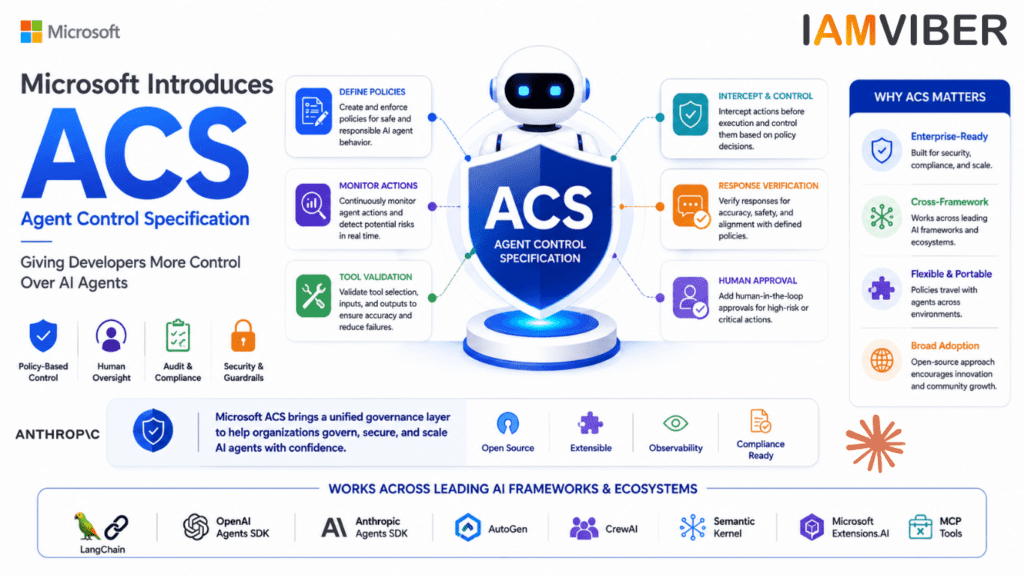
To address this growing concern, Microsoft has introduced the Agent Control Specification (ACS), a new open-source standard designed to help developers and enterprises define, manage, and enforce rules for AI agent behavior.
The announcement reflects a broader shift in the AI industry. The focus is no longer solely on building more powerful AI models. Increasingly, organizations are looking for ways to make AI agents more reliable, auditable, and controllable in real-world environments.
Why AI Agent Control Has Become a Major Challenge in 2026
AI agents are becoming increasingly autonomous. Unlike traditional AI chatbots that simply generate responses, modern agents can:
- Access enterprise databases
- Interact with third-party applications
- Execute workflows
- Use external tools
- Make recommendations based on real-time data
- As organizations adopt these systems at scale, concerns about security, compliance, and unintended actions continue to grow.
For example, an AI agent might accidentally access sensitive information, misuse a tool, trigger an incorrect workflow, or make decisions that violate company policies. Even a small mistake can create operational, financial, or reputational risks.
This challenge has led enterprises to seek stronger governance frameworks that can provide oversight without eliminating the benefits of automation.
Agent Control Specification (ACS) is an open-source framework that allows developers to define clear rules and policies governing how AI agents behave.
Rather than relying solely on prompts or custom application code, ACS introduces a dedicated governance layer that can monitor and control agent actions throughout an entire workflow. The specification allows organizations to create policy files that define:
- What an AI agent is allowed to do
- What actions are prohibited
- When human approval is required
- What activities should be logged for auditing purposes
- These policies travel with the agent and can be applied across different frameworks, environments, and deployment scenarios. This creates a more standardized approach to AI governance, making it easier for organizations to maintain control over increasingly complex AI systems.
How Agent Control Specification Works
At its core, ACS acts as a monitoring and enforcement system that evaluates agent behavior at multiple stages of execution. Instead of checking actions only after a task has been completed, ACS can intervene throughout the workflow.
Policy-Based Rules for AI Agents
Developers can create policies that define specific conditions and restrictions. These rules may determine:
- Which tools an agent can access
- Which data sources it can use
- Which actions require additional verification
- What information should be hidden or redacted
- When a human must review an action before execution
- This approach allows organizations to customize governance based on their own security and compliance requirements.
Interception Points Across the Workflow
One of the most important aspects of ACS is its use of interception points. The system can evaluate agent behavior at multiple stages, including:
Before Receiving Input
Policies can analyze incoming requests and determine whether they should be accepted, modified, or blocked.
Before Calling External Tools
Before an AI agent interacts with external software or services, ACS can verify whether the action complies with established rules.
After Tool Responses Are Returned
The framework can inspect outputs from external tools and determine whether the information should be used, filtered, or modified.
Before Sending the Final Response
ACS can perform a final review before information reaches the end user, ensuring compliance with organizational policies. This multi-layered approach provides significantly stronger oversight than traditional prompt-based guardrails.
Key Features of Microsoft ACS
Microsoft’s new specification includes several advanced capabilities that make it particularly attractive for enterprise environments.
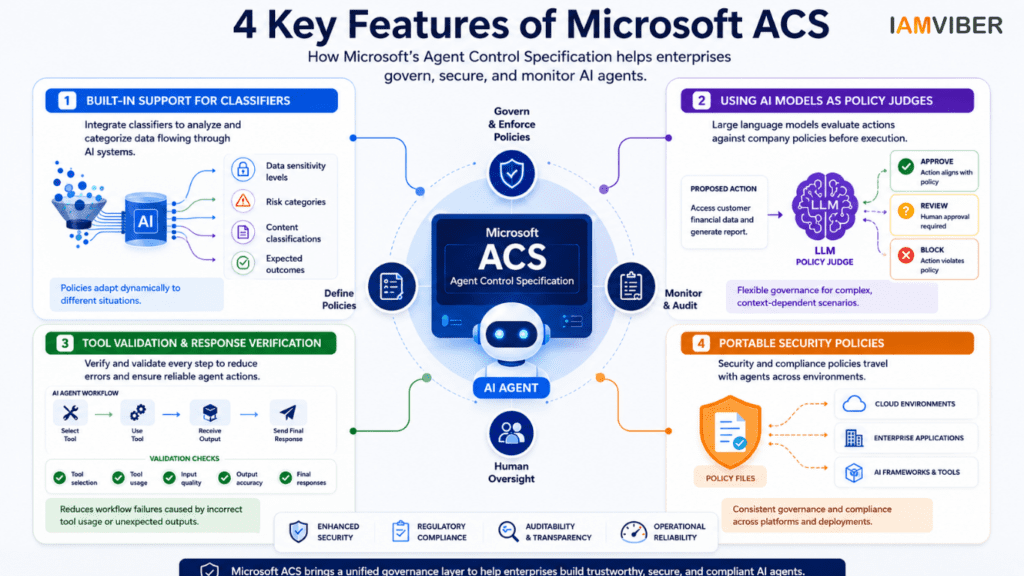
Built-In support for Classifiers
Organizations can integrate classifiers to analyze and categorize data flowing through AI systems. These classifiers can help determine:
- Data sensitivity levels
- Risk categories
- Content classifications
- Expected outcomes
- This additional layer of intelligence allows policies to adapt dynamically to different situations.
Using AI Models as Policy Judges
ACS also supports the use of large language models as evaluators. In this setup, an AI model can assess whether a proposed action aligns with company policies before the action is executed. This creates a more flexible governance model capable of handling complex and context-dependent scenarios.
Tool Validation and Response Verification
The framework enables organizations to verify:
- Tool selection
- Tool usage
- Input quality
- Output accuracy
- Final responses
- Such validation can reduce the risk of workflow failures caused by incorrect tool usage or unexpected outputs.
Portable Security Policies
One of ACS’s most valuable features is portability. Security and compliance policies can be packaged alongside AI agents, allowing them to move across environments while maintaining the same governance standards. This helps organizations achieve consistency across different platforms and deployments.
Supported AI Frameworks and Ecosystems
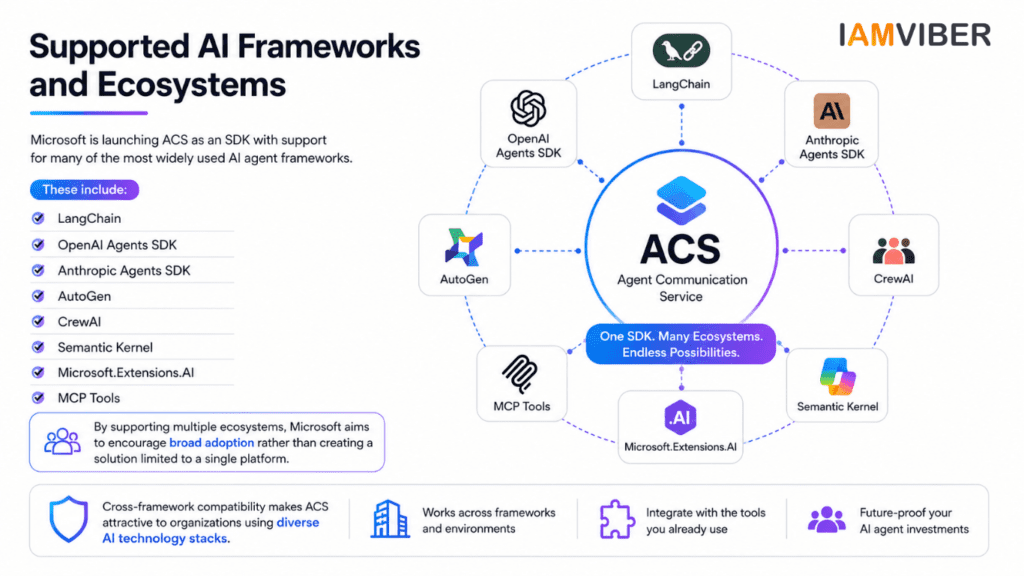
Microsoft is launching ACS as an SDK with support for many of the most widely used AI agent frameworks.These include: LangChain, OpenAI Agents SDK, Anthropic Agents SDK, AutoGen, CrewAI, Semantic Kerne, MCP Tools. By supporting multiple ecosystems, Microsoft aims to encourage broad adoption rather than creating a solution limited to a single platform. This cross-framework compatibility could make ACS attractive to organizations using diverse AI technology stacks.
Why ACS Matters for Enterprise AI Adoption
The introduction of ACS arrives at a critical moment for enterprise AI. Many organizations are eager to deploy AI agents but remain concerned about governance, compliance, and operational risk.
Improving Security
AI agents often interact with sensitive systems and business data. ACS provides a mechanism for enforcing security policies before risky actions occur.
Supporting Regulatory Compliance
Industries such as healthcare, finance, and government face strict regulatory requirements. The ability to document, audit, and control agent behavior could help organizations meet compliance obligations more effectively.
Reducing AI Misuse
By establishing clear operational boundaries, ACS helps reduce the likelihood of accidental misuse, unauthorized actions, and unexpected outcomes.
Enhancing Auditability
Enterprises increasingly require visibility into how AI systems make decisions. ACS supports logging and monitoring capabilities that can provide valuable evidence for internal reviews and external audits.
Microsoft’s Vision for Trustworthy Agentic AI
The release of Agent Control Specification reflects a broader industry trend toward trustworthy AI. As AI agents become more capable and autonomous, organizations need confidence that those systems will operate responsibly. Microsoft appears to recognize that future success in enterprise AI will depend not only on model intelligence but also on governance, transparency, and accountability.
The company’s open-source approach may also encourage collaboration across the AI ecosystem, allowing developers, researchers, and enterprises to contribute to a common standard for agent control. If widely adopted, ACS could become a foundational layer for enterprise AI governance in the coming years.
Conclusion
Microsoft’s Agent Control Specification (ACS) represents an important step forward in the evolution of Agentic AI. Rather than focusing solely on making AI agents more powerful, ACS addresses a growing industry need: ensuring that agents remain secure, compliant, and aligned with organizational objectives.
By introducing a standardized, open-source framework for policy enforcement, monitoring, and governance, Microsoft is helping enterprises gain greater confidence in deploying AI agents at scale.
As AI systems continue to expand across business operations, the ability to control and audit agent behavior may become just as important as the intelligence of the models themselves. ACS positions Microsoft at the center of this emerging movement toward safer, more trustworthy, and more manageable AI agents.