Over the past few days, Oracle stock has become one of the most searched business topics on Google Trends. While many people are focusing on price movements and market fluctuations, the real story goes far beyond the stock chart.
Oracle isn’t simply experiencing investor attention because of short-term trading activity. The company has quietly positioned itself as one of the biggest infrastructure providers powering the global AI revolution.
From massive AI data centers to billion-dollar cloud investments and strategic partnerships with companies like NVIDIA, Oracle is rapidly transforming from a traditional enterprise software company into an AI infrastructure powerhouse.
Whenever a company’s stock starts trending on Google, it’s usually because investors are reacting to new developments. In Oracle’s case, the increased interest comes from several major factors:
- Growing demand for AI cloud infrastructure
- Expansion of Oracle Cloud Infrastructure (OCI)
- Enterprise adoption of generative AI
- AI data center investments
- Partnerships with leading AI hardware companies
- Increased competition with AWS, Microsoft Azure, and Google Cloud
- Rather than viewing Oracle as a legacy database company, the market is increasingly recognizing its role in powering the next generation of artificial intelligence.
Oracle Has Quietly Become an AI Infrastructure Company
For decades, Oracle was best known for its database software and enterprise applications. Today, however, the company is writing a new chapter in its history.
As artificial intelligence becomes a priority for businesses worldwide, demand for high-performance cloud infrastructure has surged. AI applications require enormous computing power, reliable storage, advanced networking, and secure cloud environments. Instead of competing to build consumer-facing AI chatbots, Oracle has focused on providing the infrastructure that powers these technologies behind the scenes.
This strategic shift has helped Oracle position itself as one of the companies enabling the next generation of AI innovation.
Oracle Cloud Infrastructure (OCI): The Foundation of Its AI Strategy
Oracle Cloud Infrastructure, commonly known as OCI, has become the centerpiece of the company’s transformation. OCI is designed for demanding enterprise workloads, including:
- AI model training
- Large Language Models (LLMs)
- Machine learning applications
- Enterprise databases
- High-performance computing
- Data analytics
Compared with traditional cloud offerings, Oracle emphasizes:
- High performance
- Lower latency
- Competitive pricing
- Enterprise-grade security
- Scalability for AI workloads
- As organizations increase spending on AI, cloud platforms like OCI become increasingly valuable.
Artificial intelligence depends heavily on advanced graphics processing units (GPUs), and NVIDIA has become the industry’s leading supplier of AI hardware.
Oracle’s collaboration with NVIDIA allows businesses to access powerful GPU clusters directly through Oracle Cloud Infrastructure. Instead of investing millions in their own hardware, organizations can train, fine-tune, and deploy AI models using Oracle’s cloud platform.
This partnership strengthens Oracle’s position in the AI ecosystem and makes its cloud platform increasingly attractive for enterprises developing large-scale AI applications.
AI Data Centers Are the New Gold Rush
The rapid growth of artificial intelligence has sparked an unprecedented demand for data centers. Every AI model relies on powerful servers, advanced cooling systems, high-speed networking, and thousands of GPUs working together.
Oracle has responded by expanding its AI-ready cloud regions and investing in infrastructure capable of supporting these demanding workloads. As more businesses adopt AI technologies, the need for reliable cloud infrastructure will continue to grow, creating significant long-term opportunities for companies like Oracle.
Rather than chasing short-term trends, Oracle is investing in the foundation that future AI applications will depend on.
Why Businesses Are Paying Attention : Oracle AI Strategy
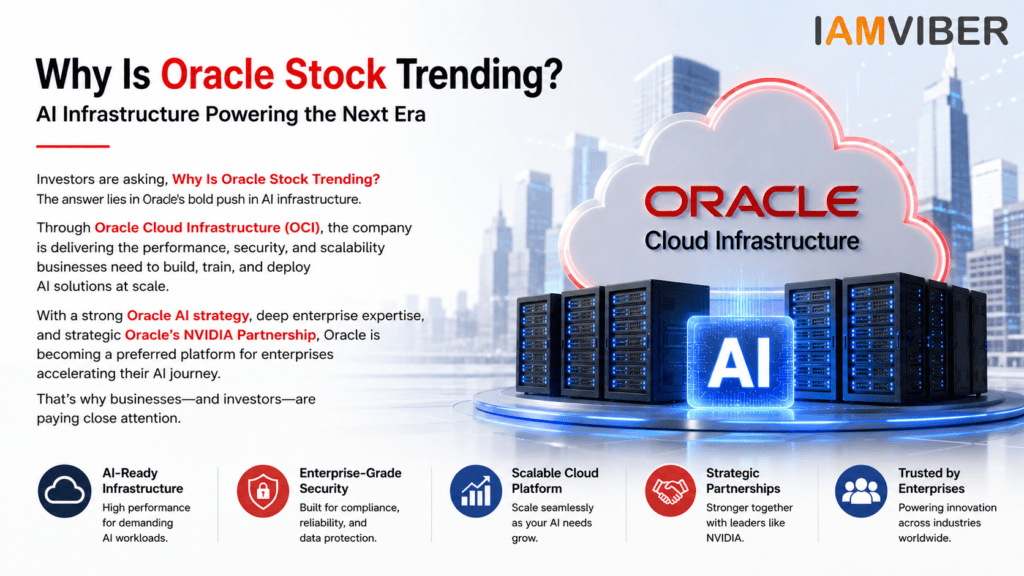
Enterprise AI adoption is no longer limited to large technology companies. Businesses across industries—including healthcare, finance, retail, manufacturing, logistics, and professional services—are integrating AI into their daily operations to improve productivity, automate repetitive tasks, and make faster, data-driven decisions. As AI moves from experimentation to real-world implementation, organizations are looking for technology partners that can support these demanding workloads.
AI-powered applications such as intelligent customer support, software development assistants, predictive analytics, fraud detection, supply chain optimization, and personalized marketing all require powerful computing resources. These workloads demand secure, scalable, and high-performance cloud infrastructure that can process massive amounts of data while maintaining reliability and compliance.
This is where Oracle is strengthening its position. Through Oracle Cloud Infrastructure (OCI), the company offers enterprises the computing power, advanced networking, and security needed to build, train, and deploy AI solutions at scale. Its cloud platform is designed to handle mission-critical workloads, making it an attractive choice for organizations that require both performance and enterprise-grade reliability.
As more businesses accelerate their AI strategies, the demand for dependable cloud infrastructure will continue to grow. Oracle’s long-standing experience in enterprise technology, combined with its expanding AI capabilities, is helping it become a trusted infrastructure provider for companies preparing for the next phase of digital transformation.
What This Means for the AI Industry
Oracle’s growing visibility reflects a broader trend. The AI economy isn’t driven solely by chatbots or AI assistants. It also depends on the companies providing the underlying infrastructure. The AI ecosystem includes:
- Semiconductor manufacturers
- GPU providers
- Cloud infrastructure companies
- Networking specialists
- Data center operators
- Enterprise software providers
- Oracle's expanding role highlights how infrastructure companies are becoming essential beneficiaries of the AI boom.
Why the Story Is Bigger Than the Stock
It’s easy to focus on daily stock price movements. However, long-term technology trends often matter far more than short-term market fluctuations. Oracle’s investments in AI infrastructure suggest a strategic shift toward supporting enterprise AI at scale.
Whether businesses are developing generative AI applications, training machine learning models, or modernizing cloud environments, infrastructure providers like Oracle are becoming increasingly critical.
This explains why Oracle continues to attract attention from technology leaders, enterprises, and investors alike.
Conclusion
Oracle stock may be trending today, but the bigger story isn’t about the market—it’s about the infrastructure powering the future of artificial intelligence.
As AI adoption accelerates worldwide, companies need scalable cloud platforms, powerful computing resources, and enterprise-grade infrastructure. Oracle has positioned itself to deliver exactly that.
Rather than competing to build the next chatbot, Oracle is helping build the foundation on which tomorrow’s AI applications will run.
For businesses, developers, and technology enthusiasts, understanding Oracle’s AI strategy provides valuable insight into where the next phase of the AI revolution is heading. The future of AI won’t be powered by algorithms alone—it will also be powered by the infrastructure behind them. And Oracle is working to become one of the companies building that foundation.
1. Why is Oracle stock trending?
Oracle stock is trending due to growing interest in the company’s AI infrastructure strategy, expanding Oracle Cloud Infrastructure (OCI), enterprise AI adoption, and continued investments in AI-ready data centers. These developments have increased attention from investors and technology professionals.
2. How is Oracle involved in artificial intelligence?
Oracle supports artificial intelligence by providing cloud infrastructure, AI services, high-performance computing, and enterprise solutions that help businesses build, train, and deploy AI applications at scale through Oracle Cloud Infrastructure (OCI).
3. What is Oracle Cloud Infrastructure (OCI)?
Oracle Cloud Infrastructure (OCI) is Oracle’s cloud computing platform that offers secure, scalable, and high-performance services for AI workloads, machine learning, enterprise applications, databases, and data analytics.
4. Why is Oracle considered an AI infrastructure company?
Oracle is increasingly recognized as an AI infrastructure company because it focuses on providing the cloud platforms, computing resources, and AI-ready data centers that power enterprise AI applications instead of building consumer AI products alone.
5. How does Oracle compete with AWS, Microsoft Azure, and Google Cloud?
Oracle competes by offering enterprise-grade cloud infrastructure with a strong focus on databases, security, AI workloads, and cost-effective cloud services. Its strategy emphasizes performance and reliability for businesses running mission-critical applications.
6. Why are Oracle's AI partnerships important?
Oracle’s collaborations with leading AI hardware and technology companies strengthen its cloud platform by enabling businesses to access powerful computing resources for training and deploying advanced AI models more efficiently.
7. What industries are using Oracle's AI solutions?
Oracle’s AI and cloud solutions are being adopted across industries such as healthcare, financial services, manufacturing, retail, logistics, telecommunications, and customer service to improve automation, analytics, and operational efficiency.
8. Is Oracle's AI strategy important for the future of enterprise technology?
Yes. Oracle’s continued investment in AI infrastructure, cloud computing, and enterprise solutions positions the company to play an important role in the future of enterprise technology as businesses increasingly adopt AI-powered applications and digital transformation initiatives.
Topics to follow: Current Affairs & Insights Tech Innovation GenZ entrepreneurship Collaborative Fashion GEO AI Agentic SME