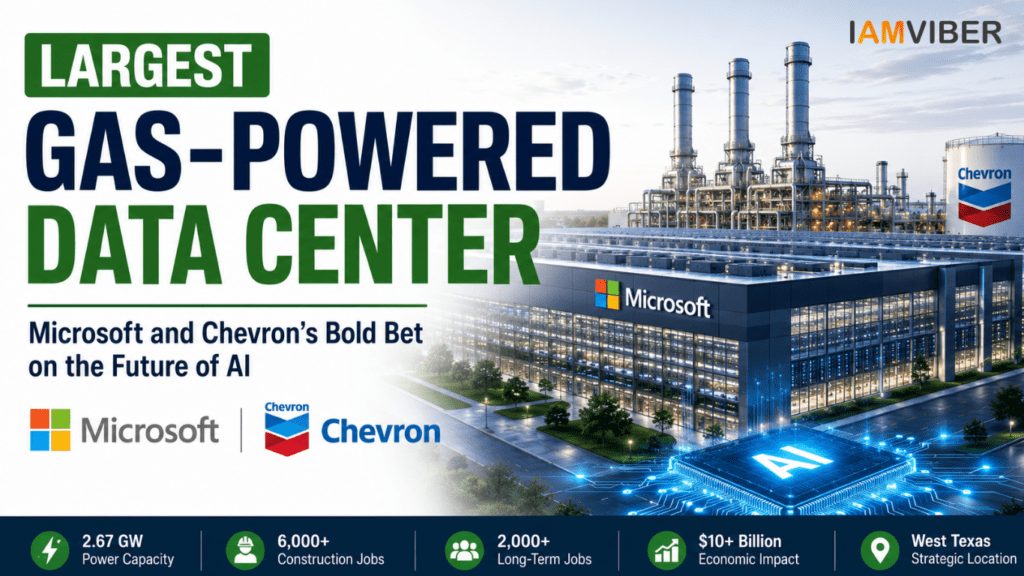
The Largest Gas-Powered Data Center project in the United States is officially underway as Microsoft and Chevron join forces to build a massive AI infrastructure hub in West Texas. Named Project Kilby, the development represents one of the biggest collaborations between the technology and energy sectors and highlights a growing reality: the future of artificial intelligence depends as much on electricity as it does on algorithms. According to reports, the project will eventually generate around 2.67 gigawatts of power, making it one of the largest natural gas-powered data center developments ever announced in America.
As AI models become larger, smarter, and more widely adopted, companies are racing to secure the energy required to power them. The Microsoft-Chevron partnership is not just about building another data center—it is about building the infrastructure needed to support the next decade of artificial intelligence.
Why the Largest Gas-Powered Data Center Matters
Over the past two years, the AI industry has experienced explosive growth.
From ChatGPT and Microsoft Copilot to enterprise AI assistants and autonomous agents, the demand for computing power has increased dramatically. Every AI model requires thousands of GPUs, massive server clusters, advanced cooling systems, and continuous electricity.
While most people focus on AI software, industry leaders are increasingly focused on the infrastructure behind it.
Data centers have become the factories of the AI economy. Without reliable power, even the most advanced AI systems cannot function.
This is exactly why Microsoft and Chevron have decided to invest heavily in dedicated energy infrastructure rather than relying solely on the traditional power grid.
Chevron announced a 20-year agreement with Microsoft to provide dedicated electricity for Microsoft’s expanding AI data center campus in Pecos, Texas. The project will be developed through Chevron subsidiary Energy Forge One in partnership with Engine No. 1.
Under the agreement, a co-located power facility will generate electricity specifically for Microsoft’s operations.
Unlike conventional data centers that depend entirely on public utilities, Project Kilby is being designed to produce electricity on-site, reducing pressure on regional power grids while ensuring reliable access to power for AI workloads.
The partnership signals a new era where technology companies and energy providers work together to build integrated AI ecosystems.
Inside Project Kilby
Project Kilby is expected to become one of the most ambitious infrastructure developments in the AI industry.
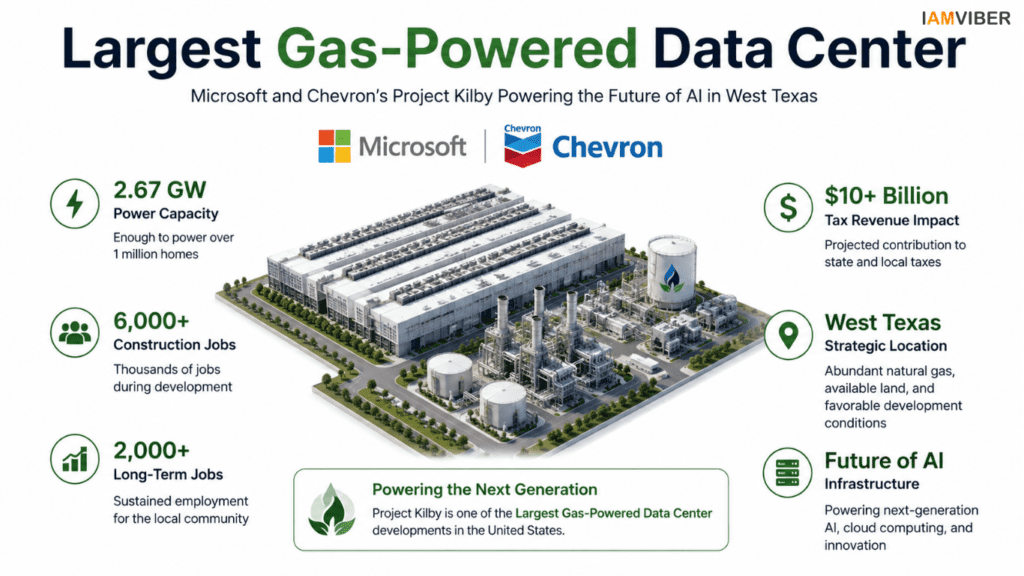
The facility is planned to deliver approximately 2.67 gigawatts of power capacity, enough electricity to power more than one million homes and, according to some estimates, close to two million homes under certain usage scenarios.
The project will be developed in phases, with initial power delivery expected around 2028.
Most of the power generation will come from advanced gas turbines supplied by GE Vernova, while additional capacity will be provided by Solar Turbines, a Caterpillar subsidiary.
At full scale, the campus is expected to significantly expand Microsoft’s AI and cloud-computing capabilities.
Artificial intelligence is rapidly becoming one of the most energy-intensive industries in the world.
Training large language models can require thousands of GPUs running continuously for weeks or months. Once deployed, these systems must process millions of user requests every day.
Microsoft’s AI ecosystem continues to grow through Azure AI, Copilot, OpenAI-powered services, enterprise automation tools, and cloud infrastructure.
As demand increases, so does electricity consumption. Industry experts now believe that access to power may become one of the biggest constraints on AI growth globally. Companies can purchase more chips and build more servers, but without sufficient electricity, expansion becomes difficult.
Why Natural Gas Instead of Renewable Energy?
One question many people are asking is why Microsoft chose natural gas instead of relying entirely on renewable energy.
The answer comes down to reliability.
Solar and wind energy remain important parts of the energy mix, but they are intermittent sources of power. AI data centers require electricity twenty-four hours a day, seven days a week.
Even a short interruption can disrupt critical computing operations.
Natural gas provides a stable source of energy capable of supporting large-scale computing facilities continuously. This reliability has made natural gas an attractive option for companies seeking guaranteed power availability.
However, the decision is likely to generate debate among environmental groups that argue technology companies should accelerate investments in cleaner energy alternatives.
The AI Infrastructure Race Is Heating Up
Microsoft is not alone in securing dedicated power sources. Across the technology industry, companies are investing billions of dollars in data centers, energy infrastructure, and semiconductor supply chains.
The AI race is no longer just about software innovation. It is becoming a competition over who can secure the resources needed to run AI at scale. That includes:
- Electricity
- Land
- Water
- Data centers
- GPUs
- Networking infrastructure
- Project Kilby demonstrates that energy security is now becoming a strategic advantage in artificial intelligence. Companies that can guarantee reliable computing power will have a significant edge over competitors.
Chevron's Transformation Into an AI Infrastructure Player
For Chevron, the agreement represents much more than a power contract.
Traditionally known as one of the world’s largest oil and gas companies, Chevron is now positioning itself as a critical infrastructure partner for the AI economy.
The company believes that abundant and reliable energy will become one of the most valuable assets in the AI era. Through Project Kilby and similar initiatives, Chevron aims to create new revenue streams that are less dependent on oil price fluctuations.
This strategic shift highlights how the rise of artificial intelligence is creating opportunities far beyond the technology sector.
Energy companies, utilities, infrastructure developers, and equipment manufacturers are all becoming important participants in the AI ecosystem.
Economic Impact of the Largest Gas-Powered Data Center
The economic impact of Project Kilby could be substantial.
The project may create thousands of jobs during construction and generate billions of dollars in economic activity across Texas. Some estimates indicate the development could contribute more than $10 billion in state and local tax revenue while supporting approximately 2,000 long-term jobs and more than 6,000 construction positions.
West Texas is increasingly emerging as a key destination for AI infrastructure because of its access to natural gas resources, available land, and favorable development conditions.
As more technology companies search for locations capable of supporting hyperscale data centers, regions with strong energy resources may become major beneficiaries.
Public Reaction: Excitement and Concerns
The announcement has sparked mixed reactions online.
Many technology enthusiasts see the project as a necessary step to support future AI innovation. Others view it as evidence that artificial intelligence is creating unprecedented demand for energy infrastructure. Community discussions on Reddit highlight both excitement about AI growth and concerns about increased reliance on fossil fuels.
One of the biggest debates centers on sustainability.
Supporters argue that AI’s rapid growth requires dependable energy sources available today. Critics contend that investments of this scale should focus more heavily on renewable energy and nuclear alternatives.
The discussion reflects a broader challenge facing the technology industry as it balances innovation, energy security, and environmental responsibility.
The story of Project Kilby is bigger than a single data center.
It represents a fundamental shift in how artificial intelligence infrastructure is being built.
For years, the technology industry focused primarily on software, cloud computing, and semiconductor innovation. Today, energy has become equally important.
The next generation of AI leaders will not simply be the companies with the best algorithms. They will be the companies capable of securing the power, infrastructure, and resources required to operate at global scale.
Microsoft’s partnership with Chevron demonstrates that the future of AI will depend on unprecedented collaboration between technology companies and energy providers. As Project Kilby moves toward development, it may become a blueprint for how future AI infrastructure projects are built around the world.
Conclusion
The Largest Gas-Powered Data Center project announced by Microsoft and Chevron marks a defining moment in the evolution of artificial intelligence infrastructure. With 2.67 gigawatts of planned power capacity, a 20-year energy agreement, and billions of dollars in expected investment, Project Kilby is far more than a data center—it is a glimpse into the future of the AI economy.
As AI continues to transform industries worldwide, one thing is becoming increasingly clear: the race for artificial intelligence is also a race for energy. And Microsoft and Chevron have just made one of the biggest moves yet.Lorem ipsum dolor sit amet, consectetur adipiscing elit. Ut elit tellus, luctus nec ullamcorper mattis, pulvinar dapibus leo.
FAQs
1. What is the Largest Gas-Powered Data Center project announced by Microsoft and Chevron?
The Largest Gas-Powered Data Center project is a massive AI infrastructure development in West Texas. Backed by Microsoft and Chevron, the project is designed to provide dedicated power for next-generation AI data centers, cloud computing services, and advanced artificial intelligence workloads.
2. Why are Microsoft and Chevron investing in AI infrastructure?
As demand for artificial intelligence, machine learning, and cloud computing continues to rise, Microsoft requires reliable energy sources to support its expanding AI ecosystem. Chevron’s energy expertise helps ensure long-term power availability for hyperscale data centers.
3. How large is Project Kilby?
Project Kilby is expected to generate around 2.67 gigawatts of electricity, making it one of the largest natural gas-powered data center projects in the United States and a significant milestone in the future of AI infrastructure.
4. Why is natural gas important for AI data centers?
AI systems require continuous power to support high-performance computing, GPU clusters, and enterprise AI applications. Natural gas provides stable 24/7 electricity, making it a reliable energy source for large-scale AI data center operations.
5. How will this project impact the future of artificial intelligence?
The project strengthens the foundation for future AI innovation, enabling faster AI model training, scalable cloud services, and advanced enterprise automation. It also highlights the growing connection between energy infrastructure and artificial intelligence development.
6. What does the Largest Gas-Powered Data Center mean for the technology industry?
The project signals a new era where AI infrastructure, data center expansion, and energy security become critical competitive advantages. Future technology growth will depend not only on AI software and chips but also on access to reliable power and computing resources.
Topics to follow: Current Affairs & Insights Tech Innovation GenZ entrepreneurship Collaborative Fashion GEO AI Agentic SME