Artificial Intelligence is moving at a pace few people expected. Just when creators and developers were getting comfortable with Google’s Nano Banana image model, the company has introduced another major upgrade—Nano Banana 2 Lite.
Unlike many AI announcements that simply promise “better quality,” this launch focuses on something creators care about every day: speed and cost.
Whether you’re a marketer generating hundreds of ad creatives, a startup building AI-powered applications, or a designer experimenting with concepts, waiting several seconds—or paying higher API costs—for every generated image adds up quickly. Google is clearly targeting this pain point.
Nano Banana 2 Lite isn’t trying to replace premium image models entirely. Instead, it’s designed to become the model developers use for rapid image generation, quick editing, and large-scale creative workflows.
Over the past year, AI image generation has become one of the most competitive segments in artificial intelligence.
Companies like OpenAI, Midjourney, Adobe, Ideogram, and Black Forest Labs have all released increasingly capable image models. While image quality has improved dramatically, another challenge has become obvious: speed and affordability. Businesses don’t generate just one image. A modern marketing team may create:
- 100 product banners
- 200 social media creatives
- Dozens of ad variations
- Multiple thumbnail concepts
- Several design drafts before selecting the final version
- When every image takes time and money, production costs increase quickly. Google's answer is Nano Banana 2 Lite—a lightweight version optimized for fast inference while maintaining strong prompt understanding and visual quality.
What Makes Nano Banana 2 Lite Different?
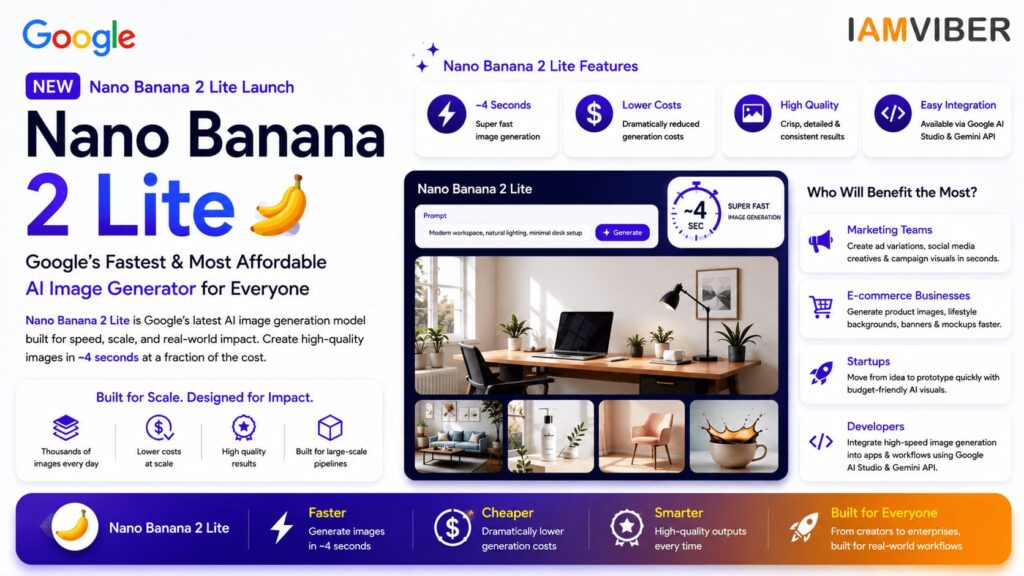
According to Google, Nano Banana 2 Lite can generate images in approximately four seconds, making it one of the fastest image generation models in Google’s portfolio today. It also significantly reduces the cost of generating images compared to previous versions, making it attractive for developers building image-heavy applications.
The company isn’t positioning it as the most artistic model ever created. Instead, it focuses on practical performance. That means users can:
- Generate images much faster
- Test multiple prompts quickly
- Build AI-powered products at lower infrastructure costs
- Produce large batches of creative assets
- Iterate without worrying about expensive API usage
- For businesses, that matters more than generating one perfect masterpiece.
Built for Scale Instead of Waiting
Imagine you’re launching a new e-commerce website.
Instead of manually designing every product background, banner, lifestyle image, and promotional creative, an AI workflow could automatically generate hundreds of visuals within minutes.
That is the audience Google appears to be targeting.
Nano Banana 2 Lite is designed for situations where users need volume, speed, and consistent quality, rather than spending extra resources on every single generation.
For startups building AI applications, this could reduce operating costs while improving user experience.
More Than Just Text-to-Image
Nano Banana 2 Lite isn’t limited to creating images from prompts.
Google says the model also supports image editing workflows, allowing developers to modify existing images through natural language instructions. Combined with Gemini technologies, this enables faster creative iterations without repeatedly starting from scratch. For creators, this means simple edits like:
- Changing backgrounds
- Adjusting lighting
- Replacing objects
- Testing color variations
- Creating multiple campaign versions
- can happen in seconds rather than requiring lengthy design sessions.
Why This Matters for Businesses
The real story isn’t just that Google released another AI model. The bigger story is that AI-generated content is becoming inexpensive enough to fit into everyday business operations.
A small startup that couldn’t previously afford thousands of AI-generated marketing assets can now experiment much more freely.
Marketing agencies can create larger batches of concepts before presenting ideas to clients. Developers can integrate image generation into apps without worrying as much about latency or infrastructure costs.
That shift could make AI image generation feel less like a premium feature and more like a standard part of modern software. And that’s exactly where Google’s broader AI strategy seems to be heading.
How Nano Banana 2 Lite Fits Into Google's Bigger AI Strategy
Nano Banana 2 Lite isn’t just another AI model—it represents a shift in how Google wants developers and businesses to build with artificial intelligence.
For years, AI image generation has largely been about creating visually stunning artwork. But Google’s latest release signals a different priority: making AI practical enough for everyday workflows.
Think about how businesses actually use visuals today.
An online retailer needs hundreds of product banners. A marketing agency creates dozens of ad variations for A/B testing. A news publisher generates featured images for daily articles. A startup builds thumbnails, illustrations, and promotional graphics every week.
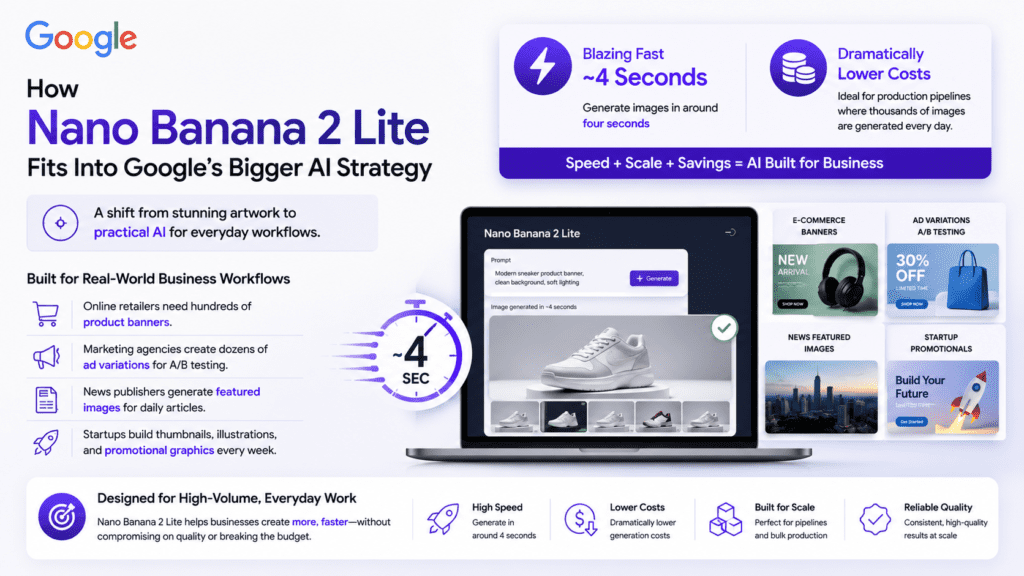
These aren’t one-off creative projects. They’re repetitive, high-volume tasks where speed matters just as much as image quality.Nano Banana 2 Lite is designed for exactly this kind of work. Google says the model can generate images in around four seconds while dramatically lowering costs, making it suitable for production pipelines where thousands of images may be generated every day.
Who Will Benefit the Most?
Nano Banana 2 Lite features: Explained
Although anyone can experiment with AI-generated images, some industries stand to gain much more than others.
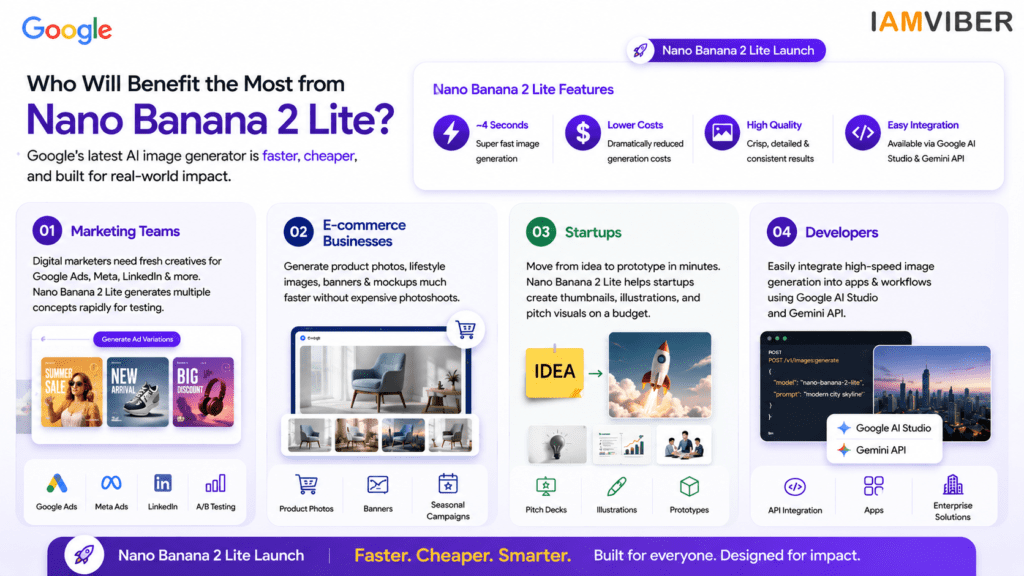
Marketing Teams
Digital marketers constantly need fresh creatives for campaigns across Google Ads, Meta, LinkedIn, and other platforms. Instead of designing every variation manually, Nano Banana 2 Lite can rapidly generate multiple concepts for testing.
E-commerce Businesses
Product photography is expensive and time-consuming. While AI won’t replace professional photography entirely, it can generate lifestyle backgrounds, promotional banners, seasonal campaigns, and mockups much faster.
Startups
Early-stage companies often have limited budgets. Hiring designers for every iteration isn’t always possible. A low-cost AI image generator allows founders to move from idea to prototype in minutes rather than days.
Developers
Google has made Nano Banana 2 Lite available through Google AI Studio, the Gemini API, and enterprise platforms, making it easy to integrate into applications that require large-scale image generation.
Nano Banana 2 Lite vs Premium AI Image Models
One important thing to understand is that Nano Banana 2 Lite isn’t trying to beat every premium AI image generator on image quality. Instead, Google has positioned it as the “speed-first” option.
If your project requires cinematic artwork, highly detailed illustrations, or complex creative direction, Google’s higher-end Nano Banana models remain the better choice. Nano Banana 2 Lite is designed for:
- Fast prototyping
- Bulk image generation
- Marketing creatives
- Social media assets
- Product mockups
- Rapid experimentation
- That positioning makes sense because not every project requires museum-quality artwork. Many businesses simply need good-looking visuals delivered quickly and affordably.
Perhaps the most interesting part of this announcement isn’t the model itself. It’s what it says about the future of AI.
Over the last two years, companies competed on who could build the smartest model. Now the competition is expanding to include:
- Lower latency
- Lower costs
- Better scalability
- Easier integration
- Real-world business adoption
- In other words, AI is becoming infrastructure rather than a novelty. Businesses no longer ask, "Can AI generate an image?" Instead, they ask, "Can AI generate 10,000 images this week without breaking our budget?" Nano Banana 2 Lite is Google's answer to that question.
Can It Replace Human Designers?
Not entirely.
AI is incredibly effective at generating first drafts, exploring concepts, and creating multiple variations in seconds.But successful branding still depends on strategy, creativity, storytelling, and understanding an audience—areas where human designers continue to play a vital role
Many creative professionals are already using AI as a collaborative tool rather than a replacement. A designer might generate ten concepts with AI, refine the strongest one, and deliver a polished final product. This hybrid workflow is likely to become increasingly common.
Availability
Google has announced that Nano Banana 2 Lite is rolling out through:
- Google AI Studio
- Gemini API
- Gemini Enterprise Agent Platform
- The company is also bringing the technology into several Google products, including AI-powered experiences across its ecosystem, making it easier for both developers and end users to access the new model.
Final Thoughts
Google’s launch of Nano Banana 2 Lite isn’t about creating the world’s most artistic AI image generator. It’s about removing two of the biggest barriers to AI adoption: speed and cost.
Generating an image in roughly four seconds at a significantly lower price opens the door to use cases that were previously impractical. Startups can prototype faster, marketers can test more campaigns, developers can build image-heavy applications more economically, and enterprises can scale creative production without dramatically increasing costs.
As competition in AI intensifies, companies are moving beyond headline-grabbing demos toward tools that solve everyday business problems. Nano Banana 2 Lite reflects that shift.
It may not replace premium creative models for every project, but it doesn’t need to. Its real strength lies in making AI image generation fast, affordable, and scalable enough to become part of daily workflows.
For creators, developers, and businesses alike, that’s a much bigger story than simply launching another AI model.
1. What is Nano Banana 2 Lite?
Nano Banana 2 Lite is Google’s latest AI image generation model designed to create high-quality images faster and at a lower cost. It is built for developers, businesses, marketers, and creators who need scalable AI-powered image generation.
2. What are the key Nano Banana 2 Lite features?
Some of the major Nano Banana 2 Lite features include faster image generation, lower API costs, seamless integration with Google AI Studio and the Gemini API, support for large-scale creative workflows, and enterprise-ready performance.
3. When was the Nano Banana 2 Lite launch announced?
The Nano Banana 2 Lite launch was announced by Google as part of its latest AI model updates, introducing a lightweight image generation model focused on speed, affordability, and scalability for developers and businesses.
4. How fast is Nano Banana 2 Lite?
According to Google, Nano Banana 2 Lite can generate AI images in approximately four seconds, making it one of the fastest image generation models available in Google’s AI ecosystem.
5. Who should use Nano Banana 2 Lite?
Nano Banana 2 Lite is ideal for marketing teams, e-commerce businesses, startups, developers, content creators, and enterprises that need to generate large volumes of AI images quickly and cost-effectively.
6. Where can developers access Nano Banana 2 Lite?
Developers can access Nano Banana 2 Lite through Google AI Studio, the Gemini API, and Google’s enterprise AI platforms, allowing easy integration into applications and creative workflows.
7. Can Nano Banana 2 Lite replace professional graphic designers?
No. While Nano Banana 2 Lite can speed up content creation and generate design concepts, professional designers remain essential for branding, creative strategy, storytelling, and producing polished final designs.
8. Why is Nano Banana 2 Lite important for businesses?
Nano Banana 2 Lite helps businesses reduce creative production costs, generate marketing assets faster, scale AI-powered content creation, and improve workflow efficiency without compromising image quality.
Topics to follow: Current Affairs & Insights Tech Innovation GenZ entrepreneurship Collaborative Fashion GEO AI Agentic SME