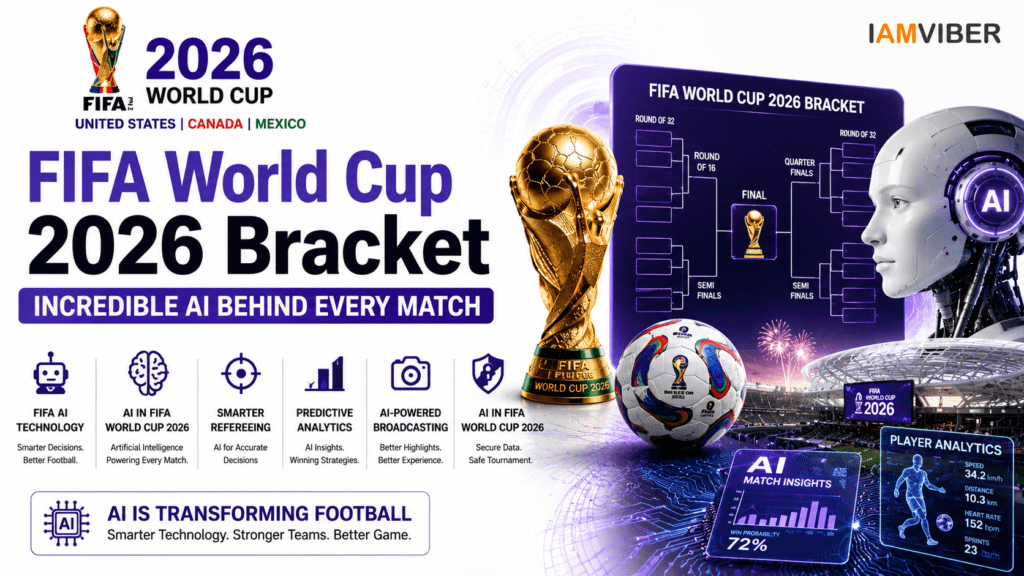
The FIFA World Cup 2026 Bracket is no longer just a knockout schedule. It has become a showcase of how Artificial Intelligence is transforming modern football. Every stage of the FIFA World Cup 2026 Bracket demonstrates the growing role of AI in refereeing, player tracking, broadcasting, and match analytics.
Artificial Intelligence is no longer just changing businesses—it is now redefining the world’s biggest football tournament.
When people search for the FIFA World Cup 2026 Bracket, they usually want to know which teams are playing, who has qualified for the next round, or which nation has the best chance of lifting the trophy. However, behind every exciting match lies an invisible force that most fans never notice—Artificial Intelligence (AI).
The FIFA World Cup 2026 is not only the biggest football tournament in history with an expanded 48-team format, but it is also one of the most technologically advanced sporting events ever organized. From AI-assisted refereeing and computer vision to predictive analytics, player tracking, and smart broadcasting, FIFA is using cutting-edge technologies to make football faster, fairer, and more engaging than ever before.
For technology enthusiasts, startups, and AI professionals, the tournament offers much more than football. It serves as a global showcase of how AI can solve complex real-world challenges in high-pressure environments where every decision matters.
Football has evolved dramatically over the past decade. Modern matches generate millions of data points through cameras, sensors, wearable devices, GPS trackers, and connected stadium infrastructure. Managing such an enormous amount of information manually is almost impossible.
That is why FIFA has increasingly embraced AI technology.
Artificial Intelligence helps tournament organizers process massive datasets in real time, allowing referees, coaches, broadcasters, analysts, and security teams to make faster and more accurate decisions. As the FIFA World Cup expands to 104 matches in 2026, AI has become essential for maintaining the quality and fairness of the competition.
Rather than replacing humans, AI acts as an intelligent assistant that provides valuable insights within seconds.
AI-Powered Refereeing Is Making Football Fairer
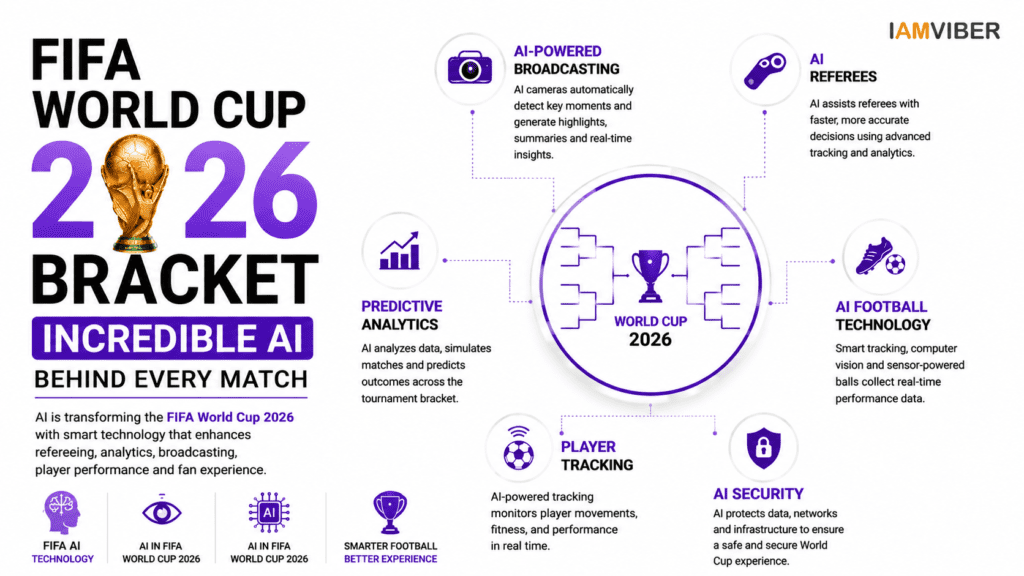
One of the most visible examples of FIFA AI Technology is the use of Semi-Automated Offside Technology (SAOT). In traditional football, offside decisions often sparked heated debates because they relied heavily on human judgment. Today, AI and computer vision work together to analyze player positions with remarkable precision.
Multiple high-speed cameras installed around the stadium continuously track every player’s body movement, while sensors inside the official match ball record every touch. AI combines these two data streams to determine whether an attacking player is offside before immediately sending the information to Video Assistant Referee (VAR) officials.
This significantly reduces decision-making time and minimizes controversial calls. Instead of replacing referees, AI provides them with accurate information that improves confidence and fairness during high-pressure matches.
Computer Vision Is Watching Every Player
Another revolutionary technology transforming the FIFA World Cup is computer vision. Every movement on the pitch is captured by advanced tracking systems capable of monitoring players dozens of times every second.
AI converts this visual information into detailed performance reports that include sprint speed, distance covered, passing accuracy, defensive positioning, pressing intensity, and tactical formations.
These insights help coaches understand exactly how their team is performing while the match is still in progress. Instead of waiting until after the game to review footage, managers receive live tactical intelligence that allows them to adjust formations, substitutions, and strategies almost instantly.
Football has become a game where data supports every important decision.
Preparation has always been one of the most important aspects of football. Traditionally, coaching staff spent countless hours watching videos of opponents, manually collecting statistics, and preparing tactical plans.
Artificial Intelligence has completely transformed this process. Machine learning algorithms analyze thousands of previous matches within minutes, identifying patterns that humans might never notice. AI can determine which passing combinations create the highest scoring opportunities, where defensive gaps appear most frequently, and which players perform best under specific match conditions.
Instead of relying only on instinct, modern football coaches now combine years of experience with AI-powered analytics to create smarter game plans.
Smart Footballs Are Collecting Real-Time Match Data
The official FIFA match ball is no longer just sports equipment—it has become a sophisticated technology device. Modern tournament footballs include embedded sensors capable of recording movement hundreds of times every second. These sensors measure speed, spin, acceleration, direction changes, and the exact moment when a player touches the ball.
Combined with AI-powered computer vision systems, this information improves offside decisions, handball detection, and match analysis while generating richer statistics for broadcasters and analysts. For fans watching at home, these technologies provide a deeper understanding of every important moment during the game.
AI Match Predictions Are Becoming More Accurate
Millions of football fans enjoy predicting the FIFA World Cup 2026 Bracket, but Artificial Intelligence approaches predictions very differently.
Instead of relying on emotions or personal preferences, AI analyzes historical records, player fitness, injuries, tactical styles, weather conditions, recent form, defensive efficiency, and dozens of other variables before calculating the probability of each possible outcome.
Advanced machine learning models can simulate an entire tournament thousands of times, helping analysts estimate which teams have the highest chances of progressing through each knockout round. While football will always remain unpredictable, AI is making match forecasting far more scientific than ever before.
AI models are now capable of simulating every fixture in the FIFA World Cup 2026 Bracket using historical data, player performance, injuries, and tactical analysis. This makes the FIFA World Cup 2026 Bracket one of the most data-driven tournaments in football history.
AI Is Helping Protect Players from Injuries
Modern football is faster, more physically demanding, and more competitive than ever before. During a tournament as intense as the FIFA World Cup, even a minor injury can change the outcome of an entire campaign. This is why FIFA AI Technology is also being used to improve player health and reduce injury risks.
National teams now rely on wearable GPS trackers, smart fitness sensors, and AI-powered analytics platforms that continuously monitor player performance during training sessions and matches. These systems collect thousands of data points, including sprint speed, heart rate, acceleration, muscle fatigue, workload, and recovery time.
Artificial Intelligence analyzes this information in real time and identifies patterns that may indicate fatigue or an increased risk of injury. If a player’s workload exceeds safe limits, coaching and medical staff receive alerts, allowing them to adjust training schedules or substitute players before injuries become serious.
Instead of reacting after an injury occurs, AI enables teams to predict potential problems before they happen. This proactive approach not only protects players but also helps teams maintain peak performance throughout the tournament.
AI Is Revolutionizing FIFA World Cup Broadcasting
Watching football today is completely different from watching it a decade ago. AI is transforming the broadcasting experience, making every match more interactive, informative, and personalized.
Broadcasters covering the FIFA World Cup use AI to automatically detect key moments such as goals, penalties, saves, celebrations, and tactical plays. Instead of editors spending hours reviewing footage, AI systems instantly identify highlights and generate match clips within minutes.
Generative AI also assists commentators and production teams by creating match summaries, multilingual captions, player statistics, and real-time insights. This allows broadcasters to deliver richer content across television, websites, mobile applications, and social media platforms.
For fans, this means faster highlights, better graphics, personalized recommendations, and a much more engaging viewing experience.
AI-generated highlights, statistics, and multilingual summaries are helping broadcasters deliver every FIFA World Cup 2026 Bracket match faster than ever before. Fans following the FIFA World Cup 2026 Bracket now receive personalized content across multiple platforms.
Cybersecurity Has Become a Critical Part of FIFA AI Technology
The FIFA World Cup is more than just a sporting event—it is a global digital ecosystem involving billions of viewers, millions of online transactions, broadcasting rights, ticketing systems, mobile apps, and connected stadiums.
Protecting this massive digital infrastructure requires advanced cybersecurity solutions powered by Artificial Intelligence.
AI continuously monitors networks for unusual activity, detects suspicious login attempts, identifies potential cyberattacks, and responds to threats before they can disrupt tournament operations. Unlike traditional security systems that react after an attack has begun, AI learns from previous threats and adapts to new attack patterns in real time.
As cybercriminals become increasingly sophisticated, FIFA AI Technology plays an essential role in protecting fan data, broadcast operations, payment systems, and tournament infrastructure.
Generative AI Is Creating Better Fan Experiences
Artificial Intelligence is not only helping players and referees—it is also changing how fans experience football.
Millions of supporters follow the FIFA World Cup through official apps, streaming platforms, social media, and digital news websites. AI personalizes this experience by recommending highlights, match updates, player statistics, and exclusive content based on individual interests.
Generative AI can instantly produce multilingual match summaries, social media posts, automated captions, and interactive chat experiences. Instead of manually searching for information, fans receive personalized updates about their favorite teams and players within seconds.
Some digital platforms are even experimenting with AI-powered virtual assistants capable of answering questions, explaining rules, recommending content, and providing live tournament information throughout the competition. The future of sports entertainment is becoming increasingly intelligent and personalized.
Cloud Computing and Digital Twins Are Powering the Future of Football
The FIFA World Cup generates enormous amounts of information every second. From player tracking and ball movement to video analysis and fan engagement, millions of data points must be processed instantly.
Cloud computing makes this possible. By storing and analyzing data in powerful cloud environments, FIFA can deliver real-time statistics, AI-powered insights, and live analytics to teams, broadcasters, and fans around the world.
Another emerging innovation is the use of digital twins. A digital twin is a virtual representation of a real player created using historical and real-time performance data. Coaches and analysts can simulate tactical scenarios, evaluate player workloads, and estimate injury risks before making important decisions.
Although still evolving, digital twin technology could become one of football’s most valuable AI applications over the next decade.
The Future of FIFA AI Technology
The FIFA World Cup 2026 represents only the beginning of AI’s influence on football.
Future tournaments could feature even smarter technologies, including fully automated camera systems, AI-generated tactical recommendations, immersive augmented reality experiences, predictive officiating, advanced player simulations, and intelligent fan assistants capable of delivering personalized content in real time.
As Artificial Intelligence continues to evolve, the relationship between sports and technology will become even stronger. Football is no longer powered solely by talent, coaching, and passion—it is increasingly powered by data.
The FIFA World Cup has always represented the highest level of football excellence, but the 2026 tournament is also becoming a global demonstration of Artificial Intelligence in action. From AI-assisted refereeing and computer vision to predictive analytics, smart footballs, injury prevention, broadcasting, cybersecurity, and personalized fan engagement, technology is transforming every aspect of the game.
The FIFA World Cup 2026 Bracket is proving that football is entering a new era powered by Artificial Intelligence. As AI technology continues to evolve, every future FIFA World Cup 2026 Bracket will become smarter, faster, and more immersive for players, officials, and billions of fans around the world.
Rather than replacing human expertise, FIFA AI Technology enhances decision-making, improves fairness, protects players, and creates richer experiences for billions of football fans worldwide.
As AI becomes more intelligent, future World Cups will become even more immersive, data-driven, and connected. What we are witnessing today is not simply the evolution of football—it is the evolution of intelligent sports.
1. How is FIFA using AI in the FIFA World Cup 2026?
FIFA is using Artificial Intelligence across multiple areas of the tournament, including Semi-Automated Offside Technology (SAOT), player tracking, match analysis, injury prevention, cybersecurity, broadcasting, and personalized fan experiences. AI processes millions of data points during every match, helping referees, coaches, analysts, and broadcasters make faster and more accurate decisions.
2. What is Semi-Automated Offside Technology (SAOT)?
SAOT is an AI-powered system that combines high-speed cameras with sensors inside the official match ball to detect offside situations more accurately. The technology quickly sends information to Video Assistant Referee (VAR) officials, reducing delays and improving the accuracy of offside decisions.
3. How does AI help football players avoid injuries?
AI analyzes data collected from wearable devices, GPS trackers, and fitness sensors to monitor player workload, sprint intensity, heart rate, muscle fatigue, and recovery levels. If the system detects signs of excessive fatigue or increased injury risk, coaching and medical staff receive alerts so they can take preventive action.
4. How does AI improve the fan experience during the FIFA World Cup?
Artificial Intelligence personalizes content by recommending match highlights, player statistics, multilingual summaries, and real-time updates based on fan preferences. Generative AI also creates automated match reports, social media content, and interactive digital experiences that keep fans engaged throughout the tournament.
5. What does the future of FIFA AI Technology look like?
The future of FIFA AI Technology includes smarter referee assistance, digital twins for players, AI-powered tactical coaching, fully automated broadcasting, augmented reality experiences, predictive match analytics, and advanced cybersecurity. As technology evolves, Artificial Intelligence will continue to play an even greater role in making football safer, fairer, and more exciting for players and fans alike.
Topics to follow: Current Affairs & Insights Tech Innovation GenZ entrepreneurship Collaborative Fashion GEO AI Agentic SME