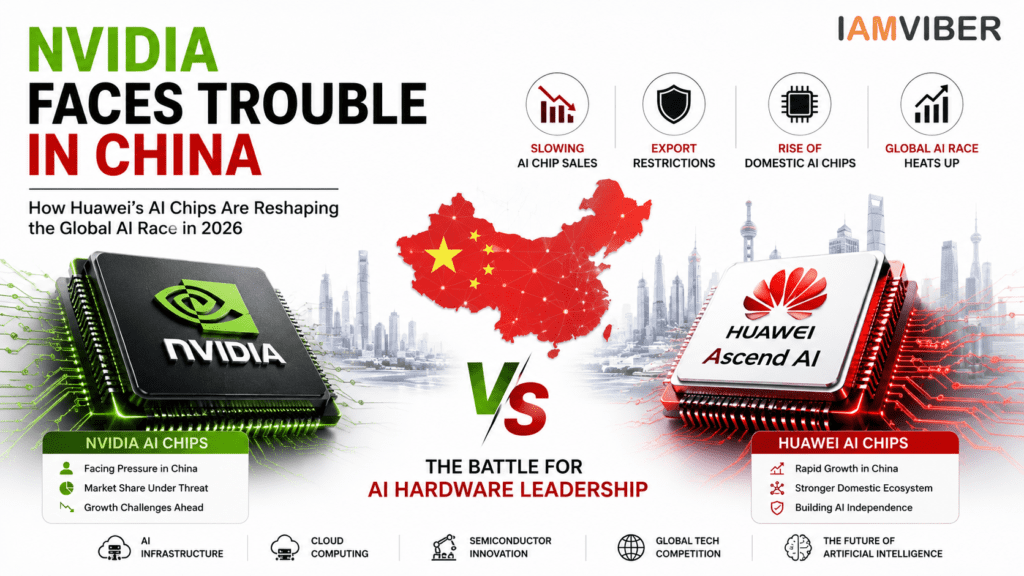
NVIDIA AI Chips Face a major turning point in 2026 as the global artificial intelligence industry enters a new era of competition. For years, NVIDIA AI chips have powered leading AI models like ChatGPT, enterprise AI platforms, cloud computing, autonomous vehicles, and advanced data centers. However, the NVIDIA AI chip market is now facing growing pressure in one of its biggest markets—China.
One of NVIDIA’s most important international markets is changing rapidly. NVIDIA AI chips face increasing competition as Chinese technology companies shift from imported GPUs to locally developed AI processors. This transition is reducing reliance on foreign semiconductor companies and strengthening China’s domestic AI chip ecosystem.
At the center of this transformation is Huawei. Its Huawei AI Chip portfolio, including the Ascend series, is becoming the preferred choice for Chinese cloud providers, AI startups, and enterprise businesses. The growing NVIDIA vs Huawei rivalry is reshaping the AI hardware market, creating new opportunities for domestic semiconductor manufacturers while increasing competition for NVIDIA AI chips.
This is more than just another semiconductor story. The battle between NVIDIA AI chips and Huawei AI Chip technology could redefine the future of the global AI chip market, influence billions of dollars in AI infrastructure investments, and reshape the balance of power in artificial intelligence. As NVIDIA AI chips face stronger competition in China, the outcome could have a lasting impact on the worldwide AI industry.
Why NVIDIA AI Chip Sales Are Slowing in China
For nearly a decade, NVIDIA established itself as the undisputed leader in AI computing.
Its GPUs became the backbone of:
- Large Language Models (LLMs)
- AI training clusters
- Cloud computing
- Robotics
- Healthcare AI
- Autonomous driving
However, geopolitical tensions and export restrictions have significantly limited NVIDIA’s ability to sell its most advanced AI processors in China.
Instead of waiting for restrictions to ease, Chinese companies have accelerated investments in homegrown alternatives.
The result is an AI ecosystem becoming increasingly independent from American hardware.
Huawei AI Chip Is Challenging NVIDIA AI Chip Leadership
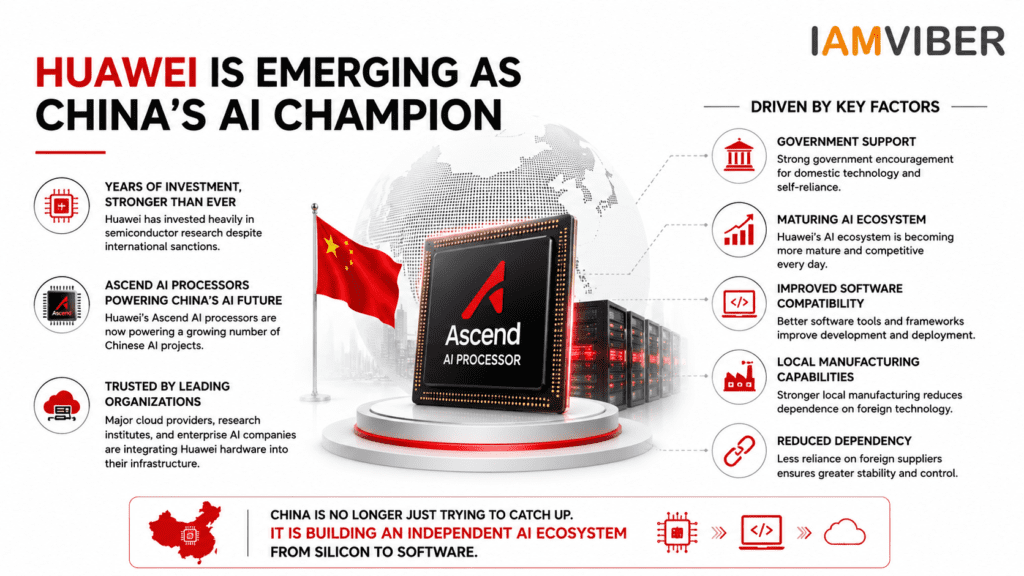
Huawei has spent years investing heavily in semiconductor research despite international sanctions.
Today, its Ascend AI processors are powering an increasing number of Chinese AI projects.
Major cloud providers, research institutes, and enterprise AI companies are gradually integrating Huawei hardware into their infrastructure.
This shift is being supported by several factors:
- Government encouragement for domestic technology
- Growing maturity of Huawei's AI ecosystem
- Improved software compatibility
- Better local manufacturing capabilities
- Reduced dependency on foreign suppliers
China is no longer simply trying to catch up.
It is attempting to build an independent AI ecosystem from silicon to software.
Why Chinese Companies Are Choosing Domestic AI Chips
Several practical reasons explain this transition.
1. Supply Stability
Export restrictions create uncertainty around long-term GPU availability.
Companies building multi-billion-dollar AI infrastructure cannot afford unpredictable supply chains.
Domestic chips provide greater planning confidence.
2. Government Support
China has prioritized semiconductor independence as a national strategy.
Domestic AI hardware manufacturers receive funding, policy support, and ecosystem development assistance.
This creates powerful incentives for local adoption.
3. Lower Strategic Risk
Relying heavily on imported AI hardware creates long-term business risks.
Chinese firms increasingly prefer solutions they can fully control.
4. Rapid Improvement in Performance
While NVIDIA still leads in absolute AI performance, Huawei’s latest processors have narrowed the gap for many enterprise workloads.
For inference, cloud deployment, and certain AI applications, domestic alternatives have become increasingly competitive.
Despite challenges in China, NVIDIA remains the global leader in AI hardware.
Its advantages include:
- CUDA software ecosystem
- Developer community
- AI frameworks
- Enterprise adoption
- Research partnerships
- Cloud integrations
Most AI companies worldwide still build their infrastructure around NVIDIA GPUs.
However, losing momentum in the world’s second-largest economy could impact future growth.
The Rise of Huawei Could Reshape the AI Hardware Market
For years, NVIDIA faced limited competition in high-performance AI computing.
That landscape is changing.
Huawei’s expanding AI portfolio means:
- Increased competition
- More regional AI ecosystems
- Greater hardware diversity
- Lower dependence on a single supplier
Competition often accelerates innovation.
The AI hardware market may soon resemble the smartphone industry, where multiple companies compete across different regions.
What This Means for AI Startups
Many startups closely watch GPU pricing.
If more companies produce competitive AI chips, startups could eventually benefit from:
- Lower hardware costs
- Increased cloud options
- Better regional pricing
- Faster infrastructure expansion
More competition typically creates more opportunities for innovation.
Impact on Global Cloud Providers
Cloud companies depend heavily on AI accelerators.
A more diversified hardware ecosystem could lead to:
- Multiple AI chip vendors
- Region-specific cloud infrastructure
- Optimized AI workloads
- Reduced dependence on one manufacturer
This diversification strengthens resilience across the AI industry.
China's AI Strategy Is Reducing Dependence on NVIDIA AI Chip
China’s long-term AI strategy extends beyond manufacturing chips.
The country is building an integrated ecosystem that includes:
- AI hardware
- Operating systems
- AI frameworks
- Cloud infrastructure
- Foundation models
- Semiconductor manufacturing
- Enterprise AI applications
The goal is clear:
Create an end-to-end AI ecosystem capable of competing globally without relying heavily on foreign technology.
Challenges Huawei Still Faces
Although Huawei has made remarkable progress, several challenges remain.
Software Ecosystem
NVIDIA’s CUDA platform remains the industry standard.
Convincing developers to migrate requires significant effort.
Global Expansion
Many international companies continue to prefer NVIDIA due to ecosystem familiarity.
Manufacturing Constraints
Advanced semiconductor manufacturing remains highly competitive and capital intensive.
Scaling production to meet global demand is a significant challenge.
Why Investors Are Watching This Closely
Semiconductor companies have become some of the world’s most valuable businesses.
Every shift in market share affects:
- AI infrastructure spending
- Cloud investments
- Semiconductor suppliers
- Enterprise technology budgets
- Government technology strategies
Investors recognize that AI chips have become one of the most strategic technologies of the decade.
The AI industry may evolve toward a multi-platform future rather than one dominated by a single hardware provider.
Just as smartphones have Android and iOS, enterprise AI may eventually rely on several competing hardware ecosystems.
This could encourage:
- Faster innovation
- Lower prices
- Better regional optimization
- Stronger supply chain resilience
The next phase of AI competition may not be about building the smartest chatbot—it may be about building the chips that power every AI system.
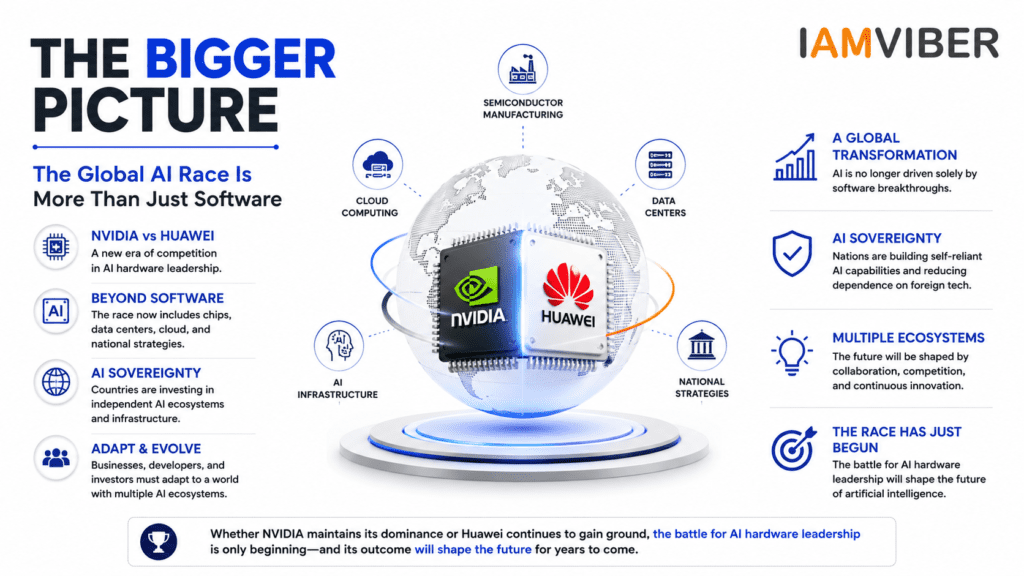
The competition between NVIDIA and Huawei reflects a broader transformation in global technology. Artificial intelligence is no longer driven solely by software breakthroughs.
The race now extends to the physical infrastructure powering AI—from semiconductor manufacturing and data centers to cloud computing and national technology strategies.
As countries invest heavily in AI sovereignty, businesses, developers, and investors will need to adapt to a world where multiple AI ecosystems coexist.
Whether NVIDIA maintains its dominance or Huawei continues to gain ground, one thing is clear: the battle for AI hardware leadership is only beginning, and its outcome will shape the future of artificial intelligence for years to come.
Conclusion
NVIDIA remains the benchmark for AI computing worldwide, but its position in China is facing unprecedented pressure. Huawei’s rapid advances in AI chips, combined with China’s push for technological self-reliance, are creating a more competitive and fragmented AI hardware landscape.
For businesses, startups, and investors, this is more than a regional story—it’s a signal that the future of AI infrastructure will be shaped by geopolitical strategy, semiconductor innovation, and the race to build the next generation of intelligent computing.
1. Why are NVIDIA's AI chip sales slowing in China?
NVIDIA’s AI chip sales in China have slowed due to U.S. export restrictions on advanced AI processors and China’s growing adoption of domestic AI chips developed by Huawei and other local manufacturers.
2. Which Huawei AI chips are competing with NVIDIA?
Huawei’s Ascend AI processor family is increasingly being used for AI training, inference, cloud computing, and enterprise AI applications across China.
3. Is Huawei replacing NVIDIA globally?
Not yet. NVIDIA continues to dominate the global AI hardware market thanks to its CUDA software ecosystem, strong developer support, and widespread adoption. Huawei’s gains are currently strongest within China.
4. How will this affect AI startups?
Greater competition in AI hardware could eventually reduce computing costs, improve cloud infrastructure options, and provide startups with more choices for deploying AI models.
5. Why is China's domestic AI chip industry growing?
China is investing heavily in semiconductor self-reliance to reduce dependence on foreign technology, strengthen supply chains, and support long-term growth in artificial intelligence and cloud computing.
Topics to follow: Current Affairs & Insights Tech Innovation GenZ entrepreneurship Collaborative Fashion GEO AI Agentic SME