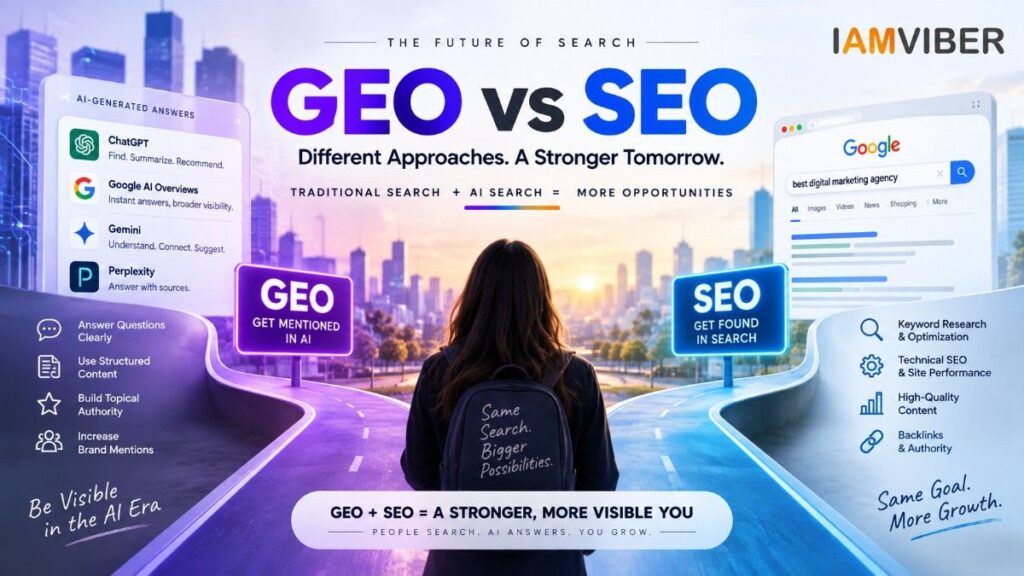
Search is changing rapidly in 2026. People are no longer relying only on traditional Google search results to find information, products, services, and brands. They are increasingly asking AI-powered platforms such as ChatGPT, Gemini, Perplexity, and Google’s AI-powered Search experiences for direct answers.
This shift has created a new digital marketing term: Generative Engine Optimization (GEO).
But what exactly is the difference between GEO vs SEO? Is GEO replacing traditional SEO, or do businesses need both?
The short answer is simple: GEO vs SEO is not really an either-or decision. GEO and SEO work together. SEO helps your website become discoverable and competitive in traditional search, while GEO focuses on increasing the chances that AI systems understand, mention, and cite your brand or content.
What Is SEO?
SEO stands for Search Engine Optimization. It is the process of improving a website so that search engines such as Google and Bing can understand, index, and rank its pages.
Traditional SEO focuses on achieving higher positions in search engine results pages (SERPs).
For example, if someone searches:
“Best digital marketing agency in India”
an SEO strategy aims to help a website appear among the top organic search results.
SEO typically involves:
- Keyword research
- On-page optimization
- Technical SEO
- Internal linking
- Backlink building
- Content creation
- Website speed and user experience
- Search intent optimization
- Structured data
The primary goal is visibility in traditional search results and generating organic traffic.
What Is GEO?
GEO stands for Generative Engine Optimization.
Unlike traditional SEO, which primarily focuses on ranking web pages, GEO focuses on making content easier for generative AI systems to understand, retrieve, summarize, and potentially cite in their responses.
This includes AI-powered search experiences and answer engines such as ChatGPT, Google AI Overviews, Google AI Mode, Gemini, Perplexity, and similar platforms.
In simple terms:
SEO asks: “Can my website rank in search results?”
GEO asks: “Can an AI system find, understand, trust, and mention my brand or content when answering a user’s question?”
This is why GEO vs SEO has become an important discussion for modern marketers.
GEO vs SEO: The Main Difference
The biggest difference in GEO vs SEO is the visibility format.
SEO traditionally tries to win a position on a search results page.
GEO tries to increase the likelihood of being represented within an AI-generated answer.
For example, traditional SEO may help your article rank for:
“How does AI marketing work?”
With GEO, the goal is for an AI search system to potentially use your article as a source when generating an answer to that question.
Google’s current generative Search experiences are designed to provide AI-generated responses while also helping users discover relevant websites and original content.
Therefore, understanding GEO vs SEO is becoming increasingly important for businesses that depend on online visibility.
GEO vs SEO: Key Differences
| Factor | SEO | GEO |
|---|---|---|
| Full form | Search Engine Optimization | Generative Engine Optimization |
| Primary target | Search engines | Generative AI / answer engines |
| Main objective | Higher search rankings | AI visibility, mentions and citations |
| Main output | Ranked webpage | AI-generated answer inclusion |
| Important elements | Keywords, links, technical SEO | Clear answers, authority, context and structured content |
| Main metrics | Rankings, impressions, clicks | AI mentions, citations and AI-referred traffic |
| Content style | Search-friendly | Search + AI extraction-friendly |
This comparison makes the GEO vs SEO distinction easier to understand.
However, these strategies have significant overlap.
How GEO and SEO Work Together
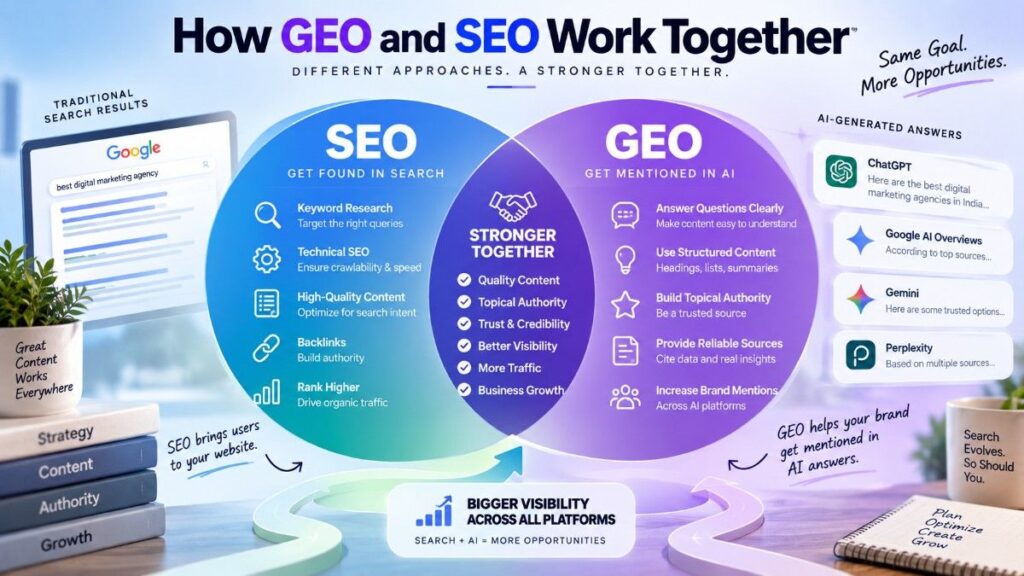
One of the biggest misconceptions about GEO vs SEO is that businesses need to choose one.
They don’t.
A strong GEO strategy usually benefits from a strong SEO foundation.
Your website still needs to be crawlable, technically accessible, useful, authoritative, and well structured. Google has also emphasized that its AI Search experiences continue to rely on core Search systems and that website owners should continue creating unique, useful content.
That means businesses shouldn’t abandon SEO simply because AI search is growing.
Instead, the smarter strategy is:
SEO + GEO = broader search visibility.
SEO can help users discover your website through traditional search.
GEO can help your content become more useful to AI systems that generate answers.
Why GEO Is Becoming Important in 2026
The rise of AI-powered search is one of the biggest reasons marketers are discussing GEO vs SEO.
Google reported in 2026 that AI Overviews have more than 2.5 billion monthly active users, while AI Mode has surpassed one billion monthly users.
Google has also continued expanding AI Mode and AI Overviews, including more conversational and exploratory search experiences.
This means the search journey is becoming more conversational.
Instead of searching:
“Best CRM software”
a user might ask:
“Which CRM is best for a small SaaS company with a five-person sales team?”
AI systems can interpret the context behind the question and generate a more personalized response.
That changes how brands need to think about visibility.
GEO vs SEO: How Content Strategy Changes
Content remains extremely important in both GEO vs SEO strategies, but the way you structure content can become even more important for AI visibility.
A GEO-friendly article should make important information easy to identify.
For example, instead of writing five paragraphs before answering a question, provide a direct answer first and then explain it.
Use:
- Clear headings
- Short paragraphs
- Bullet points
- Definitions
- Statistics with sources
- Original insights
- Examples
- FAQs
- Descriptive titles
This structure makes content easier for humans to scan and easier for AI systems to interpret.
The goal isn’t to write content exclusively for machines.
The goal is to create genuinely useful content that works well for both humans and AI systems.
What Is AI Search Optimization?
GEO can be considered one part of this larger shift.
For businesses, AI Search Optimization can include:
- Creating authoritative content
- Answering specific user questions
- Building strong topical authority
- Improving website structure
- Creating original research and insights
- Strengthening brand mentions across the web
- Making information easy to understand and verify
- Maintaining accurate business information
The important point in the GEO vs SEO discussion is that many traditional SEO fundamentals remain valuable.
How to Optimize for GEO in 2026
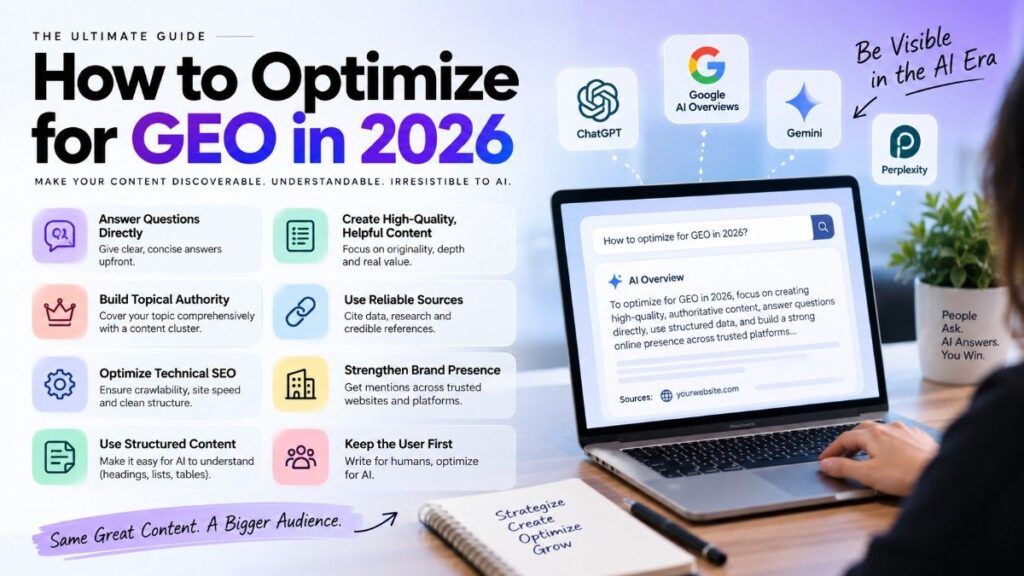
If you want to start with GEO, don’t completely rebuild your SEO strategy. Instead, improve your existing content.
1. Answer Questions Directly
Start important sections with a clear answer. For example:
What is GEO?
GEO, or Generative Engine Optimization, is the process of improving digital content so generative AI systems can understand, retrieve, and potentially cite it in AI-generated answers.
This format is clear and useful.
2. Build Topical Authority
Don’t publish one article about AI search and stop. Create a complete topic cluster. For example:
- What is GEO?
- GEO vs SEO
- GEO vs AEO
- What is AI Search Optimization?
- How to optimize content for ChatGPT
- How Google AI Overviews work
- How to improve AI visibility
- AI SEO strategies for businesses
This gives your website greater topical depth.
3. Use Reliable Sources
AI systems need trustworthy information.
Whenever you make important claims, support them with credible sources.
Original research, statistics, expert commentary, case studies, and first-hand experience can make content more valuable.
4. Strengthen Your Brand's Online Presence
GEO isn’t only about your own website.
AI systems may encounter information about your company across multiple websites, publications, directories, reviews, social platforms, and other sources.
That means digital PR and brand authority can become increasingly relevant to AI visibility.
Recent industry research and reporting also highlights the role of third-party and earned-media references in AI-generated brand visibility.
5. Keep Your SEO Fundamentals Strong
This is perhaps the most important part of the GEO vs SEO discussion. Don’t ignore:
- Technical SEO
- Internal links
- Page speed
- Mobile experience
- Crawlability
- Indexability
- Quality backlinks
- Search intent
- Helpful content
GEO does not make these fundamentals irrelevant.
GEO vs SEO: Which One Should You Choose?
If your company depends on organic visibility, the answer is simple:
SEO continues to be important because people still use traditional search results.
At the same time, AI-powered search is becoming a major discovery channel. A modern content strategy should therefore consider both traditional rankings and AI visibility. Think of it this way:
SEO gets your content into the search ecosystem.
GEO helps make that content useful for the generative search ecosystem.
Together, they create a stronger organic visibility strategy.
The Future of GEO vs SEO
The future of GEO vs SEO is unlikely to be about one completely replacing the other.
Instead, search is becoming more fragmented.
Users may discover a company through Google Search, Google AI Overviews, Google AI Mode, ChatGPT, Gemini, Perplexity, social media, YouTube, or other platforms.
Google itself continues to evolve Search around AI-powered experiences while maintaining connections to websites and the broader web.
For marketers, this means the definition of “ranking” is expanding.
Visibility may no longer mean simply being number one on Google. It can also mean being:
- Mentioned by an AI assistant
- Cited as a source
- Recommended in an AI-generated comparison
- Included in an AI-powered answer
- Referenced when users ask about your industry
That’s why GEO vs SEO is becoming one of the most important conversations in digital marketing in 2026.
Final Verdict: GEO vs SEO
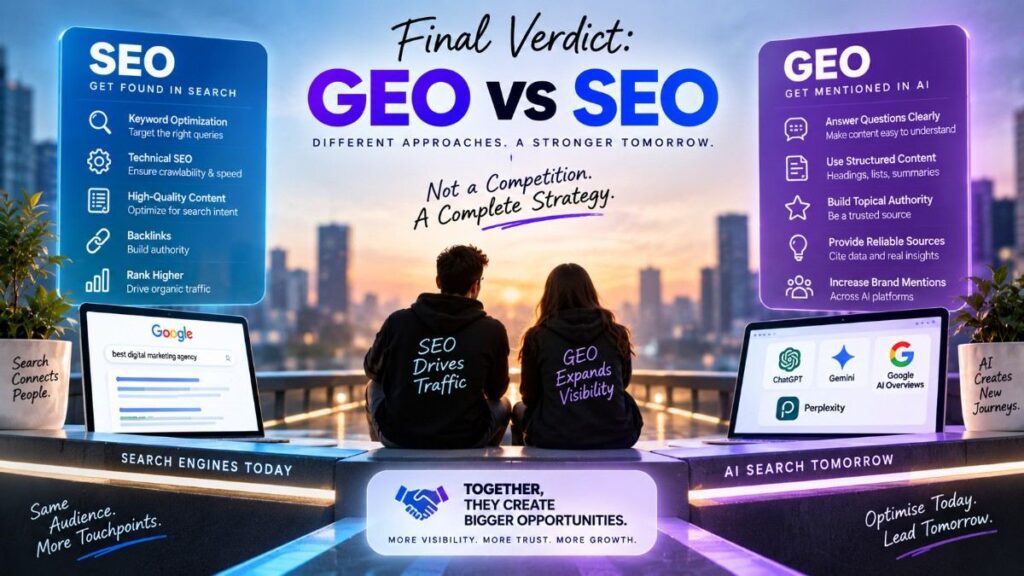
So, what is the real answer to GEO vs SEO?
SEO and GEO are different, but they are closely connected.
SEO focuses primarily on improving visibility in traditional search results.
GEO focuses on improving the chances of being understood, mentioned, or cited within generative AI experiences.
Neither should completely replace the other.
For businesses in 2026, the strongest strategy is to create high-quality, authoritative, well-structured content that satisfies users, performs well in traditional search, and is also understandable to AI systems.
In other words:
Don’t think of GEO vs SEO as a battle. Think of GEO + SEO as the future of search visibility.
Businesses that start adapting now can build stronger visibility across both traditional and AI-powered search environments.
Frequently Asked Questions
1. What is the difference between GEO vs SEO?
The main difference between GEO vs SEO is the type of search experience they target. SEO focuses on improving rankings in traditional search engines, while GEO focuses on improving a brand’s visibility within AI-generated answers and generative search experiences.
2. Is GEO replacing SEO in 2026?
No, GEO is not replacing SEO. In 2026, businesses should use both SEO and Generative Engine Optimization to reach users through traditional search results as well as AI-powered search experiences.
3. What is Generative Engine Optimization?
Generative Engine Optimization (GEO) is the process of creating and structuring content so AI-powered search systems can better understand, retrieve, summarize, and potentially cite the information when generating answers.
4. Why is GEO important for businesses in 2026?
GEO is becoming important because users are increasingly using AI-powered search tools to research products, services, brands, and questions. A strong GEO strategy can help businesses improve their visibility within these emerging search experiences.
5. What is AI Search Optimization?
AI Search Optimization refers to strategies designed to improve how easily AI-powered search systems understand and discover a website’s content. GEO is one important part of the broader AI Search Optimization approach.
6. How can I optimize my website for GEO?
You can optimize your website for GEO by publishing authoritative content, answering questions clearly, using descriptive headings, providing original insights, supporting claims with reliable sources, building topical authority, and maintaining strong technical SEO.
7. Is traditional SEO still important with Google AI Overviews?
Yes. Traditional SEO remains important because AI-powered search experiences still operate within the broader search ecosystem. Businesses should continue focusing on crawlability, useful content, technical SEO, internal linking, and other established SEO fundamentals while adapting their content for AI search.
8. Should my business invest in GEO or SEO?
Businesses should not view GEO vs SEO as an either-or choice. A combined SEO and GEO strategy can help build visibility across traditional search results and AI-powered search experiences, making it a stronger approach for long-term digital growth.
Topics to follow on IAMVIEBR : Current Affairs & Insights Tech Innovation GenZ entrepreneurship Collaborative Fashion GEO SME