Anthropic’s announcement of Claude Fable 5 and Claude Mythos 5
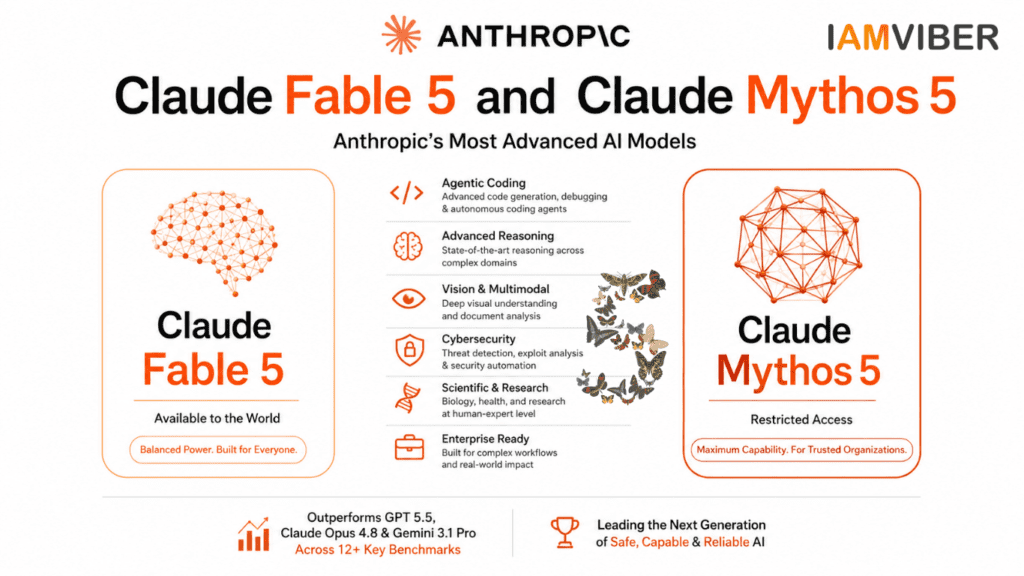
The artificial intelligence race took another major leap forward with Anthropic’s announcement of Claude Fable 5 and Claude Mythos 5. These models represent a new generation of AI systems that push beyond traditional chatbot capabilities and move toward advanced reasoning, long-horizon task execution, software engineering, scientific analysis, and agentic workflows. Anthropic describes Fable 5 as the most powerful model it has ever made available to the public, while Mythos 5 remains a restricted-access model reserved for trusted organizations and cybersecurity experts.
The release is significant because it marks the first time Anthropic has made a Mythos-class model available to general users, albeit with extensive safeguards. Until now, Mythos-level capabilities were considered too powerful and potentially risky for public deployment.
The Evolution of Claude
Anthropic has steadily improved the Claude family over the years, introducing increasingly capable models focused on reasoning, coding, and enterprise applications. Earlier generations such as Haiku, Sonnet, and Opus established Claude as a leading AI platform. However, the introduction of the Mythos architecture represented a major breakthrough in AI capability, particularly in cybersecurity and complex problem-solving.
When Anthropic first previewed Mythos in early 2026, access was limited to a small group of organizations participating in Project Glasswing. The company cited concerns about the model’s ability to identify software vulnerabilities and perform advanced cybersecurity tasks. These capabilities were considered powerful enough to require controlled deployment.
Now, with Fable 5, Anthropic is bringing much of that capability to the public while maintaining strict safety controls.
What Is Claude Fable 5?
Claude Fable 5 is a Mythos-class AI model designed for general use. According to Anthropic, it delivers state-of-the-art performance in:
- Software engineering
- Advanced coding
- Scientific reasoning
- Knowledge work
- Long-duration tasks
- Agentic workflows
- Vision and multimodal understanding
- Research and analysis
- Anthropic claims that Fable 5 exceeds the capabilities of all previous public Claude releases and performs especially well on complex tasks requiring sustained reasoning over long periods.
One of the key improvements is its ability to handle tasks that require planning, memory, and multi-step execution. Rather than simply answering questions, Fable 5 can work through lengthy objectives, maintain context, and deliver more complete solutions.
This makes it particularly valuable for developers, researchers, analysts, and businesses seeking AI-powered productivity.
Claude Mythos 5 is the unrestricted version of the same underlying architecture.
While Fable 5 includes extensive safeguards, Mythos 5 offers broader capabilities and fewer restrictions. Anthropic has chosen not to release Mythos 5 publicly due to concerns regarding misuse in sensitive areas such as cybersecurity, biology, and chemistry. Instead, access is limited to trusted partners through Project Glasswing and other approved programs.
Mythos 5 demonstrated remarkable capabilities in identifying software vulnerabilities and solving complex cybersecurity challenges. These abilities made it one of the most powerful AI systems Anthropic had ever created, but also raised questions about responsible deployment.
As a result, Anthropic opted for a cautious approach by releasing Fable 5 to the public while keeping Mythos 5 under controlled access.
Why Anthropic Added Safety Restrictions
One of the most interesting aspects of the launch is Anthropic’s decision to split the product line into Fable and Mythos. The company stated that unrestricted Mythos-level capabilities could potentially be misused in areas such as:
- Cybersecurity attacks
- Vulnerability discovery
- Biological research
- Chemical research
- Advanced model replication
To address these concerns, Anthropic built a safeguard layer into Fable 5. When users attempt to perform tasks that fall into high-risk categories, the system can automatically route requests to a less capable but safer model, Claude Opus 4.8.
Anthropic also reported extensive red-team testing and security evaluations before making Fable 5 publicly available. The company claims that hundreds of hours of testing failed to uncover a universal jailbreak capable of bypassing the model’s protections.
Key Differences Between Fable 5 and Mythos 5
| Feature | Claude Fable 5 | Claude Mythos 5 |
|---|---|---|
| Public Availability | Yes | No |
| Core Architecture | Mythos-class | Mythos-class |
| Safety Guardrails | Extensive | Limited |
| Cybersecurity Capabilities | Restricted | Full Access |
| Enterprise Access | Available | Approved Organizations Only |
| General Consumer Usage | Supported | Not Supported |
| Sensitive Research Domains | Controlled | Broader Capability |
Although both models share the same core architecture, the difference lies primarily in access controls and safety mechanisms.
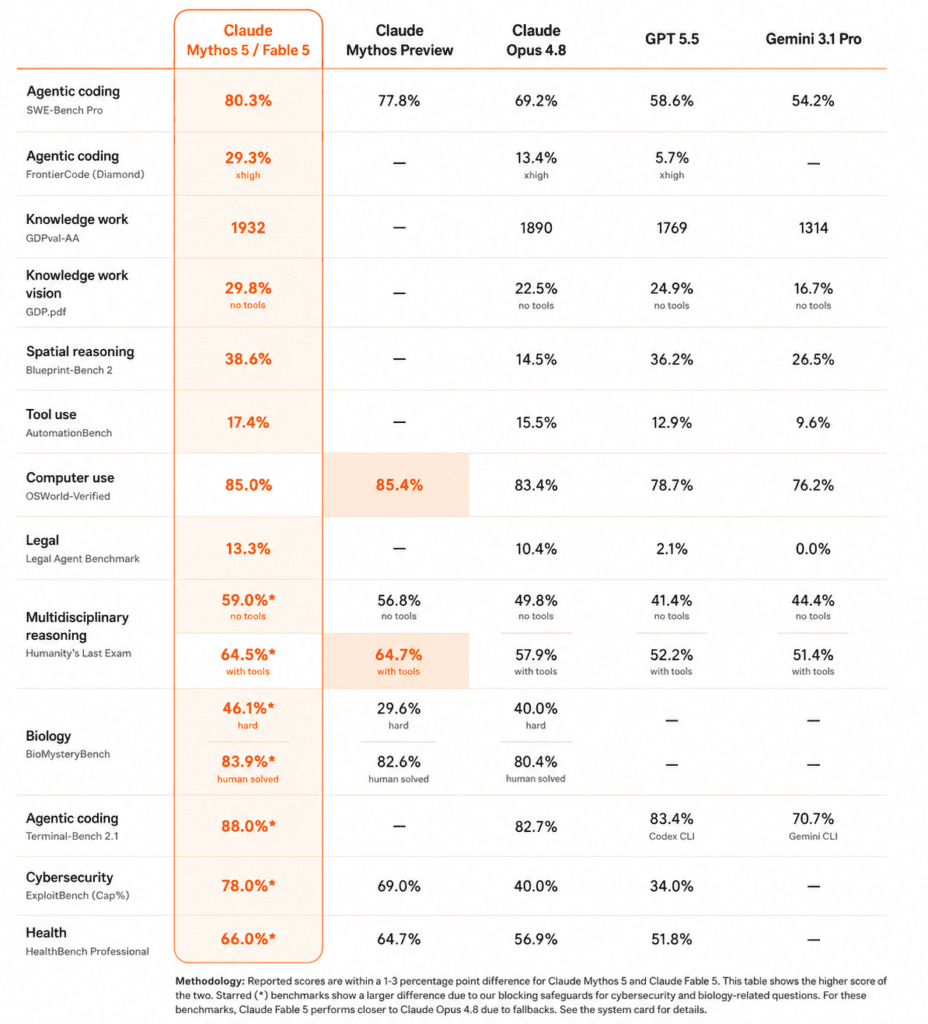
Performance Highlights
Early reports suggest that Fable 5 delivers exceptional performance across a variety of domains.
Software Development
Anthropic highlights software engineering as one of Fable 5’s strongest areas. Developers can use the model for:
- Code generation
- Debugging
- Refactoring
- Documentation
- Architecture planning
- Complex project management
- The model’s improved reasoning allows it to work on larger and more sophisticated codebases than previous Claude releases.The model’s improved reasoning allows it to work on larger and more sophisticated codebases than previous Claude releases.
Research and Knowledge Work
Fable 5 is also optimized for professional research tasks. It can analyze large volumes of information, identify patterns, and generate detailed reports with greater accuracy and contextual understanding.
Long-Horizon Tasks
A major challenge for AI systems has been maintaining consistency over long workflows. Anthropic claims Fable 5 significantly improves in this area, allowing users to assign multi-step objectives that may require extensive planning and execution.
Vision and Multimodal Understanding
Like other frontier models, Fable 5 can work with images and visual content. This enables applications such as:
- Document analysis
- Visual reasoning
- Design review
- Chart interpretation
- Image-based research
- Anthropic positions Fable 5 as a highly capable multimodal assistant for professional environments.
Pricing
Anthropic has priced both Fable 5 and Mythos 5 at:
- $10 per million input tokens
- $50 per million output tokens
- While this makes Fable 5 more expensive than some earlier Claude models, Anthropic argues that its higher efficiency and stronger reasoning capabilities can reduce overall operational costs.
Industry Impact
The launch of Fable 5 arrives during one of the most competitive periods in AI history. Anthropic now competes directly with advanced offerings from OpenAI, Google, xAI, Meta, and other frontier AI companies.
By introducing a public Mythos-class model, Anthropic is signaling confidence that powerful AI can be deployed responsibly without sacrificing safety. At the same time, the existence of Mythos 5 demonstrates how frontier AI capabilities are advancing beyond what many organizations are comfortable releasing openly. The release may also influence how other AI companies balance capability and safety in future models.
Final Thoughts
Claude Fable 5 and Claude Mythos 5 represent a major milestone in Anthropic’s AI roadmap. Fable 5 brings Mythos-class intelligence to the public with carefully designed safeguards, while Mythos 5 remains available only to trusted organizations due to its advanced capabilities.
For developers, researchers, and businesses, Fable 5 offers access to Anthropic’s most capable public AI system yet. For the broader AI industry, the launch highlights a growing challenge: how to make increasingly powerful AI available to society while minimizing the risks that come with it.