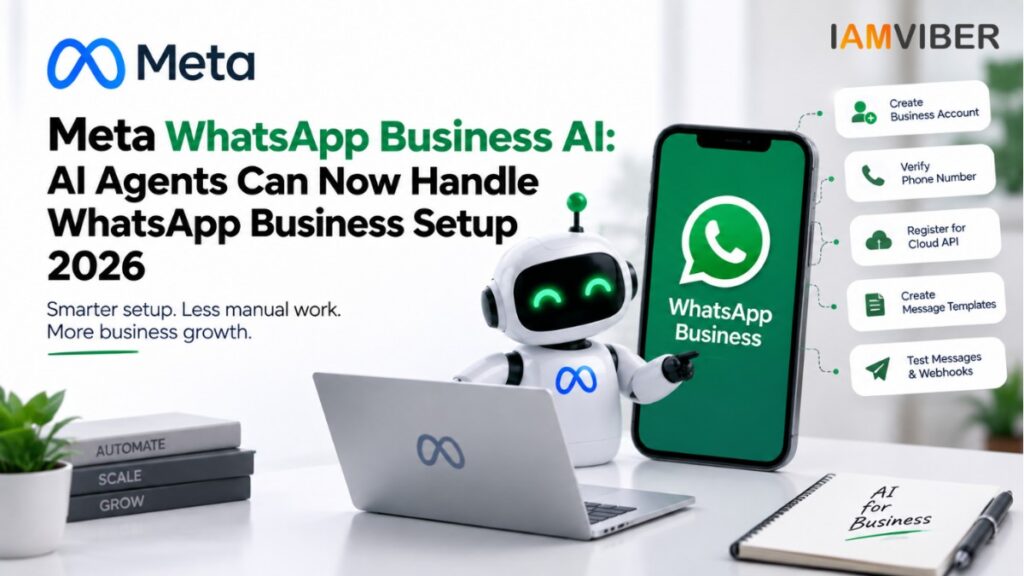
Meta is making WhatsApp Business setup much easier for developers and companies by allowing AI agents to handle many of the technical and repetitive tasks involved in configuring WhatsApp Business messaging.
The company has introduced WhatsApp Business Tools MCP, a new Model Context Protocol (MCP) server that connects AI coding agents with the WhatsApp Business Platform. Instead of switching between Meta Business Manager, Developer Console, API documentation and a code editor, developers can increasingly describe what they want in natural language and let an AI agent handle the configuration.
This latest move puts WhatsApp Business AI directly into the infrastructure and setup layer of business messaging.
What Is WhatsApp Business AI?
WhatsApp Business AI refers broadly to AI-powered tools that help businesses automate, manage or improve their WhatsApp operations.
Until recently, much of the AI conversation around WhatsApp focused on customer support, chatbots and automated replies. Meta is now moving further upstream.
With its new MCP integration, WhatsApp Business AI can assist with the technical processes required to get WhatsApp Business messaging up and running.
Meta says the new WhatsApp Business Tools MCP can connect an AI coding agent to the WhatsApp Business Platform and help with tasks such as creating accounts, adding phone numbers, building message templates and sending test messages.
That means the role of WhatsApp Business AI is expanding from simply answering customers to helping businesses configure the technology behind those conversations.
What Is WhatsApp Business Tools MCP?
MCP stands for Model Context Protocol. It is a way for AI applications and agents to interact with external tools and services through defined interfaces.
Meta’s new WhatsApp Business Tools MCP essentially provides an interface between an AI coding agent and the WhatsApp Business Platform.
Developers can use AI agents such as Claude, Cursor, Codex or ChatGPT to assist with WhatsApp Business configuration instead of manually moving through multiple Meta tools.
For developers, this could make WhatsApp Business AI workflows significantly more conversational.
Instead of asking:
“Which API endpoint do I need?”
a developer can potentially tell an AI agent what they want to accomplish, and the agent can use the connected tools to perform the relevant configuration.
What Can Meta's AI Agent Do?
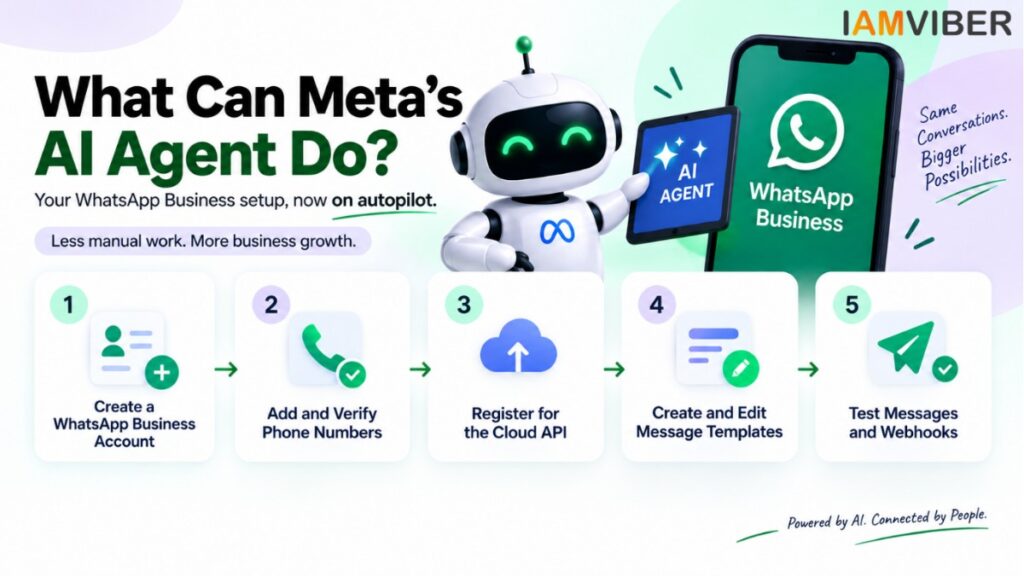
The new system is designed to handle several parts of WhatsApp Business setup and management.
1. Create a WhatsApp Business Account
One of the first steps in the process can now be handled through the AI agent.
Businesses can use the connected workflow to create their WhatsApp Business account without manually navigating through every configuration screen.
This is one of the areas where WhatsApp Business AI could reduce repetitive developer work.
2. Add and Verify Phone Numbers
Phone-number configuration is another important part of WhatsApp Business onboarding.
Meta’s new MCP workflow can help add a phone number and handle verification through the required process.
For businesses managing multiple messaging accounts, this type of automation could make onboarding considerably easier.
3. Register for the Cloud API
Businesses that want to build scalable messaging experiences often need access to the WhatsApp Cloud API.
The AI-assisted workflow can help register a number for Cloud API access, reducing the amount of manual configuration developers need to perform.
This is where WhatsApp Business AI starts becoming more interesting for technical teams.
4. Create and Edit Message Templates
Businesses rely heavily on WhatsApp message templates for notifications, marketing communication and transactional messaging.
Instead of manually creating every template, a business can describe the message it wants.
The AI agent can then help create or edit the relevant template.
For example, a company could describe a requirement such as:
“Create a WhatsApp template for confirming a customer’s appointment.”
The agent can assist with the template-building process through the connected WhatsApp Business tools.
5. Test Messages and Webhooks
Testing is another important part of WhatsApp Business development.
Meta’s new tools can help developers test messages and webhooks, making it easier to identify configuration problems before a business starts using the system at scale.
This gives WhatsApp Business AI a role in development and troubleshooting, rather than limiting it to customer conversations.
Why This Matters for Businesses
The biggest change is not simply that Meta has added another AI feature.
The bigger shift is that AI agents are increasingly being given access to business infrastructure.
Previously, a developer might have had to:
1. Open the Developer Console.
2. Configure business settings.
3. Open the Developer Console.
4. Find the relevant API documentation.
5. Configure a phone number.
6. Create message templates.
7. Test webhooks.
8. Troubleshoot errors.
9. Return to the dashboard to check verification status.
Now, many of these tasks can be assisted through an AI-agent workflow.
That is an important evolution for WhatsApp Business AI.
The AI is no longer just generating an answer. It can interact with connected systems and help execute tasks.
WhatsApp Business AI vs Traditional WhatsApp Automation
Traditional WhatsApp automation usually focuses on what happens after a customer sends a message.
For example:
Customer: “Where is my order?”
Automation: “Your order is currently out for delivery.”
That is useful, but limited.
The newer generation of WhatsApp Business AI is broader.
AI agents can potentially participate in the infrastructure, configuration and development workflow behind the business messaging system.
This creates three layers of automation:
Layer 1 — Setup: AI helps configure WhatsApp Business.
Layer 2 — Development:
AI helps build templates, test messages and troubleshoot integrations.
Layer 3 — Customer interaction:
AI helps businesses respond to customers and automate conversations.
Meta is increasingly working across all three layers.
Meta Business Agent Is Also Expanding
The WhatsApp Business Tools MCP announcement comes as Meta continues developing its broader Business Agent strategy.
Earlier in 2026, Meta introduced Meta Business Agent, an AI system designed to help businesses communicate with customers.
According to Meta, Business Agent can answer business-specific questions, recommend products, qualify leads, book appointments and allow businesses to determine when a human team member should take over.
Meta said more than one million businesses were already using a Meta Business Agent on WhatsApp and Messenger at the time of its June announcement.
The distinction is important.
WhatsApp Business AI is becoming an ecosystem rather than a single chatbot feature.
There is AI for setting up the infrastructure, AI for building messaging workflows and AI for interacting with customers.
What This Means for Developers
For developers, the biggest benefit could be reduced context switching.
Instead of repeatedly searching documentation and manually navigating dashboards, developers can use AI coding agents as an interface for certain WhatsApp Business tasks.
Meta’s existing Social Technologies MCP can also help developers discover API endpoints, search documentation and troubleshoot errors alongside the new WhatsApp Business tool.
This could make WhatsApp Business AI especially useful for startups and small development teams that do not have dedicated specialists for every Meta platform configuration task.
However, developers will still need to understand permissions, authentication, business verification, API behavior, messaging policies and data handling.
AI can automate the workflow, but businesses remain responsible for how their systems are configured and used.
What This Means for Startups and SMBs
For startups, WhatsApp is already an important customer communication channel.
Businesses use it for:
- Lead generation
- Customer support
- Appointment bookings
- Order updates
- Product inquiries
- Marketing communication
- Sales follow-ups
The easier the technical setup becomes, the easier it could be for smaller companies to build sophisticated messaging workflows.
This is where WhatsApp Business AI could have a significant impact.
A small business may not need to spend as much time navigating technical documentation just to get its messaging infrastructure configured.
Instead, an AI agent could become the first interface between the business owner and the technical platform.
Is WhatsApp Business Becoming an AI Platform?
That may be the more interesting question.
WhatsApp has already evolved from a simple messaging application into a major business communication platform.
Now Meta is adding AI agents to both sides of the ecosystem.
Businesses can use AI to build and configure their WhatsApp infrastructure. Customers can interact with AI-powered business agents. Developers can use AI coding agents to work with Meta’s APIs and tools.
Together, these developments point toward a more agent-driven business messaging ecosystem.
The long-term opportunity for WhatsApp Business AI could therefore extend beyond chatbots.
Imagine a business owner saying: “Set up WhatsApp for my new store, create an order-confirmation template, connect my customer database and test the workflow.”
The vision is moving from AI that tells you how to do something to AI that helps you actually do it.
What Businesses Should Watch Next
There are still important considerations.
Businesses should pay attention to permissions, authentication, verification requirements, message-template policies and the exact capabilities available through Meta’s MCP tools.
Availability and functionality can also change as Meta expands these systems.
Businesses should therefore treat AI agents as an operational layer that needs appropriate oversight rather than assuming every task can be fully automated.
For developers, the opportunity is to combine these tools with existing systems such as CRMs, e-commerce platforms, support software and internal databases.
That could turn WhatsApp from a communication channel into a more deeply integrated business operating layer.
The Bigger Picture
Meta’s WhatsApp Business Tools MCP is part of a broader shift happening across the technology industry. AI agents are increasingly moving beyond content generation and code suggestions.
They are being connected to APIs, databases, business applications and operational systems.
Meta’s latest move brings that trend directly into WhatsApp Business.
For businesses, this could mean faster onboarding.
For developers, it could mean less repetitive configuration.
For customers, it could eventually mean faster and more personalized interactions.
And for the AI industry, it represents another step toward software that can not only generate instructions but also take action through connected tools.
WhatsApp Business AI is therefore becoming much more than an automated customer-service chatbot. It is evolving into an interface between businesses, developers, AI agents and the WhatsApp Business Platform. The real question now is not whether AI agents will help businesses manage WhatsApp. It is how much of the entire business messaging workflow they will eventually be able to operate.
Topics to follow on IAMVIEBR : AI & Tech, Startup, AI Creative, Agentic AI, Current Affairs & Insights, Collaboration