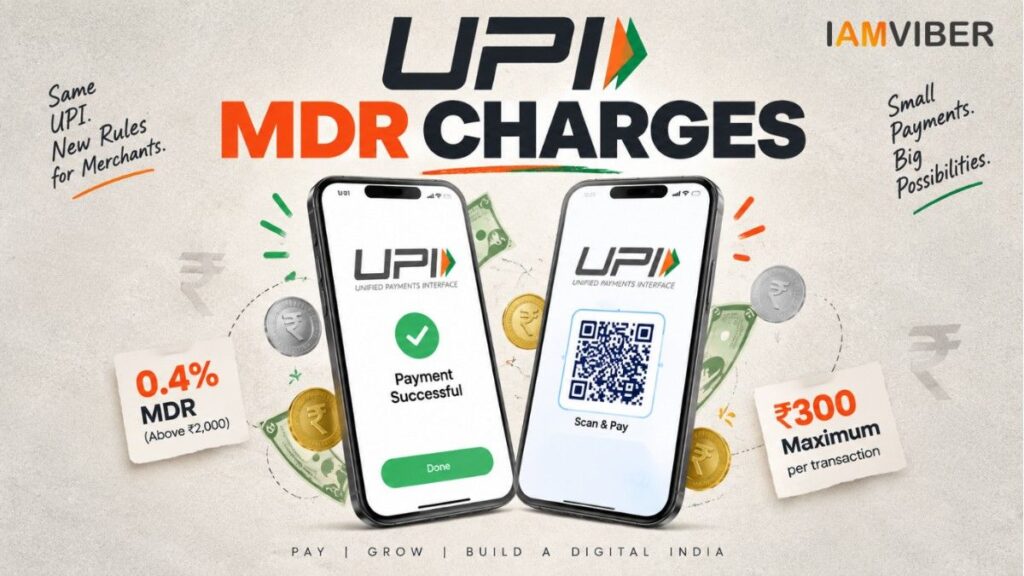
UPI MDR charges are set to become a major talking point for Indian merchants and digital-payment users from October 15, 2026. The new framework introduces a Merchant Discount Rate (MDR) on specified person-to-merchant (P2M) UPI transactions above ₹2,000. The important point is that the charge is designed as a merchant-side payment-processing fee, not a direct fee on consumers.
Under the framework, eligible P2M transactions above ₹2,000 will attract an MDR of 0.4%, while transactions of ₹75,000 or more will have a maximum MDR of ₹300. Payments between individuals will continue to remain free, and payments to eligible small merchants covered by the zero-MDR framework will also remain free.
What Is Changing With UPI MDR Charges From October 15, 2026?
UPI MDR charges will apply from October 15, 2026, to specified merchant transactions above ₹2,000. A payment of ₹3,000, for example, would carry an MDR of ₹12 at the standard 0.4% rate. A ₹50,000 payment would attract ₹200, while a ₹75,000 payment would reach the ₹300 cap. Any eligible transaction above ₹75,000 will remain subject to the same ₹300 maximum.
This does not mean that consumers will suddenly see a UPI fee added to their bills. The government has clarified that MDR is not a tax or a government collection. It is a charge within the payment ecosystem and is distributed among participating banks, payment service providers and UPI application providers.
Who Will Actually Pay UPI MDR Charges?
The new framework primarily concerns merchants receiving eligible P2M payments. The customer making the payment is not the party being charged the MDR. Banks have been advised to ensure that merchants do not pass the MDR on to customers, while UPI application providers are prohibited from imposing platform fees or hidden charges for these payments.
This distinction is important because the phrase “UPI charges” can easily create confusion. A consumer sending money to a friend, family member or another individual will not suddenly pay MDR. Person-to-person transactions remain free irrespective of the amount transferred.
Small merchants are also protected under the framework. Merchants receiving up to ₹1 lakh per month through UPI QR codes under the P2PM category will continue to receive zero-MDR treatment. According to the framework, merchants crossing the relevant inward-payment threshold for three consecutive months can move into the regular P2M category.
How Much Will Merchants Pay Under UPI MDR Charges?
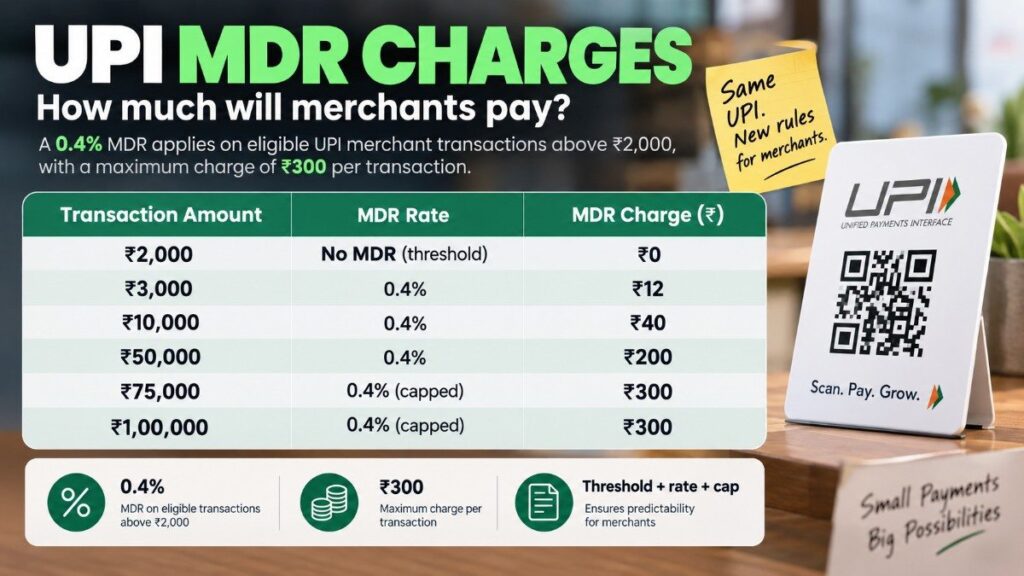
For standard eligible merchant payments, UPI MDR charges are calculated at 0.4% of the transaction value above the ₹2,000 threshold. The practical examples are straightforward:
- ₹2,000 transaction — ₹0 MDR
- ₹3,000 transaction — ₹12 MDR
- ₹10,000 transaction — ₹40 MDR
- ₹50,000 transaction — ₹200 MDR
- ₹75,000 transaction — ₹300 MDR
- ₹1,00,000 transaction — ₹300 MDR because of the cap
The ₹300 ceiling becomes important for large transactions. Once an eligible transaction reaches ₹75,000, the normal 0.4% calculation reaches ₹300, so transactions above that value do not keep increasing the MDR.
The framework therefore does not create a percentage-based charge without a ceiling. It combines a threshold, a standard rate and a maximum cap.
Which Sectors Have Different UPI MDR Charges?
Not every merchant payment follows the standard 0.4% structure. Certain essential and thin-margin categories have a flat MDR of ₹5 for eligible transactions above ₹2,000.
These include areas such as railways, telecommunications, insurance, fuel, utilities and agricultural inputs under the specified framework.
This means a qualifying ₹10,000 payment in one of these categories would attract ₹5 rather than the standard ₹40. Payments below ₹2,000 in these covered categories remain free of MDR.
Capital-market transactions have a separate rate. Payments relating to mutual funds, securities, stockbrokers and dealers will attract an MDR of 0.02%, capped at ₹300 per transaction.
What About UPI Payments and UPI MDR Charges for Small Businesses?
One of the biggest questions around UPI MDR charges is their effect on small merchants. The framework specifically creates protection for eligible small vendors. Those receiving up to ₹1 lakh per month through UPI QR codes under the P2PM framework remain under zero MDR.
The government says approximately 96% of merchant transactions will remain unaffected because they are either below the ₹2,000 threshold or covered by the zero-MDR framework for small merchants. That means the new MDR structure is aimed at a relatively limited portion of merchant payments rather than every UPI transaction.
Existing QR codes will continue to work, and small merchants covered by the P2PM framework do not have to replace their QR stands or soundboxes simply because the MDR framework is being introduced.
Will Consumers Have to Pay UPI MDR Charges?
For ordinary users, UPI MDR charges do not create a new direct payment fee. There is no monthly quota after which consumers start paying a fee, and there is no new consumer MDR.
The government has also clarified that daily transaction limits set by banks and NPCI are security and risk-management measures, not fee thresholds. In other words, a bank’s transaction limit should not be confused with a price charged for using UPI.
This is why UPI MDR charges should not be described simply as “UPI becoming paid.” The new framework is focused on specified merchant-side transactions, while P2P payments remain free and eligible small-merchant payments remain protected.
Why Are UPI MDR Charges Being Introduced?
UPI has grown into one of the world’s largest real-time payment systems, processing billions of transactions every month. The government and NPCI have argued that operating the network at this scale requires continuing investment in infrastructure, cybersecurity, fraud prevention, reliability and technology.
The new framework is intended to create a revenue mechanism within the payment ecosystem while keeping everyday consumer usage free. The MDR collected from eligible transactions is distributed among ecosystem participants rather than being treated as a tax collected by the government.
The policy is also designed to support continued expansion of digital payments. The government has said a dedicated fund for small merchants is proposed, with the framework indicating support for expanding UPI acceptance and digital-payment infrastructure.
How Will UPI MDR Charges Be Distributed?
The new UPI MDR charges are part of a payment ecosystem rather than a government tax. The official framework says MDR will be shared among participants involved in processing the payment, including banks, payment service providers and UPI application providers.
This revenue model is intended to provide an economic incentive for the companies and financial institutions that maintain the payment infrastructure. The broader objective is to support the continued operation and expansion of UPI while protecting users and small merchants from direct charges.
What Do UPI MDR Charges Mean for Businesses?
For larger merchants, UPI MDR charges introduce a new cost that will need to be considered alongside other payment-processing expenses.
Businesses that regularly receive high-value UPI payments may need to review their payment mix, accounting systems and reconciliation processes before October 15.
However, the framework also provides predictability. Standard eligible transactions have a defined 0.4% rate, while transactions at ₹75,000 and above have a ₹300 cap. Certain essential sectors have a ₹5 flat MDR, and eligible small P2PM merchants remain at zero MDR.
Businesses should also avoid automatically adding a separate UPI surcharge to customer bills. The government has explicitly stated that merchants should not pass the MDR to customers, and UPI apps are not permitted to add hidden platform fees.
What Should UPI Users Know?
For consumers, the key takeaway from the UPI MDR charges framework is simple: sending money to another person remains free, and eligible merchant payments up to ₹2,000 remain free. The new MDR applies only to specified merchant transactions above the threshold.
Customers should therefore be cautious about messages or social posts claiming that every UPI payment will start attracting a fee from October 15. The official framework does not support that interpretation.
The same applies to claims that users will be charged after a fixed number of monthly transactions. This has clarified that there is no such monthly usage quota under the new framework.
UPI MDR Charges: What Changes on October 15?
The October 15 implementation marks a structural change in how parts of the UPI ecosystem are funded. For years, merchant acceptance on UPI operated without a standard MDR.
The new model introduces UPI MDR charges as a limited merchant-side fee for specified higher-value transactions while preserving free P2P payments and protection for eligible small merchants.
For consumers, the everyday experience of scanning a QR code and paying should remain broadly unchanged in terms of the transaction fee.
For merchants, especially those handling larger-value payments, the economics of accepting UPI will change for qualifying transactions.
The most important facts to remember are that UPI MDR charges start on October 15, 2026; the standard rate is 0.4% for specified P2M transactions above ₹2,000; the maximum MDR is ₹300 for transactions of ₹75,000 or more; P2P payments remain free; eligible small P2PM merchants remain at zero MDR; and consumers are not supposed to be charged the MDR directly.
For anyone following India’s fintech and digital-payments market, the new framework will be worth watching closely as banks, payment apps, merchants and businesses adapt to the revised economics of UPI.
Topics to follow on IAMVIEBR : Current Affairs & Insights Tech Innovation GenZ entrepreneurship Collaborative Fashion GEO SME