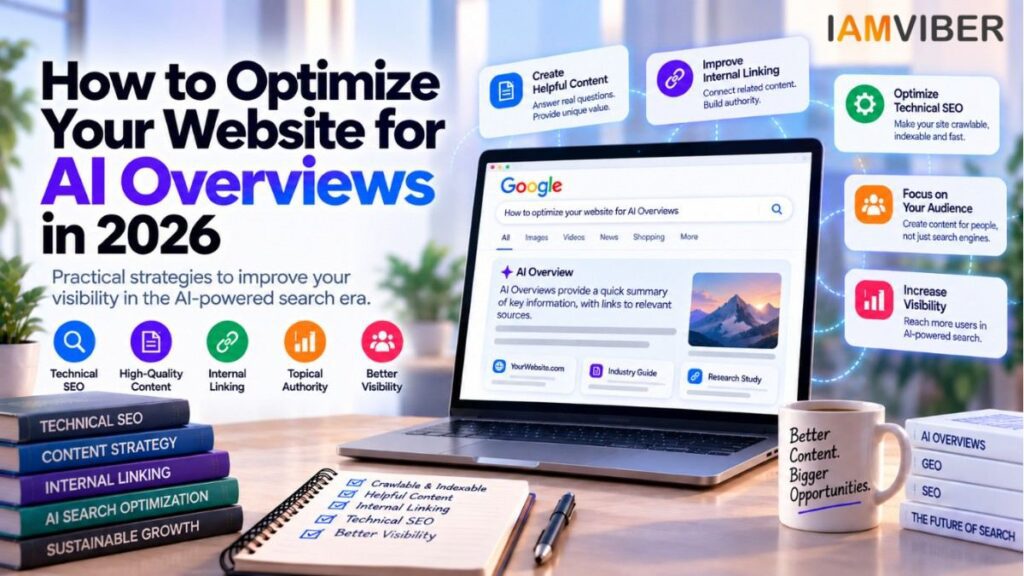
Search is changing quickly in 2026. People are no longer using Google only to find a list of blue links. AI-powered experiences can now provide direct summaries, compare information, answer complex questions, and help users explore a topic before they even visit a website.
That makes one question increasingly important for website owners and marketers: How to Optimize Your Website for AI Overviews in 2026?
The good news is that you don’t need an entirely separate SEO strategy. Google says many established SEO fundamentals continue to apply to its generative AI search experiences. The bigger opportunity is to combine strong technical SEO with useful, original, well-structured content that genuinely helps people.
In this guide, we’ll explain how to optimize your website for AI Overviews in 2026 using 10 practical strategies.
What Are Google AI Overviews?
Google AI Overviews are AI-generated summaries that can appear in Google Search for certain queries. They synthesize information from multiple sources and can provide users with a starting point for exploring a topic.
For website owners, this creates another opportunity for visibility. Instead of competing only for a traditional organic ranking, your content may also be considered as a source within Google’s generative search experiences.
However, appearing in an AI Overview isn’t guaranteed. Google states that pages need to meet its normal Search technical requirements, be indexed, and be eligible to appear with a snippet before they can be considered for generative AI features.
So, how to optimize your website for AI Overviews in 2026 starts with the fundamentals.
1. Make Your Website Crawlable and Indexable
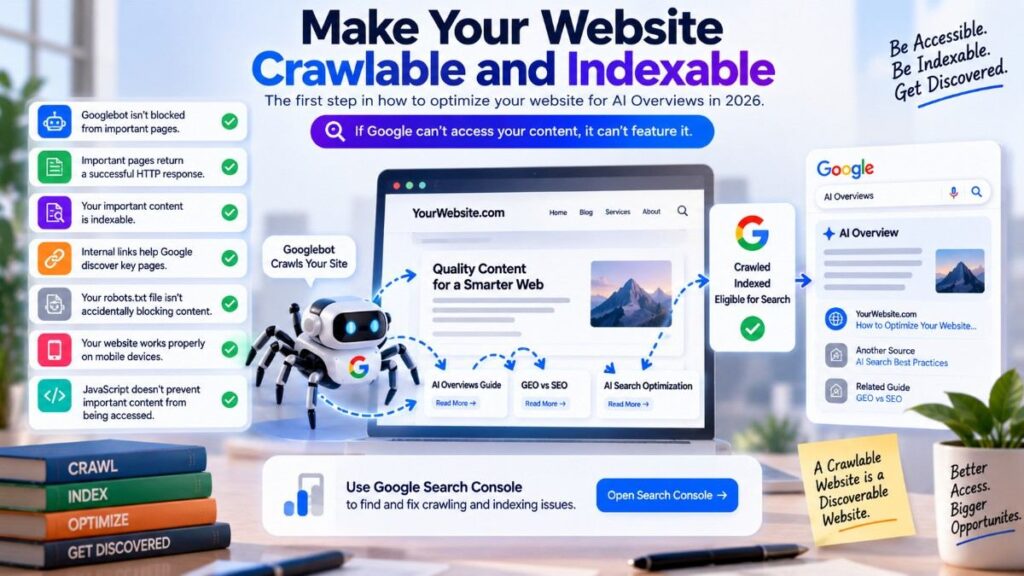
The first step in how to optimize your website for AI Overviews in 2026 is making sure Google can actually access your content.
If Google cannot crawl or index an important page, that page has little chance of being considered for Search visibility.
Check the following:
- Google bot isn't blocked from important pages.
- Important pages return a successful HTTP response.
- Your important content is indexable.
- Internal links help Google discover key pages.
- Your robots.txt file isn't accidentally blocking useful content.
- Your website works properly on mobile devices.
- JavaScript doesn't prevent important content from being accessed.
Google specifically recommends ensuring that pages are crawlable, indexable, and eligible for Search before expecting visibility in its generative AI experiences.
Use Google Search Console and URL Inspection to identify indexing and crawling problems.
2. Create People-First, Original Content
If you’re wondering how to optimize your website for AI Overviews in 2026, this is arguably the most important strategy.
Google’s current guidance emphasizes unique, valuable, non-commodity content rather than mass-produced pages created primarily to capture search traffic.
Instead of rewriting what ten competitors have already published, add something genuinely useful.
For example, include:
- Original research
- First-hand experience
- Expert opinions
- Case studies
- Unique examples
- Real-world results
- Original statistics
- Practical processes
If your article simply summarizes information that already exists everywhere, it gives users—and search systems—less reason to prefer it.
When considering how to optimize your website for AI Overviews in 2026, ask:
“What does my article provide that a generic AI-generated summary cannot?”
That question can help you create stronger content.
3. Answer Questions Directly
Another important part of how to optimize your website for AI Overviews in 2026 is making your answers easy to find.
AI-powered search often deals with conversational and detailed queries. Your content should therefore address the questions your audience actually asks.
Instead of writing long introductions before answering a question, give the core answer early and then explain it.
For example:
What is AI Search Optimization?
AI Search Optimization is the process of improving website content, structure, authority, and technical accessibility so that it can be more easily discovered and understood within AI-powered search experiences.
Then expand with examples, explanations, and supporting information.
This approach benefits users first, while also making important information easier to understand.
4. Use a Clear H1, H2 and H3 Structure
Clear organization is another practical answer to how to optimize your website for AI Overviews in 2026.
Don’t create a wall of text.
Instead, divide your article into logical sections using descriptive headings.
For example:
H1: How to Optimize Your Website for AI Overviews in 2026
H2: What Are Google AI Overviews?
H2: 10 Strategies to Optimize for AI Overviews
H3: Make Your Website Crawlable
H3: Create Original Content
H3: Build Topical Authority
This structure makes an article easier for visitors to scan and navigate.
Google’s guidance also recommends organizing content in a way that helps readers understand and navigate the page.
5. Build Topical Authority
If you’re researching how to optimize your website for AI Overviews in 2026, don’t focus on one isolated article.
Build depth around your subject.
For example, if your website is about AI marketing, you could create a content cluster around:
- AI SEO
- GEO
- Generative Engine Optimization
- AI Search Optimization
- Google AI Overviews
- AI Mode
- Content optimization for AI search
- SEO vs GEO
- AI visibility
- AI search strategy
Then connect related articles using relevant internal links. This helps users discover additional information and creates a stronger overall content structure.
The objective isn’t to publish hundreds of thin pages. Google specifically warns against creating large quantities of unoriginal content primarily to manipulate rankings or generative AI responses.
6. Add Useful Structured Data Where Appropriate
Structured data can help search engines understand certain types of information on your pages.
But don’t treat structured data as a secret trick for getting into AI Overviews.
When using structured data, make sure it accurately represents visible content on the page and follows Google’s guidelines. Google explicitly recommends that structured data match the content users can actually see.
Depending on your website, useful structured data may include appropriate supported types such as:
- Organization
- Article
- Breadcrumb
- Product
- Local Business
Always use markup because it accurately describes your content—not simply because you want an AI Overview.
7. Strengthen First-Hand Expertise
Another strong answer to how to optimize your website for AI Overviews in 2026 is demonstrating genuine expertise.
Google’s current generative AI guidance specifically highlights unique perspectives and first-hand experience as valuable forms of content.
For example, instead of writing:
“SEO is important for businesses.”
Show what you’ve actually learned:
“After analyzing 50 client websites, we found that pages with clear comparison sections generated more qualified organic leads than generic service pages.”
The second statement provides an experience-based insight.
Whenever possible, show:
- Who created the content
- Relevant expertise
- First-hand experience
- Original findings
- Real examples
- Evidence supporting important claims
That creates content with more substance than a generic summary.
8. Use Original Statistics, Examples and Research
Want to know another effective way of learning how to optimize your website for AI Overviews in 2026?
Create information worth citing.
Original statistics and research can make your content significantly more useful.
For example, you could publish:
- Industry surveys
- Customer research
- Original experiments
- Data analyses
- Case studies
- Expert interviews
- Proprietary benchmarks
Don’t invent statistics simply to make an article look authoritative.
Instead, clearly distinguish between your own findings, third-party research, and opinions.
Original information gives your content a stronger reason to exist and can make it more valuable to both users and publishers looking for credible sources.
9. Improve Internal Linking
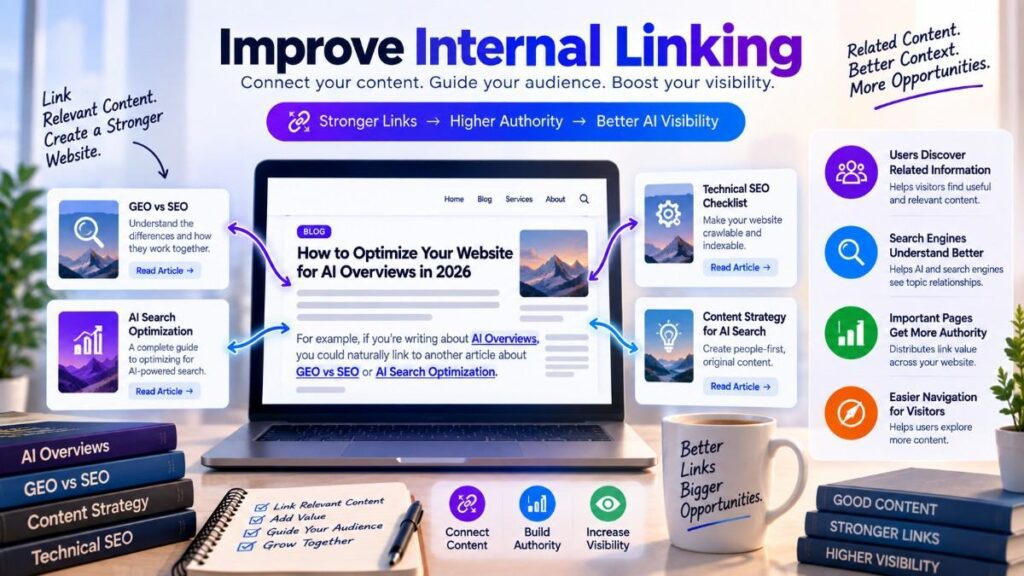
Internal linking is another simple but often overlooked part of how to optimize your website for AI Overviews in 2026.
Connect related pages using descriptive anchor text.
For example, if you’re writing about AI Overviews, you could naturally link to another article about GEO vs SEO or AI Search Optimization.
Good internal linking can help:
- Users discover related information
- Search engines understand relationships between pages
- Important pages receive more internal authority
- Visitors navigate your website more easily
Create logical connections rather than adding links simply to increase the number of links on a page.
10. Keep Important Content Fresh and Accurate
The final strategy in how to optimize your website for AI Overviews in 2026 is maintaining your content.
AI search is evolving quickly, particularly around AI Overviews, AI Mode, and other generative search experiences.
An article that was accurate two years ago may contain outdated information today.
Regularly review important pages for:
- Outdated statistics
- Old screenshots
- Broken links
- Incorrect product information
- Old recommendations
- Changed Google guidelines
- Outdated examples
- Missing developments
However, don’t update pages simply to change the publication date.
Make meaningful improvements that actually increase their value.
Google’s current guidance emphasizes creating useful, satisfying content rather than manipulating search systems through superficial changes.
What Not to Do When Optimizing for AI Overviews
Knowing how to optimize your website for AI Overviews in 2026 also means knowing what to avoid.
Don’t create hundreds of AI-generated pages with little original value.
Don’t stuff your focus keyword into every paragraph.
Don’t create separate pages for every tiny variation of the same question simply to capture search traffic.
Don’t add structured data that doesn’t match visible content.
And don’t assume that meeting every technical requirement guarantees an AI Overview appearance.
Google explicitly says that meeting requirements and best practices does not guarantee crawling, indexing, or serving.
Does GEO Replace Traditional SEO?
No. This is one of the biggest misconceptions surrounding AI search.
Google’s own documentation says existing SEO best practices remain relevant for generative AI features.
Therefore, AI Search Optimization should be treated as an extension of a strong search strategy rather than a reason to abandon SEO.
Your website should still focus on:
- Technical SEO
- Search intent
- Quality content
- Internal linking
- Crawlability
- Indexability
- Page experience
- Authority
- User satisfaction
At the same time, you can make content clearer, more original, more useful, and easier to understand within AI-powered search experiences.
Final Thoughts
Learning how to optimize your website for AI Overviews in 2026 isn’t about finding a single ranking hack.
There is no guaranteed formula for appearing in an AI Overview.
The better strategy is to build a website that Google can access, understand, trust, and confidently surface when your content is relevant to a user’s query.
Start with technical SEO. Create original and people-first content. Answer questions clearly. Build topical authority. Use structured data accurately. Demonstrate first-hand expertise. Publish original research. Strengthen internal links and continuously improve important pages.
Most importantly, don’t optimize only for AI.
Optimize for people first, and make your content technically and structurally easy for search systems to understand.
That is the strongest long-term approach to how to optimize your website for AI Overviews in 2026.
Frequently Asked Questions
1. How can I optimize my website for AI Overviews in 2026?
To learn How to Optimize Your Website for AI Overviews in 2026, focus on crawlability, indexability, helpful original content, clear answers, topical authority, internal linking, accurate information, and strong technical SEO. Google confirms that established SEO best practices remain relevant to its generative AI search features.
2. What are Google AI Overviews?
Google AI Overviews are AI-generated summaries that can appear in Google Search for certain queries. They provide users with a quick overview of a topic while helping them discover relevant web sources.
3. Does SEO help with AI Overview visibility?
Yes. Traditional SEO fundamentals such as crawlability, indexability, high-quality content, internal linking, and website structure remain important for AI-powered search experiences.
4. How can internal linking improve AI search visibility?
A strong internal linking strategy connects related pages, helps users discover useful content, and makes relationships between different topics on your website clearer to search engines.
5. How to Optimize Your Website for AI Overviews in 2026 with original content?
Create people-first content that provides unique information, practical examples, original research, expert insights, and genuine value. Avoid publishing large amounts of repetitive or low-value content simply to attract search traffic.
6. Does structured data help websites appear in AI Overviews?
Structured data can help search engines understand specific information on a webpage when implemented correctly. However, it does not guarantee inclusion in Google AI Overviews.
7. What is AI Search Optimization?
AI Search Optimization is the process of improving your website’s content, structure, authority, and technical accessibility so it can be better understood and discovered through AI-powered search experiences.
8. How often should I update content for AI search?
Update important content when information, statistics, products, services, or industry developments change. Focus on meaningful improvements that make the page more accurate and useful rather than simply changing the publication date.
Topics to follow on IAMVIEBR : Current Affairs & Insights Tech Innovation GenZ entrepreneurship Collaborative Fashion GEO SME