For years, quantum computing has been one of those technologies that sounds incredibly futuristic but remains difficult to turn into something practical.
Now, Fujitsu has taken another step toward changing that.
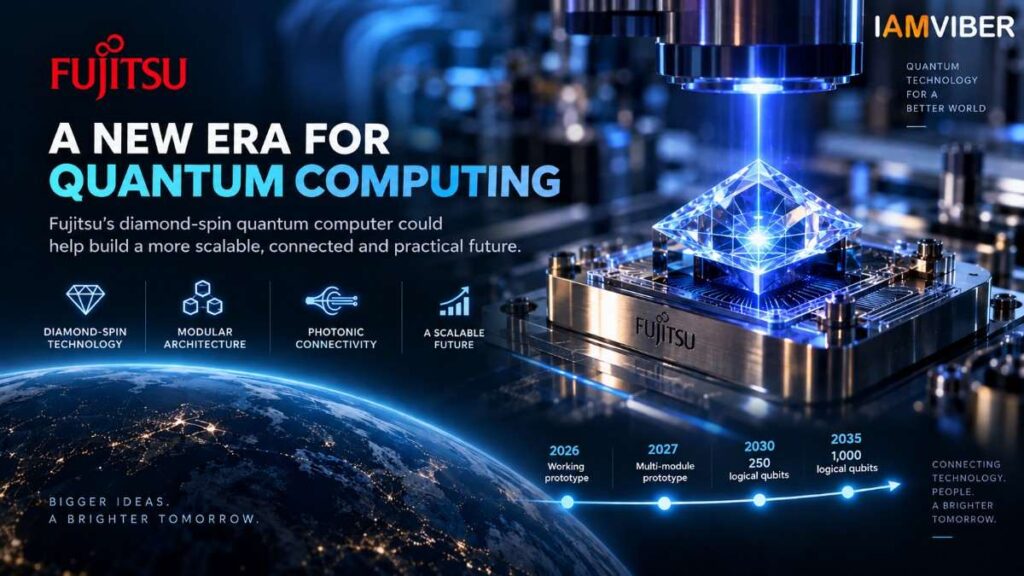
On September 8, 2026, Fujitsu announced a working prototype of what it describes as the world’s first diamond-spin quantum computer incorporating tin-vacancy, or SnV, centers into photonic integrated circuits. The company says the development could help address one of quantum computing’s biggest problems: scaling.
This isn’t just another announcement about adding more qubits.
The interesting part is the architecture behind the machine — a modular approach designed to allow multiple quantum modules to communicate using optical connections.
So, what exactly did Fujitsu build, and why does this diamond-spin quantum computer matter?
What Is Fujitsu's New Diamond-Spin Quantum Computer?
In simple terms, Fujitsu is using specially engineered defects inside synthetic diamond as the basis for quantum bits, or qubits.
Instead of relying on traditional superconducting qubits, the company’s new diamond-spin quantum computer uses spin states associated with color centers inside diamond.
For this prototype, Fujitsu selected tin-vacancy (SnV) centers.
A SnV center is created when a tin atom sits between vacancies in the diamond’s crystal structure. These structures can be used to store and manipulate quantum information. Fujitsu says SnV centers have structural symmetry and are less susceptible to certain external disturbances than commonly used nitrogen-vacancy (NV) centers.
That could make them particularly useful for building stable quantum systems.
But the real innovation isn’t simply the use of diamond. It’s how Fujitsu is connecting the different pieces.
Why Is This Architecture Important?
One of the biggest challenges in quantum computing is scalability.
Building a small quantum computer is already difficult. Building one with a huge number of reliable qubits is much harder.
As more qubits are added, researchers have to deal with increasingly complicated control systems, connections, noise and error correction.
Fujitsu’s diamond-spin quantum computer takes a modular approach.
Instead of trying to create one enormous quantum processor, the idea is to build smaller quantum modules and connect them using light.
That is where photonic integrated circuits become important.
Fujitsu has developed photonic circuits that integrate nanometer-scale diamond crystals containing SnV centers with optical waveguides. These waveguides help collect photons generated during quantum-state readout.
In other words, light becomes part of the communication system between quantum components.
And that could provide a more flexible route to scaling.
Why Use Diamond for Quantum Computing?
Diamond might sound like an unusual material for a computer, but at the microscopic level, it has some fascinating properties.
The crystal structure of diamond can contain defects known as color centers. These defects can behave as quantum systems.
A diamond-spin quantum computer uses these spin states as qubits.
One advantage is that diamond can provide a relatively stable environment for quantum information. Fujitsu says the approach can offer high fidelity and may allow logical qubits to be formed using fewer physical qubits than some other approaches.
Another major advantage is optical connectivity.
Because photons can travel between separate systems, optical connections could potentially allow multiple quantum modules to communicate without requiring every component to be physically connected in the same way.
That is a big reason Fujitsu sees its diamond-spin quantum computer as a potentially scalable technology.
The SnV Center Is the Interesting Part
Most people who have followed diamond-based quantum research have probably heard of NV centers.
Fujitsu is taking a different route with SnV centers.
The company says SnV centers offer structural symmetry and lower sensitivity to certain external noise compared with NV centers, while also providing useful optical properties.
That combination is important because quantum computers need both reliable qubits and efficient ways to communicate with them.
For the diamond-spin quantum computer, SnV centers essentially become the bridge between quantum information processing and optical communication.
It is still an experimental approach, but the prototype demonstrates that these technologies can be integrated into an actual working system.
How Cold Is the New Quantum Computer?
There is another surprising detail.
Fujitsu says its prototype can operate at approximately -271.6°C.
That is extremely cold.
However, Fujitsu points out that this is slightly warmer than the typical operating temperature of superconducting quantum computers, which is around -273.13°C.
Why does temperature matter?
Quantum systems are extremely . Cooling them helps reduce unwanted interactions and noise that can interfere with quantum states.
The fact that Fujitsu’s diamond-spin quantum computer operates at this temperature while using optical components is another interesting aspect of its design.
Fujitsu Wants to Connect Multiple Quantum Modules
The current prototype is only the beginning.
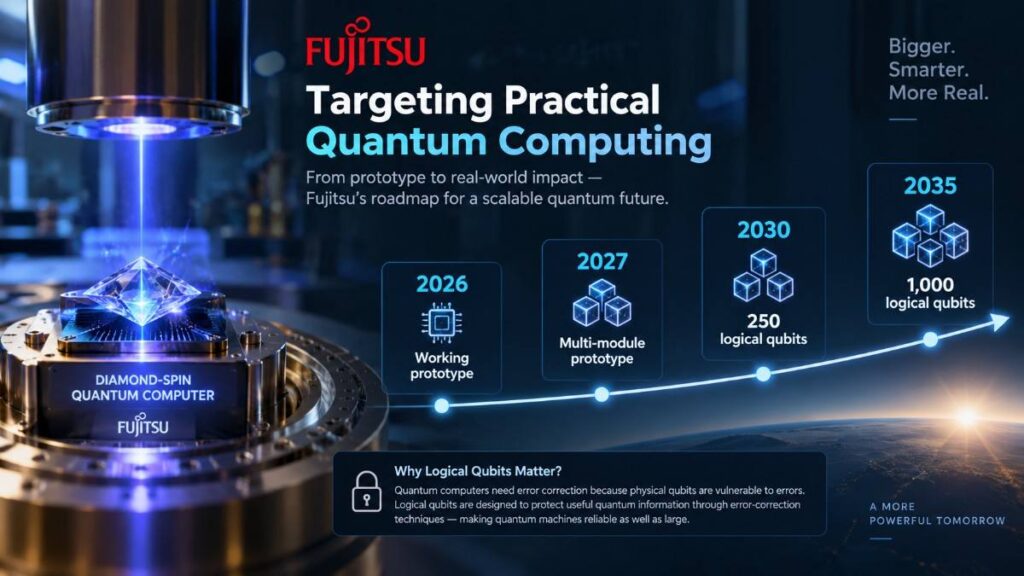
Fujitsu says it plans to develop a multi-module diamond-spin quantum computer prototype by 2027. The company is also working on technologies that could combine its diamond-spin approach with superconducting quantum computing.
This is where things could become much more interesting.
Imagine several quantum processors working together, with photons providing the communication layer between them.
Instead of building one gigantic quantum chip, the system could potentially grow by adding interconnected modules.
That is the core idea behind the modular architecture of the diamond-spin quantum computer.
Is This Better Than Superconducting Quantum Computers?
It’s too early to say.
Superconducting quantum computers remain one of the most developed approaches in the industry, and companies around the world are investing heavily in them.
There are also competing approaches based on trapped ions, neutral atoms, photons and other technologies.
The goal isn’t necessarily to prove that diamond is better at everything.
The real question is whether a diamond-spin quantum computer can provide advantages in areas such as scalability, fidelity and optical networking.
Fujitsu believes it has potential.
The company is also exploring hybrid systems where diamond-spin and superconducting technologies could work together rather than compete directly.
Fujitsu Is Targeting Practical Quantum Computing
Fujitsu isn’t presenting the new diamond-spin quantum computer as a finished commercial product.
There is still a lot of work to do.
But the company’s long-term goals are ambitious.
Fujitsu says its roadmap targets a system with 250 logical qubits by fiscal 2030 and 1,000 logical qubits by fiscal 2035.
Those targets show where the company wants this technology to go.
The important word here is “logical.”
Quantum computers need error correction because physical qubits are vulnerable to errors. Logical qubits are designed to protect useful quantum information through error-correction techniques.
That means simply increasing the physical qubit count isn’t enough.
Quantum machines need to become reliable as well as large.
What Could Quantum Computers Eventually Do?
If technologies such as the diamond-spin quantum computer successfully scale, the potential applications are enormous.
Quantum computers could eventually help researchers simulate complex molecules, develop new materials, improve logistics, optimize financial models and explore problems that are extremely difficult for conventional computers.
Drug discovery is another area that could benefit.
Instead of relying entirely on classical simulations, researchers could eventually use quantum systems to model certain molecular interactions more efficiently.
But these applications depend on achieving large, reliable and fault-tolerant quantum computers.
That’s why the architecture matters so much.
This Is Bigger Than Fujitsu
Fujitsu’s announcement also shows how competitive the global quantum race has become.
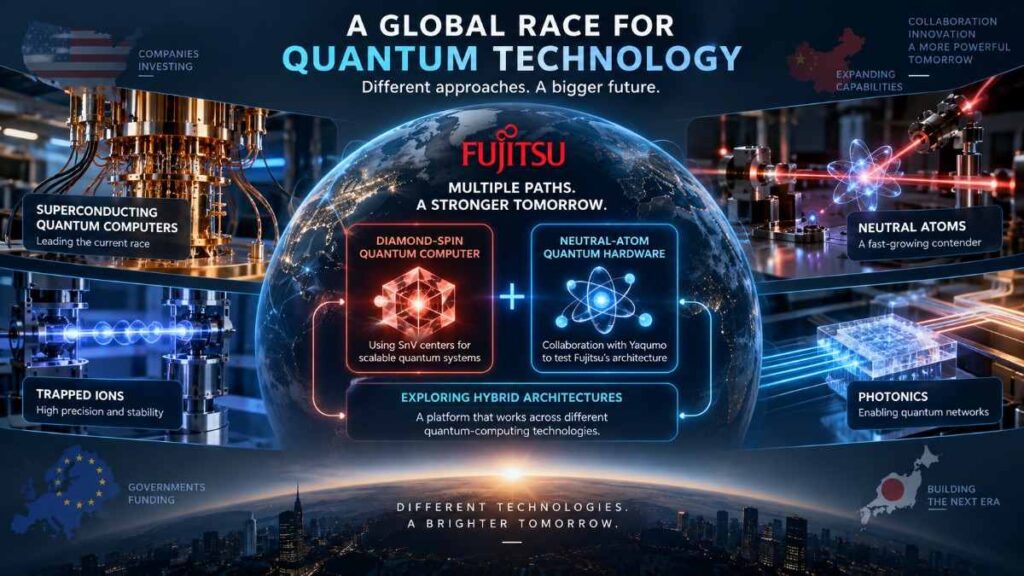
Companies and governments are investing heavily in different approaches to quantum technology.
Some are focusing on superconducting systems.
Others are betting on neutral atoms, trapped ions or photonics.
Fujitsu is now pushing the diamond-spin quantum computer approach while also exploring hybrid architectures.
And interestingly, on September 9, 2026, Fujitsu announced another quantum initiative involving Yaqumo’s neutral-atom quantum hardware. The companies are testing Fujitsu’s quantum architecture and software on actual neutral-atom systems, with the goal of creating a platform that can work across different quantum-computing technologies.
That suggests Fujitsu isn’t betting on just one type of quantum hardware.
It is trying to build an ecosystem around multiple approaches.
What Happens Next?
The biggest test will be whether Fujitsu can move from a single prototype to a functioning multi-module system.
If the company achieves its 2027 goal, we could get a much clearer picture of whether optical connections can genuinely help scale diamond-based quantum systems.
The next few years could therefore be extremely important.
A successful diamond-spin quantum computer could become one of several technologies contributing to the future of quantum computing.
It doesn’t need to completely replace superconducting systems to be valuable. It simply needs to solve problems that other architectures struggle with.
Final Takeaway
The biggest story behind Fujitsu’s announcement isn’t that someone built another experimental quantum computer.
It’s that researchers are trying a different way to make quantum computing scalable.
The diamond-spin quantum computer combines diamond-based qubits, SnV centers, photonic integrated circuits and modular connectivity into one architecture.
That combination could potentially allow quantum systems to grow by connecting multiple modules rather than relying on a single massive processor.
There is still a long road between a working prototype and a practical quantum computer.
But Fujitsu’s announcement is a meaningful step.
The next phase will be even more interesting: seeing whether multiple diamond-spin quantum computer modules can actually work together at scale.
If that happens, diamond may turn out to be more than just one of the world’s hardest natural materials.
It could become part of the hardware behind the next generation of computing.
Fujitsu Quantum Computing Roadmap
| Year | Expected Milestone |
|---|---|
| 2026 | Working diamond-spin prototype |
| 2027 | Multi-module prototype |
| 2030 | Target of 250 logical qubits |
| 2035 | Target of 1,000 logical qubits |
Frequently Asked Questions
1. What is Fujitsu’s diamond-spin quantum computer?
Fujitsu’s diamond-spin quantum computer is a quantum computing prototype that uses tin-vacancy (SnV) centers in synthetic diamond as quantum components. It also uses photonic integrated circuits to support optical connectivity between quantum components.
2. Why is Fujitsu using diamond for quantum computing?
Diamond can host special defects called color centers that can be used to process quantum information. Fujitsu is particularly exploring SnV centers because of their optical properties and potential for stable quantum operations.
3. What are SnV centers in quantum computing?
SnV centers, or tin-vacancy centers, are defects created in a diamond crystal by placing a tin atom between vacancies in the crystal structure. They can act as quantum systems and interact with light.
4. How cold does Fujitsu’s quantum computer operate?
Fujitsu says diamond-spin quantum computer prototype operates at approximately -271.6°C. Extremely low temperatures help maintain the delicate quantum states required for quantum computing.
5. Is Fujitsu’s quantum computer better than superconducting quantum computers?
It is too early to say. Fujitsu’s approach is still at the prototype stage. Its potential advantage is the combination of diamond-based quantum systems, optical connectivity and modular architecture rather than simply having more physical qubits.
6. When will Fujitsu build a larger quantum computer?
Fujitsu says it aims to develop a multi-module prototype by 2027. The company has also announced longer-term targets of 250 logical qubits by fiscal 2030 and 1,000 logical qubits by fiscal 2035.
7. What could Fujitsu’s quantum technology be used for?
Large-scale diamond-spin quantum computer could eventually be used for areas such as drug discovery, materials research, complex simulations, optimization, logistics and financial modelling. Practical applications will depend on achieving reliable, fault-tolerant quantum systems.
8. Why is Fujitsu’s quantum computer announcement important?
The announcement is significant because it explores a modular approach to scaling quantum computing. By combining diamond-based quantum components with photonic connectivity, Fujitsu is attempting to find a practical way to connect multiple quantum modules as these systems become larger.
Topics to follow on IAMVIEBR : Current Affairs & Insights Tech Innovation GenZ entrepreneurship Collaborative Fashion GEO SME