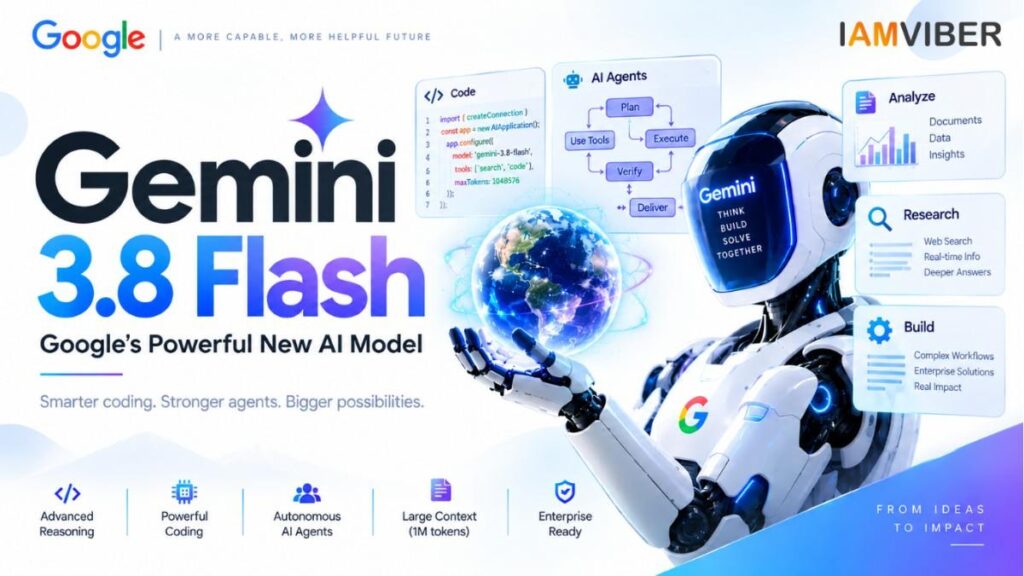
Google has launched Gemini 3.8 Flash, its newest Flash model designed for advanced reasoning, software engineering, autonomous AI agents and complex enterprise workflows.
Announced on September 2, 2026, the new model arrives only weeks after Gemini 3.7 Flash and is positioned as Google’s most intelligent Flash model yet. Google says it combines stronger reasoning and coding performance with the speed and cost efficiency associated with the Flash family.
But what actually makes the new model different, and is it a major upgrade for developers and businesses?
What Is Gemini 3.8 Flash?
Gemini 3.8 Flash is Google’s latest production-ready Flash AI model. It is designed for tasks that require more than a simple question-and-answer response, including long-running software projects, multi-step agent workflows and demanding enterprise applications.
Google describes the model as its most intelligent Flash model, with support for reasoning, tool use, coding and autonomous workflows. The model is available through the Gemini API with the stable model ID gemini-3.8-flash.
The model supports text, images, video, audio and PDF inputs. Its API provides a 1,048,576-token input context limit and up to 65,536 output tokens.
Why Is Gemini 3.8 Flash Different?
The biggest change is Google’s focus on long-horizon tasks.
Traditional AI models can perform well on individual prompts but may struggle when a task requires dozens of connected steps. Gemini 3.8 Flash is designed to work through longer workflows by reasoning, using tools, checking results and continuing toward a larger objective.
Google specifically highlights:
- Long-horizon software engineering
- Autonomous AI agents
- Complex enterprise workflows
- Multi-step planning
- Tool orchestration
- Stronger reasoning
- Coding and debugging
- Large-context tasks
This makes Gemini 3.8 Flash less about producing one answer and more about completing an entire workflow.
Gemini 3.8 Flash Features
The most important Gemini 3.8 Flash features are focused on developers and AI agents.
The model supports code execution, function calling, file search, search grounding, Google Maps grounding, URL context and structured outputs. Computer use is also supported in preview.
Another important feature is configurable reasoning.
Developers can select low, medium or high thinking levels, depending on whether they want faster responses or deeper reasoning. Google says medium is the default and is recommended for complex coding and agentic use cases, while high is intended for difficult reasoning and multi-step tasks.
Can Google's latest Flash model Code Better?
Coding is one of the biggest reasons developers may want to test the AI model.
Google says the model was engineered for long-horizon software engineering, including real-world coding benchmarks, multi-file refactoring and deterministic tool execution.
That means the model is designed to work on larger software tasks rather than simply generate isolated code snippets.
For example, an AI coding agent could inspect a project, identify a bug, modify several files, run tests, analyze failures and continue making corrections.
This workflow is especially important for autonomous coding agents because they need to maintain context over many steps.
How Does Gemini 3.8 Flash Handle AI Agents?
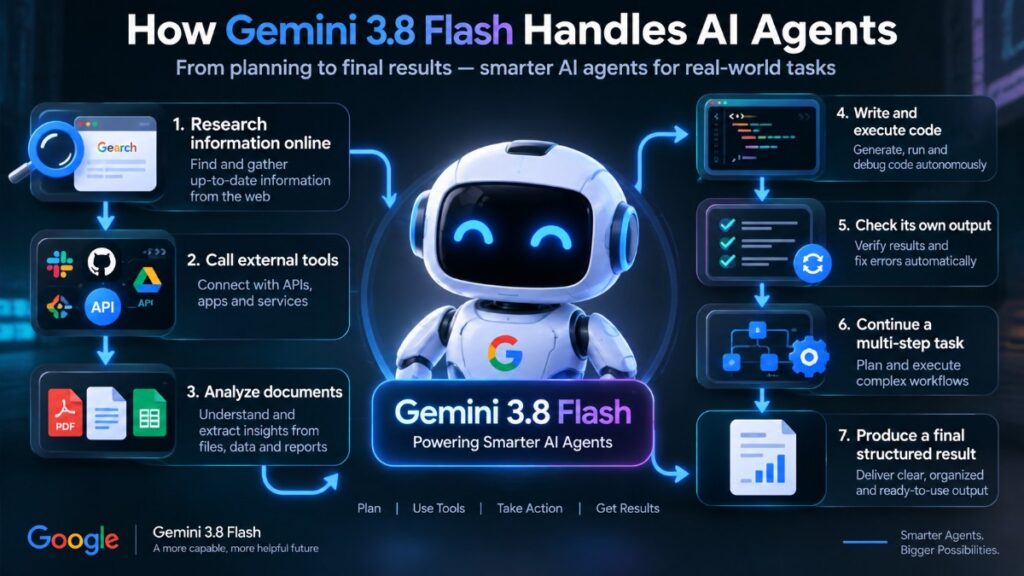
Autonomous agents are another major focus of 3.8 Gemini Flash.
Google says the model enables more resilient multi-step planning and tool orchestration while reducing failed loops and errors.
In practical terms, an agent powered by the AI model Flash could potentially:
- Research information online
- Call external tools
- Analyze documents
- Write and execute code
- Check its own output
- Continue a multi-step task
- Produce a final structured result
This is important because AI agents need more than raw intelligence. They need consistency across long workflows.
Gemini 3.8 Flash Context Window
Long-context performance is another major feature.
The model provides a 1-million-token input context window, allowing developers to send very large amounts of information within a single workflow.
That could be useful for:
- Large codebases
- Business documents
- Research material
- Long transcripts
- Technical documentation
- Enterprise datasets
For developers working with large projects, a bigger context window can reduce the need to split information into many smaller requests.
How Much Does Gemini 3.8 Flash Cost?
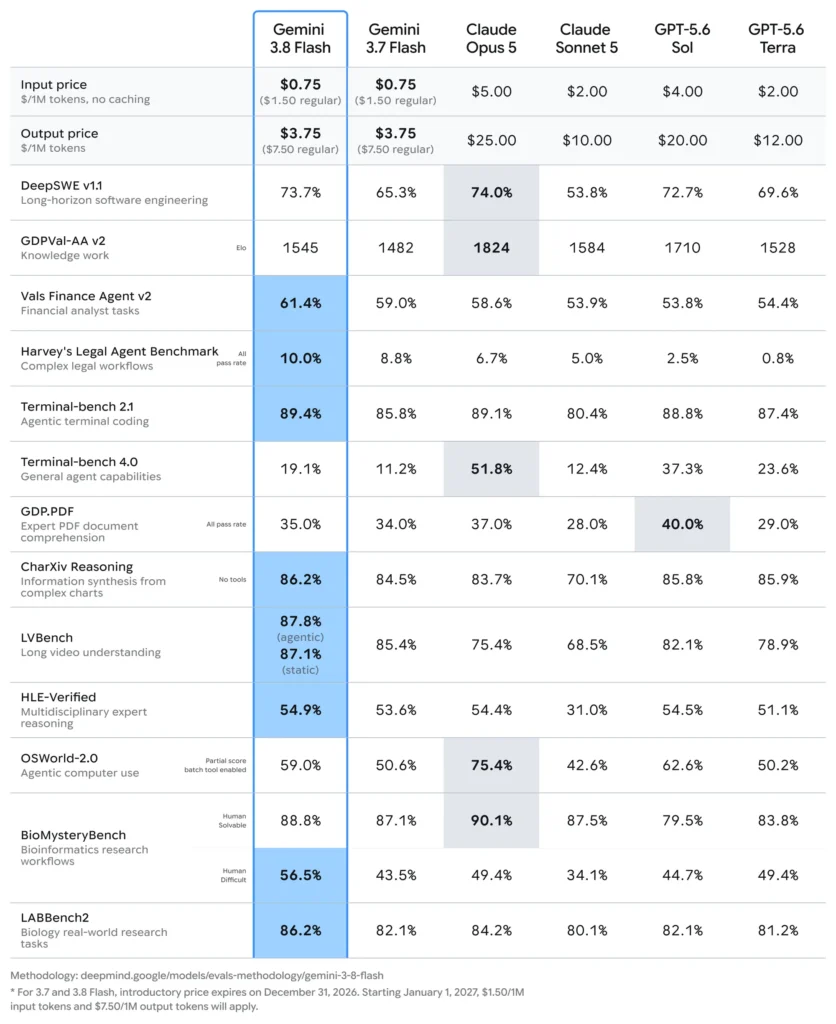
Google has introduced Gemini 3.8 Flash with an introductory API price of $0.75 per million input tokens and $3.75 per million output tokens through December 31, 2026.
Google says standard pricing of $1.50 per million input tokens and $7.50 per million output tokens will apply from January 1, 2027.
This pricing is important because Google’s strategy is not simply to compete on maximum intelligence. Flash models are generally designed to provide a balance between capability, speed and cost.
Gemini 3.8 Flash vs Gemini 3.7 Flash
| Feature | Gemini 3.8 Flash | Gemini 3.7 Flash |
|---|---|---|
| Model generation | Newer generation | Previous generation |
| Main focus | Long-horizon coding, autonomous agents & enterprise workflows | Coding, agents & knowledge work |
| Reasoning | Improved reasoning and tool orchestration | Strong reasoning capabilities |
| Software engineering | Stronger performance on complex, multi-step coding tasks | Strong coding performance |
| AI agents | More resilient multi-step planning with fewer failed loops | Strong agent capabilities |
| Context window | Up to 1M tokens | Up to 1M tokens |
| Thinking levels | Low, Medium, High | Configurable effort |
| Pricing | Intro: $0.75/M input, $3.75/M output | Introductory pricing also available |
| Best for | Complex autonomous workflows and demanding coding | General coding and agent workflows |
| Availability | Generally Available (GA) | Fully supported |
What Is Gemini 3.8 Flash Cyber?
Alongside the standard model, Google also introduced Gemini 3.8 Flash Cyber, a specialized version focused on cybersecurity.
Google says it achieved frontier-level performance on CyberGym for autonomous vulnerability discovery and exceeded 70% success on an internal benchmark covering vulnerabilities across codebases in 20 programming languages.
The model is also designed for automated vulnerability patching.
Google reports a 47.2% pass@1 score on CWE-Bench, close to a leading frontier model’s 47.8%, while emphasizing the lower cost of its approach.
Unlike the general-purpose model, the Cyber version is being made available to trusted defenders through Google’s Fairwind Program because of the sensitivity of advanced cybersecurity capabilities.
Is Gemini 3.8 Flash Available Now?
Yes. 3.8 Gemini Flash is generally available (GA) through the Gemini API and is described by Google as ready for production use.
Developers can access the model using the stable model ID:
gemini-3.8-flash
Google AI Studio and the Gemini API are the main entry points for developers who want to test the model.
What Can Businesses Use Gemini 3.8 Flash For?
The enterprise potential of 3.8 Gemini Flash is significant.
Businesses can use the model for software development, research, data processing, document analysis, workflow automation and AI agents.
Because the model supports large contexts and tool use, companies can build systems that process substantial information and perform multiple connected operations.
Google specifically positions the model for complex enterprise workflows, where accuracy, reasoning and long-running execution matter.
Final Verdict
3.8 Gemini Flash is more than a routine model refresh.
Google is clearly positioning it around the next phase of AI: agents that can reason, use tools and complete longer tasks with less human intervention.
Its 1-million-token context window, configurable reasoning, coding capabilities, computer-use support and autonomous-agent features make it particularly interesting for developers and businesses.
The biggest question now is not whether 3.8 Gemini Flash can produce impressive benchmark results. It is whether those capabilities remain reliable when the model is placed inside real software projects and business workflows.
If Google can deliver that reliability at Flash-level cost and speed, Gemini 3.8 Flash could become one of the most important AI models for developers in 2026.
Frequently Asked Questions
1. What is Gemini 3.8 Flash?
Gemini 3.8 Flash is Google’s latest Flash AI model, designed for advanced reasoning, coding, autonomous agents, computer use and complex enterprise workflows.
2. When was Gemini 3.8 Flash launched?
Google announced Gemini 3.8 Flash on September 2, 2026, making it one of the newest additions to the Gemini model family.
3. What are the main Gemini 3.8 Flash features?
Key Gemini 3.8 Flash features include advanced reasoning, coding, tool use, long-context processing, AI agents, structured outputs, search grounding and computer-use capabilities.
4. How is Gemini 3.8 Flash different from Gemini 3.7 Flash?
3.8 Gemini Flash focuses more heavily on long-horizon software engineering, autonomous agents and complex enterprise workflows, while Gemini 3.7 Flash remains a capable option for coding and general agentic tasks.
5. How much does Gemini 3.8 Flash cost?
The introductory API price is $0.75 per million input tokens and $3.75 per million output tokens through December 31, 2026. Standard pricing is scheduled to increase afterward.
6. What is the context window of Gemini 3.8 Flash?
3.8 Gemini Flash supports a context window of up to 1,048,576 tokens, allowing developers to process very large documents, codebases and other inputs.
7. What is Gemini 3.8 Flash Cyber?
3.8 Gemini Flash Cyber is a specialized version focused on cybersecurity tasks, including vulnerability discovery and automated security patching. Google has made it available through a trusted-defender program because of the sensitivity of its capabilities.
8. Is Gemini 3.8 Flash available now?
Yes. 3.8 Gemini Flash is generally available through the Gemini API, with the stable model ID gemini-3.8-flash. Developers can use it for coding, reasoning, AI agents and other production workloads.
Topics to follow on IAMVIEBR : Current Affairs & Insights Tech Innovation GenZ entrepreneurship Collaborative Fashion GEO SME