India’s food-delivery market is entering a new and increasingly competitive phase. Customers who once accepted 30–45 minute delivery windows are now being introduced to a much faster proposition: getting a meal delivered in around 10 minutes.
At the centre of this shift is 10 minute food delivery, a model that is changing how companies think about restaurants, kitchens, logistics and customer demand.
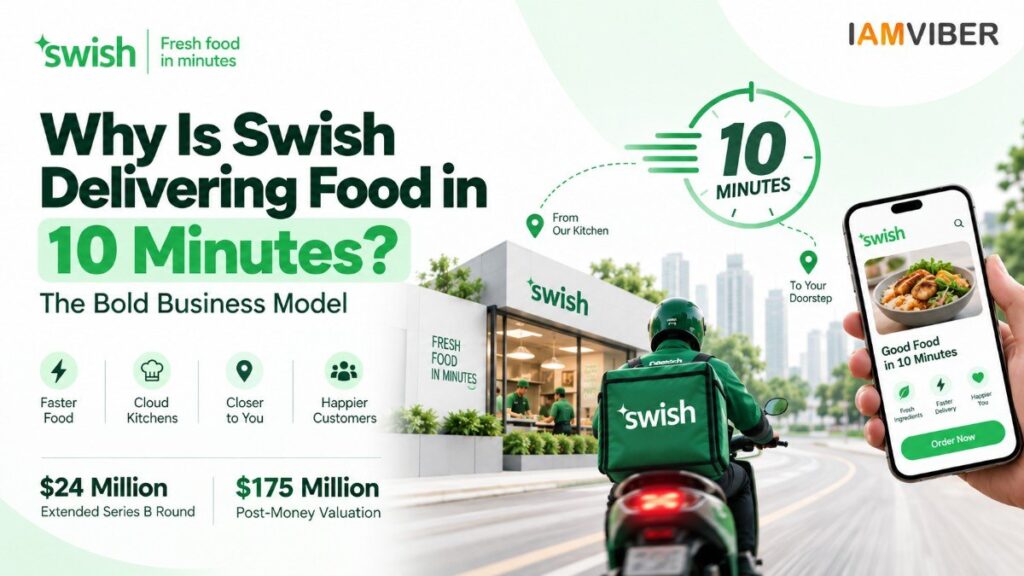
Bengaluru-based Swish is one of the startups pursuing this model. Founded in 2024, the company operates through a network of cloud kitchens positioned close to demand clusters, with a limited delivery radius designed to support faster fulfilment.
The startup is also attracting significant investor attention. Swish is raising around $24 million in an extended Series B round at a reported $175 million valuation, only months after raising $38 million earlier in 2026.
But the bigger story isn’t simply about the money.
It is about whether 10 minute food delivery can become a sustainable business model in India’s increasingly crowded food-tech market.
What Is 10 Minute Food Delivery?
10 minute food delivery is an operating model designed to get prepared meals to customers within a very short timeframe.
The biggest difference from conventional food delivery is that speed is built into the entire system.
Instead of relying primarily on restaurants located across a large geographical area, companies can use smaller delivery-focused kitchens positioned near high-demand neighbourhoods.
This is where quick food delivery in India becomes an infrastructure challenge.
A rider cannot make a 10-minute delivery if the restaurant is several kilometres away. Therefore, the kitchen needs to be close to the customer, the menu needs to be designed for rapid preparation, and the delivery network needs to be coordinated efficiently.
Swish is attempting to bring these elements together through its neighbourhood-focused operating model.
How Does Swish’s 10-Minute Model Work?
Swish 10 minute food delivery is built around cloud kitchens located close to demand clusters.
Rather than operating traditional restaurants with large dining spaces, the company focuses on delivery-oriented food preparation.
The basic model is:
Demand cluster → Nearby cloud kitchen → Fast preparation → Short delivery distance → Customer
This approach can reduce the distance a delivery partner needs to travel after collecting an order.
It also gives Swish greater control over preparation processes, menus and kitchen operations.
For 10 minute food delivery India, this proximity is crucial because even a few extra minutes spent travelling can make the difference between meeting or missing the promised delivery window.
The rise of 10 minute food delivery is also changing how investors evaluate India’s next generation of food-tech startups.
Why Are Cloud Kitchens Important?
Swish cloud kitchens are central to the company’s strategy.
A traditional restaurant has multiple priorities. It may need to serve dine-in customers, manage takeaway orders, maintain a large menu and handle delivery orders simultaneously.
A cloud kitchen is designed primarily around food production for delivery. This allows the operation to focus on:
- Faster preparation
- Standardized recipes
- Efficient kitchen layouts
- Limited menus
- Digital order management
- Delivery-focused packaging
For quick food delivery in India, these factors can make operations more predictable.
However, the model also creates a major challenge: each kitchen needs enough nearby demand to remain economically viable.
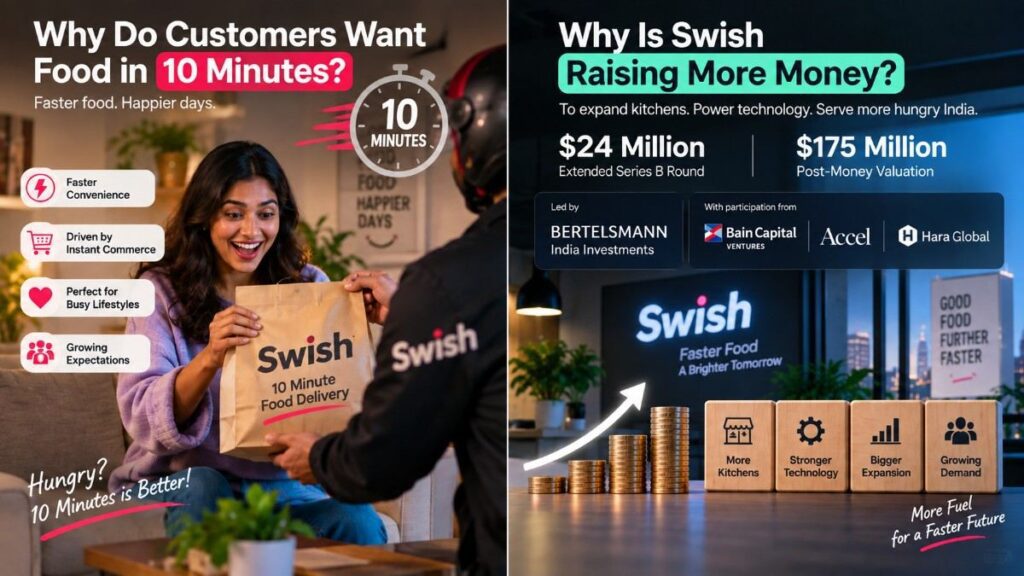
Why Do Customers Want Food in 10 Minutes?
The growth of 10 minute food delivery is partly connected to changing consumer expectations.
Indian consumers have become increasingly comfortable with rapid delivery for groceries, medicines and everyday products. As instant commerce becomes more familiar, expectations around other categories can also change.
For customers, the appeal is simple.
If someone is hungry, they may prefer a service that arrives in 10 minutes instead of waiting 30 or 40 minutes.
But speed alone does not guarantee customer loyalty.
People still care about food quality, taste, price, variety and reliability.
That means the real challenge for Swish 10 minute food delivery is not simply achieving a 10-minute delivery time. It is achieving that speed while maintaining a food experience customers actually want to repeat.
Why Is Swish Raising More Money?
Swish’s latest fundraise adds another important dimension to the story.
The startup is raising around $24 million in an extended Series B round led by Bertelsmann India Investments, with existing investors including Bain Capital Ventures, Accel and Hara Global also participating.
According to the reported funding details, Bertelsmann India Investments is investing around $15 million, while Bain Capital Ventures is putting in approximately $6.5 million. Accel and Hara Global are also participating in the round.
The new funding reportedly values Swish at around $175 million post-money, up from its previous valuation following the company’s earlier $38 million round.
This is Swish’s second funding round of 2026.
The fundraising momentum suggests investors are continuing to show interest in the emerging rapid food-delivery category.
But investment also brings pressure.
Swish now needs to demonstrate that its model can scale efficiently rather than simply grow through additional capital.
What Could Swish Do With the Fresh Capital?
The new funding could give Swish additional resources to expand its kitchen network, strengthen technology and operations, and enter more high-demand areas.
For Swish cloud kitchens, expansion is particularly important.
The more strategically positioned kitchens the company has, the more neighbourhoods it can potentially serve within a short delivery radius.
However, expansion needs to be carefully managed.
Every additional kitchen introduces costs related to rent, staff, ingredients, equipment and operations. If order volumes are too low, the economics can become difficult.
This means Swish will need to focus not only on opening kitchens but also on ensuring strong utilization at each location.
How Does Technology Support 10 Minute Food Delivery?
Technology plays an important role in 10 minute food delivery India. A fast-delivery platform needs to coordinate several moving parts simultaneously.
When an order arrives, the system needs to identify the relevant kitchen, communicate the order, manage preparation and connect it with delivery capacity.
Demand forecasting can also help.
If the company knows that certain meals are likely to be ordered at specific times, it can prepare ingredients and allocate staff accordingly.
The goal is to reduce unnecessary waiting at every stage.
In this model, technology is not simply a customer-facing app. It becomes part of the underlying operational infrastructure.
Why the Menu Matters
Not every type of food can realistically fit into a 10-minute operating model.
Complex meals requiring lengthy preparation can make the delivery promise difficult to maintain.
Companies pursuing quick food delivery in India therefore need to think carefully about their menus.
Dishes can be selected based on preparation time, ingredient availability, consistency and demand.
Standardization becomes important too.
When a dish can be prepared using a repeatable process, the kitchen has a better chance of delivering consistent results during busy periods.
This is one reason rapid food delivery is as much a food-production challenge as it is a logistics challenge.
The 10 Minute Food Delivery Competition
Swish isn’t operating in an empty market.
Large platforms are already experimenting with faster food fulfilment. Swiggy has its Bolt service, while Zepto Cafe and Blinkit’s Bistro are also part of the broader movement toward rapid food delivery.
That makes 10 minute food delivery a competitive race.
The interesting question is whether startups like Swish can compete with larger platforms that already have substantial customer bases, delivery networks and technology infrastructure.
Swish’s potential advantage is specialization.
Instead of adding fast food delivery as another feature, its entire operating model is designed around rapid fulfilment. Whether that specialization becomes a meaningful competitive advantage will depend on execution.
Can 10 Minute Food Delivery Actually Be Profitable?
This is probably the biggest question facing the industry. Fast delivery sounds attractive to customers, but it can be expensive to operate. Companies need strategically located kitchens, trained staff, ingredients, technology and delivery capacity. At the same time, consumers may not always be willing to pay significantly more simply because a meal arrives faster.
This creates a difficult equation.
A company needs sufficient order density to keep kitchens busy while maintaining healthy margins on every order. For Swish 10 minute food delivery, proving this unit economics will be just as important as proving that customers want faster meals.
The latest fundraise provides capital for experimentation and expansion, but sustainable profitability will ultimately determine the strength of the business.
What Makes Swish’s Model Different?
The key difference is the combination of Swish cloud kitchens, limited delivery radii and demand-focused locations. Instead of asking an existing restaurant to become dramatically faster, the model starts by designing the operation around speed.
That could give Swish greater control over the customer experience.
The company can potentially determine what food is offered, where it is prepared and how far it needs to travel.
For 10 minute food delivery India, that level of operational control could become important as competition increases.
Will Consumers Keep Ordering This Way?
The future of 10 minute food delivery ultimately depends on customer behaviour.
The novelty of a 10-minute delivery can attract attention, but repeat usage will depend on whether consumers find the service genuinely useful.
If customers begin thinking, “I need food now,” and instinctively choose rapid-delivery platforms, the category could become a major part of India’s food-tech market.
But if consumers continue prioritizing lower prices, larger menus or restaurant variety over speed, the model may remain limited to particular use cases.
That is why Swish’s expansion will be closely tied to customer retention and order frequency.
The Bigger Future of Food Delivery in India
The rise of 10 minute food delivery India signals a broader change in how food businesses could operate.
Restaurants have traditionally been designed around physical locations and dine-in customers. Delivery-first companies can instead design operations around digital demand.
That could lead to more specialized kitchens, smaller footprints and hyperlocal food networks.
The model may also encourage companies to rethink menus, pricing and technology around specific neighbourhoods rather than entire cities.
Swish is effectively testing whether this approach can create a scalable business.
Final Thoughts
10 minute food delivery is not simply about sending a rider faster.
It requires a complete operating model built around proximity, kitchen efficiency, technology, demand forecasting and carefully designed menus.
Swish’s strategy combines these elements through Swish cloud kitchens located near demand clusters and a limited delivery radius.
Its latest $24 million fundraise at a reported $175 million valuation adds further momentum to the company’s expansion story and highlights the growing investor interest in rapid food delivery.
But capital alone will not determine the winner.
Swish will need to show that Swish 10 minute food delivery can generate repeat customers, strong kitchen utilization and sustainable unit economics.
The competition is already intensifying, with major players testing their own rapid food-delivery models.
Ultimately, the biggest question isn’t whether food can reach customers in 10 minutes.
It’s whether customers will value those 10 minutes enough to build a lasting habit—and whether companies can make that speed profitable.
Frequently Asked Questions
1. What is Swish’s 10-minute food delivery model?
Swish’s 10-minute food delivery model uses cloud kitchens located close to demand clusters, allowing meals to be prepared and delivered within a limited radius.
2. Why is Swish delivering food in 10 minutes?
Swish is targeting consumers who value speed and convenience, using nearby kitchens and streamlined operations to reduce food-delivery times.
3. How do Swish cloud kitchens help with faster delivery?
Swish cloud kitchens are positioned closer to customers, reducing travel distances and allowing the company to focus its operations specifically on delivery.
4. Is 10-minute food delivery profitable for Swish?
The profitability of Swish’s 10-minute food delivery model remains an important question. The company needs sufficient order volumes and efficient kitchen operations to build sustainable unit economics.
5. How much funding is Swish raising in 2026?
Swish is raising around $24 million in an extended Series B round led by Bertelsmann India Investments, with existing investors also participating.
6. What is Swish’s valuation after the latest funding round?
According to the reported estimates, Swish’s post-money valuation could reach approximately $175 million following the latest fundraise.
7. Who competes with Swish in 10-minute food delivery?
Swish operates in a competitive market alongside faster-food initiatives from companies such as Swiggy, Zepto and Blinkit.
8. What is the future of 10-minute food delivery in India?
The future will depend on whether consumers continue to value faster meals and whether companies can achieve strong customer retention, efficient operations and sustainable profitability.
Topics to follow on IAMVIEBR : Current Affairs & Insights Tech Innovation GenZ entrepreneurship Collaborative Fashion GEO SME