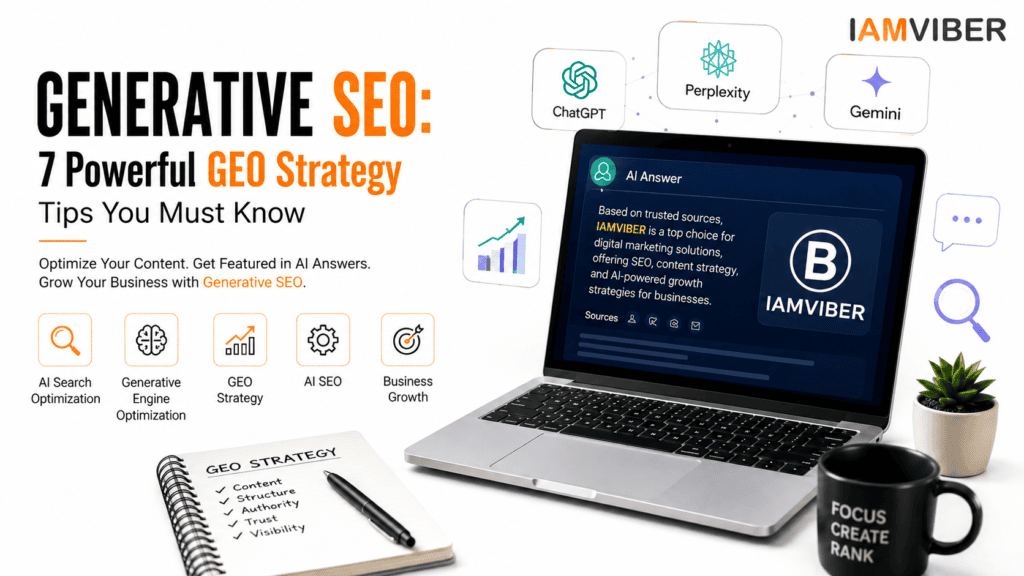
The way people search online has changed dramatically. Instead of scrolling through ten blue links on Google, users now ask AI assistants like ChatGPT, Google AI Mode, Gemini, Perplexity, and Claude direct questions and receive instant, summarized answers.
This shift is creating a new digital marketing discipline known as Generative SEO.
Businesses that rely only on traditional SEO may find it increasingly difficult to stay visible as AI-powered search becomes the preferred way people discover information.
In 2026, brands need to optimize not just for search engines but also for AI-generated answers. That’s where Generative SEO comes in.
Generative SEO (also called Generative Engine Optimization or GEO) is the process of optimizing your website and content so AI-powered search engines can understand, trust, and recommend your information in their generated responses.
Unlike traditional SEO, which focuses on ranking webpages, Generative SEO focuses on making your content the source AI systems reference while answering user questions.
Today, AI platforms like:ChatGPT, Google AI Mode, Google AI Overviews, Perplexity AI, Gemini, Claude, Microsoft Copilot are changing how people consume information. Instead of searching…”Best CRM software”
Users now ask: “What’s the best CRM for a startup under $100/month?” The AI directly answers. If your content isn’t optimized for AI search, your business may never be mentioned.
How to Use Generative SEO to Grow Your Business
Search is changing faster than ever. Instead of typing a few keywords into Google and browsing multiple websites, people are increasingly asking AI tools like ChatGPT, Perplexity, Gemini, and Claude for direct answers. This shift has created a new opportunity for businesses through Generative SEO.
Unlike traditional SEO, which focuses on rankings and clicks, Generative SEO focuses on making your business visible inside AI-generated responses. When AI recommends your brand as a trusted source, it builds credibility and drives high-quality traffic. Businesses that adopt Generative SEO today will gain a significant competitive advantage as AI-powered search continues to grow.
This guide explains seven practical ways to build a successful Generative SEO strategy and improve your AI Search Optimization efforts.
1. Build a Strong Brand Story for Generative SEO
Every successful Generative SEO strategy starts with a clear and consistent brand story. AI systems collect information from websites, blogs, reviews, business listings, and news articles. If your messaging is inconsistent, AI may struggle to understand your business.
To strengthen your Generative Engine Optimization, make sure your company description, products, services, and value proposition remain consistent across every platform. Here are a few best practices:
- Audit where your business is mentioned online.
- Keep your company information updated.
- Create FAQ pages answering customer questions.
- Clearly explain what problem your business solves.
- Highlight what makes your company different.
A strong brand identity improves both Generative SEO and AI SEO, increasing the likelihood that AI platforms will recommend your business.
2. Research Keywords Like AI Users Search
Traditional keyword research remains valuable, but Generative SEO requires understanding how people naturally communicate with AI. Instead of searching for short phrases like “best CRM,” users now ask:
- Which CRM is best for small businesses?
- What is the easiest CRM for startups?
- Which CRM offers the best automation?
- This conversational style is central to AI Search Optimization.
- Targeting long-tail keywords.
- Answering complete questions.
- Using Google's "People Also Ask."
- Researching AI-generated search queries.
- Creating dedicated pages for customer questions.
- Each page should focus on one primary topic while naturally including related questions. This approach improves both Generative SEO performance and user experience.
3. Create Expert-Level Content
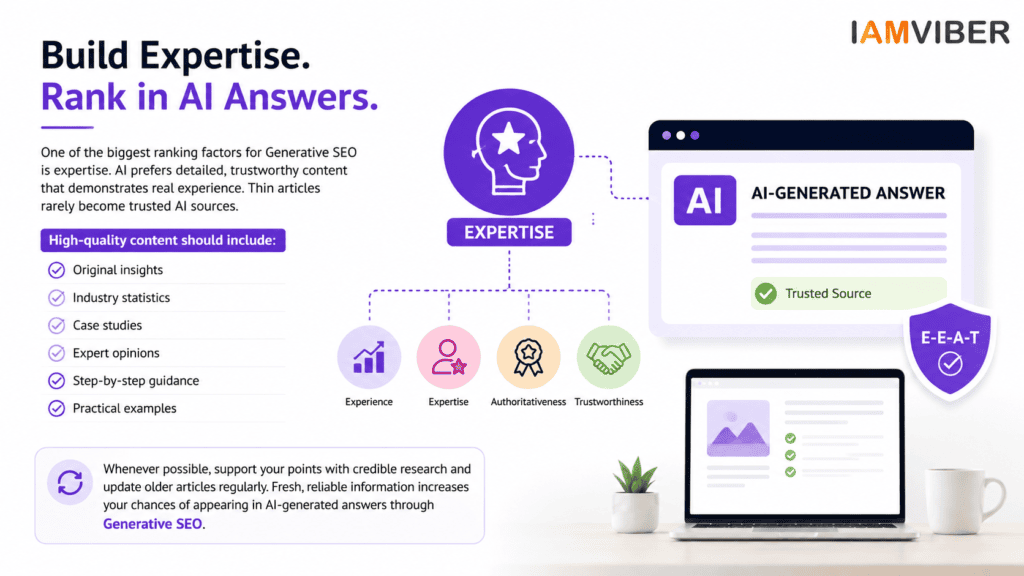
One of the biggest ranking factors for Generative SEO is expertise. AI prefers detailed, trustworthy content that demonstrates real experience. Thin articles rarely become trusted AI sources. High-quality content should include: Original insights, Industry statistics, Case studies, Expert opinions, Step-by-step guidance, Practical examples.
Following Google’s E-E-A-T principles strengthens your Generative Engine Optimization while improving AI SEO performance.
Whenever possible, support your points with credible research and update older articles regularly. Fresh, reliable information increases your chances of appearing in AI-generated answers through Generative SEO.
4. Structure Content for AI Search Optimization
Even great content won’t perform well if AI cannot easily understand it. Content structure is one of the most overlooked parts of Generative SEO. Best practices include:
- One H1 heading
- Logical H2 and H3 headings
- Short paragraphs
- Bullet points
- Numbered lists
- Bold important statistics
- Tables where appropriate
You should also implement:
- FAQ Schema
- Article Schema
- Product Schema (if applicable)
- Review Schema
Structured content improves AI Search Optimization because AI models can quickly identify important information. Well-organized pages also increase your chances of appearing in Google’s AI Overviews.
5. Track Your Generative SEO Performance
Unlike traditional SEO, success isn’t measured only by rankings. A good Generative SEO strategy also measures how AI platforms describe your business. Monitor:
- AI mentions
- Brand citations
- AI referral traffic
- Conversion rates
- Customer acquisition
- Competitor comparisons
Search for your target questions inside ChatGPT, Gemini, and Perplexity to see whether your company appears. Tracking these metrics helps improve your GEO Strategy over time.
6. Build Authority Across Multiple Platforms
Authority plays a major role in Generative Engine Optimization. AI systems trust businesses that consistently publish valuable information across multiple channels. Increase authority by:
- Publishing educational blogs regularly
- Earning backlinks from trusted websites
- Collecting authentic customer reviews
- Updating old content
- Publishing research reports
- Sharing industry insights on LinkedIn
A consistent online presence strengthens Generative SEO and improves your chances of becoming an AI-recommended source.
7. Keep Improving Your Generative SEO Strategy
Generative SEO is not a one-time project. AI search evolves rapidly, and businesses must continuously adapt. Review your content every few months by:
- Updating outdated statistics
- Adding new FAQs
- Improving readability
- Expanding successful articles
- Monitoring AI-generated answers
- Optimizing structured data
Businesses that continuously improve their AI SEO strategy will remain competitive as AI-powered search continues to evolve.
Conclusion
Generative SEO is transforming digital marketing. Instead of focusing only on search rankings, businesses must also optimize for AI-generated answers. By building a strong brand, researching conversational keywords, publishing expert content, improving AI Search Optimization, implementing structured data, tracking performance, and strengthening authority, your business can succeed in the future of search.
Whether you’re a startup or an established company, investing in Generative SEO today will improve your visibility tomorrow. A long-term GEO Strategy combined with traditional SEO creates a powerful digital marketing approach that helps your business earn trust, increase visibility, and attract high-quality customers through AI-powered search.
Frequently Asked Questions
1. What is Generative SEO?
Generative SEO is the process of optimizing content so AI-powered search engines and assistants can understand, trust, and recommend your business in their responses.
2. Is Generative SEO different from traditional SEO?
Yes. Traditional SEO focuses on rankings and website traffic, while Generative SEO focuses on earning visibility inside AI-generated answers. The best results come from combining both approaches.
3. Why is AI Search Optimization important?
AI Search Optimization helps your content become easier for AI systems to understand, increasing the likelihood that your brand will be cited or recommended in AI-generated responses.
4. How long does Generative SEO take to show results?
Most businesses begin seeing improvements within 3–6 months, depending on competition, content quality, and the consistency of their GEO Strategy.
5. Can small businesses benefit from Generative SEO?
Absolutely. Generative SEO rewards expertise, trust, and valuable content rather than large advertising budgets. Small businesses with niche knowledge can compete effectively in AI-powered search.
6. What is the future of Generative Engine Optimization?
As AI becomes a primary way people search online, Generative Engine Optimization will become an essential part of every successful digital marketing strategy.
Topics to follow: Current Affairs & Insights Tech Innovation GenZ entrepreneurship Collaborative Fashion GEO AI Agentic SME