Software has always been built one line of code at a time. Developers spent countless hours writing functions, fixing bugs, designing interfaces, integrating APIs, and testing every feature before a product could reach users. It was a process that demanded time, expertise, and large engineering teams. Today, that process is changing faster than anyone imagined.
Artificial Intelligence has introduced a new way of building software—one that prioritizes ideas over implementation and creativity over repetition. This new approach is known as Vibe Coding, and it is quickly becoming one of the most talked-about trends in the technology industry. Rather than replacing developers, Vibe Coding empowers them to work alongside AI, transforming software development into a faster, more collaborative, and more innovative experience.
For startups, it means launching products in weeks instead of months. For businesses, it means accelerating digital transformation. And for developers, it marks the beginning of a new era where writing code is no longer the primary measure of productivity.
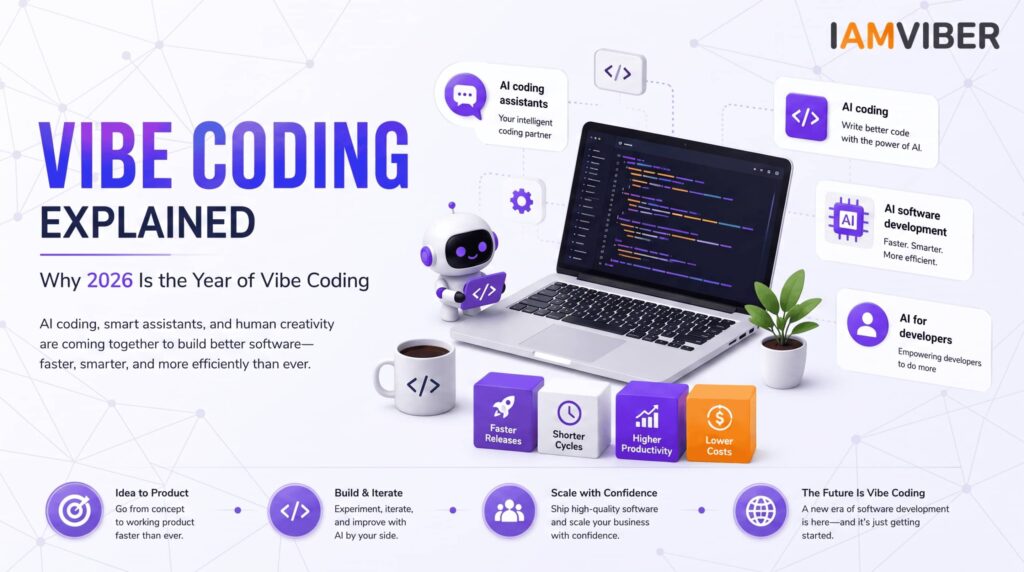
At its core, Vibe Coding is an AI-first approach to software development where developers use intelligent coding assistants to build applications through natural language instructions, rapid iteration, and continuous collaboration with AI.
Instead of manually writing every line of code, developers can describe what they want to build. Modern AI tools understand those instructions, generate production-ready code, suggest improvements, identify bugs, and even recommend better architectural patterns. The developer remains in control, but AI handles much of the repetitive work that once consumed hours of engineering time.
Imagine asking an AI assistant to build a responsive dashboard with user authentication, payment integration, analytics, and an admin panel. Within minutes, the foundation of the application is ready. Developers can then refine, optimize, and customize it according to business requirements. This is the essence of Vibe Coding—transforming ideas into working software with unprecedented speed.
Why Is Vibe Coding Becoming So Popular?
The growing popularity of Vibe Coding is closely tied to the rapid advancement of Large Language Models (LLMs) and AI-powered development tools. Over the past few years, AI has evolved from simply answering questions to understanding programming languages, frameworks, and software architecture.
This technological leap has significantly reduced the time required to build applications. Tasks that once required days of development—such as creating APIs, designing interfaces, writing documentation, or generating unit tests—can now be completed in a fraction of the time.
For startups operating with limited budgets and small engineering teams, this change is transformative. Instead of spending months validating an idea, founders can launch a Minimum Viable Product (MVP) within days, collect real customer feedback, and iterate rapidly.
The faster a business learns from its users, the greater its chances of building a successful product.
From Writing Code to Solving Problems
One of the most significant changes introduced by Vibe Coding is the shift in how developers spend their time.
Traditional software development often involves repetitive tasks such as creating login systems, configuring databases, writing validation rules, or implementing standard CRUD operations. While essential, these activities rarely contribute to a product’s uniqueness.
AI excels at handling repetitive work.
As AI takes over these routine tasks, developers gain more time to focus on higher-value activities such as product strategy, system architecture, user experience, performance optimization, and innovation. In other words, Vibe Coding changes the role of developers from code writers to problem solvers.
Why Startups Are Embracing Vibe Coding
For startups, speed is more valuable than perfection.
Launching quickly allows businesses to gather customer feedback, validate assumptions, and improve products before competitors have the opportunity to react.
Traditional development cycles often require six months or more before users interact with the product. By that point, market conditions may have changed, customer needs may have evolved, or the original assumptions may no longer be relevant.
Vibe Coding dramatically shortens this cycle.
With AI assisting throughout the development process, founders can transform concepts into prototypes within days and launch functional applications in weeks rather than months. This rapid experimentation enables startups to innovate faster while reducing development costs and business risk.
The Developer's Role Is Evolving
Despite widespread concerns, Vibe Coding is not replacing software developers. Instead, it is changing what developers are expected to contribute.
AI can generate code, but it cannot fully understand business strategy, customer behavior, regulatory requirements, or long-term product vision. It cannot make critical architectural decisions or determine how different technical choices impact scalability and maintainability.
These responsibilities continue to require experienced human judgment. The most successful developers of the future will not necessarily be those who write the fastest code. They will be those who understand products, communicate effectively with AI, evaluate generated code critically, and solve complex business problems.
The Business Impact
Organizations across industries are beginning to recognize that Vibe Coding is more than a productivity tool—it is a competitive advantage.
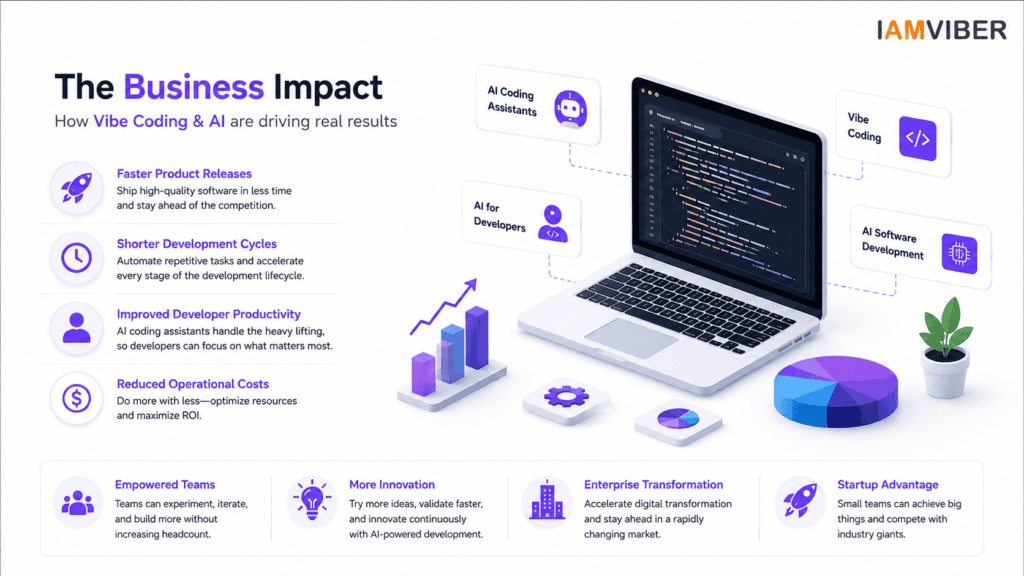
Companies adopting AI-assisted development report faster product releases, shorter development cycles, improved developer productivity, and reduced operational costs. Teams can experiment with multiple ideas simultaneously without dramatically increasing engineering resources.
For enterprises, this means accelerating digital transformation initiatives. For startups, it creates opportunities to compete with much larger organizations by leveraging AI to maximize the efficiency of small teams. As software becomes easier to build, innovation becomes more accessible.
Challenges That Cannot Be Ignored
Although Vibe Coding offers tremendous advantages, it is not without limitations. AI-generated code is not always accurate or secure. It can introduce performance issues, security vulnerabilities, inefficient algorithms, or outdated implementation patterns.
Organizations that rely solely on AI without proper code review risk accumulating technical debt that becomes increasingly difficult to manage over time. Successful teams treat AI as an intelligent collaborator rather than an autonomous developer.
Every generated solution should be reviewed, tested, optimized, and aligned with the organization’s engineering standards before reaching production. Human oversight remains essential.
Best Practices for AI-Assisted Development
Organizations adopting Vibe Coding successfully follow a disciplined approach.
Developers should always understand the code generated by AI before integrating it into production environments. Security reviews should remain mandatory, especially for authentication systems, payment processing, and data privacy.
Automated testing becomes even more valuable because rapid development must still be supported by reliable quality assurance.
Most importantly, AI should be viewed as a productivity multiplier rather than a replacement for engineering expertise.
The combination of human creativity and artificial intelligence consistently delivers stronger outcomes than either could achieve independently.
The software industry has experienced several major technological shifts over the past few decades. High-level programming languages replaced assembly code. Open-source frameworks accelerated development. Cloud computing simplified infrastructure management.
Artificial Intelligence represents the next major transformation.
Over the coming years, software development is expected to become increasingly conversational. Developers, designers, product managers, and even entrepreneurs without traditional programming backgrounds will collaborate with AI to create functional applications more efficiently than ever before.
Rather than spending weeks implementing basic functionality, teams will invest their time refining user experiences, improving product strategy, and delivering greater customer value.
This evolution does not diminish the importance of software engineering. Instead, it elevates it.
As AI becomes capable of generating code, the true differentiator will be human creativity, strategic thinking, and the ability to solve meaningful problems.
Vibe Coding is more than a passing trend—it represents a fundamental shift in the way software is conceived, developed, and delivered.
By combining human expertise with the speed and intelligence of AI, organizations can dramatically reduce development timelines while maintaining high standards of quality and innovation.
The future of software development will not belong to those who simply write more code. It will belong to those who can transform ideas into impactful digital products with greater speed, efficiency, and purpose.
In the age of Vibe Coding, success is no longer defined by how much code you write. It is defined by how much value you create.
Frequently Asked Questions (FAQs)
1. What is Vibe Coding?
Vibe Coding is an AI-first approach to software development where developers collaborate with artificial intelligence to write, review, debug, and optimize code. Instead of manually coding every feature, developers use AI to accelerate development while focusing on product strategy, architecture, and problem-solving.
2. Is Vibe Coding replacing software developers?
No. Vibe Coding is designed to enhance developer productivity, not replace developers. AI can generate code and automate repetitive tasks, but human expertise is still essential for system design, security, business logic, scalability, and decision-making.
3. How does Vibe Coding improve software development?
Vibe Coding significantly reduces development time by automating repetitive coding tasks, generating documentation, assisting with debugging, and creating code from natural language prompts. This allows teams to build, test, and launch products much faster.
4. Who can benefit from Vibe Coding?
Startups, enterprises, freelance developers, product managers, and even non-technical founders can benefit from Vibe Coding. It helps teams build MVPs faster, reduce development costs, and accelerate innovation across industries.
5. What are the advantages of Vibe Coding?
Some of the biggest advantages include faster product development, lower engineering costs, rapid prototyping, improved developer productivity, quicker time-to-market, and the ability to experiment with new ideas more efficiently.
6. Are there any risks associated with Vibe Coding?
Yes. AI-generated code may contain bugs, security vulnerabilities, or inefficient implementations. Developers should always review, test, and optimize AI-generated code before deploying it to production.
7. What tools are commonly used for Vibe Coding?
Popular AI-powered development tools include GitHub Copilot, Cursor, Claude, ChatGPT, Windsurf, Replit AI, Bolt.new, Lovable, Firebase Studio, and other AI-assisted coding platforms that help developers write, debug, and optimize code more efficiently.
8. Is Vibe Coding the future of software development?
Many industry experts believe Vibe Coding represents the future of software development. As AI continues to evolve, developers will spend less time writing repetitive code and more time designing innovative products, solving complex business problems, and delivering exceptional user experiences.
Topics to follow: Current Affairs & Insights Tech Innovation GenZ entrepreneurship Collaborative Fashion GEO AI Agentic SME