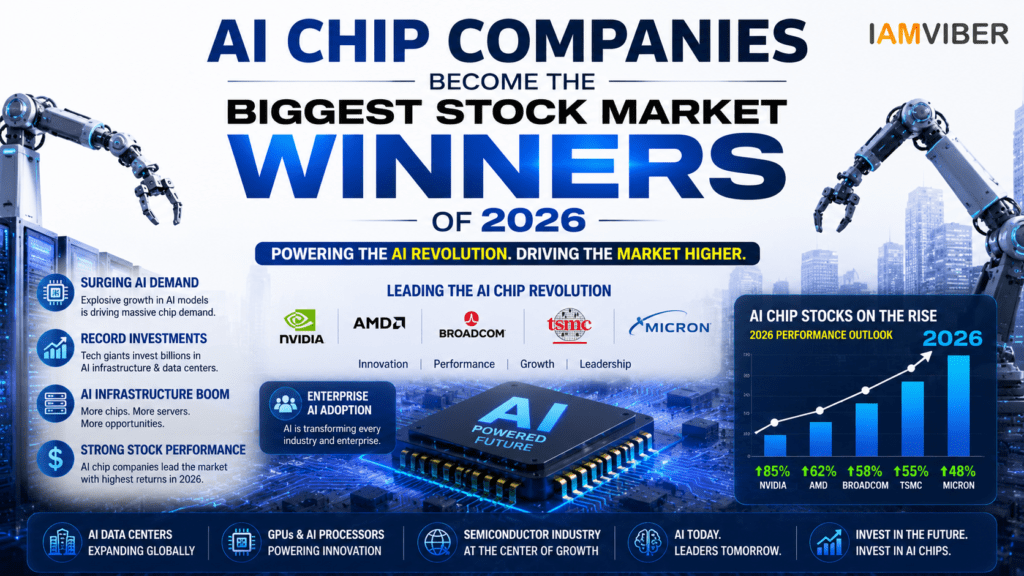
The artificial intelligence revolution is reshaping industries, businesses, and the global economy. While AI powered software such as chatbots, coding assistants, image generators, and enterprise automation tools continue to dominate headlines, another part of the industry is quietly becoming the biggest winner of all the semiconductor sector. In 2026, AI chip companies have emerged as the strongest performers in global stock markets, fueled by unprecedented demand for AI infrastructure, advanced processors, memory chips, and data center technologies.
From Silicon Valley to South Korea and Taiwan, investors are pouring billions of dollars into companies that manufacture the hardware powering artificial intelligence. Every major AI company—including OpenAI, Microsoft, Google, Meta, Amazon, xAI, and Anthropic—is expanding its computing capacity at an extraordinary pace. Behind every new AI model lies an enormous network of GPUs, AI accelerators, networking chips, memory modules, and advanced semiconductor fabrication facilities.
As a result, AI chip companies are becoming the backbone of the modern digital economy, outperforming many traditional technology stocks and setting new benchmarks for growth. Analysts believe this trend is far from over, with AI infrastructure spending expected to remain one of the strongest investment themes throughout the decade.
The AI Infrastructure Race Is Fueling Semiconductor Growth
Artificial intelligence has become one of the world’s most capital-intensive industries. Training and deploying large language models requires vast amounts of computing power, forcing technology giants to invest heavily in data centers and specialized AI hardware. Unlike previous waves of digital transformation, today’s AI revolution cannot function without cutting-edge semiconductor technology.
Every time a company launches a new AI chatbot, video generator, coding assistant, or enterprise AI platform, thousands of high-performance chips work behind the scenes to process billions of calculations every second. This demand has transformed semiconductor manufacturers from component suppliers into strategic players at the center of the AI economy.
Cloud providers are announcing multibillion-dollar investments in AI infrastructure almost every quarter. These investments include building next-generation data centers, expanding GPU clusters, improving networking systems, and upgrading storage capabilities. As these projects scale globally, semiconductor companies are benefiting directly from rising orders and long-term supply agreements.
Why AI Chip Companies Are Leading the Stock Market in 2026
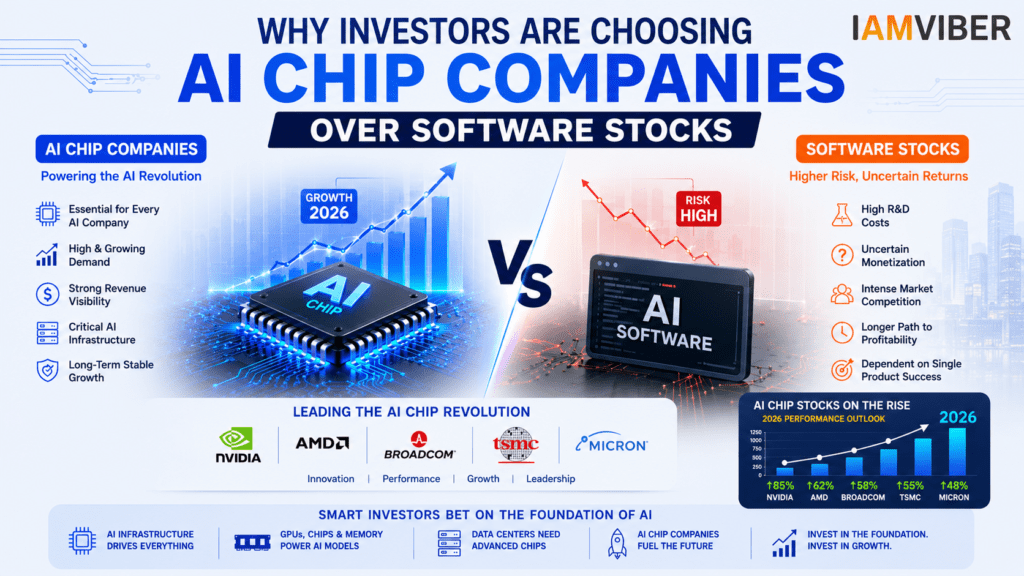
One of the biggest shifts in the stock market during 2026 has been the growing preference for AI infrastructure companies over software businesses. While software firms continue investing heavily in artificial intelligence, investors have become increasingly focused on companies generating immediate revenue from AI adoption.
Many AI software companies are still searching for sustainable monetization strategies. Building advanced AI models requires massive research budgets, cloud computing costs, and continuous product development. Although these companies have tremendous long-term potential, profitability remains uncertain for many of them.
Semiconductor manufacturers, however, operate under a different business model. Every AI company—regardless of which chatbot or AI platform eventually dominates the market—must purchase processors, memory chips, networking equipment, and advanced manufacturing services. This means AI chip companies benefit from the overall growth of the industry rather than relying on the success of a single software product.
For investors, this creates a relatively stable growth opportunity. Instead of betting on which AI application will win, they are investing in the infrastructure required by every AI company.
One of the biggest reasons behind the stock market rally is the rapid growth of AI chip companies. As global demand for AI infrastructure continues to rise, AI chip companies are receiving massive orders for GPUs, AI processors, memory chips, and networking hardware. Every major AI model requires advanced semiconductor technology, making AI chip companies the foundation of the artificial intelligence revolution. Investors now view AI chip companies as long-term growth opportunities because every AI platform depends on their hardware.
GPUs Continue to Dominate AI Computing
Graphics Processing Units, commonly known as GPUs, remain the foundation of modern artificial intelligence. Originally designed for gaming and graphics rendering, GPUs have become essential for training and running large AI models because they can process thousands of mathematical operations simultaneously.
As AI models continue growing in size and complexity, demand for high-performance GPUs has reached record levels. Companies building AI products often require tens of thousands of advanced GPUs operating together inside massive data centers. This surge in demand has significantly increased revenues for companies producing AI accelerators and related hardware.
The shortage of advanced AI chips seen in previous years has gradually improved, but demand continues to outpace supply in several markets. Governments, enterprises, research institutions, and cloud providers are all competing to secure access to next-generation AI processors.
Memory Chips Are Becoming Just as Important
While GPUs receive most of the attention, memory technology has become equally critical for AI performance. High-Bandwidth Memory (HBM) allows AI processors to transfer enormous amounts of data at incredible speeds, reducing processing bottlenecks and improving efficiency.
Without advanced memory solutions, even the most powerful AI processors cannot achieve maximum performance. As a result, companies specializing in memory manufacturing have experienced rising revenues and increased investor confidence throughout 2026.
Industry analysts believe demand for advanced memory will continue growing as AI models become larger, more complex, and capable of handling multimodal tasks involving text, images, audio, and video simultaneously.
AI Data Centers Are Creating New Growth Opportunities
Artificial intelligence has also sparked one of the biggest construction booms in technology history. Around the world, companies are investing billions of dollars in AI-focused data centers equipped with advanced cooling systems, networking infrastructure, high-speed storage, and energy-efficient power management.
Unlike traditional cloud facilities, AI data centers require significantly more computing resources and electricity. Building these facilities generates demand not only for processors but also for networking chips, power management systems, optical connectivity solutions, and semiconductor manufacturing equipment.
This broader ecosystem means the AI boom benefits dozens of companies across the semiconductor supply chain rather than just GPU manufacturers alone.
Governments Are Investing in Domestic Chip Manufacturing
National governments have also recognized semiconductors as a strategic priority. The United States, South Korea, Japan, Taiwan, India, and several European countries are increasing investments in domestic semiconductor production to reduce dependence on global supply chains.
Public funding, tax incentives, and industrial partnerships are encouraging companies to build new fabrication plants capable of producing advanced AI chips. These investments are expected to strengthen semiconductor manufacturing capacity while supporting future AI innovation.
Government-backed initiatives have further boosted investor confidence, reinforcing the belief that semiconductor companies will remain essential to national technology strategies for years to come.
Enterprise AI Adoption Is Expanding Hardware Demand
The AI boom is no longer limited to technology companies. Banks, hospitals, manufacturers, retailers, logistics firms, media organizations, and governments are integrating AI into daily operations. Every new AI deployment increases demand for computing infrastructure capable of handling complex workloads.
Enterprise AI applications such as intelligent automation, predictive analytics, AI-powered cybersecurity, customer support assistants, and digital content generation all require reliable hardware. As organizations scale these systems, semiconductor demand continues rising across multiple industries.
This diversification makes AI infrastructure less dependent on consumer technology trends and more closely tied to the broader digital transformation of global businesses.
Challenges That Could Slow the Rally
Although the outlook remains positive, investors recognize that semiconductor stocks are not immune to risk. Supply chain disruptions, geopolitical tensions, export restrictions, rising manufacturing costs, and changing economic conditions could create short-term volatility.
Competition within the semiconductor industry is also intensifying as companies race to develop faster, more efficient AI processors. Technological breakthroughs from emerging competitors could reshape market leadership over time.
Nevertheless, analysts generally agree that demand for AI computing infrastructure is likely to remain strong because artificial intelligence adoption is still in its early stages.
Looking ahead, AI infrastructure spending is expected to accelerate as organizations deploy increasingly sophisticated AI systems. Future technologies such as autonomous robotics, AI-powered healthcare, digital twins, scientific research, personalized education, and advanced enterprise automation will require exponentially greater computing power.
This means semiconductor companies will continue playing a central role in enabling the next generation of AI innovation. While software applications may evolve rapidly, the underlying demand for powerful processors, memory, networking equipment, and advanced manufacturing is expected to grow for many years.
For investors, the message is becoming increasingly clear. The biggest winners of the AI revolution may not be the companies building the most popular chatbots but the businesses supplying the essential hardware that makes artificial intelligence possible. As AI infrastructure investment continues reaching record levels in 2026, semiconductor companies have firmly established themselves as the backbone of the global AI economy and one of the stock market’s most promising sectors.
1. Why are AI chip companies the biggest stock market winners in 2026?
AI chip companies are benefiting from record demand for GPUs, AI accelerators, memory chips, and semiconductor manufacturing as technology companies invest billions of dollars in AI infrastructure and data centers worldwide.
2. Which industries are driving demand for AI chips?
Technology, healthcare, finance, manufacturing, retail, automotive, logistics, education, defense, and cloud computing are among the industries increasing demand for AI hardware to support advanced artificial intelligence applications.
3. Why are investors preferring semiconductor stocks over AI software companies?
Many AI software companies are still working toward long-term profitability, while semiconductor manufacturers generate immediate revenue because every AI platform requires processors, memory chips, networking hardware, and data center infrastructure
4. What role do GPUs play in artificial intelligence?
GPUs perform thousands of calculations simultaneously, making them essential for training and running large AI models. They significantly improve AI performance, enabling faster machine learning, deep learning, and generative AI applications.
5. Will AI chip companies continue to grow beyond 2026?
Most industry analysts expect continued growth as AI adoption expands across businesses, governments, and consumers. Increasing investments in AI data centers, semiconductor manufacturing, and enterprise AI solutions are expected to support long-term demand for AI hardware.
Topics to follow: Current Affairs & Insights Tech Innovation GenZ entrepreneurship Collaborative Fashion GEO AI Agentic SME