The AI Race Has Entered a New Phase
South Korea’s AI Investment has become one of the biggest technology story. Marking a major turning point in the global artificial intelligence race. Artificial intelligence is no longer just about building smarter chatbots or launching the next viral AI application.
The focus has shifted toward something far more fundamental—computing infrastructure. Every AI breakthrough, whether it is a large language model, an AI video generator, or an autonomous agent, depends on advanced semiconductor chips and powerful data centers.
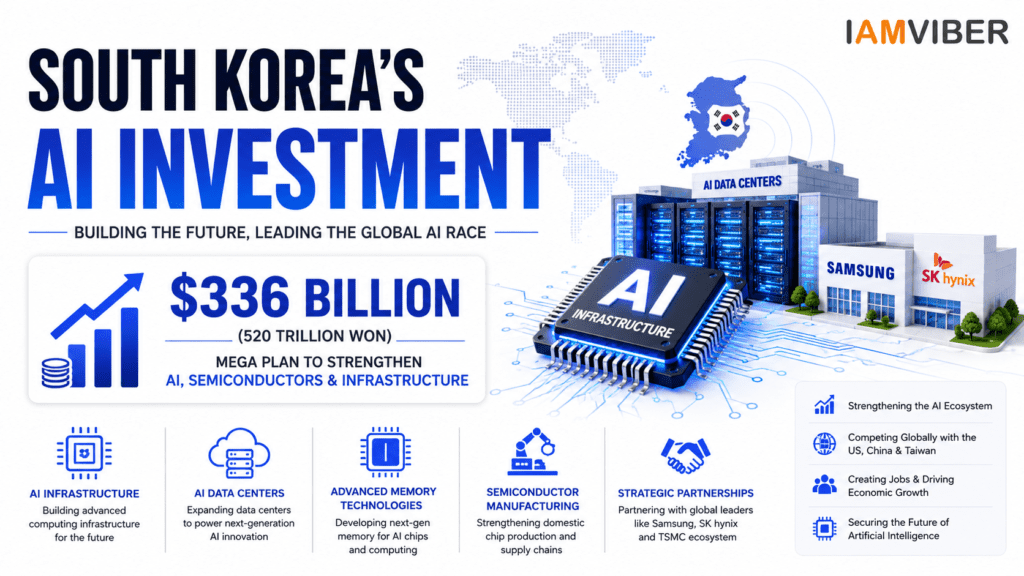
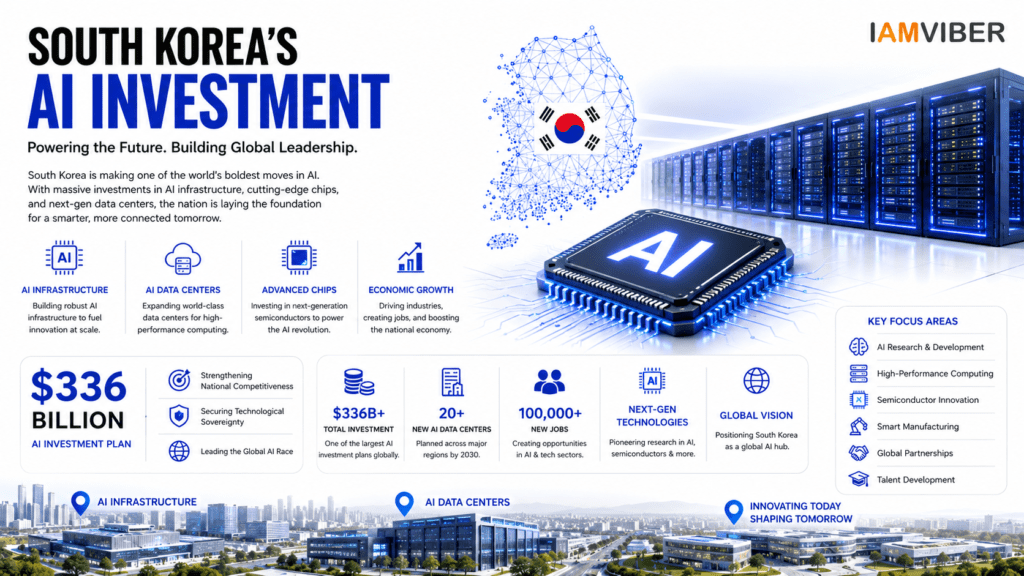
Recognizing this shift, South Korea has announced one of the world’s largest AI infrastructure initiatives, unveiling a 520 trillion won (approximately $336.7 billion) investment plan to strengthen its AI and semiconductor ecosystem. The announcement marks a significant milestone in the global technology race and reflects the country’s ambition to become one of the world’s leading AI powerhouses.
Why South Korea Is Making This Historic Investment
The rapid growth of artificial intelligence has dramatically increased the demand for computing power. Modern AI systems require thousands of advanced processors working together to train large language models and deliver billions of AI responses every day.
Countries that control semiconductor manufacturing now hold a strategic advantage in the AI economy. South Korea understands this reality and is responding with a long-term investment strategy designed to strengthen every part of its AI ecosystem. Rather than focusing only on software innovation, the government is investing in semiconductor manufacturing, AI data centers, research facilities, advanced memory technology, and next-generation computing infrastructure
The goal is to ensure that South Korea remains competitive against global technology leaders such as the United States and China.
Unlike many government technology initiatives that focus on individual projects, South Korea’s plan is designed to build an entire AI ecosystem. The investment will support the construction of advanced semiconductor fabrication plants, expansion of AI computing infrastructure, development of high-performance memory technologies, and establishment of new research and innovation centers
It also includes initiatives to strengthen supply chains, encourage domestic manufacturing, and develop skilled talent capable of supporting future AI industries. By investing across the entire technology stack, South Korea aims to reduce dependence on foreign manufacturing while creating a sustainable foundation for long-term AI growth.
How Samsung and SK Hynix Will Power South Korea's AI Investment Strategy
Two of South Korea’s biggest technology companies, Samsung Electronics and SK Hynix, are expected to be at the center of this ambitious initiative. Samsung has long been recognized as one of the world’s leading semiconductor manufacturers and continues investing heavily in advanced AI chips and fabrication technologies.
Meanwhile, SK Hynix has become a global leader in High Bandwidth Memory (HBM), an essential component used in AI processors developed by companies such as NVIDIA. As demand for AI accelerators continues to grow, advanced memory has become one of the most valuable technologies in the semiconductor industry. With these two industry leaders driving innovation, South Korea is well positioned to strengthen its influence in the global AI supply chain.
AI Chips Have Become the New Strategic Resource
Only a few years ago, conversations around artificial intelligence were focused mainly on software. Today, the conversation has shifted toward hardware. AI models cannot function without advanced processors capable of handling enormous computational workloads. Every AI-generated image, chatbot response, recommendation engine, and autonomous system relies on powerful semiconductor chips.
This has transformed semiconductors into one of the world’s most strategically important technologies. Governments now view semiconductor manufacturing not only as an economic opportunity but also as a matter of national security and technological independence.
Massive AI Data Centers Will Power Future Innovation
One of the key pillars of South Korea’s investment strategy is the expansion of AI data centers. These facilities are essential because they provide the computing power needed to train and operate advanced AI models. Modern AI data centers contain thousands of GPUs, specialized AI accelerators, high-speed networking systems, and advanced cooling infrastructure.
As businesses across industries continue adopting artificial intelligence, demand for these computing facilities is expected to increase significantly. By investing heavily in AI data centers, South Korea aims to create the digital infrastructure necessary to support future innovation while attracting global technology companies to invest in the country.
Competing With the World's Largest Technology Powers
Countries around the world are racing to secure leadership in artificial intelligence, making South Korea’s AI Investment one of the biggest technology developments of 2026. The United States continues to dominate AI software through companies such as OpenAI, Google, Microsoft, Meta, and NVIDIA, while China is aggressively expanding its domestic AI ecosystem and semiconductor manufacturing despite ongoing export restrictions. As global competition intensifies, South Korea AI Investment highlights the country’s determination to become a leading force in AI infrastructure and next-generation chip manufacturing.
Taiwan continues to play a crucial role in the global semiconductor industry through TSMC, the world’s leading producer of advanced semiconductor chips. However, the massive South Korea’s AI Investment is expected to strengthen the country’s position by expanding semiconductor manufacturing, AI data centers, advanced memory technologies, and high-performance computing infrastructure. This long-term strategy aims to reduce supply chain risks while boosting South Korea’s influence in the global AI ecosystem.
In this increasingly competitive landscape, South Korea’s AI Investment demonstrates that the country is not simply participating in the global AI race—it is positioning itself to lead it. By investing heavily in AI infrastructure, semiconductor innovation, and strategic partnerships with industry leaders like Samsung Electronics and SK Hynix, South Korea is building the technological foundation needed to compete with the world’s largest AI economies and secure long-term leadership in artificial intelligence.
Economic Growth and Job Creation
Beyond technological leadership, the investment is expected to generate significant economic benefits for South Korea. Large-scale semiconductor manufacturing facilities require thousands of highly skilled engineers, researchers, technicians, and construction workers. New AI data centers and research laboratories will also create employment opportunities while encouraging collaboration between universities, startups, and established technology companies.
As investment flows into AI infrastructure, supporting industries such as cloud computing, robotics, cybersecurity, renewable energy, and advanced manufacturing are also expected to benefit. This broader economic impact makes the initiative much more than a technology project—it represents a long-term national growth strategy.
What South Korea's AI Investment Means for AI Startups, Businesses, and Investors
The expansion of AI infrastructure could create enormous opportunities for startups and enterprises alike. Many AI startups currently face challenges related to limited access to high-performance computing resources and rising cloud costs. Increased semiconductor production and expanded AI data center capacity could make advanced computing more accessible and affordable.
Businesses developing AI-powered healthcare solutions, financial technologies, autonomous systems, cybersecurity platforms, and enterprise software may benefit from improved infrastructure and lower operational costs. Better access to computing resources could also accelerate innovation by enabling smaller companies to compete with larger technology firms.
Why This Matters for the Global AI Industry
South Korea’s announcement reinforces a growing trend in the technology industry: artificial intelligence is becoming an infrastructure business. While AI software continues to evolve rapidly, long-term success will increasingly depend on access to advanced chips, reliable data centers, high-speed networking, and stable energy supplies.
Countries capable of producing these critical technologies will have a significant competitive advantage in the coming decades. This investment demonstrates that South Korea is preparing not just for today’s AI market but for the future of global computing itself.
Final Thoughts: Can South Korea Become the World's Next AI Superpower?
South Korea’s AI and semiconductor $336 billion mega plan is one of the most ambitious technology investments announced in recent years. It highlights a major shift in the global AI race, where leadership is no longer determined solely by software innovation but also by the ability to build and control the infrastructure that powers artificial intelligence.
With strong government support and the expertise of companies like Samsung Electronics and SK Hynix, South Korea is positioning itself as a global hub for AI chips, advanced memory, and next-generation computing.
As artificial intelligence continues transforming industries worldwide, investments in semiconductors, AI data centers, and computing infrastructure will shape the next decade of innovation. South Korea has made it clear that it intends to play a leading role in that future. The AI revolution is no longer just about creating smarter machines—it is about building the technological foundation that will power the world’s digital economy for years to come.
Frequently Asked Questions (FAQs)
1. What is South Korea's AI investment and semiconductor $336 billion investment plan?
South Korea has announced a 520 trillion won (approximately $336.7 billion) investment initiative to strengthen its artificial intelligence and semiconductor industry. The plan focuses on expanding AI infrastructure, semiconductor manufacturing, AI data centers, advanced memory technologies, and research to position the country as a global AI leader.
2. Why is South Korea investing so heavily in AI and semiconductor technology?
South Korea is investing in AI infrastructure to secure long-term leadership in the global AI race. As demand for AI chips, cloud computing, and advanced data centers grows, the country aims to strengthen its semiconductor ecosystem, reduce supply chain risks, and compete with major technology leaders like the United States and China.
3. Which companies are expected to benefit from South Korea's AI investment?
Leading South Korean technology companies, including Samsung Electronics and SK Hynix, are expected to play a major role in the initiative. Their expertise in semiconductor manufacturing and High Bandwidth Memory (HBM) technology makes them critical to powering next-generation AI systems.
4. Why are semiconductor chips important for artificial intelligence?
Semiconductor chips are the foundation of artificial intelligence because they provide the computing power needed to train and run AI models. Every AI application—from chatbots and AI assistants to autonomous vehicles and enterprise AI platforms—depends on advanced processors and high-performance memory.
5. How will South Korea's AI investment impact the global AI industry?
South Korea’s massive AI investment is expected to strengthen global semiconductor supply chains, expand AI computing capacity, accelerate innovation, and support the development of more powerful AI technologies. The initiative could also create new opportunities for startups, businesses, and investors worldwide while reinforcing South Korea’s position as a global AI hub.