OpenAI Wants to Patch the Internet Before Hackers Break it
The internet runs on open-source software.
From cloud infrastructure and operating systems to developer tools and AI frameworks, thousands of critical digital services rely on code maintained by small teams of developers—many of whom work without significant funding, resources, or security support.
But there’s a problem.
Cybercriminals are increasingly targeting open-source projects because a single vulnerability can impact millions of devices, businesses, and users worldwide.
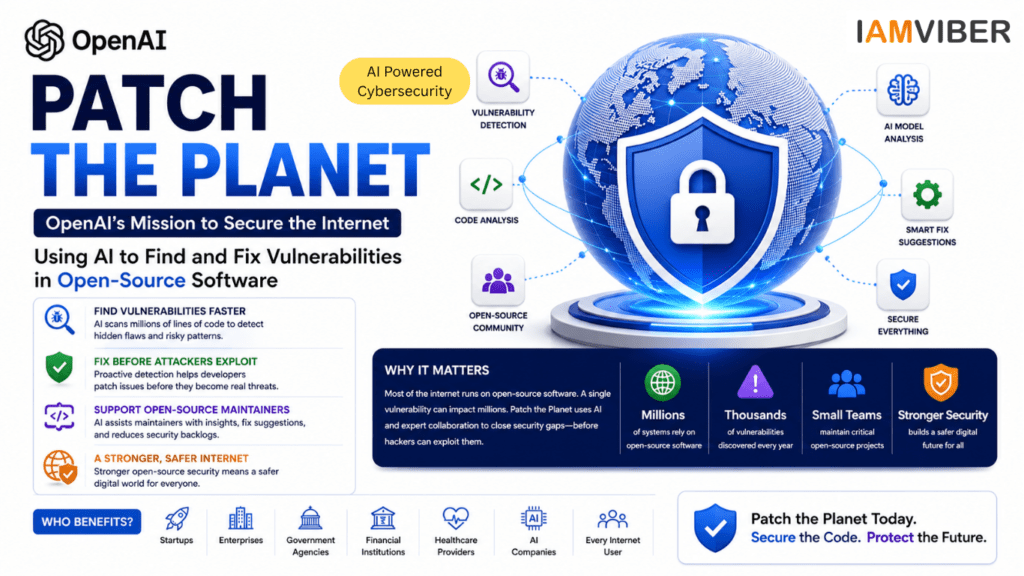
To address this growing challenge, OpenAI has launched Patch the Planet, a new initiative designed to help identify and fix vulnerabilities across critical open-source software projects using AI-powered tools and security research.
The announcement signals a major shift in how artificial intelligence could be used—not just to create content or write code—but to actively protect the software infrastructure that powers the modern world.
The question now is simple: Can AI help secure the internet faster than hackers can exploit it?
Patch the Planet is OpenAI’s latest cybersecurity initiative focused on strengthening open-source software security.
The program combines advanced AI models, automated vulnerability discovery systems, and collaboration with leading security researchers to identify software weaknesses before attackers can exploit them.
Rather than waiting for security incidents to occur, OpenAI aims to proactively scan and analyze critical open-source projects to uncover hidden vulnerabilities and support developers in fixing them.
The initiative is being developed in partnership with cybersecurity experts and open-source communities to ensure discovered vulnerabilities are responsibly disclosed and patched. In simple terms: Patch the Planet is OpenAI’s attempt to use AI as a defensive security force for the internet.
Why Open-Source Software Is So Important
Most internet users never think about open-source software. Yet nearly every digital service relies on it. Popular technologies such as:
- Linux
- Kubernetes
- PostgreSQL
- OpenSSL
- Python, Node.js, Apache
- form the foundation of modern applications and cloud systems. Millions of startups, enterprises, governments, and AI companies depend on these projects every day.
- The challenge is that many critical open-source projects are maintained by small teams with limited resources. Some projects used by billions of people may have only a handful of active maintainers.
- That creates a massive security risk. When vulnerabilities remain undiscovered or unpatched, attackers can exploit them to launch large-scale cyberattacks.
The Growing Threat to Open-Source Security
Cyberattacks targeting software supply chains have become increasingly common over the past decade. Instead of attacking individual companies directly, hackers often target software dependencies and libraries that thousands of organizations use. A single vulnerability can create a domino effect across industries. Examples include:
- Software supply-chain attacks
- Dependency hijacking
- Remote code execution exploits
- Credential theft
- Infrastructure compromise
- Infrastructure compromise
- The famous Log4Shell vulnerability demonstrated how dangerous this problem can become. A flaw in a widely used logging library created a global cybersecurity emergency and forced organizations worldwide to scramble for fixes.
- Incidents like these reveal a harsh reality: The internet's most important software often lacks sufficient security resources. That is exactly the problem Patch the Planet hopes to address.
How AI Can Help Find Bugs Faster
Traditional security audits require human researchers to manually inspect code, test software behavior, and identify vulnerabilities. While effective, the process is often slow and resource-intensive. AI changes the equation. Modern large language models can:
- Analyze massive codebases
- Detect suspicious patterns
- Identify insecure coding practices
- Simulate attack paths
- Suggest remediation strategies
- Generate patches
- Instead of reviewing thousands of files manually, security teams can use AI to prioritize potential vulnerabilities and accelerate investigations. This allows researchers to focus on validating findings rather than searching for issues from scratch. OpenAI believes AI can significantly reduce the time needed to discover security flaws.
OpenAI’s Vision for AI-Powered Cybersecurity
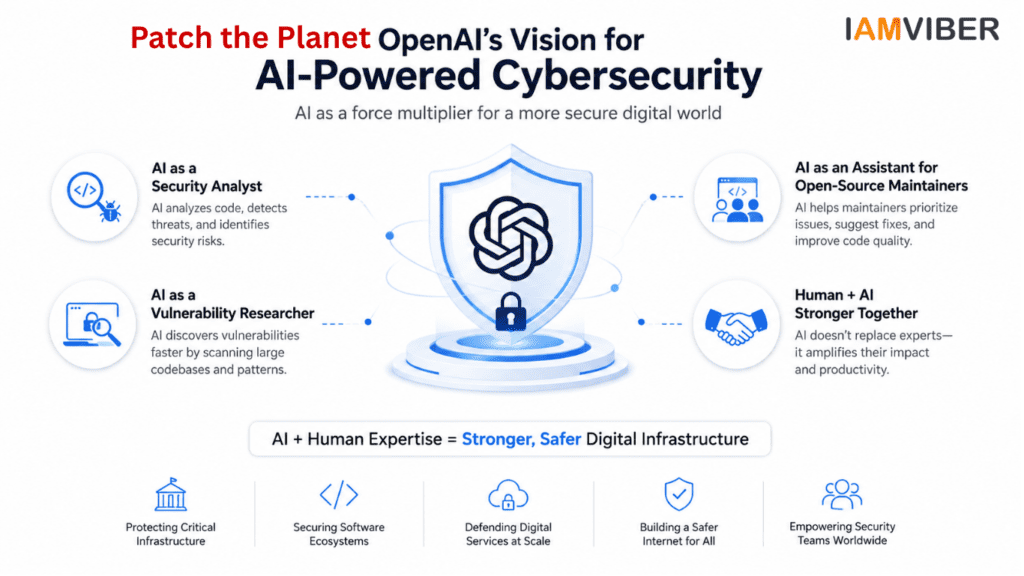
Patch the Planet reflects a broader trend in the AI industry. Major AI companies are increasingly investing in cybersecurity capabilities. OpenAI’s vision extends beyond simply building smarter chatbots.The company sees AI as a tool that can help defend critical infrastructure, software ecosystems, and digital services at scale.
In this model: AI becomes a security analyst, AI becomes a vulnerability researcher, AI becomes an assistant for open-source maintainers. Instead of replacing human experts, AI acts as a force multiplier. This hybrid approach could allow security teams to protect far more software than previously possible.
Why This Matters for Developers
For developers, Patch the Planet could become one of the most important AI initiatives launched this year. Many open-source maintainers struggle with:
- Limited budgets
- Volunteer contributors
- Growing code complexity
- Security backlogs
- Increasing attack surfaces
- An AI-powered system capable of identifying vulnerabilities and recommending fixes could dramatically reduce maintenance burdens. Developers could spend less time searching for security issues and more time improving software functionality. Smaller projects may especially benefit because they often lack dedicated security teams.
Why Businesses Should Pay Attention
This initiative isn’t just relevant to developers—it has significant implications for businesses of all sizes. Modern organizations rely heavily on open-source software, often using hundreds or even thousands of open-source components within their technology stacks.
These components power everything from websites and cloud infrastructure to internal applications and customer-facing products. However, a vulnerability in just one dependency can create serious risks, potentially exposing customer data, internal systems, financial information, and critical operational infrastructure.
If OpenAI’s Patch the Planet initiative succeeds in improving vulnerability detection and accelerating the patching process across widely used open-source projects, businesses could benefit from a much stronger security foundation.The impact would extend across startups, large enterprises, government agencies, financial institutions, healthcare providers, and AI companies. Ultimately, strengthening open-source security helps create a safer and more resilient digital ecosystem for everyone who depends on modern technology.
The Challenges OpenAI Still Faces
While the vision is compelling, AI-driven security is not without risks. Security researchers have long warned that AI systems can generate false positives. An AI model might flag code as vulnerable when no real issue exists. This can create unnecessary workload for developers.
Another concern involves AI-generated patches. Automatically generated fixes must be carefully reviewed because poorly designed patches can introduce new vulnerabilities.
There is also the broader question of responsible disclosure. Finding vulnerabilities is only part of the challenge. Organizations must ensure discovered flaws are privately reported and fixed before public disclosure. Patch the Planet will need strong governance frameworks to manage these issues effectively.
The AI Security Arms Race Has Already Begun
One of the most fascinating aspects of Patch the Planet is what it reveals about the future of cybersecurity. Artificial intelligence is no longer just a tool for productivity and automation—it is rapidly becoming a weapon used by both cyber defenders and attackers.
Cybercriminals are already experimenting with AI to accelerate malware development, create more convincing phishing campaigns, enhance social engineering tactics, and even identify software vulnerabilities at scale. At the same time, security teams are leveraging AI for threat detection, incident response, security monitoring, code analysis, and vulnerability management.
This has created a new AI-powered cybersecurity arms race, where the ability to discover and address security flaws faster than adversaries can exploit them becomes a critical advantage. Through Patch the Planet, OpenAI is positioning itself on the defensive side of this battle, aiming to help developers and organizations stay one step ahead by using AI to identify and patch vulnerabilities before they become major security threats.
What This Means for the Future of Open Source
For decades, open-source software has powered innovation across the technology industry. However, security funding has often lagged behind adoption. Patch the Planet could help change that dynamic.
If successful, the initiative may establish a new model where AI continuously assists maintainers in identifying, prioritizing, and fixing vulnerabilities before they become major incidents. Instead of reacting to cyberattacks, the industry could move toward proactive defense. That shift would represent one of the most significant changes in software security in years.
Final Thoughts
OpenAI’s Patch the Planet initiative is more than just another AI announcement. It highlights a growing recognition that artificial intelligence can play a critical role in protecting the digital infrastructure that powers modern society.
The internet depends on open-source software. Open-source software depends on maintainers. Maintainers need better security tools. By combining AI capabilities with cybersecurity expertise, OpenAI hopes to strengthen one of the internet’s weakest links before attackers can exploit it.
Whether Patch the Planet becomes a transformative security platform or simply another step toward AI-assisted cybersecurity remains to be seen. But one thing is clear: The future of cybersecurity won’t be powered by humans alone—it will be powered by humans and AI working together.
Frequently Asked Questions (FAQs)
1. What is Patch the Planet?
Patch the Planet is OpenAI’s cybersecurity initiative that uses AI to identify and help fix vulnerabilities in critical open-source software projects before they can be exploited by attackers.
2. Why is Patch the Planet important?
Open-source software powers much of the internet, but many projects lack dedicated security resources. Patch the Planet aims to strengthen these projects by helping developers detect and resolve security issues faster.
3. How does AI help find software vulnerabilities?
AI can analyze large codebases, detect suspicious patterns, identify insecure coding practices, and assist security researchers in discovering potential vulnerabilities more efficiently than traditional methods alone.
4. Who can benefit from Patch the Planet?
The initiative can benefit developers, open-source maintainers, startups, enterprises, government organizations, financial institutions, healthcare providers, and any business that relies on open-source software.
5. Can Patch the Planet improve cybersecurity worldwide?
If successful, Patch the Planet could help make the internet more secure by reducing vulnerabilities in widely used open-source software, strengthening the digital infrastructure that organizations and individuals depend on every day.
Topics to follow: Current Affairs & Insights Tech Innovation GenZ entrepreneurship Collaborative Fashion GEO AI Agentic SME