What Makes an AI Agent Autonomous? Complete Guide to Autonomous AI Agents in 2026
Artificial Intelligence has come a long way from simple rule-based systems and chatbots. Today, we are entering the era of Autonomous AI Agents—intelligent systems capable of making decisions, executing tasks, and adapting to changing environments with minimal human intervention. While most people interact with AI through tools like chatbots or virtual assistants, autonomous AI agents represent a much more advanced stage of artificial intelligence. They are designed not just to respond to instructions but to pursue goals, solve problems, and take meaningful actions independently.
The rise of Agentic AI has sparked conversations across industries, from healthcare and finance to software development and marketing. Businesses are increasingly exploring autonomous AI systems to automate workflows, improve productivity, and reduce operational costs. However, one question remains central to understanding this technological shift: What exactly makes an AI agent autonomous?
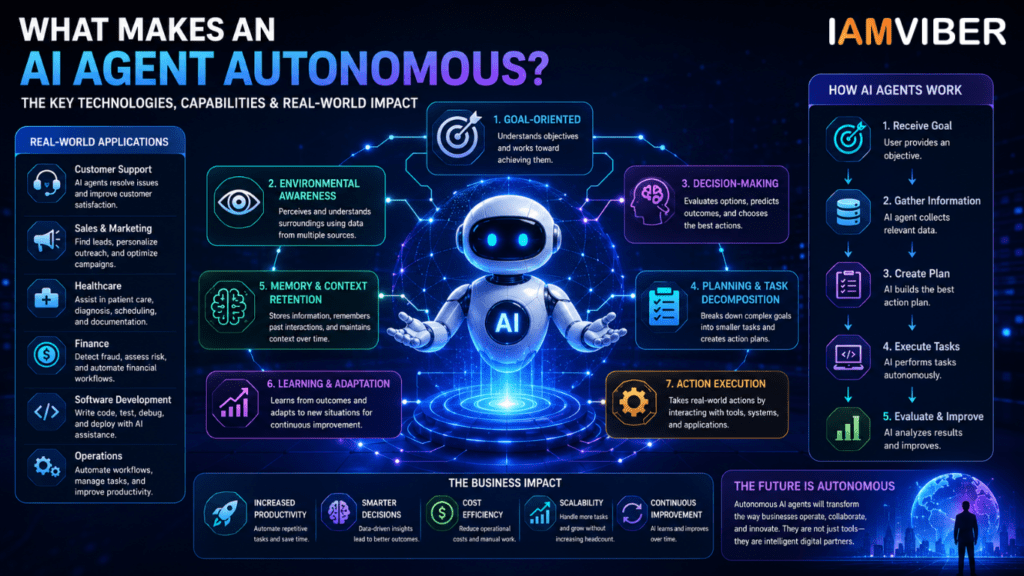
The answer lies in a combination of intelligence, decision-making, memory, planning, learning, and action-taking capabilities. An AI agent becomes truly autonomous when it can understand objectives, evaluate different paths to success, execute tasks, learn from outcomes, and continuously improve without requiring detailed instructions at every step.
Understanding AI Agents
Before exploring AI Agent autonomy, it is important to understand what an AI agent is. An AI agent is a software entity that interacts with its environment, gathers information, processes data, and takes actions to achieve specific goals. Unlike traditional software that follows predefined commands, AI agents can analyze situations and make decisions based on available information.
For example, a standard chatbot may answer customer questions when prompted. An autonomous AI agent, on the other hand, can monitor customer interactions, identify unresolved issues, prioritize urgent requests, draft responses, escalate critical cases, and track outcomes without requiring constant supervision. This ability to move beyond simple responses and actively pursue objectives is what separates AI agents from conventional software systems.
Autonomy refers to an AI system’s ability to operate independently while pursuing a defined objective. An autonomous AI agent doesn’t require step-by-step instructions for every action. Instead, it:
- Understands goals
- Creates plans
- Chooses actions
- Monitors results
- Adjusts strategies
- The more decisions an AI system can make without human supervision, the higher its level of autonomy. This capability is what differentiates autonomous AI agents from traditional automation tools.
Goal-Oriented Intelligence: The Core of Autonomy
One of the most important characteristics of autonomous AI agents is their ability to work toward goals rather than simply execute commands. Traditional automation tools rely on predefined workflows. If a process changes unexpectedly, the system often fails because it lacks flexibility.
Autonomous AI agents, however, focus on achieving outcomes. Instead of being told exactly how to perform every task, they are given objectives. For example, a sales AI agent may receive the goal of generating qualified leads. It can then decide which databases to search, how to analyze prospects, what communication strategies to use, and how to prioritize outreach efforts.
This goal-oriented behavior allows AI agents to operate in dynamic environments where conditions change frequently. Rather than depending on rigid instructions, they can continuously adjust their actions to maximize the chances of success.
Environmental Awareness and Context Understanding
An autonomous AI agent must understand its surroundings. This capability, known as environmental awareness, enables the agent to gather and interpret information from various sources. These sources may include websites, databases, customer interactions, documents, software applications, sensors, APIs, and enterprise systems.
Environmental awareness allows AI agents to react intelligently to changing circumstances. For example, a customer support agent may detect a sudden increase in complaints related to a specific product issue. Instead of waiting for human intervention, it can categorize tickets, identify patterns, prioritize responses, and alert the appropriate teams.
Context is equally important. An AI agent that understands context can make more informed decisions. It can recognize whether a customer is frustrated, whether a business opportunity is urgent, or whether market conditions have shifted. This deeper understanding enables more effective and autonomous decision-making.
Decision-Making: The Brain Behind Autonomous Agents
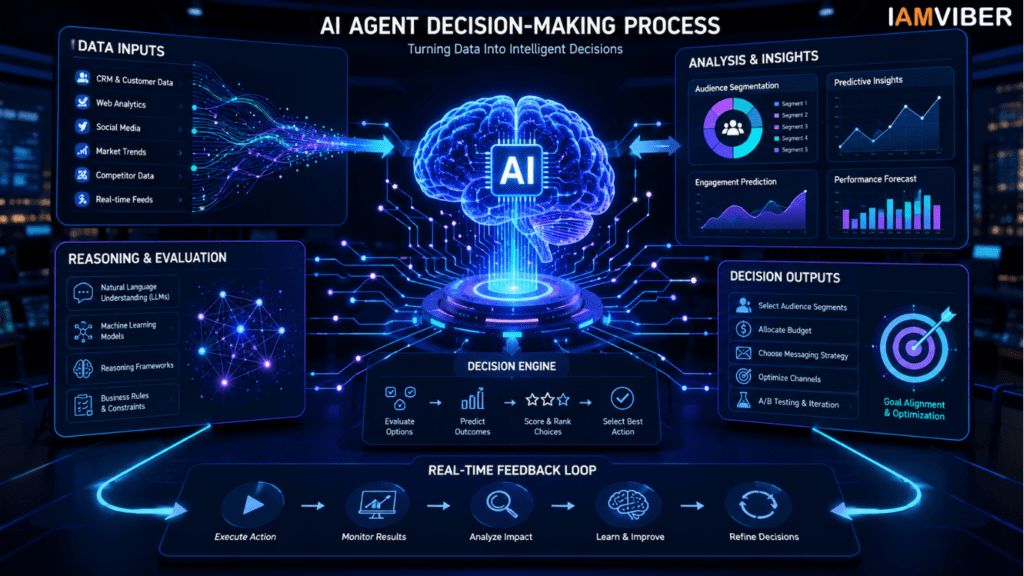
Decision-making is perhaps the most visible feature of an autonomous AI system. Every autonomous agent must evaluate options, predict outcomes, and choose actions that align with its objectives.
Modern AI agents combine technologies such as Large Language Models (LLMs), machine learning algorithms, reasoning frameworks, and business rules to make decisions. They analyze vast amounts of information, identify patterns, and determine the most effective course of action.
For example, an AI-powered marketing agent may decide which audience segments should receive advertisements, how much budget should be allocated to different campaigns, and which messaging strategies are likely to generate the highest engagement. Rather than relying solely on predefined rules, the agent continuously evaluates data and updates its decisions based on real-time insights.
The quality of an AI agent’s autonomy often depends on the sophistication of its decision-making capabilities.
Planning and Task Decomposition
Humans naturally break large goals into smaller, manageable tasks. Autonomous AI agents possess a similar capability known as task decomposition.
Suppose an organization asks an AI agent to launch a product marketing campaign. The agent may begin by researching competitors, identifying target audiences, developing messaging, generating content, scheduling distribution, monitoring performance, and optimizing results. Each of these activities becomes part of a structured plan designed to achieve the overall objective.
Planning allows autonomous agents to handle complex, multi-step tasks that cannot be completed through a single action. More importantly, advanced AI agents can revise their plans when circumstances change. If a marketing campaign performs poorly, the agent may adjust its strategy without waiting for new instructions.
This ability to create, manage, and modify plans is a key component of autonomy.
Memory: Learning From the Past
Without memory, autonomy would be impossible. Every intelligent decision depends on access to previous experiences and relevant information.
Autonomous AI agents use both short-term and long-term memory systems. Short-term memory helps the agent maintain awareness of ongoing tasks and recent interactions. Long-term memory stores historical information, patterns, preferences, and knowledge accumulated over time.
For example, a customer service AI agent can remember previous conversations with a customer, understand recurring issues, and personalize future interactions. A business operations agent can recall past performance metrics and use them to improve future decisions.
Memory transforms AI agents from reactive systems into adaptive entities capable of building knowledge over time.
Learning and Adaptation
Another defining characteristic of autonomous AI agents is their ability to learn. Learning enables agents to improve performance based on experience rather than relying solely on static programming.
As AI agents interact with their environments, they receive feedback about the effectiveness of their actions. Successful outcomes reinforce useful behaviors, while unsuccessful outcomes encourage adjustments. This process allows agents to become more efficient, accurate, and capable over time.
For instance, an AI sales agent may discover that certain outreach messages generate higher response rates. By analyzing performance data, the agent can automatically refine its communication strategy. Similarly, a logistics AI agent may identify more efficient delivery routes based on historical traffic patterns and operational outcomes.
Adaptation is critical because real-world environments are constantly changing. Autonomous agents that can learn and adapt remain effective even as conditions evolve.
Action Execution: Turning Intelligence Into Results
Intelligence alone does not make an AI agent autonomous. The ability to take action is equally important. Autonomous agents must be capable of interacting with external systems and executing tasks independently.
Modern AI agents can send emails, update databases, schedule meetings, manage workflows, generate reports, analyze documents, deploy software updates, and interact with business applications. Through integrations with APIs and digital tools, they can move beyond recommendations and actively perform work.
This action-taking capability is what transforms AI from an advisory tool into a digital workforce. Organizations increasingly view autonomous agents as virtual employees capable of handling operational tasks at scale.
The Future of Autonomous AI Agents
The future of artificial intelligence is moving beyond conversation and toward action. While chatbots introduced the world to AI-powered interactions, autonomous agents are introducing the world to AI-powered execution.
Industry experts predict that autonomous AI agents will become central to business operations over the next decade. They will coordinate projects, manage workflows, conduct research, analyze markets, automate customer interactions, and even assist in strategic decision-making. As advances in reasoning, memory, planning, and learning continue, AI agents will become increasingly capable of handling sophisticated responsibilities across industries.
Companies that adopt autonomous AI systems early are likely to gain significant competitive advantages through improved productivity, scalability, and operational efficiency.
Conclusion
An AI agent becomes autonomous when it can understand goals, perceive its environment, make decisions, create plans, remember past experiences, learn from outcomes, and execute actions independently. These capabilities work together to transform AI from a simple tool into an intelligent system capable of pursuing objectives with minimal human supervision.
As Agentic AI continues to evolve, autonomous AI agents are expected to reshape how businesses operate, how work is performed, and how humans collaborate with machines. The organizations that understand and embrace this shift today will be better positioned to thrive in the AI-driven future of tomorrow.
Frequently Asked Questions (FAQs)
1. What is an autonomous AI agent?
An autonomous AI agent is an intelligent system that can understand goals, make decisions, plan tasks, and execute actions independently with minimal human intervention.
2. What makes an AI agent autonomous?
An AI agent becomes autonomous when it can perceive its environment, reason through problems, retain memory, learn from experience, and take actions to achieve specific objectives without constant guidance.
3. How do autonomous AI agents differ from traditional AI?
Traditional AI typically responds to commands or follows predefined rules, whereas autonomous AI agents can proactively make decisions, adapt to changing situations, and complete multi-step tasks on their own.
4. What are the main benefits of autonomous AI agents?
Autonomous AI agents improve productivity, reduce operational costs, automate repetitive tasks, enhance decision-making, and enable businesses to scale operations more efficiently.
5. What industries use autonomous AI agents?
Autonomous AI agents are widely used in healthcare, finance, customer service, marketing, logistics, software development, and cybersecurity to automate workflows and improve efficiency.
Topics to follow: Current Affairs & Insights Tech Innovation GenZ entrepreneurship Collaborative Fashion GEO AI Agentic SME