Ultraviolette EV Expansion: Why Its $82 Million Bet Matters for India’s Electric Two-Wheeler Market
India’s electric mobility story is entering a new phase, and the latest Ultraviolette EV expansion is a strong example of how Indian startups are moving from premium products toward large-scale manufacturing.
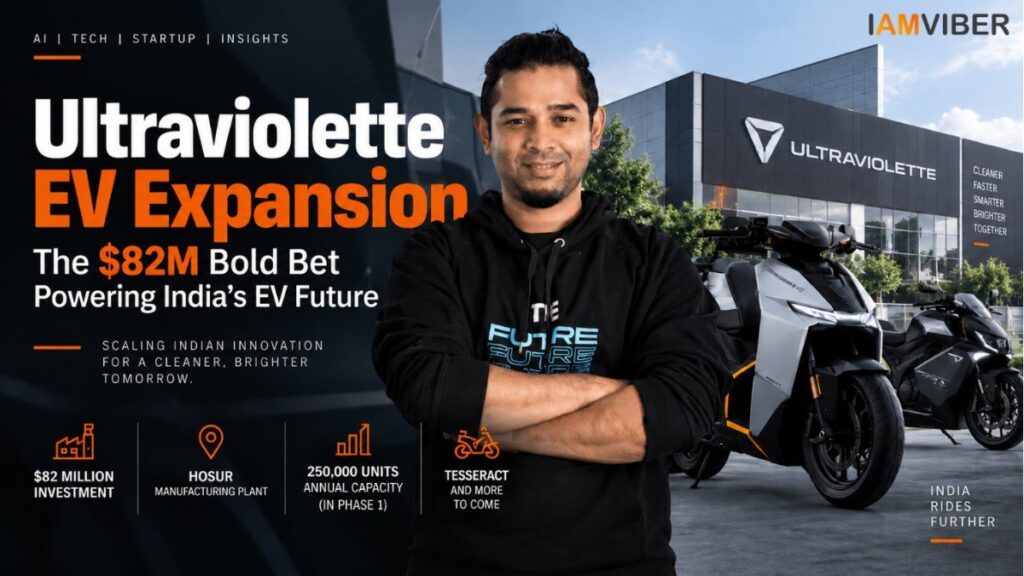
Ultraviolette Automotive plans to invest about $82 million (₹779 crore) in a new manufacturing facility in Hosur, Tamil Nadu. The plant will initially have annual capacity for 250,000 vehicles and can eventually be expanded to 500,000 units. The investment is planned over five years and is designed to support the company’s move into higher-volume electric two-wheelers.
For investors, the Ultraviolette EV expansion is interesting because it is not simply a factory story. It combines manufacturing scale, product diversification, domestic EV adoption and export ambitions.
What Is Behind the Ultraviolette EV Expansion?
The company’s existing facility near Bengaluru can produce up to 50,000 units annually, demand for upcoming products such as the Tesseract scooter and Shockwave motorcycle is already significantly higher than what the current facility can support.
The new Ultraviolette EV expansion is therefore intended to remove a major constraint: production capacity.
The Hosur plant will begin with 250,000 units of annual capacity, with the possibility of reaching 500,000 units as demand develops. Recent reporting indicates the facility could be commissioned within roughly six to eight months, with capacity added in phases rather than all at once.
For investors, this phased approach matters because manufacturing capacity can grow alongside demand instead of creating a large fixed-cost burden before the market is ready.
The scale of the Ultraviolette EV expansion also signals that management is preparing for a substantially larger volume opportunity than the company has historically addressed.
Why the $82 Million Investment Matters
The size of the investment makes the Ultraviolette EV expansion one of the more significant manufacturing bets by an Indian electric two-wheeler startup.
The company says the ₹779 crore investment will be funded through internal reserves, equity and future cash flows, with limited reliance on debt. Hosur was selected partly because of its proximity to Ultraviolette’s Bengaluru R&D centre and its access to an established automotive supply chain.
For an EV manufacturer, supply-chain access can influence manufacturing costs, component availability and production speed.
The Ultraviolette $82 million plant is therefore not only about increasing output. It is also about creating a manufacturing base capable of supporting multiple products and potentially larger export volumes.
India’s Electric Two-Wheeler Market Is Getting Bigger
The Ultraviolette EV expansion comes as India’s electric two-wheeler market accelerates.
Government data cited by Reuters shows electric two-wheeler sales crossed 1.03 million units during the first eight months of 2026. Their share of overall two-wheeler sales also crossed 10% for the first time in August 2026. McKinsey estimates electric two-wheelers could represent 40% to 45% of India’s total two-wheeler sales by fiscal 2030.
These numbers help explain why startups are investing in production capacity now.
The opportunity is no longer limited to premium electric motorcycles. Scooters and more affordable motorcycles could drive the next phase of volume growth.
That is exactly where the Ultraviolette EV expansion becomes strategically important.
From Premium Motorcycles to Mass-Market Products
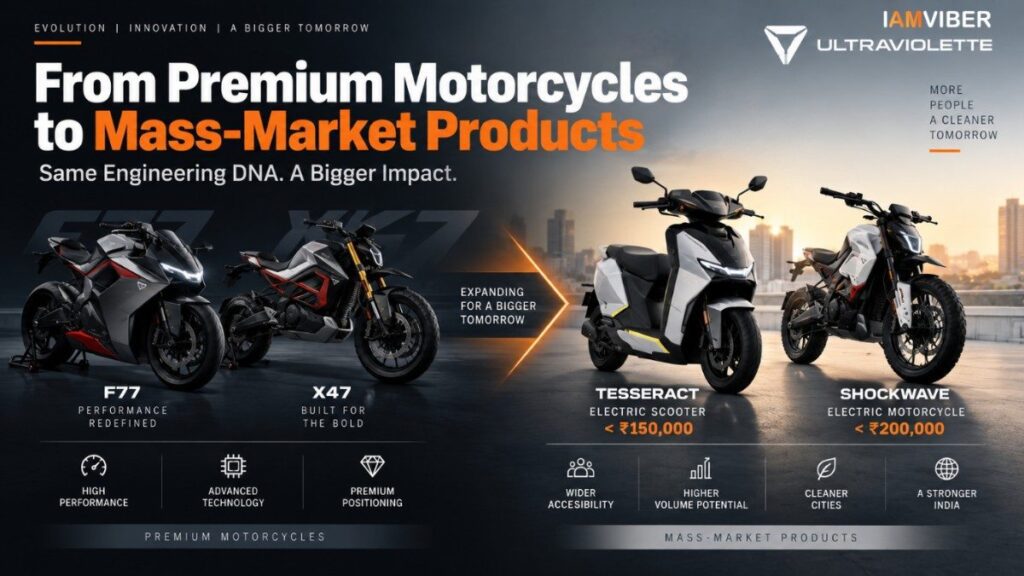
Ultraviolette built its reputation around performance-focused electric motorcycles such as the F77 and X47. Now the company is widening its product strategy.
Its upcoming Tesseract electric scooter is expected to be priced below ₹150,000, while the Shockwave motorcycle is planned at below ₹200,000.
This is a major shift in addressable market.
Premium electric motorcycles can establish a technology brand, but mass-market scooters can potentially create much larger unit volumes.
The Ultraviolette EV expansion is being designed around that transition.
Moving into more accessible price segments could allow Ultraviolette to compete for customers beyond the premium performance category and build a much larger volume business.
Why Tesseract Could Be the Volume Driver
The Tesseract electric scooter could become one of the most important products in the Ultraviolette EV expansion strategy.
Business Standard reports that Tesseract is expected to enter the market in Q1 2027, initially using the Karnataka facility before production shifts to Hosur once the new plant is commissioned. The company expects scooter volumes to ramp toward around 10,000 units per month.
The strategic logic is straightforward: if the company establishes demand for a lower-priced scooter, the new plant provides the capacity required to serve it.
But reaching 10,000 units per month requires more than production capacity. It requires sustained customer demand, financing availability, distribution, service infrastructure and reliable supply chains.
That makes the success of the Tesseract launch a key milestone for the broader Ultraviolette EV expansion.
Hosur Manufacturing Plant: More Than Just Capacity
The Hosur manufacturing plant is important because it can become a platform for several products rather than a facility dedicated to a single model.
The first phase is designed for 250,000 annual units, while a second phase could eventually take capacity toward 500,000. Capacity will be added progressively as volumes increase.
That makes the Ultraviolette EV expansion more flexible than simply bringing maximum capacity online from day one.
The location also provides access to the broader automotive ecosystem around Tamil Nadu and southern India, potentially supporting supplier access, logistics and skilled manufacturing.
For investors, the Ultraviolette EV expansion could therefore create operating leverage if utilization rises quickly enough.
The Export Opportunity
Another important part of the Ultraviolette EV expansion is international growth.
Ultraviolette already exports to European markets and sells the F77 in around 20 European countries. Management expects exports to become more important, with the share potentially rising toward 25% within five years. The company is also looking toward Latin America and other international markets.
For an Indian EV startup, export growth can diversify revenue beyond domestic demand.
However, international expansion also brings certification, distribution, after-sales service, spare-parts and logistics challenges.
If the company can successfully scale exports alongside domestic sales, the Ultraviolette EV expansion could give it a more diversified revenue base.
Competition and the Investor Question
The Indian electric two-wheeler market is becoming increasingly competitive, with companies such as Ola Electric and Ather Energy also pursuing scale.
The Ultraviolette EV expansion therefore needs to deliver more than manufacturing capacity. The company needs products that are competitively priced, technologically differentiated and supported by dependable service.
Its engineering experience in premium electric motorcycles could be an advantage. The challenge is converting that engineering capability into products that can sell at much larger volumes.
For investors, the most important question is not whether Ultraviolette can build 250,000 vehicles.
It is whether it can sell them profitably.
Manufacturing expansion increases fixed costs, working-capital requirements and operational complexity. Investors should monitor production utilization, average selling prices, gross margins, battery costs, warranty expenses and customer acquisition costs.
If the company reaches high utilization without sacrificing margins, the new facility could improve operating leverage. If demand grows more slowly than expected, however, a large manufacturing footprint could become an expensive asset.
Capital Discipline and Startup Lessons
The Ultraviolette EV expansion is also notable for its funding approach. The company plans to use internal reserves, equity and future cash flows, with limited debt. That can provide flexibility during an uncertain EV cycle, although large manufacturing projects still require sustained capital.
The company may eventually need additional funding if it moves beyond the planned 500,000-unit capacity or accelerates international expansion.
For Indian hardware startups, the broader lesson is clear: building a differentiated product is only the first stage.
The harder challenge is moving from product-market fit to manufacturing scale while protecting unit economics.
The Ultraviolette EV expansion shows how that transition requires a combination of product strategy, manufacturing investment and disciplined capital allocation.
What Investors Should Watch Next
The Ultraviolette EV expansion should be judged against a few measurable milestones:
- Hosur commissioning: Can the plant become operational on schedule?
- Tesseract ramp-up: Can scooter volumes approach the company’s targets?
- Capacity utilization: Can production scale without creating excess capacity?
- Margins: Can higher volumes translate into better economics?
- Exports: Can international sales grow without excessive distribution costs?
- Capital efficiency: Can expansion be funded without excessive dilution or debt?
These indicators will tell investors much more than the headline $82 million investment.
For investors following the electric two-wheeler market India, Ultraviolette is particularly interesting because its strategy combines premium engineering with a push toward higher-volume products.
Final Takeaway
The Ultraviolette EV expansion is ultimately a bet on the next stage of India’s electric mobility market.
The company is moving beyond a premium motorcycle niche and preparing for higher-volume scooters and motorcycles. Its Hosur facility will start with 250,000 units of annual capacity and could eventually reach 500,000 units, while Tesseract and Shockwave are expected to help unlock broader demand.
For investors, the key metrics will be demand, production utilization, margins, cash generation and the speed at which new products achieve scale.
If Ultraviolette can convert its technology advantage into high-volume, profitable manufacturing, the Ultraviolette EV expansion could become an important case study in how Indian hardware startups scale.
The bigger story is not simply an $82 million factory.
It is the transition from building an EV product to building an EV business at scale.
In short: Ultraviolette is no longer betting only on premium electric motorcycles — it is betting on its ability to become a scaled Indian EV manufacturer.
Topics to follow on IAMVIEBR : Current Affairs & Insights Tech Innovation GenZ entrepreneurship Collaborative Fashion GEO SME