
The latest Positron AI funding round is more than another billion-dollar startup financing story. It is a strong signal about where investors believe the next major opportunity in artificial intelligence could emerge: AI inference infrastructure.
On September 10, 2026, Positron AI announced that it had raised $875 million in its latest financing round, pushing the company’s valuation to approximately $5 billion.
The scale of the Positron AI funding is remarkable on its own. What makes the announcement even more significant is the speed at which the company has increased its valuation.
In February 2026, Positron raised $230 million at a valuation of $1.06 billion, according to PitchBook data cited by Reuters. Seven months later, the company is valued at $5 billion.
That represents an increase of approximately 371.7% in valuation, or about 4.72 times its February valuation.
For investors, however, the most interesting question is not simply how much money Positron raised.
It is:
Why are investors willing to put $875 million behind an AI-chip startup whose next-generation hardware is still targeting production in 2027?
The answer lies in the rapidly growing AI inference market.
What Is Positron AI?
Positron AI is a semiconductor and AI infrastructure company focused on building specialized hardware for AI inference.
Training an AI model and running that model are two different computational problems.
Training involves teaching a model using enormous datasets and large amounts of compute. Inference happens after training, when the model is actually used to generate an answer, process information, run an AI agent or perform a task.
As AI adoption increases, inference workloads can become enormous.
Every chatbot response, AI-generated piece of content, coding request, agent action and enterprise AI workflow requires inference compute.
This creates a massive infrastructure opportunity.
And this is where the Positron AI funding story becomes particularly interesting.
$875 Million Positron AI Funding: Where Is the Money Coming From?
The new financing is structured in two parts.
The first is a $375 million Series C, followed by a Series C-1 of up to $500 million.
Together, the financing represents up to $875 million.
The round was co-led by major investors including New Enterprise Associates (NEA), Atreides Management, Valor Equity Partners, Andra Capital, SemiAnalysis Capital and Jim Clark, founder of Silicon Graphics.
Additional investors include Qatar Investment Authority, Cisco Investments and Naver Ventures.
The investor list is important because it demonstrates that the Positron AI funding is attracting interest across venture capital, technology and institutional investment circles.
The company intends to use the capital primarily to advance its next-generation Asimov chip and associated inference infrastructure.
Positron AI Valuation Jumps to $5 Billion
One of the biggest headlines surrounding the deal is the Positron AI valuation.
In February, the company was valued at $1.06 billion following its $230 million financing.
Its latest financing values Positron at approximately $5 billion.
That means the Positron AI valuation has increased by roughly 4.72 times in seven months.
For comparison, a company moving from a $1 billion valuation to $5 billion in less than a year requires investors to believe that its addressable market, technology and future revenue potential could expand dramatically.
That does not mean the company is guaranteed to achieve that outcome.
A private-market valuation represents what investors are willing to pay based on their expectations about the company’s future.
That distinction is particularly important when evaluating high-growth AI semiconductor startups.
The valuation reflects future expectations rather than simply today’s revenue.
Why AI Inference Is Becoming the Next Battleground
“The latest Positron AI funding could become a defining deal in the growing AI infrastructure market.”
The Positron AI funding comes at a time when demand for efficient inference computing is increasing across enterprise and consumer applications.
For years, the AI industry conversation was dominated by model training. Companies wanted larger models, more parameters and greater training compute.
But the economics of AI are changing.
Once a model is trained, it has to serve users.
That means inference becomes an ongoing operational cost.
Imagine an AI application with millions of users. Every user interaction generates inference demand.
Now imagine autonomous AI agents that can perform dozens or hundreds of model calls while completing a single task.
The amount of required inference can grow rapidly.
This is why AI inference chips are becoming strategically important.
Specialized processors can potentially improve inference economics by optimizing the combination of compute, memory bandwidth, latency and power consumption for particular AI workloads.
If these improvements translate into lower cost per token or higher performance per watt, infrastructure providers can potentially save substantial amounts of money at scale.
That is the market Positron is targeting.
Asimov: The Technology Behind the Positron AI Funding Story
A major objective behind the Positron AI funding is to bring Asimov from its design stage toward commercial production.
The centerpiece of the company’s future roadmap is Asimov, its next-generation AI inference processor.
Positron says Asimov is designed around a memory-first architecture.
That matters because modern AI models increasingly require enormous amounts of memory to operate efficiently.
According to Positron’s published specifications, Asimov is targeting:
- Up to 2.3 TB of memory per chip
- Up to 2.76 TB/s memory bandwidth
- Approximately 400W target TDP
- Production targeted for 2027
These specifications are company-provided targets rather than independently verified market benchmarks.
That distinction is important when evaluating the Positron AI funding.
A startup can raise substantial capital based on a promising technology roadmap, but investors ultimately need the company to translate those specifications into reliable commercial products.
The challenge for Positron will therefore be execution.
Designing an advanced chip is only the beginning.
The company needs to manufacture it, validate it, integrate it into systems and convince customers to deploy it at scale.
Titan Takes the Strategy Beyond a Single Chip
The Positron AI funding gives the company the financial resources needed to continue developing its full-stack inference strategy.
Positron isn’t simply developing a processor. It is also developing Titan, an inference system built around multiple Asimov chips.
The company says Titan can combine four or eight Asimov chips and is designed to support extremely large AI models and long context windows.
According to Positron, Titan is designed to serve models exceeding 16 trillion parameters, while the company’s product material describes configurations capable of supporting up to 32 trillion parameters per server.
The company also says its system is designed for context windows beyond 10 million tokens.
These numbers illustrate the kind of workloads Positron is targeting.
Rather than competing solely for conventional enterprise inference workloads, the company is positioning its hardware for extremely large models and memory-intensive AI applications.
That creates a potentially attractive niche within the broader AI infrastructure investment market.
Positron Already Has Commercial Infrastructure
One of the more encouraging aspects of the Positron AI funding story is that the company isn’t merely presenting a future technology concept.
Positron says it is deploying more than 50 racks of its Atlas inference system at Oracle Cloud Infrastructure.
This is significant because one of the biggest risks facing AI semiconductor startups is the transition from prototype to commercial deployment.
A chip can look impressive in a laboratory environment but still face major challenges in real-world cloud infrastructure.
Commercial deployments provide an opportunity to demonstrate reliability, integration and economics at scale.
Positron’s Atlas system therefore provides an important bridge between its current products and the future Asimov/Titan platform.
The NVIDIA Question
Any discussion about AI inference chips eventually leads to NVIDIA.
NVIDIA currently has a dominant position across AI computing, supported by its hardware ecosystem, software platform and enormous installed base.
But the growing size of the AI market has created opportunities for specialized alternatives.
AMD is developing competing accelerators.
Google has its own TPU architecture.
Cloud providers increasingly develop custom silicon.
And startups are attempting to solve specific AI workloads with specialized hardware.
This means the opportunity for AI semiconductor startups isn’t necessarily to replace NVIDIA overnight.
Instead, the opportunity may be to capture specific workloads where a specialized architecture can offer a meaningful advantage.
That could be better performance per watt, lower cost per token, greater memory capacity or improved inference efficiency.
Why Investors Are Interested in Positron AI Funding
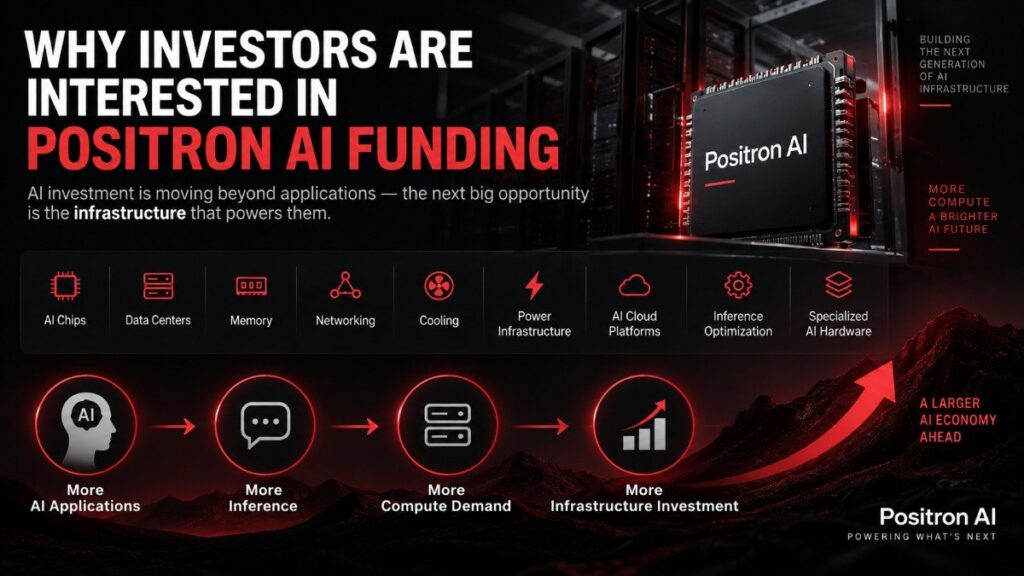
The most important part of the Positron AI funding story may be what it says about the broader investment market.
AI investment is gradually moving deeper into the technology stack.
The first wave created enormous interest in AI applications.
The next wave is increasingly focused on infrastructure.
Investors are looking at:
- AI chips
- Data centers
- Memory
- Networking
- Cooling
- Power infrastructure
- AI cloud platforms
- Inference optimization
- Specialized AI hardware
This is why AI infrastructure investment is becoming an increasingly important theme.
If AI adoption continues growing, the infrastructure required to support that adoption could become an enormous market.
In simple terms:
More AI applications → more inference → more compute demand → more infrastructure investment.
Positron wants to capture part of that chain.
What Investors Should Watch Next
From an investor perspective, the Positron AI funding demonstrates confidence in the long-term economics of AI inference.
Despite the impressive Positron AI funding, there are significant risks.
The company has a demanding technology roadmap.
Its Asimov chip is targeting production in 2027, meaning there is still substantial execution risk between design and mass deployment.
Investors should therefore watch several milestones.
1. Asimov production
Can Positron move from design to commercially viable silicon on schedule?
2. Independent performance
Will Asimov’s real-world performance match the company’s projections?
3. Customer adoption
Can Positron convert infrastructure deployments into large, recurring commercial contracts?
4. Software ecosystem
Hardware alone isn’t enough. AI developers need software tools, frameworks and compatibility that make switching hardware practical.
5. Unit economics
Ultimately, customers care about economics. If Positron can demonstrate materially better cost-per-token, performance-per-watt or throughput compared with alternatives, its technology could become much more attractive.
What the Positron AI Valuation Really Tells Us
The Positron AI valuation is impressive, but it should be interpreted carefully. A $5 billion valuation does not mean Positron has already generated $5 billion in economic value.
It means investors participating in the financing believe the company’s future opportunity justifies that valuation.
The market is essentially pricing in substantial future growth.
That makes execution even more important.
The company now has significant capital, prominent investors and a large technological ambition.
The next challenge is proving that the technology can become a scalable business.
The Bigger Startup Lesson
The biggest lesson from the Positron AI funding is not that every AI startup needs to build a chip.
It is that investors are increasingly interested in businesses solving fundamental infrastructure constraints created by AI growth.
That’s an important distinction. Instead of asking:
“What AI application can we build?”
Founders and investors are increasingly asking:
“What bottleneck will become more valuable as AI scales?”
It could be compute.
It could be memory.
It could be energy.
It could be data-center capacity.
It could be networking.
It could be inference.
Companies solving these bottlenecks may become critical infrastructure providers for the AI economy.
Final Takeaway
Ultimately, the success of the Positron AI funding will be measured not by the size of the round, but by Positron’s ability to turn capital and technology into scalable commercial deployments.
The latest Positron AI funding round gives investors another data point suggesting that AI infrastructure is entering a new investment cycle.
The numbers are difficult to ignore:
$875 million in new financing.
$5 billion valuation.
Approximately 4.72× valuation growth in seven months.
More than 50 Atlas racks being deployed at Oracle Cloud Infrastructure.
A next-generation Asimov chip targeting 2027 production.
And a market increasingly focused on making AI inference faster, cheaper and more energy efficient.
For investors, the real story isn’t simply the size of the Positron AI funding.
It is the market behind it.
As AI applications become more capable and AI agents generate increasingly complex workloads, the demand for efficient inference infrastructure could rise substantially.
That makes AI inference chips, AI semiconductor startups and broader AI infrastructure investment themes worth watching closely.
Positron still has to prove that its technology can scale commercially.
But with a $5 billion Positron AI valuation, $875 million of fresh capital and backing from major institutional and technology investors, the company has certainly positioned itself as one of the startups worth watching in the next phase of the AI infrastructure race.
The AI race may not only be about who builds the smartest model.
It may also be about who can run those models most efficiently.
Topics to follow on IAMVIEBR : Current Affairs & Insights Tech Innovation GenZ entrepreneurship Collaborative Fashion GEO SME