Google Maps is becoming much more than a navigation app. With Gemini increasingly integrated into the driving experience, Google is turning Maps into a conversational AI driving assistant that can answer questions, find places, handle multi-step requests and interact with other Google services.
But the latest Google Maps Gemini Update is also raising an important question: how much AI interaction do drivers actually want while they are navigating?
Google has been steadily moving users from the traditional Google Assistant experience toward Gemini. In November 2025, Google announced Gemini Navigation Feature for Google Maps, describing it as a hands-free, conversational driving experience. The company said users could ask for places along their route, find EV chargers, report traffic disruptions and complete multi-step tasks through voice.
The transition is part of Google’s broader plan to make Gemini its primary assistant across devices. Google has now confirmed that Google Assistant will begin disappearing from Android phones, tablets, Wear OS devices and Android Auto from September 4, 2026.
That makes the Google Maps Gemini Update more significant than a simple Maps feature refresh. It represents another step toward an AI-first interface where users increasingly interact with software through conversations rather than buttons and menus.
What Is the Google Maps Gemini Update?
The Google Maps Gemini Update brings Google’s generative AI deeper into navigation.
Instead of simply following a route, users can communicate with Maps more naturally. Google says Gemini can help with requests such as finding a petrol station along the route, answering questions about a destination, finding restaurants and completing follow-up requests without requiring users to restart the interaction.
This is the central idea behind Gemini in Google Maps: navigation becomes conversational.
For example, a driver could ask where the nearest restaurant is, ask for options, select one and then request directions. Gemini can also connect with services such as Calendar when users give it permission.
The Google Maps Gemini Update therefore changes the traditional relationship between a driver and a navigation app. Instead of Maps waiting for a specific command, the experience is increasingly designed around natural conversation.
Why Are Users Concerned?
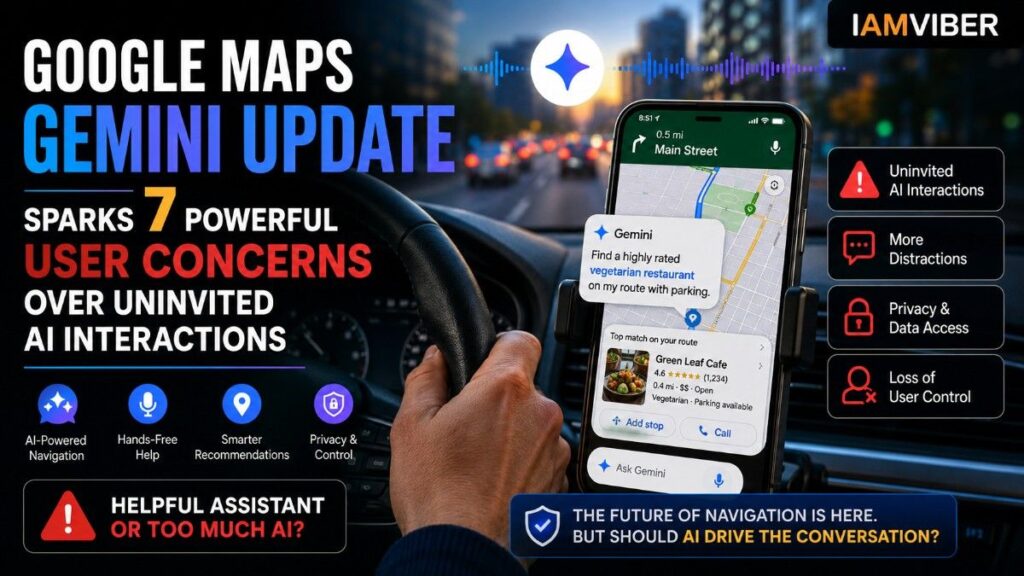
The controversy surrounding the Google Maps Gemini Update is less about whether Gemini is intelligent and more about control.
AI assistants are useful when users intentionally invoke them. The experience becomes more complicated when a software update changes how voice assistance behaves without users immediately understanding what changed.
Some Android Auto users have reported that Gemini appeared after an update and behaved differently from Google Assistant, including changes to how messages and contacts were handled while driving. One Reddit discussion described a user’s experience in which Gemini appeared during Android Auto navigation and required additional interaction to complete a messaging task. This is anecdotal user feedback, not evidence of a universal problem.
That distinction matters.
There is no evidence that every Google Maps user is suddenly experiencing unsolicited Gemini conversations. However, reports like these highlight a broader usability concern: drivers need predictable interfaces.
The Google Maps Gemini Update makes that issue particularly important because navigation happens in a safety-sensitive environment.
Gemini in Google Maps: Helpful or Too Much?
Google’s argument is straightforward. Drivers should not have to look down at their phones to search for information.
The Google Maps Gemini Update is designed to reduce that friction.
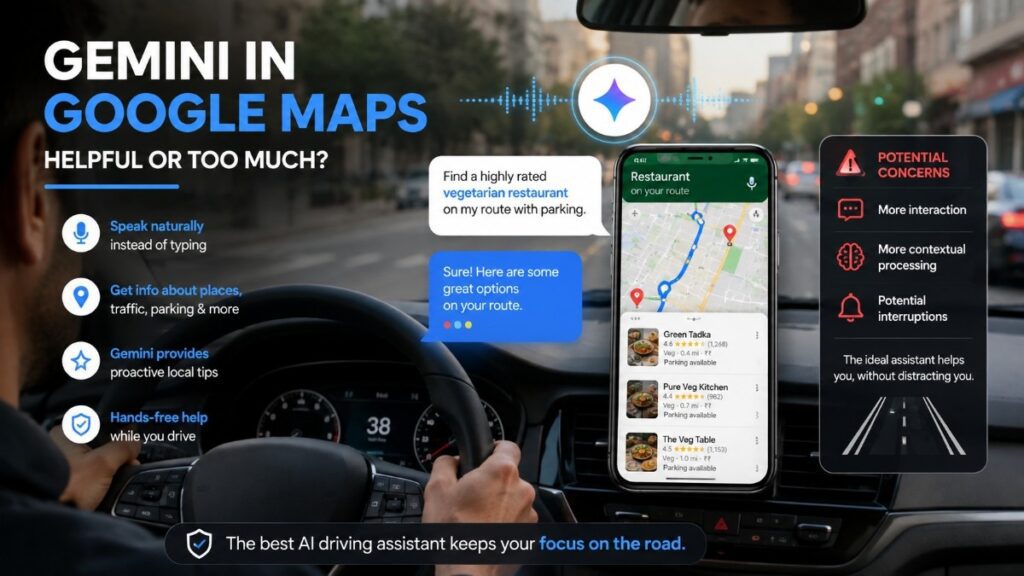
Users can speak naturally instead of typing. They can ask about nearby places, traffic, parking or other destination information. Google also says Gemini can proactively provide useful local tips by analyzing Maps reviews and web content.
In that sense, Google Maps AI could make navigation more convenient.
Imagine driving through an unfamiliar city and saying:
“Find a highly rated vegetarian restaurant on my route with parking.”
A conversational assistant can potentially understand the entire request instead of requiring several individual searches.
That is where Gemini navigation becomes more interesting than traditional voice commands.
But convenience has another side.
More conversational AI can mean more interaction, more contextual processing and potentially more interruptions. The ideal driving assistant should help users complete tasks while keeping their attention on the road—not encourage longer conversations.
The Google Maps Gemini Update Is Part of a Bigger Transition
The Google Maps Gemini Update cannot be viewed in isolation.
Google is replacing Google Assistant with Gemini across much of its ecosystem. The company has already been moving Gemini into phones, Maps and Android Auto, while older Assistant experiences are being phased out.
Google also previously removed the dedicated Assistant Driving Mode interface from Maps as part of this broader transition.
This creates an important product-design challenge.
Users may understand that Google wants Gemini everywhere. But they may not necessarily want every interaction redesigned around generative AI.
A navigation system has different requirements from a chatbot.
A chatbot can afford a longer conversation. A navigation assistant needs to be fast, predictable and minimally distracting.
Safety Matters More Than AI Personality
One of the biggest questions surrounding the Google Maps Gemini Update is whether conversational AI can remain genuinely hands-free.
Research published in 2026 examined the visual and cognitive demands of an LLM-powered in-vehicle conversational agent. In that controlled study, Gemini Live interactions produced cognitive demands comparable to hands-free phone conversations, while participants reported relatively low effort and distraction.Lorem ipsum dolor sit amet, consectetur adipiscing elit. Ut elit tellus, luctus nec ullamcorper mattis, pulvinar dapibus leo.
That is encouraging—but it does not mean every implementation of Gemini in a vehicle is automatically safe.
The interface matters.
If Gemini gives a short spoken answer, that can be useful. If the system requires drivers to look at the screen, select a contact, confirm multiple options or navigate additional menus, the experience becomes much less hands-free.
This is why the Google Maps Gemini Update should ultimately be judged by one question:
Does it reduce driver interaction with the screen, or does it create new reasons to interact with it?
Google Maps AI Could Become More Proactive
The direction of the Google Maps Gemini Update suggests that Google wants Maps to become increasingly proactive.
Recent Maps upgrades have expanded AI capabilities through Ask Maps, including more complex requests, personalized recommendations, event discovery, restaurant searches and other travel-related tasks. Google has also expanded Gemini’s ability to work with information users have permitted it to access.
This points toward a future where Google Maps AI does not simply answer “Where am I?”
Instead, it could understand what a user is trying to accomplish.
Going to a meeting?
Gemini could potentially help find parking.
Looking for food?
It could identify suitable restaurants.
Planning a trip?
It could combine places, reservations and schedules.
The Google Maps Gemini Update is therefore part of a much larger transformation from maps as a static tool to maps as an intelligent travel companion.
The Privacy and Permission Question
Another issue raised by the Google Maps Gemini Update is data access.
Google’s Maps Gemini experience can connect with services such as Gmail and Calendar when users give permission.
That can make the assistant dramatically more useful, but it also makes permission controls increasingly important.
Users need to understand:
- What information Gemini can access
- Which services are connected
- When Gemini is listening
- Which actions require confirmation
- How conversations and activity are handled
- How to disable or modify features
As AI becomes more embedded in everyday applications, transparent permissions become just as important as model intelligence.
Is the Google Maps Gemini Update Actually Bad?
Not necessarily.
The Google Maps Gemini Update solves a real problem: interacting with navigation and information while keeping your hands on the wheel.
Google’s own design goal is clearly centered around hands-free interaction, and the company has introduced features specifically intended to make driving more conversational and less dependent on touching the phone.
The concern is not that Gemini exists in Maps.
The concern is whether users feel in control of when and how it interacts with them.
An AI assistant should be available when needed, quiet when unnecessary and predictable when activated.
That balance will determine whether Gemini in Google Maps becomes a genuinely useful upgrade or another example of AI being added simply because it can be.
What Users Should Watch Next
The Google Maps Gemini Update is likely only the beginning.
As Google continues replacing Assistant with Gemini, users can expect deeper AI integration across navigation, Android Auto and other connected experiences. The transition is already accelerating, with Google announcing the shutdown of Assistant on many Android devices beginning September 2026.
The biggest changes to watch will be:
More natural voice commands
Gemini will increasingly understand conversational requests rather than rigid commands.
Deeper app integration
Calendar, Gmail and other Google services can make navigation more personalized when permissions are granted.
More proactive recommendations
Maps may increasingly surface relevant information without requiring traditional searches.
Better contextual understanding
Gemini could remember the context of an ongoing navigation conversation.
Greater user-control expectations
As AI becomes more proactive, users will increasingly expect clear settings and permissions.
Final Takeaway
The Google Maps Gemini Update represents a major shift in how people interact with navigation.
Google is no longer treating Maps simply as a digital map with directions. Through Gemini navigation, the company is building a conversational layer that can understand requests, provide recommendations and connect navigation with other parts of the Google ecosystem.
That is powerful.
But powerful AI also needs boundaries.
The strongest AI driving assistant will not be the one that talks the most. It will be the one that understands when to speak, when to stay silent and when to let the driver remain completely focused on the road.
The Google Maps Gemini Update may ultimately prove that the future of navigation is conversational—but the real test will be whether that conversation remains useful, predictable and genuinely hands-free.
For Google, the challenge is no longer simply making Gemini smarter.
It is making Gemini know when not to interrupt.
Frequently Asked Questions
1. What is the Google Maps Gemini Update?
The Google Maps Gemini Update brings Google’s Gemini AI deeper into Maps, enabling more natural voice interactions, place searches, navigation assistance, and conversational requests.
2. Why are users concerned about Gemini in Google Maps?
Some users are concerned about unexpected AI interactions, changes to voice-assistant behavior, privacy, permissions, and whether Gemini could become distracting while driving.
3. Is Gemini replacing Google Assistant in Google Maps?
Google is transitioning from Google Assistant to Gemini across its ecosystem, including Android and driving-related experiences.
4. Can Gemini interact with Google Maps while driving?
Yes. Gemini is designed to provide hands-free assistance while driving, including finding places, answering questions, and helping with navigation.
5. Is the Google Maps Gemini Update safe for drivers?
The goal is to make interactions hands-free and reduce screen use. However, drivers should avoid unnecessary conversations or interactions that could distract them from the road.
6. Can users control Gemini's access to their information?
Yes. Google provides permission and connected-service controls for features that allow Gemini to access information from services such as Calendar or Gmail.
7. Is Google Maps becoming an AI assistant?
Increasingly, yes. Google is evolving Maps from a traditional navigation tool into a conversational platform that can understand more complex requests and provide contextual recommendations.
8. What does the Google Maps Gemini Update mean for the future?
It signals a broader shift toward AI-powered navigation, where users can communicate with Maps naturally instead of relying primarily on menus, typing, and individual searches.
Topics to follow on IAMVIEBR : Current Affairs & Insights Tech Innovation GenZ entrepreneurship Collaborative Fashion GEO SME