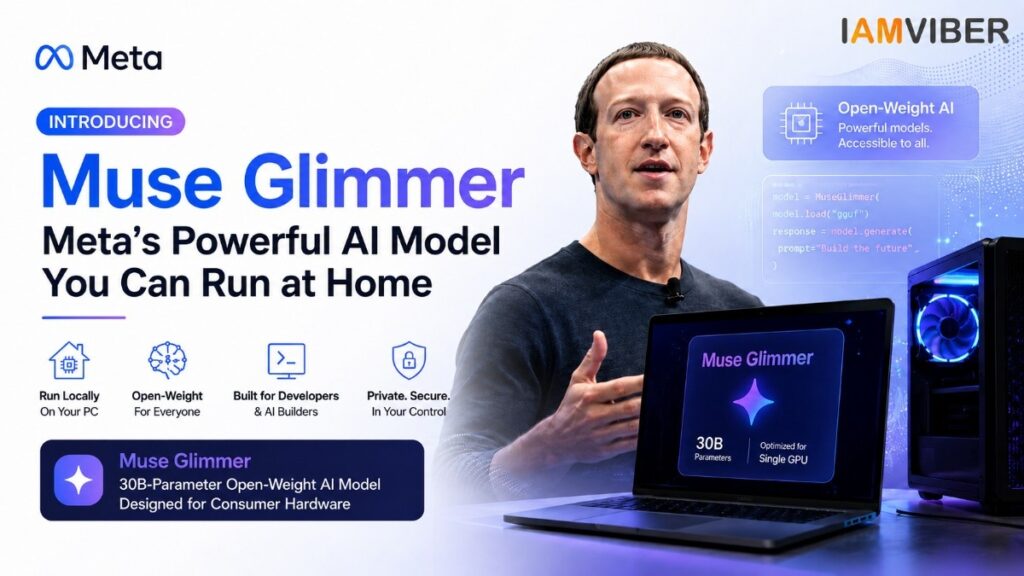
Artificial intelligence is moving closer to the devices people already own, and Meta is making another major move in that direction. On August 10, 2026, Meta introduced Muse Glimmer, a 30-billion-parameter open-weight model designed to run locally on consumer hardware with a single graphics card. The launch is part of Mark Zuckerberg’s broader push to make advanced AI more accessible instead of keeping powerful systems limited to large cloud platforms. Reuters reports that the release strengthens Meta’s open-weight strategy as competition around AI models intensifies.
What Is Muse Glimmer?
At its core, Muse Glimmer is a 30B dense AI model aimed at local and agentic workloads. The Business Times describes it as a scaled-down model that consumers can use at home, while Reuters says it is designed to run efficiently on personal devices with a single graphics card.
The key idea behind Muse Glimmer is not simply to create another large language model. In practical terms, Muse Glimmer is designed to make useful intelligence easier to deploy locally. For developers, researchers, and advanced users, that means experimenting with AI agents and coding workflows without necessarily relying on a remote inference service.
Why Mark Zuckerberg Is Betting on Open-Weight AI
Mark Zuckerberg has increasingly positioned Meta as a major supporter of Meta open-weight AI. In his latest messaging, he argued that advanced AI should not be controlled by only a small number of companies. Reuters reported that Zuckerberg sees open-weight models as a way to broaden access and strengthen competition, particularly as Chinese AI companies continue to advance their own open models.
This strategy gives Meta a different position from companies that primarily provide AI through closed APIs. Open weights can allow developers to inspect, modify, fine-tune, and deploy models according to their own needs, although the exact freedoms depend on the model’s license and release terms.
The arrival of Muse Glimmer therefore fits into a much bigger strategic battle over who controls the next generation of AI infrastructure.
What Makes the Model Different?
The biggest attraction of Muse Glimmer is its local-first design. A 30B model is still substantial, but the goal is to make it practical on consumer-class hardware rather than requiring a huge server cluster.
Reports indicate that the model is optimized for agentic and coding use cases. That matters because AI agents need to do more than generate text. They may need to reason through tasks, interact with tools, maintain context, and execute multi-step workflows.
For developers, Muse Glimmer AI could become interesting as an experimentation platform. A locally running model can be integrated into private development environments, automation systems, coding assistants, and other workflows where sending information to an external API may not be desirable.
Can Consumers Actually Run It at Home?
Yes, that is one of the central points of the announcement. Bloomberg’s headline describes Meta’s release as a scaled-down AI model consumers can use at home, while Reuters says the model is designed to run efficiently on personal devices using a single graphics card.
However, “consumer hardware” does not mean every laptop will run a 30B model smoothly. Hardware requirements depend on quantization, memory, inference software, context length, and the exact workload. Users with stronger GPUs or systems with substantial unified memory will have a much easier experience.
The significance is not that AI has suddenly become effortless to run locally. Instead, Meta is pushing the boundary of what advanced models can realistically do outside hyperscale data centers.
Local AI vs. Cloud AI
Cloud AI remains convenient because users do not need specialized hardware and providers handle infrastructure, scaling, updates, and serving.
Local AI offers a different trade-off. With Muse Glimmer, users can potentially keep workloads on their own machines and gain more control over deployment. Developers can experiment without paying for every inference through a hosted API.
The downside is responsibility: hardware, installation, model management, performance tuning, and updates become part of the equation. That makes local models especially relevant to developers and AI enthusiasts rather than a replacement for cloud AI.
Why Developers Should Pay Attention
For developers, Muse Glimmer could be more significant than it initially appears. Agentic AI is becoming a major software development direction, and local models can provide another layer for building these systems.
A developer could potentially use a local model for coding assistance, private document processing, internal automation, or tool-based agents. Local deployment can also help teams test workflows without constantly sending sensitive prompts or source code to a third-party cloud.
The model’s size is strategically interesting. A 30B model sits in a middle ground: large enough to target sophisticated workloads while being more practical than frontier-scale systems requiring extensive infrastructure. For this reason, Muse Glimmer could appeal to teams that want a capable model without relying entirely on centralized infrastructure.
Meta’s Bigger AI Strategy
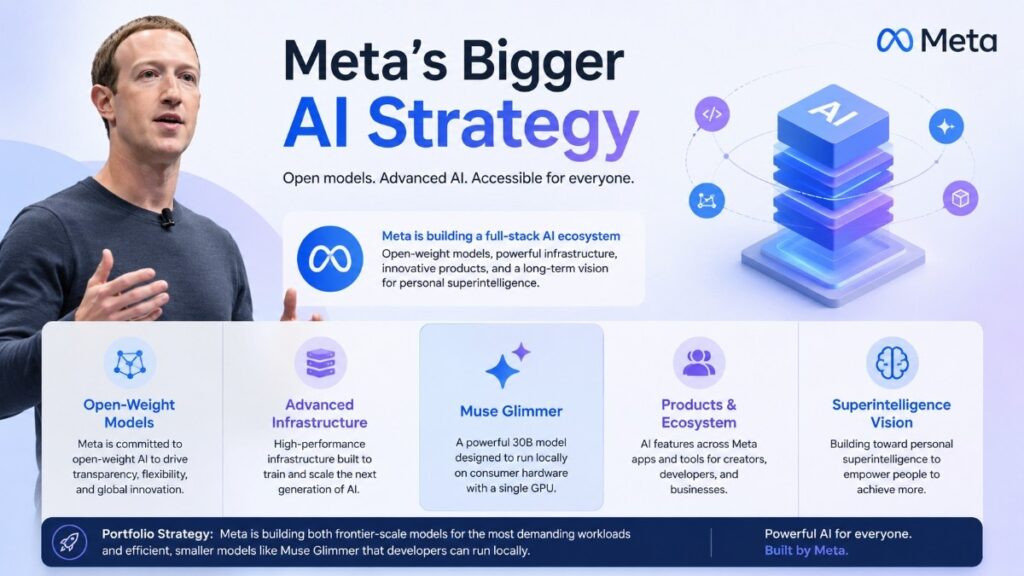
The launch should not be viewed in isolation. Meta has been building a broader AI ecosystem around open-weight models, infrastructure, products, and its superintelligence ambitions. Meta’s earlier Muse Spark releases show that the company is also pursuing multimodal reasoning, tool use, coding, and agentic workflows as part of its personal-superintelligence vision.
Meta Muse Glimmer arrives alongside the company’s continued development of larger foundation models. Reuters also reported that Meta plans to release additional models, including Muse Spark 1.2, from its superintelligence team.
That makes the release part of a portfolio strategy. Meta can pursue frontier-scale models for demanding workloads while also offering smaller models that developers can run locally.
What Does This Mean for AI Users?
For everyday users, the immediate impact may be limited. Running a 30B model locally still requires capable hardware and some technical knowledge. But the direction is significant.
If increasingly capable models can run efficiently on personal computers, AI could become less dependent on centralized servers. That could lead to more privacy-focused applications, offline AI experiences, and software that works without a permanent internet connection.
Muse Glimmer also demonstrates that model size alone is not the only metric that matters. Efficiency, deployment requirements, context handling, agentic capabilities, and customization are becoming equally important.
The Privacy and Security Question
Local AI can offer privacy advantages because data does not necessarily need to leave the user’s device. This can help developers working with proprietary code or businesses processing internal documents.
But local deployment does not automatically make an AI system secure. Users still need to manage model files, dependencies, tool permissions, and data access carefully. Agentic systems can create additional risks when they can execute commands or interact with external services.
For that reason, Muse Glimmer should be viewed as a deployment option, not a guarantee of privacy or security.
Final Takeaway
Muse Glimmer represents an important step in Meta’s open-weight AI strategy. By releasing Muse Glimmer as a 30B model designed for single-GPU local use, Meta is making a serious argument that advanced AI does not always need to live exclusively in massive data centers.
For developers, the model could open new possibilities around local coding assistants, private AI workflows, and agentic applications. For consumers, it signals a future where increasingly capable AI may run directly on personal computers.
The bigger story is the shift from AI as a cloud-only service toward AI as software that can be deployed wherever users need it. If Meta and other AI companies continue improving efficiency, local models could become a much more important part of the AI ecosystem.
And that is ultimately why Muse Glimmer is worth watching. It is not simply another model launch. It is part of a broader contest over whether the future of AI will be centralized in a handful of cloud platforms or distributed across millions of personal and business devices.
Frequently Asked Questions
1. What is Muse Glimmer?
Muse Glimmer is Meta’s 30-billion-parameter open-weight AI model designed to make advanced AI capabilities more accessible on consumer hardware.
2. Who developed Muse Glimmer?
Muse Glimmer was developed by Meta as part of the company’s broader open-weight AI strategy and push toward more accessible AI models.
3. Can Muse Glimmer run on a personal computer?
Yes. Muse Glimmer is designed to run locally on compatible consumer hardware, including systems equipped with a suitable single GPU.
4. What is Muse Glimmer AI designed for?
Muse Glimmer AI is aimed at workloads such as coding, reasoning, agentic AI tasks, and other applications where developers may want to run an AI model locally.
5. What does “open-weight” mean for Meta’s AI model?
An open-weight model makes its trained model parameters available for developers to download and use under its applicable license, providing greater flexibility than a traditional closed API.
6. What is the connection between Mark Zuckerberg and Muse Glimmer?
Mark Zuckerberg has strongly promoted Meta’s open-weight approach to AI. The Muse Glimmer release fits into his broader strategy of making powerful AI models more widely accessible.
7. Is Muse Glimmer better than cloud-based AI models?
Not necessarily. Muse Glimmer offers the advantage of local deployment, while cloud models can provide easier access to larger computing resources. The better option depends on the user’s hardware and specific requirements.
8. Why is Muse Glimmer important for the future of AI?
Muse Glimmer highlights the growing shift toward local AI. As models become more efficient, increasingly capable AI could run directly on personal computers instead of depending entirely on centralized cloud infrastructure.
Topics to follow on IAMVIEBR : Current Affairs & Insights Tech Innovation GenZ entrepreneurship Collaborative Fashion GEO SME