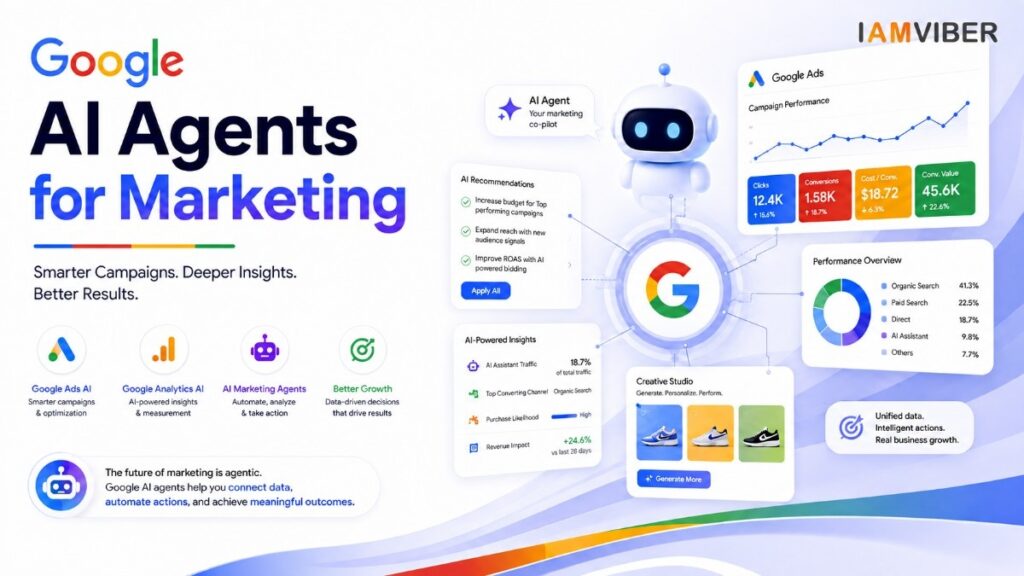
Marketing is entering a new phase where artificial intelligence is no longer just a tool for generating content or summarizing reports. Google AI Agents for Marketing are becoming part of a much bigger shift toward systems that can understand goals, connect data and help marketers take action.
At Google Marketing Live 2026, Google introduced several AI-powered marketing capabilities, including Ask Advisor, a cross-product AI agent designed to work across Google Ads, Google Analytics and Merchant Center. Google describes it as a strategic collaborator that can provide proactive, personalized recommendations and help marketers move faster.
For marketers, this signals an important change: AI is moving from simply assisting with individual tasks toward helping manage entire marketing workflows.
So, what exactly are Google AI Agents for Marketing, and why could they matter for businesses in 2026?
What Are Google AI Agents for Marketing?
Google AI Agents for Marketing refer to Google’s growing ecosystem of AI-powered and agentic capabilities designed to help marketers analyze information, create campaigns, optimize performance and make better decisions.
Traditional marketing automation follows predefined rules. Generative AI can create content when a user gives it a prompt. Agentic systems go a step further.
An AI agent can understand a broader objective, examine relevant information, suggest actions and potentially help execute multiple steps.
That distinction is important.
Instead of asking AI to simply write five ad headlines, a marketer could eventually ask it to help improve a campaign based on a business goal such as increasing qualified leads while maintaining a target acquisition cost.
This is the broader direction of agentic AI in marketing.
1. Google Ads Is Becoming More Intelligent
One of the biggest areas affected by Google AI Agents for Marketing is advertising.
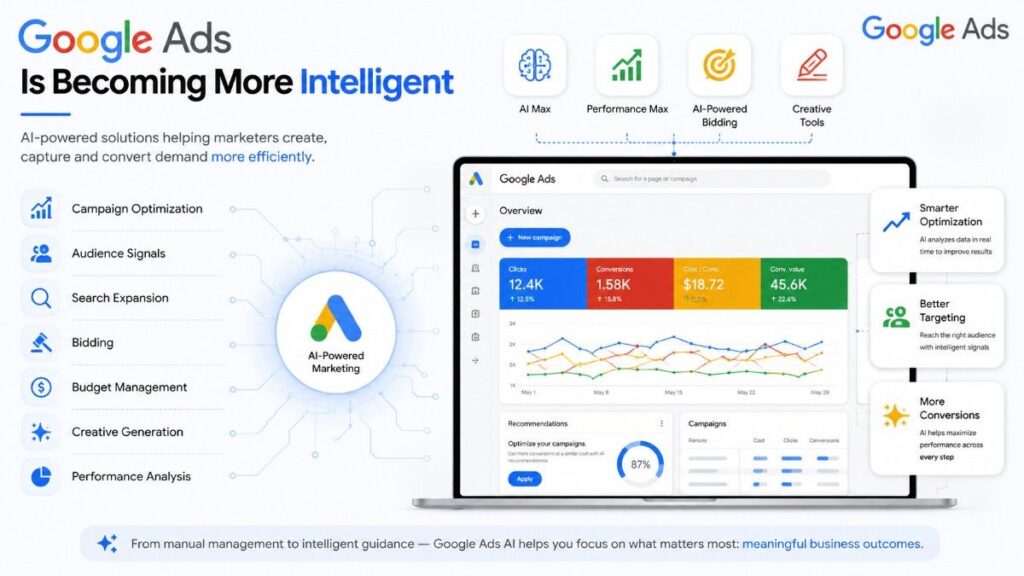
Google has been steadily integrating AI into Google Ads through products such as AI Max, Performance Max, AI-powered bidding and creative tools. At Google Marketing Live 2026, the company announced additional AI capabilities designed to help advertisers create, capture and convert demand more efficiently.
This means marketers increasingly don’t have to manually control every part of a campaign. AI can help with areas such as:
- Campaign optimization
- Audience signals
- Search expansion
- Bidding
- Budget management
- Creative generation
- Performance analysis
The rise of Google Ads AI changes the marketer’s role from manually managing every setting to guiding the system toward meaningful business outcomes.
2. Ask Advisor Brings Agentic AI Into Marketing Workflows
Perhaps the most interesting development is Google’s new Ask Advisor.
Ask Advisor is designed as a cross-product AI agent connecting Google’s marketing ecosystem. Google says it can work across Google Ads, Google Analytics, Merchant Center and Google Marketing Platform, helping marketers receive proactive recommendations and solve problems faster.
This is where Google AI Agents for Marketing become particularly interesting.
Instead of jumping between different dashboards, marketers can increasingly interact with their marketing data through a more conversational experience.
Imagine asking:
“Why did my conversions fall this month?”
Rather than manually checking multiple reports, an AI-powered system could help identify patterns across campaigns, traffic and performance data.
The goal isn’t simply automation.
It’s making marketing technology easier to operate.
3. Google Analytics Is Moving Toward AI-Powered Insights
Analytics is another major part of the transformation.
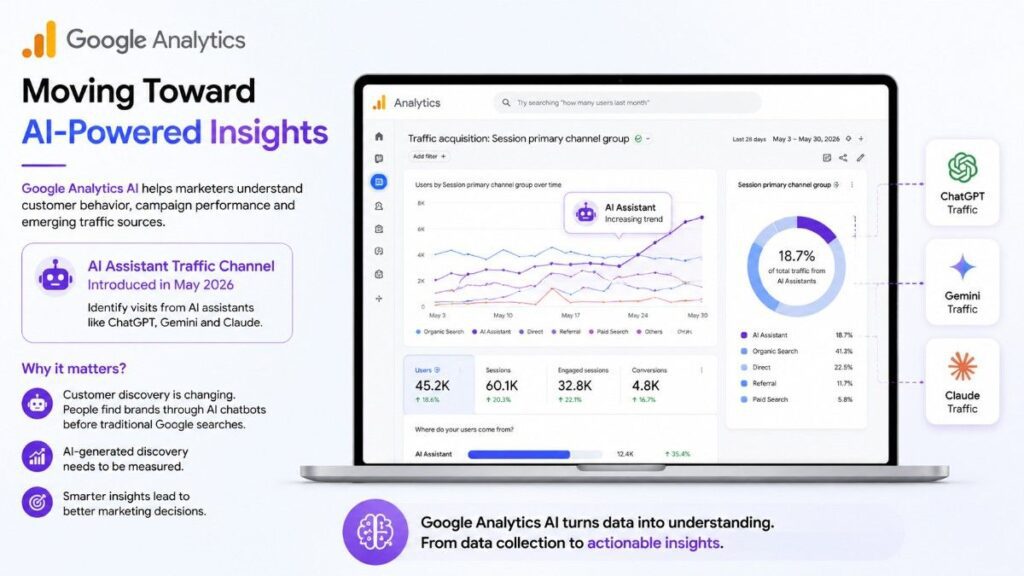
The growing role of Google Analytics AI means marketers can increasingly use AI-powered capabilities to understand customer behavior, campaign performance and emerging traffic sources.
Google Analytics introduced a dedicated AI Assistant traffic channel in May 2026. This allows businesses to identify visits originating from recognized AI assistants such as ChatGPT, Gemini and Claude.
That’s a significant development because customer discovery is changing.
People may now discover a company through an AI chatbot before they ever perform a traditional Google search.
For marketers, that means AI-generated discovery needs to become part of the measurement conversation.
Google AI Agents for Marketing can potentially help marketers move from simply collecting analytics data to actually interpreting what that data means.
4. AI Is Changing How Marketers Think About Search
Search itself is also evolving.
Google is integrating Gemini into Search and testing new advertising experiences designed for AI-driven search journeys. These include conversational and AI-powered ad formats that are intended to provide more useful information during the user’s decision-making process.
This creates a new environment for brands.
Previously, a marketer might focus primarily on ranking for a keyword or appearing in a search ad.
Now, the bigger question is:
How does my brand appear when a consumer asks an AI-powered search experience for a recommendation?
That is one reason AI marketing agents could become increasingly valuable.
They can help marketers understand changing search behavior, analyze performance and identify opportunities across increasingly complex customer journeys.
5. Marketing Measurement Is Becoming More Predictive
Another important development is the move from reporting what happened to understanding what could happen next.
Google is bringing Meridian, its open-source Marketing Mix Model, into Google Analytics 360. The system is designed to help businesses unify data, measure causal performance and model future investment scenarios.
Google has also introduced Qualified Future Conversions, which use predictive signals to connect upper-funnel advertising activity with future sales.
This is a major shift. Instead of asking only:
“How many conversions did this campaign generate?”
marketers can increasingly ask:
“What is this campaign likely to contribute to future business growth?”
That makes Google AI Agents for Marketing more than campaign automation. It moves AI closer to strategic marketing decision-making.
6. Creative Production Is Becoming Faster
AI is also changing the creative side of advertising.
Google announced new capabilities in Asset Studio that connect creative workflows with Gemini models. The objective is to help marketers create more variations and scale creative production while maintaining brand guidelines.
For marketing teams, this could significantly reduce repetitive production work.
Instead of creating every variation manually, marketers can provide the strategy, brand direction and desired outcome while AI helps generate and adapt creative assets.
This is another area where Google Ads AI can become useful.
The competitive advantage may no longer come from simply producing more creative.
It may come from producing the right creative faster and learning from performance data more efficiently.
7. What Google AI Agents for Marketing Mean for Small Businesses
The impact isn’t limited to large brands.
Small businesses often struggle because marketing platforms can be complicated and teams are small.
A business owner may have to manage Google Ads, Analytics, creative, SEO, reporting and customer acquisition without having specialists for every function.
Google AI Agents for Marketing could reduce some of that complexity.
A small business could potentially use AI-powered systems to identify campaign issues, understand customer behavior, discover opportunities and receive recommendations without spending hours inside multiple dashboards.
Google’s India team has specifically positioned Ask Advisor and other AI tools as ways for Indian businesses to simplify marketing and move from automation toward marketing intelligence.
That could make advanced marketing capabilities more accessible to smaller teams.
What Marketers Should Do Now
The rise of Google AI Agents for Marketing doesn’t mean marketers should hand everything over to AI. The smarter approach is to build a human-AI workflow.
Start With Better Data
AI needs reliable information.
Make sure conversion tracking, campaign data, CRM information and website analytics are properly configured.
Focus on Business Outcomes
Don’t optimize only for clicks. Define goals around qualified leads, revenue, customer acquisition cost, retention or lifetime value.
Experiment With AI Features
Start testing Google’s AI-powered campaign and analytics capabilities instead of waiting for the technology to become mainstream.
Monitor AI-Driven Discovery
With Google Analytics now providing an AI Assistant traffic channel, businesses should start understanding whether AI platforms are becoming meaningful sources of website traffic.
Keep Humans Involved
AI can identify patterns and recommend actions, but marketers still need to provide context, judgment and brand direction. This is particularly important when decisions involve large budgets, brand reputation or customer trust.
The Future of Marketing Is Agentic
The most important takeaway from Google’s latest announcements is not one individual feature.
It is the direction of the entire marketing ecosystem.
Google AI Agents for Marketing represent a move from isolated AI features toward connected, intelligent marketing workflows.
Google Ads is becoming increasingly AI-powered. Google Analytics is expanding its ability to understand new sources of traffic. Creative production is becoming more automated. Measurement is becoming more predictive. And Ask Advisor is bringing several marketing products together through an agentic interface.
The role of the marketer will evolve alongside these changes.
Instead of spending most of their time navigating dashboards, creating repetitive assets and manually analyzing reports, marketers may increasingly focus on strategy, positioning, experimentation and business decisions.
That is the real opportunity behind Google AI Agents for Marketing. AI isn’t simply becoming another marketing tool. It is becoming part of the marketing operating system.
And businesses that learn how to combine human creativity with AI marketing agents, strong data and strategic decision-making will be better positioned for the next phase of digital growth.
The future of marketing won’t necessarily be humans versus AI.
It will be humans directing intelligent AI systems to achieve better business outcomes.
Frequently Asked Questions
1. What are Google AI Agents for Marketing?
Google AI Agents for Marketing are AI-powered systems designed to help marketers analyze data, create campaigns, optimize advertising and make marketing decisions. Google’s newer agentic experiences are designed to work across products such as Google Ads, Google Analytics and Merchant Center.
2. How is Google AI changing digital marketing?
Google AI is making digital marketing more automated and data-driven. AI can help with campaign optimization, creative generation, audience insights, performance analysis and marketing recommendations, allowing marketers to spend more time on strategy.
3. What is Google Ads AI?
Google Ads AI refers to the growing set of artificial intelligence capabilities within Google Ads that help advertisers with campaign creation, bidding, targeting, optimization and creative development. These tools are designed to improve campaign performance while reducing manual work.
4. What are AI marketing agents used for?
AI marketing agents can help businesses analyze campaign performance, identify opportunities, generate creative variations, understand customer behavior and recommend marketing actions. More advanced agentic systems can coordinate multiple tasks around a specific business objective.
5. What is Google Analytics AI?
Google Analytics AI refers to AI-powered capabilities that help marketers understand website traffic, customer behavior and marketing performance. Google Analytics is also adding ways to identify traffic originating from AI assistants, helping businesses measure emerging AI-driven discovery.
6. What is agentic AI in marketing?
Agentic AI in marketing describes AI systems that can work toward a defined marketing goal rather than performing only one isolated task. They can analyze information, identify potential actions, provide recommendations and, where supported, assist with execution.
7. Will Google AI Agents replace marketers?
No. Google AI Agents for Marketing are more likely to change how marketers work than completely replace them. AI can handle repetitive analysis and optimization, while humans remain responsible for strategy, creativity, brand decisions, business context and final judgment.
8. Why are Google AI Agents important for marketers in 2026?
Google AI Agents for Marketing are important because advertising, analytics and customer discovery are becoming increasingly complex. Google’s agentic approach could help marketers connect data, automate repetitive workflows and make faster decisions while keeping humans involved in strategic decision-making.
Topics to follow on IAMVIEBR : Current Affairs & Insights Tech Innovation GenZ entrepreneurship Collaborative Fashion GEO SME