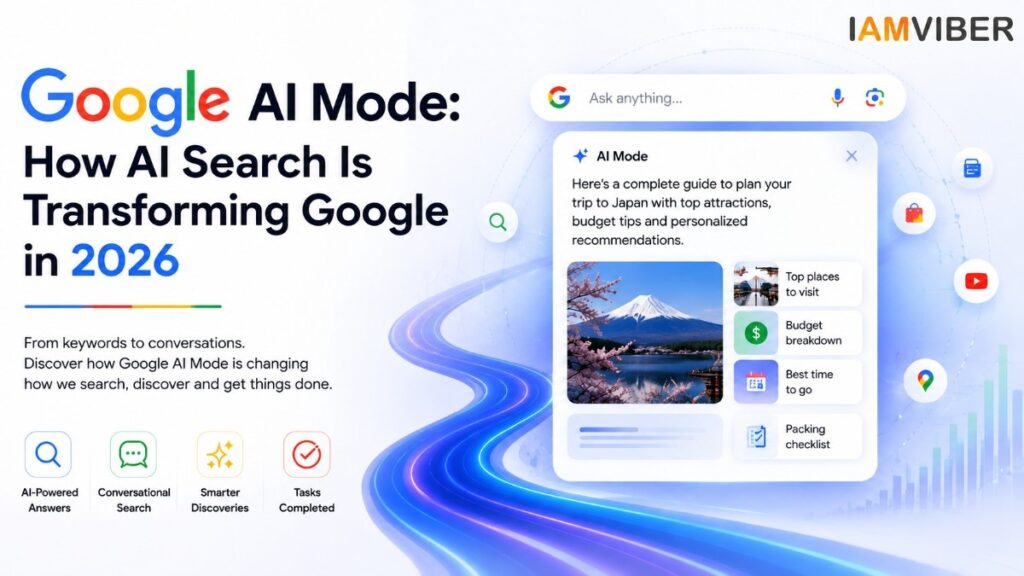
Google Search is changing faster than ever. For years, people searched Google by typing a few keywords and opening different websites. In 2026, that behavior is moving toward something much more conversational.
The biggest change is Google AI Mode.
Instead of giving users only a list of links, Google can understand longer questions, follow the conversation, combine information and help users explore a topic in a more natural way. Google has also been expanding AI-powered Search with features that allow users to ask follow-up questions and move between AI Overviews and a deeper conversational experience.
This shift is important for everyone who uses Google — from students and consumers to businesses, marketers, bloggers and publishers.
What Is Google AI Mode?
Google AI Mode is an AI-powered search experience built directly into Google Search.
Traditional Google Search mainly works by matching a user’s query with relevant web pages. The user then chooses which links to open.
Google AI Mode takes a different approach.
A user can ask a detailed question in normal language. The system can understand the context, break a complicated question into smaller parts and provide a more direct response.
For example, instead of searching:
“best laptops for video editing”
a user could ask:
“I need a laptop under ₹1 lakh for 4K video editing, AI tools and occasional gaming. Which one should I buy?”
This is where Google AI Search becomes more conversational.
Google has also been adding capabilities around text, images and voice, making Search less dependent on short keyword-based queries.
How Google AI Mode Is Different From Traditional Search
The biggest difference is how users interact with information.
Traditional Search generally follows this pattern:
Search → Results → Website → Information
The new experience is moving toward:
Question → AI understanding → Answer → Follow-up → Deeper information
With Google AI Mode, users can continue asking questions without starting a completely new search every time.
This makes Search feel more like a conversation.
It also means that Google is no longer just helping people find information. It is increasingly helping people understand, compare and explore information.
Google AI Mode vs AI Overviews
Many people confuse Google AI Mode with AI Overviews, but they are not exactly the same.
AI Overviews provide an AI-generated summary within the normal Search results page. They are designed to give users a quick overview of a topic while still providing links to explore further. Google describes AI Overviews as a way to get a snapshot of important information with links to the wider web.
Google AI Mode, on the other hand, is designed for deeper interaction.
A user can ask a complex question, receive an AI response and then ask follow-up questions based on the first answer.
This difference is important for publishers because both experiences can change how users discover websites.
Why Google AI Mode Matters for SEO
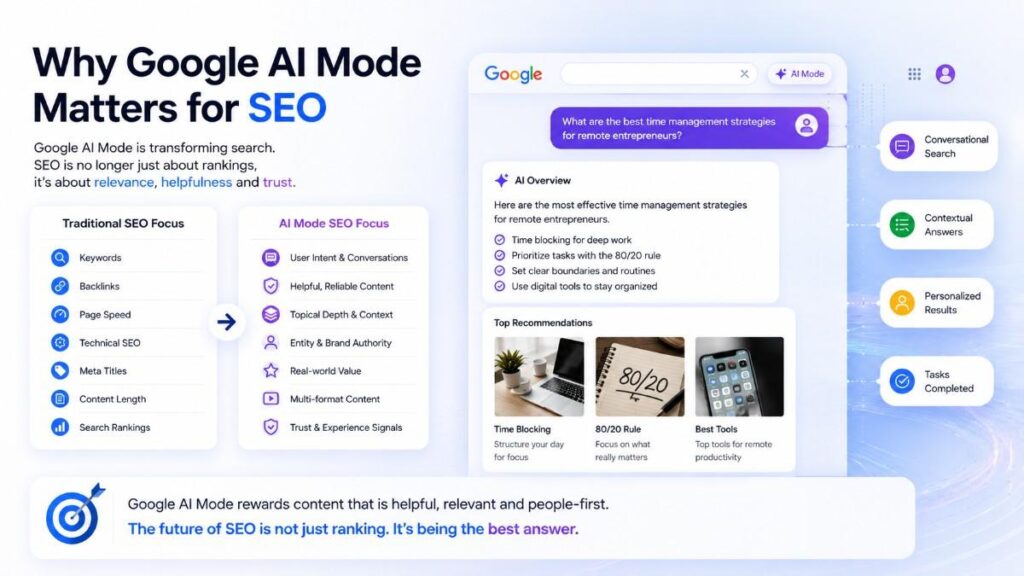
The rise of Google AI Mode is creating a major change for SEO. For many years, SEO focused heavily on ranking a webpage for specific keywords. Businesses worked on:
- Keywords
- Backlinks
- Page speed
- Technical SEO
- Meta titles
- Content length
- Search rankings
These things still matter, but the search experience is becoming more complicated.
Google’s own documentation says websites should continue focusing on helpful, reliable and people-first content when appearing in AI-powered Search features.
This means publishers need to think beyond simply ranking for one keyword.
The Rise of AI Search SEO
AI Search SEO is becoming an important part of modern digital marketing. The goal is no longer only to appear at the top of a traditional results page.
The bigger goal is to create content that search systems can understand, trust and potentially reference when generating an answer.
That means articles should answer real questions clearly.
For example, instead of writing:
“AI Search is changing SEO.”
a stronger article might explain:
“How does AI Search affect website traffic, rankings and content visibility?”
The second approach matches the way people increasingly ask questions.
This is one reason conversational and question-based content is becoming more valuable.
Google AI Mode and Zero-Click Searches
A zero-click search happens when someone gets enough information directly from the Search results and does not visit another website.
Recent academic research examining AI Overviews found that clicks to cited sources were rare in the studied browsing data, occurring in about 1% of visits to AI Overviews. The study also found that AI Overviews were associated with fewer clicks and more browsing sessions ending after the result.
This creates a major challenge.
If Google answers the question directly, why would a user click?
That is one of the biggest questions facing publishers in the age of Google AI Mode.
What Happens to Websites?
Websites are not disappearing, but their role is changing.
Google still relies heavily on information from the web. Its own Search documentation continues to provide guidance for website owners on how their content can work with AI features.
The challenge is getting users to want more than the basic answer. This means publishers should create content that offers:
- Original insights
- First-hand experience
- Expert opinions
- Data
- Examples
- Unique research
- Useful explanations
- Strong visuals
- Clear comparisons
Generative Engine Optimization Is Becoming Important
This is where Generative Engine Optimization enters the picture.
Generative Engine Optimization focuses on making content easier for AI-powered search and answer systems to understand and use.
The idea is closely connected to the evolution of search.
“How do I rank higher?”
Modern Generative Engine Optimization also asks:
“How can my content become a useful source for an AI-generated answer?”
This does not mean traditional SEO is dead. Instead, the two approaches are increasingly working together.
A strong website needs good technical SEO, useful content, authority and information that AI systems can clearly understand.
How Businesses Should Prepare
Businesses should start treating Google AI Mode as another major discovery channel.
The first step is to understand what customers actually ask. Instead of only researching keywords, businesses should research questions. For example, a travel company could create content around:
- “What is the best time to visit Dubai?”
- “How much does a Dubai trip cost?”
- “Is Dubai expensive for Indian tourists?”
- “Which areas are best for families?”
These questions can then become detailed, useful content.
The same strategy works for technology, finance, healthcare, education, ecommerce and almost every other industry.
Content Quality Will Matter More
The arrival of Google AI Mode does not mean writers should simply produce more content. It means they need to produce better content.
AI can already generate thousands of articles quickly. Because of this, low-quality and repetitive content is becoming easier to create.
The websites that stand out will be the ones that provide something genuinely useful.
Human experience will become especially valuable.
A product review based on actually using a product is more useful than a generic AI-written description.
An interview with a founder is more valuable than a rewritten press release. Original research is more valuable than copying statistics from another website. That is where publishers can build a long-term advantage.
Google AI Mode Is Also Changing User Behavior
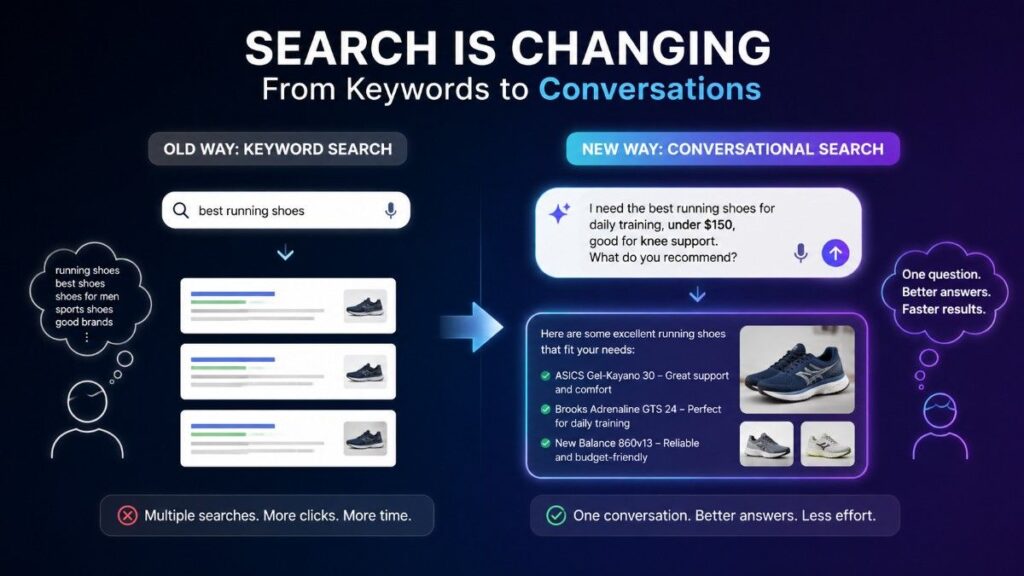
Search behavior itself is changing.
Users are becoming comfortable asking longer and more detailed questions.
Instead of searching for five separate keywords, one person can ask one detailed question and then continue the conversation.
This creates a new opportunity for brands.
A company that understands customer questions can build content around entire conversations rather than individual keywords.
This is one of the biggest changes brought by Google AI Mode. Search is becoming less about finding a page and more about completing a task.
What Does This Mean for Content Creators?
For content creators, the message is simple.
Don’t create content only because a keyword has search volume. Create content because someone has a real question. Start with the user’s problem. Then provide a clear answer.
Add examples. Explain the details. Add original opinions or research where possible. Make the article easy to scan. Use headings, tables, images and short paragraphs.
Most importantly, make the content useful even if the reader has never heard of your brand.
That approach works for traditional SEO, Google AI Search, AI Overviews and newer AI-driven discovery experiences.
The Future of Google Search
The future of Search is unlikely to be completely traditional or completely AI-generated.
Instead, Google Search will probably combine AI answers, websites, videos, images, products, maps and other information sources.
Google has already been moving in this direction, while also testing new ways to make AI-powered capabilities more visible from the Search homepage. A current test adds shortcuts such as creating images, asking about files and brainstorming directly below the search box.
This shows how quickly Search is evolving. The search box is becoming more than a place to type keywords.
It is becoming an interface for interacting with AI.
Final Thoughts
Google AI Mode represents one of the biggest changes to Google Search in years.
It is changing how people ask questions, how information is presented and how websites compete for attention.
For users, the experience can become faster and more conversational. For businesses, it creates new ways to reach customers. For publishers, it creates both opportunities and risks.
The old SEO question was:
“How do I rank number one on Google?”
The new question is becoming:
“How do I become one of the most useful sources in an AI-powered Search experience?”
That is the real shift behind Google AI Mode.
And for brands, publishers and content creators, understanding that shift early could make a major difference in the next generation of search.
Frequently Asked Questions
1. What is Google AI Mode?
Google AI Mode is an AI-powered Search experience that lets users ask detailed questions, receive conversational answers and continue with follow-up questions. It is designed to make Google Search more interactive and useful.
2. How is Google AI Mode different from AI Overviews?
AI Overviews provide a quick AI-generated summary within Google Search results. Google AI is designed for deeper conversations, allowing users to ask follow-up questions and explore a topic in more detail.
3. Will Google AI Mode replace traditional Google Search?
No. Google AI Mode is changing how people interact with Search, but traditional search results, websites, videos, images and other sources remain an important part of the overall Search experience.
4. Does Google AI Mode affect SEO?
Yes. Google AI Mode can change how users discover websites and interact with search results. Businesses and publishers should focus on helpful, original and reliable content that clearly answers users’ questions.
5. What is AI Search SEO?
AI Search SEO is the practice of optimizing content for AI-powered search experiences. It focuses on creating useful, trustworthy and clearly structured content that can be understood by modern search systems.
6. What is Generative Engine Optimization?
Generative Engine Optimization, or GEO, focuses on improving the chances of content being understood, surfaced or referenced by AI-powered search and answer engines. It works alongside traditional SEO rather than completely replacing it.
7. How can businesses prepare for Google AI Mode?
Businesses should create people-first content that answers real customer questions, provide original insights and maintain strong technical SEO. Clear structure, useful examples, expert information and trustworthy sources can also improve content quality.
8. Will Google AI Mode reduce website traffic?
It may reduce clicks for some informational searches because users can get answers directly in Google’s AI-powered experiences. However, websites that offer original research, detailed expertise, products, services or information that users want to explore further can still attract valuable search traffic.
Topics to follow on IAMVIEBR : Current Affairs & Insights Tech Innovation GenZ entrepreneurship Collaborative Fashion GEO SME