The race to build the next generation of enterprise AI platforms is entering a new phase, and Brahma AI is emerging as one of the companies attracting serious attention.
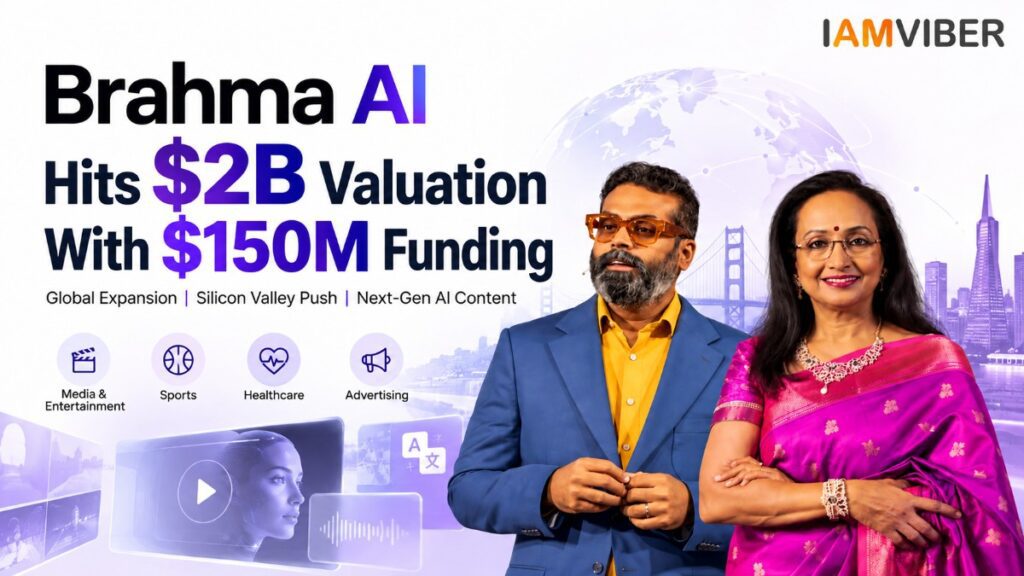
The AI company has raised $150 million in a new funding round led by Multiples Alternate Asset Management, giving it a reported $2 billion post-money valuation. The company says the fresh capital will accelerate research and development, global go-to-market efforts and the creation of a significant presence in Silicon Valley. Brahma AI
But the funding is not simply another large AI investment.
Brahma AI is attempting to build something broader: an AI-native operating system for enterprise audiovisual content that combines content intelligence with AI-powered creation, digital humans, voice, multilingual performance and visual AI.
And that ambition could place the company at the intersection of several rapidly growing markets — AI video, enterprise AI, digital humans, media technology and automated content production.
Brahma AI Raises $150 Million at a $2 Billion Valuation
The latest round represents a major financial milestone for Brahma AI.
According to the company’s announcement, it raised $150 million through the issuance of preferred shares, including a $100 million investment from Multiples Alternate Asset Management. The company has also received an additional $100 million of investor interest, which could potentially allow the financing round to increase.
The transaction values Brahma AI at approximately $2 billion post-money, according to company and financial reporting. Prime Focus remains the company’s largest shareholder following the transaction.
For the broader AI industry, the round highlights how investors are increasingly looking beyond foundational AI models toward companies building applications, infrastructure and workflows around enterprise content.
That distinction matters.
Instead of competing directly to create another general-purpose AI model, Brahma AI is building technology designed around how large organisations create, manage, localise and distribute audiovisual content.
What Is Brahma AI?
At its core, Brahma AI describes itself as an AI-native operating system for enterprise audiovisual content.
Its platform combines two major components: Brahma AI Core, which focuses on enterprise content intelligence and management, and Brahma AI Studio, an AI-powered creation environment covering visual AI, digital humans, voice and multilingual performance.
This means the company’s ambition goes beyond simply generating an AI video from a text prompt.
Large enterprises have massive amounts of existing video, images, audio, characters, brand assets and institutional knowledge. Managing this information — while creating new content from it — can involve complex workflows and significant human effort.
The opportunity for Brahma AI is to connect these pieces through an AI-native platform.
In practical terms, that could mean helping organisations create new content, transform existing footage, localise experiences into different languages, develop digital characters and automate parts of the content supply chain.
Why the $2 Billion Valuation Matters
The Brahma AI $2 billion valuation is significant because it reflects investor interest in enterprise-focused AI infrastructure rather than only consumer-facing generative AI applications.
The company is targeting four major verticals:
- Media and entertainment
- Sports
- Healthcare
- Advertising
Its reported global anchor customers include Warner Bros., the NBA and Mayo Clinic, while strategic distribution partners include Google, Hakuhodo and DNEG.
These industries share one important characteristic: they are highly dependent on content.
Studios produce films and television. Sports organisations create enormous volumes of video and digital media. Healthcare companies increasingly use visual communication and digital experiences. Advertising agencies need large quantities of creative assets across markets and languages.
This is where the enterprise content opportunity becomes interesting.
Brahma AI's Silicon Valley Push
One of the most notable elements of the announcement is the company’s plan to establish a significant Silicon Valley presence. The Brahma AI Silicon Valley strategy is part of a broader global expansion plan covering research and development, go-to-market operations and talent. Brahma AI
Silicon Valley remains one of the world’s largest centres for AI talent, enterprise technology and venture capital.
For Brahma AI, expanding its presence there could provide closer access to technology partners, enterprise customers, AI researchers and the wider ecosystem building the next generation of AI infrastructure.
The company already has an international footprint, with its announcement coming from Los Angeles, London and Mumbai. Its next phase appears designed to make that global positioning even stronger.
Digital Humans Could Be Brahma AI's Next Big Bet
Another major development is the company’s plan to launch interactive digital humans.
The concept of digital humans has evolved rapidly with advances in generative AI, voice synthesis, facial animation and visual generation.
Instead of static avatars, interactive digital humans can potentially communicate, respond to users and deliver personalised experiences.
Brahma AI digital humans could therefore have applications across multiple industries.
In entertainment, they could support characters and interactive experiences.
In advertising, brands could potentially create multilingual digital spokespeople.
In healthcare, digital representations could support education and communication.
For enterprises, they could become another interface between people and information.
The company has also indicated that it is building its technology to be model agnostic, meaning its platform is intended to work across different AI models rather than being dependent on one model provider.
That could become increasingly important as the AI model ecosystem becomes more fragmented.
From AI Video Generation to an AI Content Operating System
The bigger story behind Brahma AI is perhaps the shift from individual AI tools toward complete AI-powered workflows.
The first wave of generative AI introduced tools that could generate images, text and videos.
The next wave is increasingly focused on connecting those capabilities to business processes.
Imagine a global entertainment company that needs to take one piece of content and create hundreds of localised versions.
Instead of separately handling translation, voice production, visual adaptation, editing and distribution, an integrated AI platform could potentially coordinate many of those steps.
That is the type of opportunity Brahma AI is positioning itself around.
Its platform combines content intelligence and management with creation capabilities covering visual AI, digital humans, voice and multilingual performance. Brahma AI
Brahma AI's Technology Heritage
The company also has an unusual technology heritage.
Brahma AI was created by bringing together technology and capabilities developed across DNEG, Metaphysic and Prime Focus Technologies.
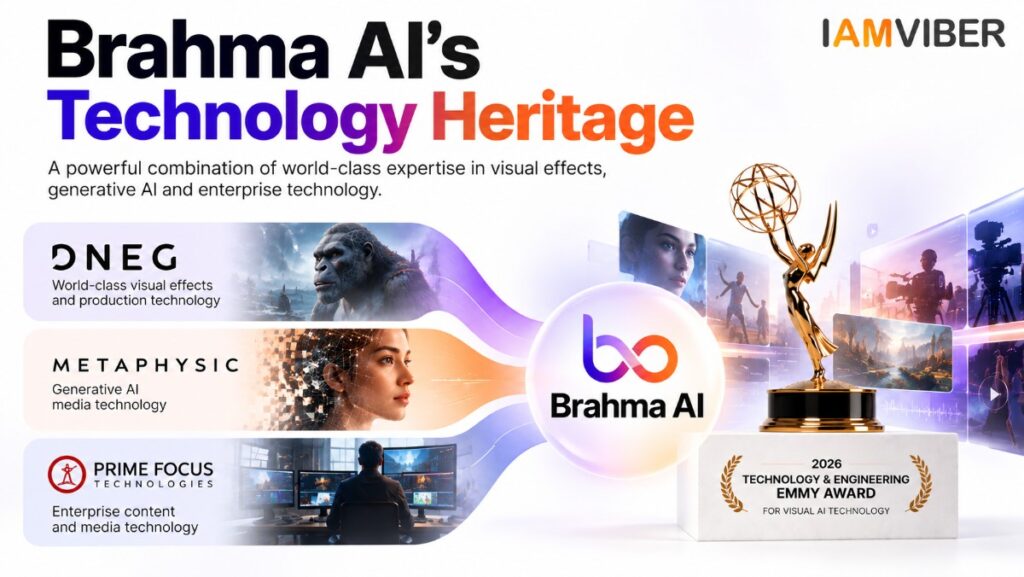
DNEG is known globally for visual effects and production technology, while Metaphysic became known for generative AI media technology.
This combination gives Brahma AI a connection to both traditional high-end content production and newer generative AI technologies.
The company recently received a 2026 Technology & Engineering Emmy Award for its visual AI technology, according to its announcement and industry reporting.
That recognition adds another dimension to the company’s positioning as it expands its enterprise offering.
What Brahma AI Funding Means for the AI Video Industry
The Brahma AI funding round also tells us something about where the AI video market may be heading.
AI video is moving beyond experimentation.
Companies are now exploring how generative technology can fit into actual production pipelines, marketing operations, localisation, entertainment workflows and customer experiences.
That means the biggest opportunities may not necessarily belong only to companies generating impressive five-second clips. They may also belong to platforms capable of connecting generation with enterprise data, asset management, workflow automation, localisation, compliance and distribution.
This is an important distinction.
Generating content is one problem.
Managing thousands of pieces of AI-generated content across a global organisation is another.
Why Enterprises Are Looking Beyond AI Models
Another reason the Brahma AI story is worth watching is the growing importance of enterprise context.
Large organisations already have enormous content libraries and proprietary information. Their challenge is not simply accessing a powerful AI model.
They need systems that understand their content, workflows, brand requirements and operational processes.
This is where enterprise AI platforms can potentially create value.
Rather than asking employees to move between dozens of disconnected AI tools, businesses can increasingly look toward integrated systems that bring creation, management and automation together.
That is the market Brahma AI is attempting to address.
What Comes Next for Brahma AI?
The new funding gives Brahma AI additional resources to invest in R&D, talent, global expansion and product development. Its upcoming interactive digital humans will be an important product milestone.
So will its continued development of a model-agnostic platform.
The company is also expanding across media and entertainment, sports, healthcare and advertising, giving it multiple potential markets for its technology.
The key question now is not whether AI can create content. That capability is already rapidly advancing. The bigger question is whether companies can build reliable, scalable systems around that capability.
Brahma AI is betting that the answer will involve an enterprise-level operating system connecting content intelligence, AI creation and automated workflows.
The Bigger Picture
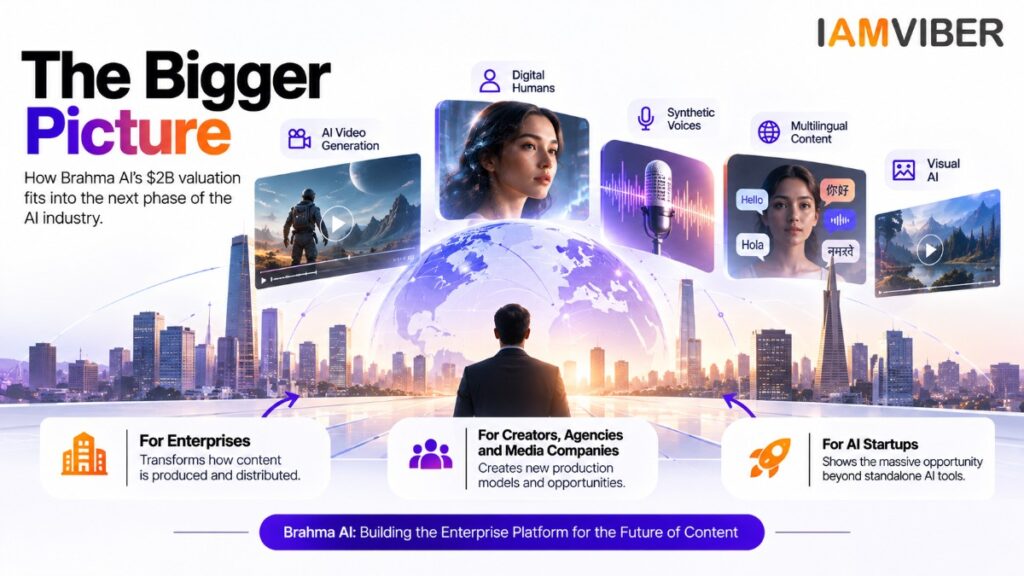
The Brahma AI $2 billion valuation arrives at an important moment for the AI industry.
The market is moving from fascination with individual AI capabilities toward competition around complete platforms.
AI video generation, digital humans, synthetic voices, multilingual content and visual AI are becoming increasingly interconnected.
For enterprises, this could eventually transform how content is produced and distributed. For creators, agencies and media companies, it could create new production models. And for AI startups, it demonstrates the size of the opportunity that exists beyond building another standalone AI tool.
The Brahma AI Silicon Valley expansion is therefore more than a geographic move. It represents the company’s attempt to position itself within the global AI ecosystem while building an enterprise platform around one of the world’s most content-intensive industries.
With $150 million in new funding, a $2 billion valuation, major global customers and plans for interactive digital humans, the next phase of Brahma AI will be worth watching closely.
The company is no longer simply betting on AI-generated content.
It is betting on the idea that AI could become the operating layer for how enterprises create, manage and experience audiovisual content.
And that could be one of the more important stories to follow as the AI video industry moves from experimentation to enterprise scale.
Topics to follow on IAMVIEBR : AI & Tech, Startup, AI Creative, Agentic AI, Current Affairs & Insights, Collaboration